Place Value
x

Revision notes for Edexcel GCSE Maths Place Value. Open the guide for explanations and worked examples. Written against the Edexcel GCSE Maths (1MA1) specification, so the content matches what's examinable rather than general Maths background.

Place Value

What you'll learn

  • How to find the value of a digit in a whole number or decimal.
  • How to write numbers from clues, including millions.
  • How to arrange and order numbers, including decimals and number cards.

Digits and place value

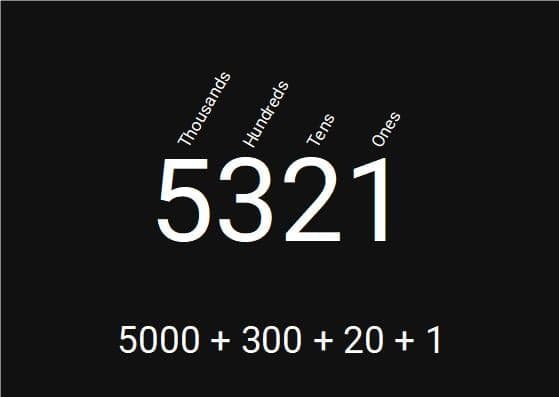
Numbers are made from digits. The position of a digit tells you how much it is worth.

For example, in 642:

A place-value chart shows that each digit in 642 has a different value depending on its column.

HundredsTensOnes
642

The 6 means 6 hundreds, so it is worth 600.
The 4 means 4 tens, so it is worth 40.
The 2 means 2 ones, so it is worth 2.

Definition

Digit and place value

  • A digit is a single symbol used to make numbers, like 0, 1, 2, 3, 4, 5, 6, 7, 8 or 9.
  • Place value means the value a digit has because of its position in the number.
Key Idea

Column position matters

The same digit can have different values in different places. In 50 the 5 is worth 50, but in 500 the 5 is worth 500.

Example

Finding the value of a digit

Find the value of the 7 in 274.

A place-value chart identifies the 7 in 274 as the tens digit.

Place-value chart showing that the 7 in 274 is in the tens column, so it represents 7 tens.

  1. Write the number in columns: hundreds, tens, ones.

  2. The number 274 has 2 hundreds, 7 tens and 4 ones.

  3. The 7 is in the tens column.

  4. 7 tens are worth 70, so the value of the 7 is 70.

Common Mistake

Writing the digit instead of its value

If the question asks for the value of the 7 in 274, the answer is 70, not just 7.

Zeros as placeholders

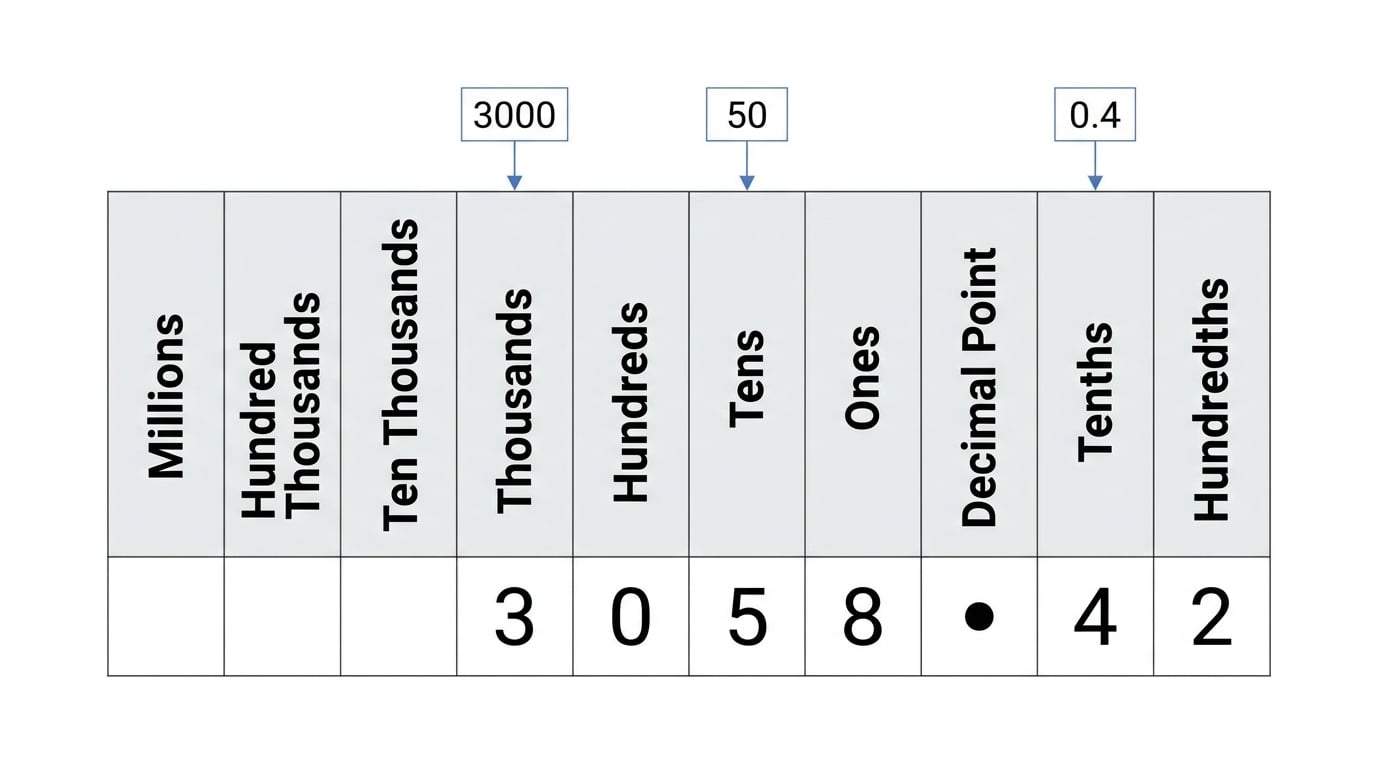
Sometimes a zero is used to show that a column is empty. It still matters because it keeps the other digits in the correct places.

For example, in 3058, the zero shows there are no hundreds.

The zero in 3058 keeps the 3 in the thousands column and the 5 in the tens column.

Definition

Placeholder

A placeholder is a digit, often 0, that holds a position in a number so the other digits keep their correct place values.

Example

Finding a value when there is a zero

Find the value of the 9 in 5096.

Place-value chart for 5096 showing the zero as a placeholder in the hundreds column and the 9 in the tens column.

  1. Read the columns from right to left: ones, tens, hundreds, thousands.

  2. In 5096, the 6 is in the ones column and the 9 is in the tens column.

  3. The zero is in the hundreds column, but you still count that column.

  4. The 9 is worth 90.

Decimals and the decimal point

A decimal is a number with a decimal point. The decimal point separates the whole-number part from the part that is smaller than 1.

In 36.8:

The decimal point separates the whole-number part from the tenths column in 36.8.

  • 36 is the whole-number part.
  • The 8 is after the decimal point, so it is in the tenths column.
Definition

Decimal point

The decimal point is the dot in a decimal number. Digits to the left are whole numbers. Digits to the right are tenths, hundredths, thousandths and so on.

Example

Value of a digit after the decimal point

Find the value of the 6 in 42.6.

Decimal place-value chart showing that the 6 in 42.6 is in the tenths column.

  1. Look at the decimal point in 42.6.

  2. The first digit to the right of the decimal point is the tenths column.

  3. The 6 is in the tenths column.

  4. The value of the 6 is 6 tenths, written as 0.6.

Tip

Say the column name

For decimals, say “tenths” for the first digit after the decimal point and “hundredths” for the second digit. This helps you avoid treating decimal digits like normal ones.

Making a number from a clue

You may be asked to write a number with a certain digit in a certain place.

A 5-digit number has five digits. For example, 28,451 is a 5-digit number. The comma is just there to make it easier to read; it is not a digit.

Example

Writing a number with a given thousands digit

Write a 5-digit number with 4 as its thousands digit. Use the digit 4 only once.

Five-digit place-value chart showing the thousands position as the second column from the left.

  1. A 5-digit number has these columns: ten-thousands, thousands, hundreds, tens, ones.

  2. The thousands digit must be 4, so put 4 in the second column from the left.

  3. Choose other digits that are not 4.

  4. One possible answer is 24,056.

Common Mistake

Mixing up thousands and ten-thousands

In a 5-digit number, the first digit is the ten-thousands digit. The second digit is the thousands digit.

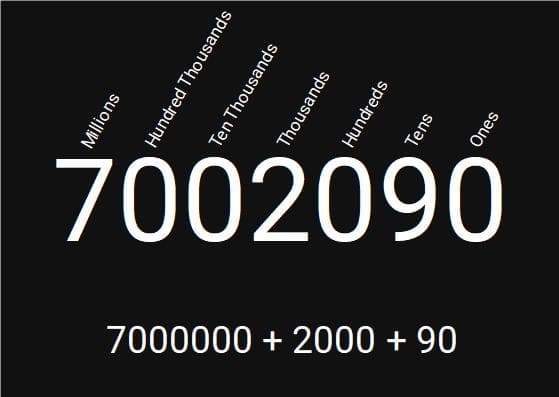
Writing millions in figures

Figures means digits instead of words.

So “three million” in figures is 3,000,000.

Definition

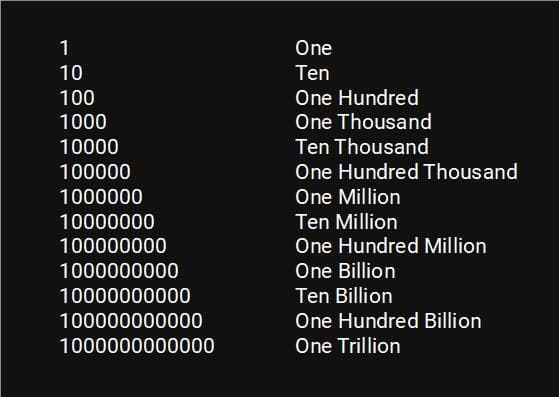
Million

One million is written as 1,000,000. It is a 1 followed by six zeros.

Example

Writing a decimal million in figures

Write 6.4 million in figures.

Partition diagram showing 6.4 million as 6,000,000 plus 400,000.

  1. 6 million is 6,000,000.

  2. 0.4 million is 400,000.

  3. Add them together: 6,000,000 + 400,000 = 6,400,000.

  4. So 6.4 million is 6,400,000.

Tip

Count the zeros

For a whole number of millions, write the number, then add six zeros. For example, 8 million is 8,000,000.

Ordering whole numbers

To order whole numbers, compare from left to right.

Start with the largest place value. If the first digits are the same, compare the next digit.

Example

Putting whole numbers in order

Put these numbers in order, starting with the smallest:

Decimal comparison chart showing all numbers written to three decimal places before ordering.

Place-value comparison chart for ordering 128, 172, 205, 139 and 170 from smallest to largest.

128, 172, 205, 139, 170

  1. Look at the hundreds digits first.

  2. The numbers starting with 1 are smaller than 205, because they have 1 hundred instead of 2 hundreds.

  3. Now compare the numbers starting with 1: 128, 172, 139, 170.

  4. Compare the tens digits: 2, 7, 3, 7. So 128 comes first, then 139.

  5. For 170 and 172, compare the ones digits: 0 is smaller than 2.

  6. The order is 128, 139, 170, 172, 205.

Ordering decimals

Decimals can be tricky because a longer decimal is not always bigger.

For example, 0.4 is the same as 0.400. Adding zeros at the end of a decimal does not change its value.

Key Idea

Make decimal lengths match

When ordering decimals, add zeros to the end so they all have the same number of decimal places. Then compare from left to right.

Example

Putting decimals in order

Put these numbers in order, starting with the smallest:

0.42, 0.402, 0.24, 0.024, 0.204

  1. Make them all have three decimal places by adding zeros to the end where needed.

  2. Write them as: 0.420, 0.402, 0.240, 0.024, 0.204.

  3. Compare the digits after the decimal point from left to right.

  4. The smallest is 0.024, then 0.204, then 0.240, then 0.402, then 0.420.

  5. Write the original numbers in order: 0.024, 0.204, 0.24, 0.402, 0.42.

Common Mistake

Thinking more decimal digits means bigger

0.307 is smaller than 0.37 because 0.37 can be written as 0.370.

Number cards

Sometimes you are given digit cards and asked to make the largest or smallest number.

To make the largest number, put the biggest digits in the biggest place-value columns.

To make the smallest number, put the smallest digits in the biggest place-value columns.

Example

Making the largest three-digit number

Use the cards 8, 1, 6 and 4 to make the largest possible three-digit number.

  1. A three-digit number has hundreds, tens and ones.

  2. To make the number as large as possible, use the biggest digit in the hundreds column.

  3. The three biggest digits are 8, 6 and 4.

  4. Put them in descending order: 864.

Definition

Sum

A sum is an addition calculation, or the answer to an addition calculation.

For a two-digit plus two-digit card sum, the tens columns are more important than the ones columns.

Example

Arranging cards to make the smallest sum

Use the cards 9, 5, 2 and 1 to make the smallest possible answer to a two-digit plus two-digit sum.

Digit-card layout showing the smallest digits placed in the tens columns to minimise the sum.

  1. The tens digits matter most because each tens digit is worth ten times as much as a ones digit.

  2. To make the sum as small as possible, put the smallest digits in the tens columns.

  3. Put 1 and 2 in the tens columns.

  4. Put 5 and 9 in the ones columns.

  5. One smallest arrangement is 15 + 29 = 44.

Exam technique

In the exam

  1. Underline the digit the question asks about, then name its column before writing its value.

  2. For decimals, add zeros at the end to help compare them fairly.

  3. For number cards, decide first whether you need the largest or smallest answer, then fill the biggest place-value columns first.

Self review

Check yourself

  • What is the value of the 6 in 4,638?

  • Write a 5-digit number with 2 as the hundreds digit, using 2 only once.

  • Put these in order from smallest to largest: 0.7, 0.07, 0.707, 0.77.

Recap questions

Test yourself with 5 quick questions on this guide. Answer them all correctly to complete it.

You've reached the end

Test yourself on this topic, or move on to the next guide.

Practice questionsTake a quick quiz on this topicFlashcardsSelf-test with active recall
RoundingUp next

How was this guide?

Place Value Revision Guide

  1. GCSE
  2. /Maths
  3. /Place Value