Physical Flashcards vs App for GCSE PE
Physical flashcards vs app GCSE Physical Education: compare recall, focus, cost and convenience, then build a practical hybrid revision routine.

Revision tools are easy to confuse with revision itself. A neat stack of cards can feel productive. So can watching an app’s progress bar climb. But the real question in the physical flashcards vs app GCSE Physical Education debate is simpler: which option makes you retrieve the right knowledge, repeatedly, without turning revision into a stationery project or another reason to look at your phone?
For most students, the best answer is a hybrid system. Use physical cards for difficult concepts, diagrams and distraction-free sessions. Use an app for portable, automatically scheduled recall. Then move beyond both formats into exam questions, because GCSE PE rewards application, analysis and evaluation as well as remembering facts.
The quick decision checklist
Choose physical flashcards when you:
- concentrate better away from screens;
- want to draw, annotate or organise cards spatially;
- enjoy making a small, carefully selected deck;
- are easily distracted by notifications;
- want to revise with a friend without opening an app.
Choose a flashcard app when you:
- need revision available on the bus or between lessons;
- want cards shuffled and scheduled automatically;
- have a large amount of factual content to revisit;
- regularly lose or forget paper resources;
- will genuinely answer before revealing the card.
Choose a hybrid approach if both lists sound familiar. The format matters less than whether you attempt retrieval, check the answer and return to mistakes later.
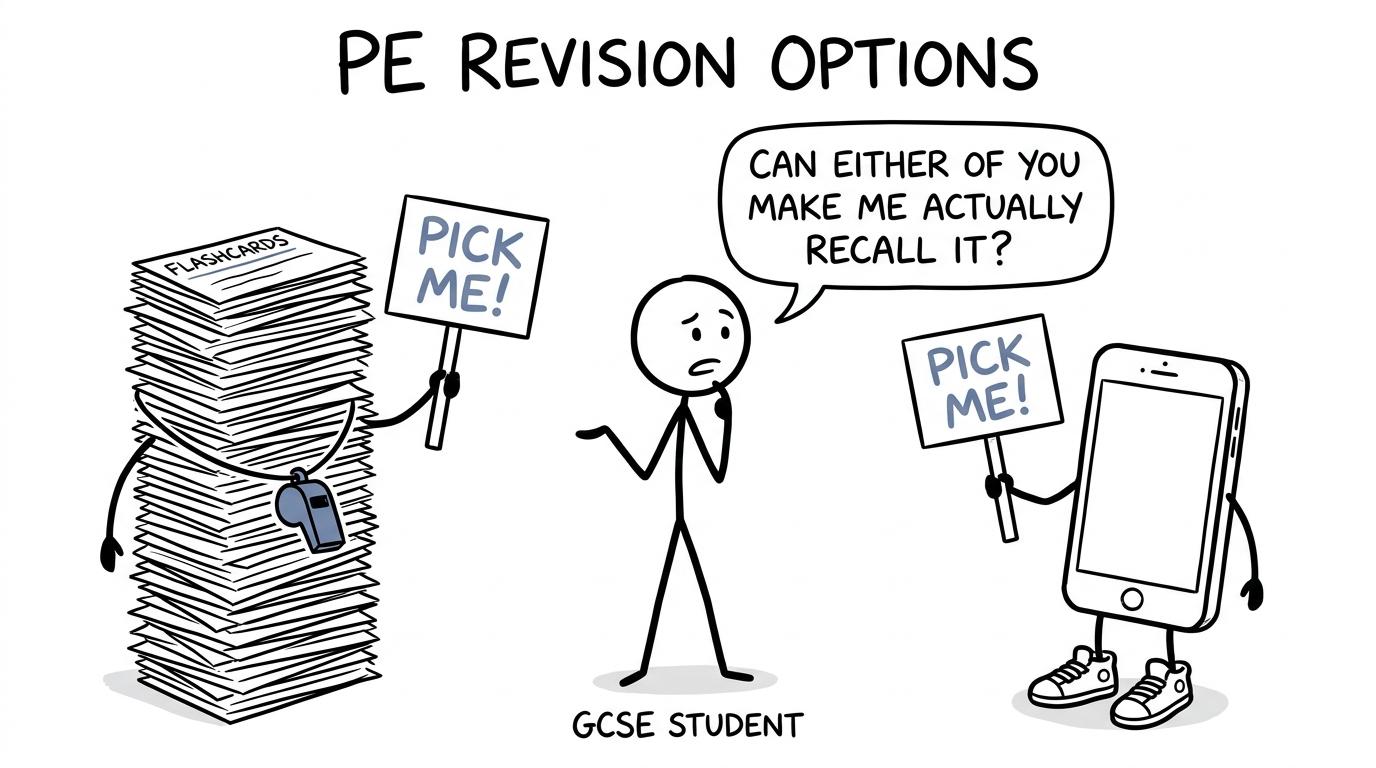 A student choosing between an enormous paper flashcard coach and a smartphone coach
What GCSE Physical Education revision actually demands
GCSE PE is not simply a collection of definitions. Current specifications from AQA, Edexcel, OCR and Eduqas vary in structure and terminology, so always use the specification for your own exam board. Across the subject, however, students need to remember theoretical content and connect it to physical activity and sporting situations.
That distinction matters. A card can help you recall a component of fitness, a training principle or the role of a body system. It cannot, by itself, guarantee that you can apply the idea to a performer, analyse an effect or construct an extended response.
AQA and OCR, for example, use written assessments containing a mixture of objective, short-answer and extended-response questions. Edexcel also assesses theory through written papers with short and extended answers. The exact paper structure differs, but the underlying revision lesson is stable: flashcards are strongest for building accessible knowledge, not for replacing exam practice.
This resembles GCSE maths revision. Remembering a formula helps, but marks usually come from selecting and applying it correctly. Maths students can see that progression on the GCSE Maths revision hub, where active-recall flashcards sit alongside lessons, exam questions and papers rather than replacing them.
Why either type of flashcard can work
The useful part of a flashcard is not the card. It is the pause before the answer appears.
Retrieval practice means trying to bring information back from memory rather than simply rereading it. Educational research supports retrieval as a way to make previously learnt knowledge more accessible. Spacing those attempts over time is generally more effective for long-term retention than compressing the same practice into one session.
Both paper and digital cards can produce those conditions. Both can also fail.
If you turn over a physical card immediately, you have not tested yourself properly. If you tap through an app while half-watching a video, the automatic schedule cannot manufacture attention. Technology can organise retrieval, but it cannot do the retrieval for you.
A sound flashcard cycle is:
- read the question or prompt;
- commit to an answer aloud or in writing;
- reveal the back;
- compare precisely rather than generously;
- separate errors from secure cards;
- revisit errors after a gap.
That same retrieve-check-correct loop works in maths. MathsGenie’s guide to finding weak GCSE topics quickly explains why evidence from mistakes is more useful than guessing what needs revision.
The real advantages of physical flashcards
They create a distraction-free boundary
Paper has no notifications, recommended videos or messages waiting behind the revision screen. If your phone tends to turn a planned ten-minute session into unrelated browsing, physical cards remove that decision altogether.
This is not an argument that paper is automatically superior. It is an argument for knowing your own habits. The best system is often the one with the fewest escape routes.
They handle visual and spatial information well
GCSE PE includes content that may be easier to organise through labelled sketches, arrows, categories and comparisons. A larger card gives you freedom to design prompts without being constrained by a small screen or rigid template.
Cards can also be spread across a desk and sorted into piles such as:
- secure knowledge;
- partly secure knowledge;
- not yet secure;
- needs an exam question.
That last pile is important. It stops factual revision from disguising an application problem.
Making them can expose weak understanding
Writing a concise question and an accurate answer forces you to decide what matters. However, copying paragraphs from a textbook is not effective flashcard creation. The value comes from selecting and simplifying information, not from the quantity of handwriting.
Keep the deck small enough to use. A beautiful set that takes days to produce but never gets tested is a craft project, not a revision system.
The real advantages of a flashcard app
It reduces the work of scheduling
Many flashcard apps can bring difficult or overdue cards back more frequently while delaying cards you answer confidently. Features vary between apps, and students should check cost, privacy and account requirements before choosing one, but automatic scheduling can reduce the burden of deciding what to revisit.
This is particularly useful across a broad GCSE PE specification. Instead of repeatedly reviewing the easiest definitions, an app can help keep forgotten material visible.
It makes short sessions practical
A digital deck is available wherever your phone or tablet is available. Five focused minutes can be useful when the alternative is no revision at all. Small sessions also make it easier to revisit content across several days rather than attempting one exhausting evening.
Maths students can apply the same principle with GCSE 45-minute tests: a smaller, completed task often produces better feedback than an ambitious session that never begins.
It can shuffle away false confidence
Physical cards often remain in the same order. That can make you remember what comes next rather than retrieve the answer independently. Apps usually make shuffling easy, helping you test whether the knowledge is secure without clues from sequence or location.
The weakness is that tapping can become mechanical. Say or write the full answer before revealing it. Recognition is not the same as recall.
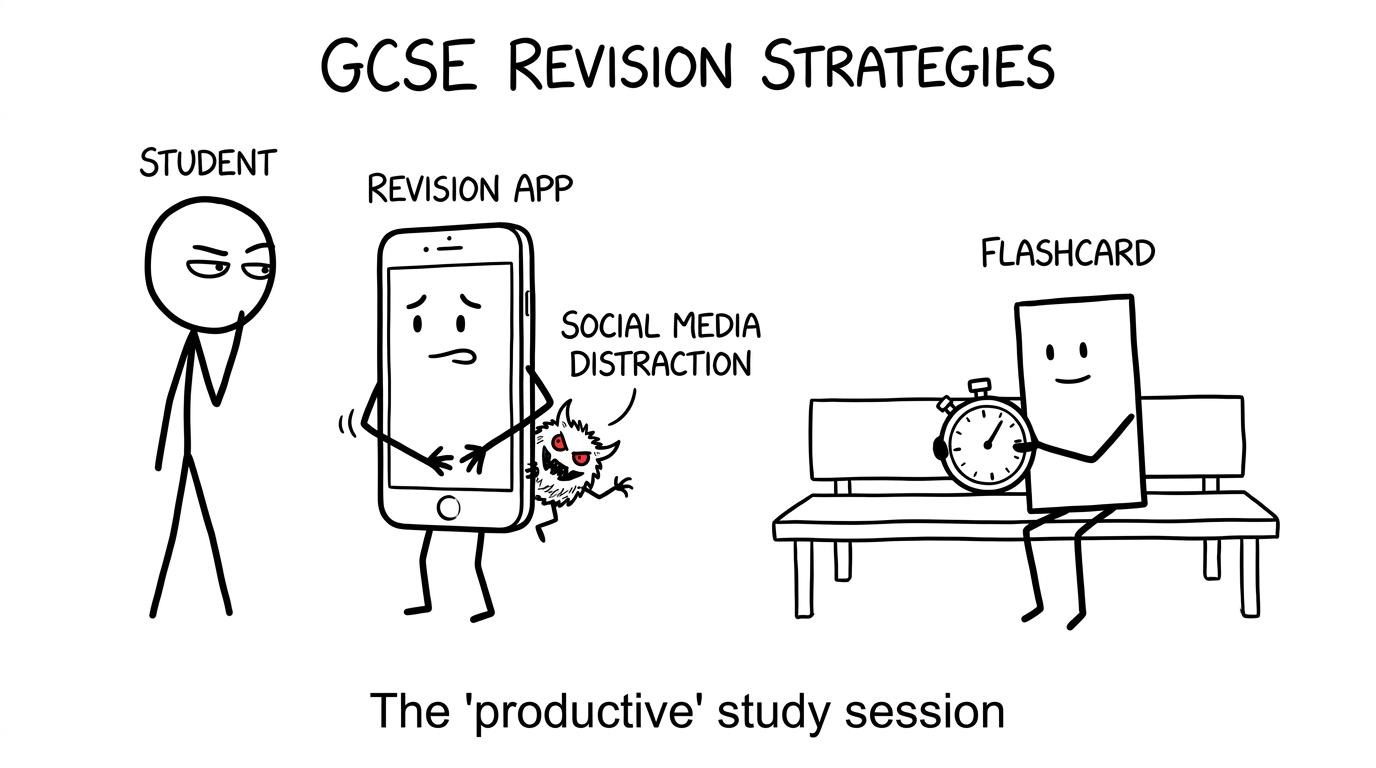 A revision app attempting to hide a distraction while a paper card waits with a stopwatch
How to build a hybrid GCSE PE system
A hybrid system is not maintaining two identical decks. That doubles administration without doubling learning. Give each format a distinct job.
Use an app for the factual core
Digital cards are well suited to concise definitions, key relationships, classifications and short sequences. Tag cards by your exam board’s specification headings rather than inventing broad labels such as “body” or “psychology”. Precise organisation makes gaps easier to identify.
Use paper for stubborn or visual content
Create physical cards only when a digital card repeatedly causes trouble, when a diagram improves the prompt or when you need to compare connected ideas side by side. The paper deck should be a selected collection of difficult material, not a handwritten copy of the whole course.
Add exam questions every week
Once facts can be recalled, practise applying them. Use questions and mark schemes supplied by your teacher or exam board for GCSE PE, checking that they match your specification. Look closely at command words and how many distinct points the mark scheme requires.
For maths revision, the equivalent progression is visible in MathsGenie’s advice on when to start GCSE past papers: begin with topic work, introduce shorter assessments and build towards realistic timed papers.
Keep a simple error log
Record the topic, what went wrong and the next action. An error might require:
- another factual card;
- a clearer distinction between two terms;
- an application question;
- practice using a command word;
- a timed extended response.
Do not measure progress only by cards completed. Measure whether yesterday’s error can be answered correctly today and applied later.
When flashcards should stop being your main tool
Flashcards become less valuable when you can recall the content but still lose marks on questions. At that point, the bottleneck has changed. You may need to interpret a scenario, select relevant knowledge, develop a chain of reasoning or manage time.
Move towards question practice when:
- most cards feel secure across several spaced sessions;
- errors come from application rather than forgotten facts;
- you know definitions but struggle with extended answers;
- your responses do not match the precision of mark schemes;
- exam timing is becoming the larger concern.
In maths, GCSE predicted papers and past papers create this pressure-testing stage. Predicted papers are practice tools, not guarantees of future content. The same caution applies to any unofficial GCSE PE resource: your exam-board specification remains the boundary of what you need to know.
Common mistakes with paper and app flashcards
Putting too much information on one card
A card containing half a page of notes does not create a clear retrieval task. Split it into focused prompts. One card should test one manageable idea or one tightly connected explanation.
Looking before answering
Feeling that an answer is familiar is not evidence that you could produce it in an exam. Commit to an answer first, even when that feels uncomfortable.
Making cards but never revisiting them
Creation can feel satisfying because progress is visible. Memory is built through later retrieval. Set review dates as soon as a card is made.
Trusting an app’s progress percentage blindly
An app records taps and self-ratings. It cannot always detect a vague, incomplete or guessed answer. Mark yourself strictly and occasionally answer on paper to test whether digital confidence survives without prompts.
Using flashcards for every revision problem
Poor extended responses are rarely fixed by adding fifty definitions. Use the right tool for the weakness. MathsGenie’s one-week GCSE maths revision plan uses lessons, questions, marking and papers for different purposes because no single format does everything.
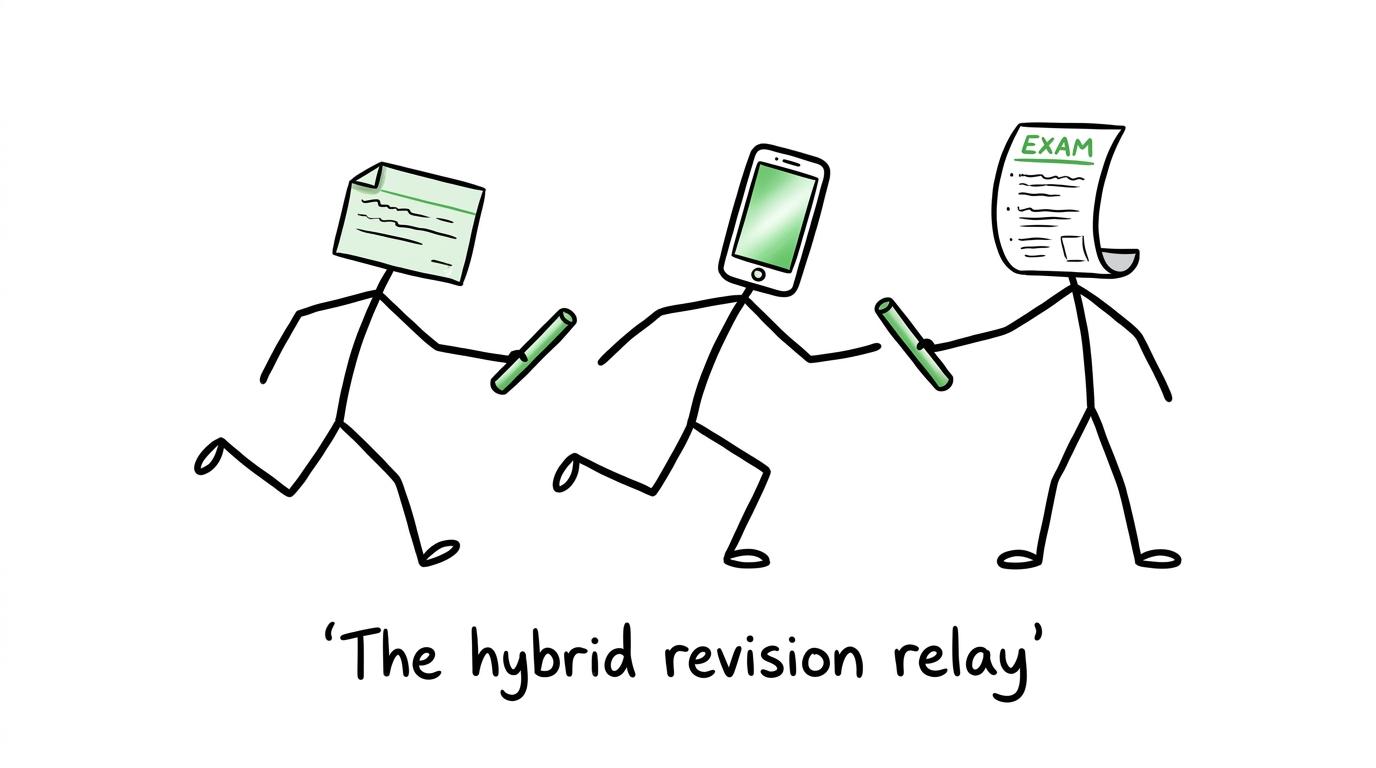 A paper flashcard and smartphone completing a hybrid revision relay towards an exam paper
The verdict: choose the behaviour, not the format
Physical cards win when they protect attention, support visual organisation and make difficult ideas tangible. Apps win when portability, shuffling and automatic scheduling make consistent retrieval more likely. Neither wins if you avoid answering, review only easy material or never practise exam questions.
Start with the format you will use honestly. After a week, inspect the evidence. Can you retrieve more? Are repeated errors shrinking? Can you apply the knowledge in an unfamiliar sporting context? If not, change the system rather than blaming your memory.
And carry that lesson into your maths revision. Use free MathsGenie GCSE revision resources to learn and recall methods, then practise with topic questions and mini tests. Move on to past papers, mark schemes, video solutions and predicted papers when you need exam realism. A revision planner can organise the journey, but improvement still happens in the same quiet moment: you attempt an answer, check it properly and return stronger next time.