Physical Flashcards vs App GCSE Economics Guide
Physical flashcards vs app GCSE Economics revision: compare recall, focus, cost and convenience, then choose a system that prepares you for exams.
Revision tools are easy to confuse with revision itself. A neat stack of cards can feel productive. So can an app displaying a reassuring streak. But neither guarantees that you can explain inflation, interpret economic data or evaluate a policy under exam pressure.
The honest answer to physical flashcards vs app GCSE Economics is that neither format always wins. Paper cards are usually better for distraction-free thinking, diagrams and flexible written answers. Apps are stronger for portability, scheduling and reviewing a large collection efficiently. For many students, the best choice is a small hybrid system: an app for short, regular recall and physical cards for difficult ideas that need more space.
The important part is not where a question appears. It is whether you try to retrieve the answer before looking.
The quick decision checklist
Choose physical flashcards if you:
- concentrate better away from a screen;
- want to draw and annotate economic diagrams;
- remember information through handwriting;
- prefer arranging topics physically;
- are easily distracted by notifications.
Choose a flashcard app if you:
- revise during short gaps in the day;
- want reminders and automatic review schedules;
- need to carry many cards without carrying several boxes;
- regularly lose or damage paper notes;
- will genuinely use the app rather than wander into something else.
Choose a hybrid approach if you want the app's convenience without forcing every topic into a tiny digital card. That is often the most sensible option.
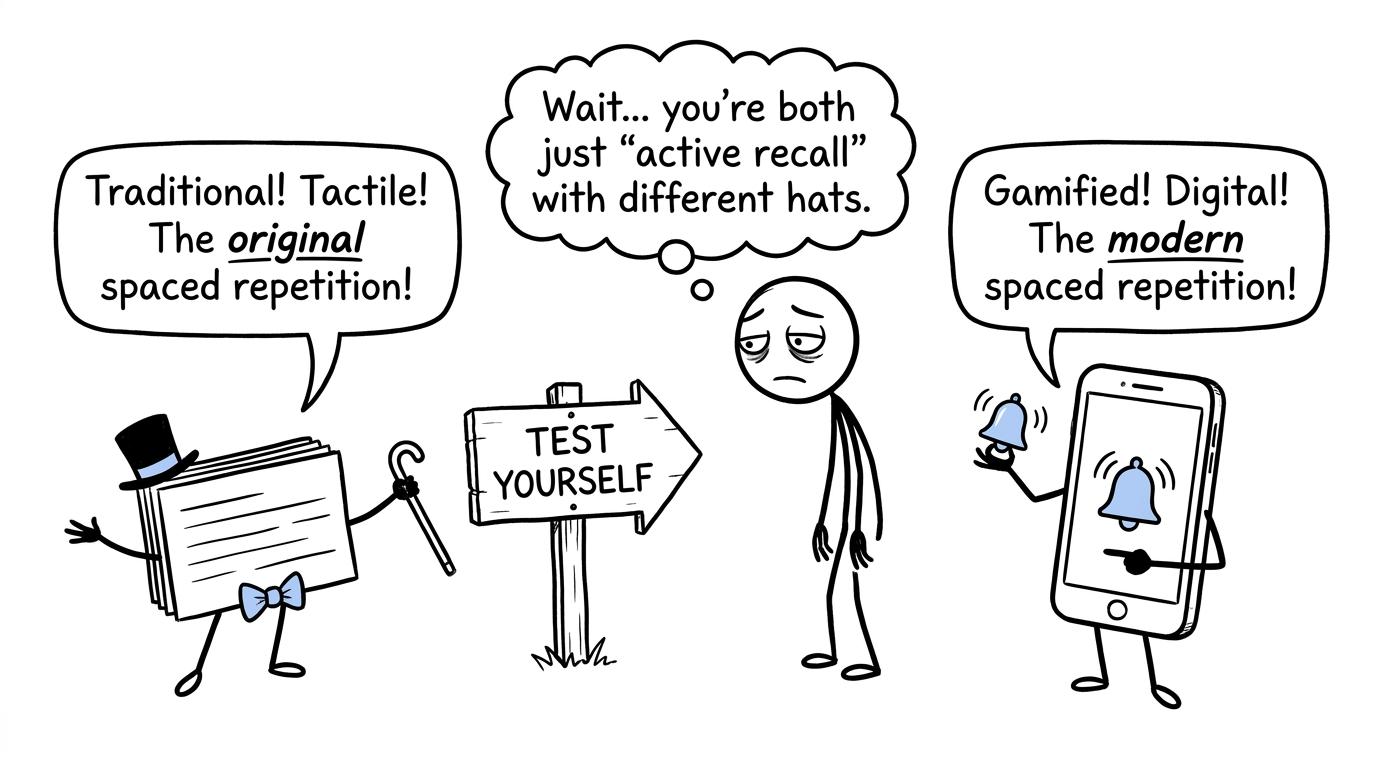 A student discovers that paper cards and apps both depend on self-testing
What actually makes a flashcard effective?
A flashcard works when it creates retrieval practice. You see a prompt, pause, produce an answer from memory and then check it. Reading both sides immediately removes the useful struggle.
Research on learning consistently distinguishes active retrieval from passive rereading. Spacing reviews over time is also more useful for durable memory than squeezing every review into one long session. An app can organise that spacing automatically, but paper cards can achieve it through simple piles such as:
- review tomorrow;
- review later this week;
- secure for now.
The technology is optional. The thinking is not.
Good GCSE Economics cards also demand more than recognition. A prompt such as “inflation” is too vague. Better prompts ask for a definition, cause, consequence, diagram feature or judgement. For example, a card could ask you to explain why a rise in interest rates may affect household consumption. Your answer should include a connected chain of reasoning rather than a single memorised phrase.
Flashcards are particularly useful for:
- precise economic definitions;
- causes and consequences;
- assumptions behind models;
- diagram labels and shifts;
- quantitative formulas;
- advantages, disadvantages and evaluative conditions.
They are less suitable for practising complete extended responses. Those require planning, application, analysis and judgement across several paragraphs. Flashcards build the pieces; exam questions test whether you can assemble them.
The real advantages of physical flashcards
Paper encourages undivided attention
A paper card does not contain messages, videos or a browser. That sounds trivial until a five-minute review becomes twenty minutes of unrelated screen time.
Physical cards create a clear boundary: this object has one purpose. For students who find phones difficult to resist, that reduced friction can matter more than any sophisticated app feature.
You can draw, connect and rearrange ideas
Economics contains relationships. Supply and demand diagrams, chains of reasoning and comparisons between policies do not always fit naturally into a rigid digital template.
On paper, you can use arrows, small diagrams, annotations and colour selectively. You can also spread cards across a desk to sort them by topic, confidence or relationship. That physical overview can reveal gaps that disappear inside a long digital deck.
Handwriting may also make you more selective. Because writing takes time, you are pushed to decide what deserves a card. Copying an entire textbook paragraph into an app is faster, but speed is not always helpful.
Physical cards have visible limits
A thick deck tells you something. Perhaps the topic has been split too finely, or perhaps you are trying to memorise what should be understood.
Paper's inconvenience can become a useful constraint. It encourages shorter decks and better questions. The trade-off is that editing, carrying and scheduling those cards takes more effort.
Where flashcard apps are stronger
Apps make spaced review easier
Digital flashcard systems can schedule cards according to previous responses. Difficult material returns sooner, while secure material appears less frequently. The exact algorithm matters less than answering honestly. Marking every uncertain answer as correct protects a streak, not your knowledge.
Apps are also practical when your course contains many definitions and connected topics. Search, tagging and filtering make it easier to review one area without rebuilding a paper deck.
Your cards are available in small pockets of time
A short review while waiting for a bus is not a substitute for sustained exam practice. It can, however, keep knowledge active between longer sessions.
Convenience matters because the best system is one you can repeat. An elaborate paper method that stays at home is less valuable than a simple digital deck you actually test yourself with.
Digital cards are easier to maintain
Specifications and classroom emphasis vary between AQA, OCR, Pearson Edexcel and other qualifications, so your cards should follow the exact course taught by your school. Apps make it easy to correct wording, add tags and remove material that is not relevant.
Be cautious with shared decks. A polished collection may use imprecise definitions, follow a different specification or contain answers you have never understood. Treat imported cards as a draft to check, not as an authority.
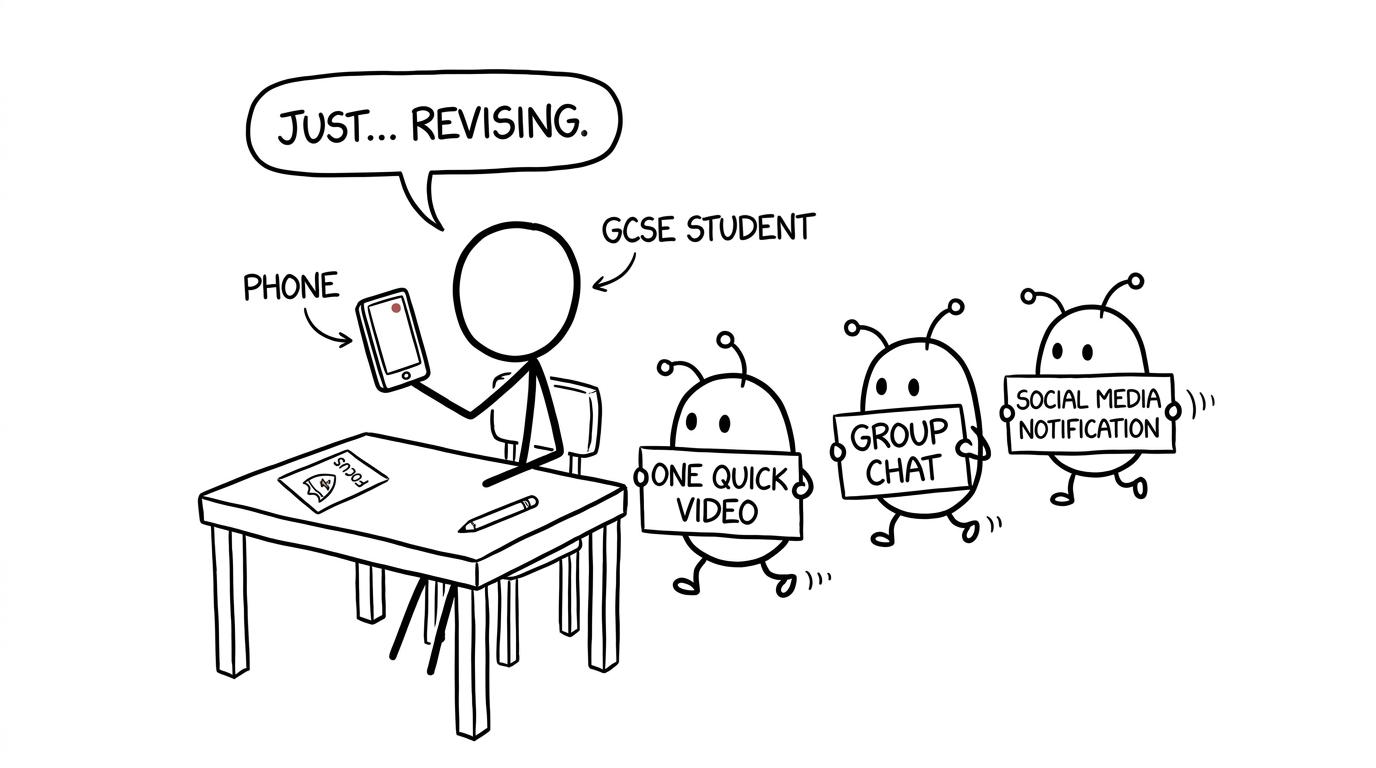 Phone notifications attempt to interrupt an economics revision session
How GCSE Economics connects with maths revision
Economics is not only a vocabulary subject. Depending on your specification, questions may involve percentages, ratios, averages, graphs and interpreting numerical evidence. Flashcards can help you remember a method, but they cannot replace calculation practice.
Useful formula cards might prompt you to recall percentage change:
Percentage change=new value−original valueoriginal value×100\text{Percentage change}=\frac{\text{new value}-\text{original value}}{\text{original value}}\times 100Percentage change=original valuenew value−original value×100They might also test the mean:
Mean=sum of valuesnumber of values\text{Mean}=\frac{\text{sum of values}}{\text{number of values}}Mean=number of valuessum of valuesThe back of the card should explain what each quantity represents and when the formula applies. It should not merely display symbols.
Then move beyond recall. Use MathsGenie's free lessons and questions on percentages, percentage change, ratio and averages to practise carrying out the methods. The GCSE Maths revision page can help you identify related skills by grade and topic.
This distinction matters: remembering a formula is retrieval; choosing and applying it accurately is problem-solving.
A practical hybrid system for Economics revision
A hybrid system avoids turning the decision into a contest.
Use an app for compact facts that benefit from frequent review:
- definitions;
- formulas;
- short causal links;
- diagram labels;
- conditions that strengthen or weaken an argument.
Use paper cards for material that needs room:
- economic diagrams;
- multi-stage chains of reasoning;
- comparisons between policies;
- prompts requiring a conditional judgement;
- concepts you repeatedly answer incompletely.
Keep each card focused on one retrieval task. If the answer resembles a page of notes, divide the idea or use an exam question instead.
A sensible revision cycle is:
- retrieve the answer without notes;
- say or write it clearly;
- check it against your course materials;
- identify exactly what was missing;
- schedule another attempt;
- practise using the knowledge in an exam-style question.
The final step prevents flashcards from becoming an isolated memory game. For quantitative confidence, combine cards with GCSE Maths past papers. Nearer the exam, MathsGenie predicted papers can support timed maths practice alongside your Economics revision.
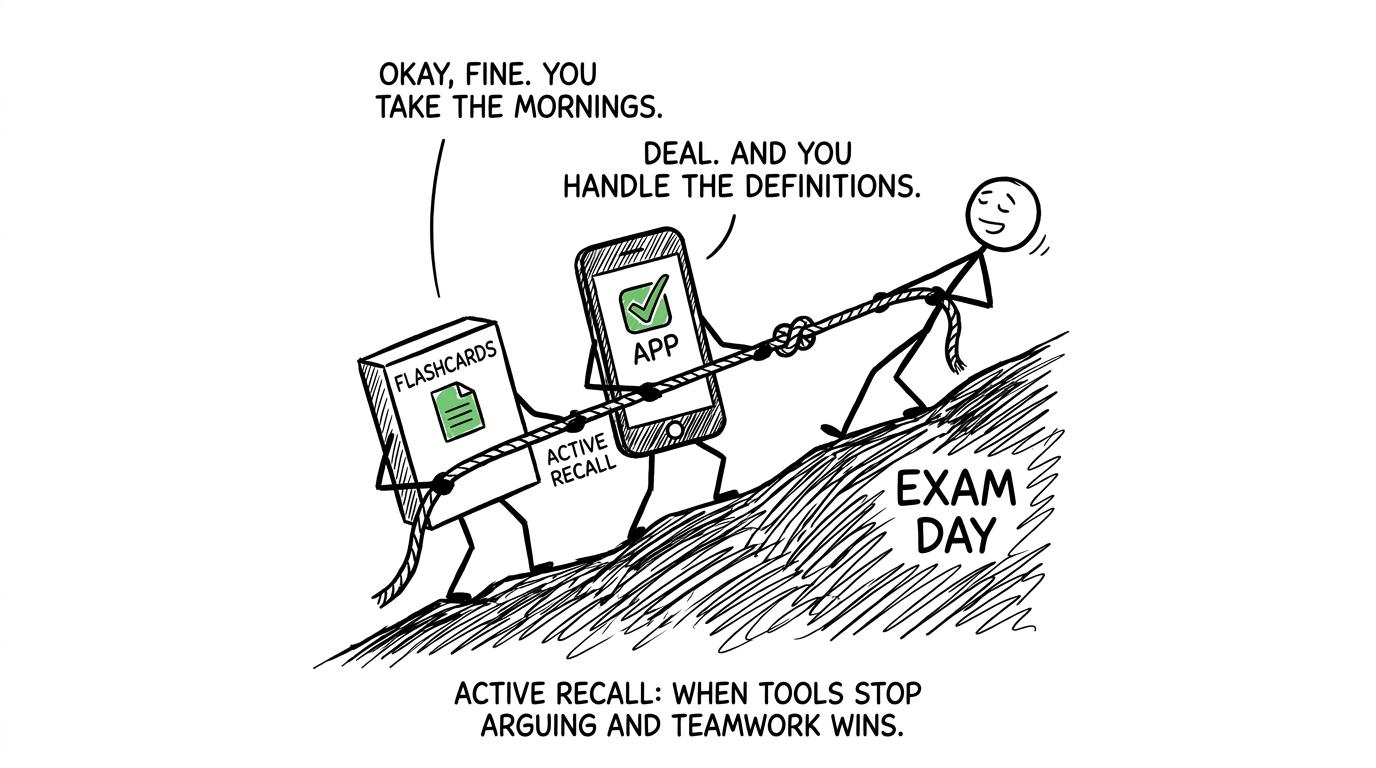 Paper flashcards and a phone app cooperate using active recall
Common mistakes with paper cards and apps
Spending longer making cards than using them
Beautiful cards can create the feeling of control without testing knowledge. Set a limit on card creation, then begin retrieval. Revision starts when you close the notes.
Writing prompts that are too broad
“Explain demand” may produce an unclear answer. Ask for one definition, relationship, diagram change or consequence at a time. Precise prompts make errors easier to diagnose.
Revealing the answer too quickly
Memory often feels blank for a few seconds before an idea appears. Allow yourself time. That pause is part of the practice, not evidence that the method has failed.
Trusting an app's progress score
A percentage, streak or pile labelled “mastered” is only a record of how you used the system. It is not an exam mark. Test supposedly secure knowledge without hints and in mixed-topic practice.
Using flashcards for every revision task
Cards cannot fully rehearse data interpretation, extended analysis or timed writing. Nor can a formula card replace doing calculations. Strengthen the mathematical side through MathsGenie practice resources and complete papers with mark schemes and video solutions.
Revising someone else's specification
Check topic names and required content against the specification used by your school. Exam boards can organise and assess content differently. Your teacher's guidance and official course documents should determine what enters your deck.
The best tool is the one that exposes uncertainty
Physical cards offer focus, flexibility and a useful distance from the phone. Apps offer portability, scheduling and efficient organisation. Neither has a monopoly on good revision.
Choose the format that makes you retrieve answers honestly and revisit weaknesses consistently. If the decision still feels close, use both for a fortnight and judge them by outcomes: which system helps you explain ideas without prompts, retain them later and apply them to exam questions?
Then connect memory to performance. Use MathsGenie's free GCSE Maths revision lessons, practice questions, mini tests, past papers, predicted papers, mark schemes and video solutions to strengthen the numerical skills that Economics questions may call upon. Flashcards can keep knowledge available. Deliberate practice teaches you what to do with it.