

Perpendicular Lines GCSE Maths: Mock Revision
Perpendicular lines GCSE maths revision for December mocks: learn the gradient rule, tackle two exam-style questions and build a targeted practice paper.
December mocks can make a familiar topic feel suddenly unfamiliar. Imagine a Year 11 student opening a question about perpendicular lines: they remember something about changing a sign, but cannot quite remember what happens next. For perpendicular lines GCSE maths questions, the key is this: find the original gradient, take its negative reciprocal, then use a point to find the new line’s equation.
That gives you a repeatable method. This revision guide explains it, works through two original exam-style questions, and shows how to turn your mistakes into targeted practice before your mock.
Your perpendicular lines revision checklist
Before attempting a full question, check that you can:
- Identify the gradient in y=mx+cy=mx+cy=mx+c.
- Rearrange a straight-line equation into that form.
- Find a gradient from two coordinates.
- Calculate a negative reciprocal.
- Substitute a point to find ccc.
Finding equations of perpendicular lines is Higher tier material. If you take foundation tier, prioritise the straight-line graph skills on your teacher’s mock revision list.
For Higher students, the most useful starting point is often MathsGenie’s gradient of a line revision lesson. A secure understanding of gradient makes the perpendicular step much easier to remember.
The perpendicular lines method
Perpendicular lines meet at a right angle. For two perpendicular lines with defined gradients, those gradients multiply to give −1-1−1:
m1m2=−1m_1m_2=-1m1m2=−1Therefore, when the original gradient is non-zero:
m2=−1m1m_2=-\frac{1}{m_1}m2=−m11This is the negative reciprocal. Turn the fraction upside down and change its sign. If the gradient is a whole number, write it as a fraction over 111 first.
Parallel lines have equal gradients. Perpendicular lines have negative reciprocal gradients. Read that word carefully before doing any algebra.
There is one special case: horizontal and vertical lines are perpendicular. A horizontal line has gradient 000, while a vertical line has an undefined gradient, so the negative reciprocal calculation does not apply to that pair.
From gradient to equation
A gradient tells you a line’s direction, but many lines share that direction. A point tells you which particular line you need.
Once you know the perpendicular gradient, substitute it into:
y=mx+cy=mx+cy=mx+cThen substitute the given point’s coordinates for xxx and yyy, and solve for ccc. Finally, check that the point satisfies your completed equation.
MathsGenie’s parallel and perpendicular lines revision guide can support this method when you need another explanation.
Exam-style question: a rearranged equation
Question: A line has equation 2x+3y=122x+3y=122x+3y=12. Find the equation of the line perpendicular to it that passes through (6,1)(6,1)(6,1).
The coefficient of xxx is not yet the gradient. Rearrange first:
3y=−2x+123y=-2x+123y=−2x+12 y=−23x+4y=-\frac{2}{3}x+4y=−32x+4The original gradient is −23-\frac{2}{3}−32, so the perpendicular gradient is:
m=32m=\frac{3}{2}m=23Now write the new line using that gradient:
y=32x+cy=\frac{3}{2}x+cy=23x+cSubstitute (6,1)(6,1)(6,1):
1=32×6+c1=\frac{3}{2}\times6+c1=23×6+c 1=9+c1=9+c1=9+c c=−8c=-8c=−8The answer is:
y=32x−8\boxed{y=\frac{3}{2}x-8}y=23x−8Check both conditions. The gradients multiply to −1-1−1:
−23×32=−1-\frac{2}{3}\times\frac{3}{2}=-1−32×23=−1Substituting x=6x=6x=6 gives y=1y=1y=1, so the new line also passes through the required point.
The useful habit here is to rearrange before reading the gradient. Skipping that line of working can send an otherwise sound method in the wrong direction.
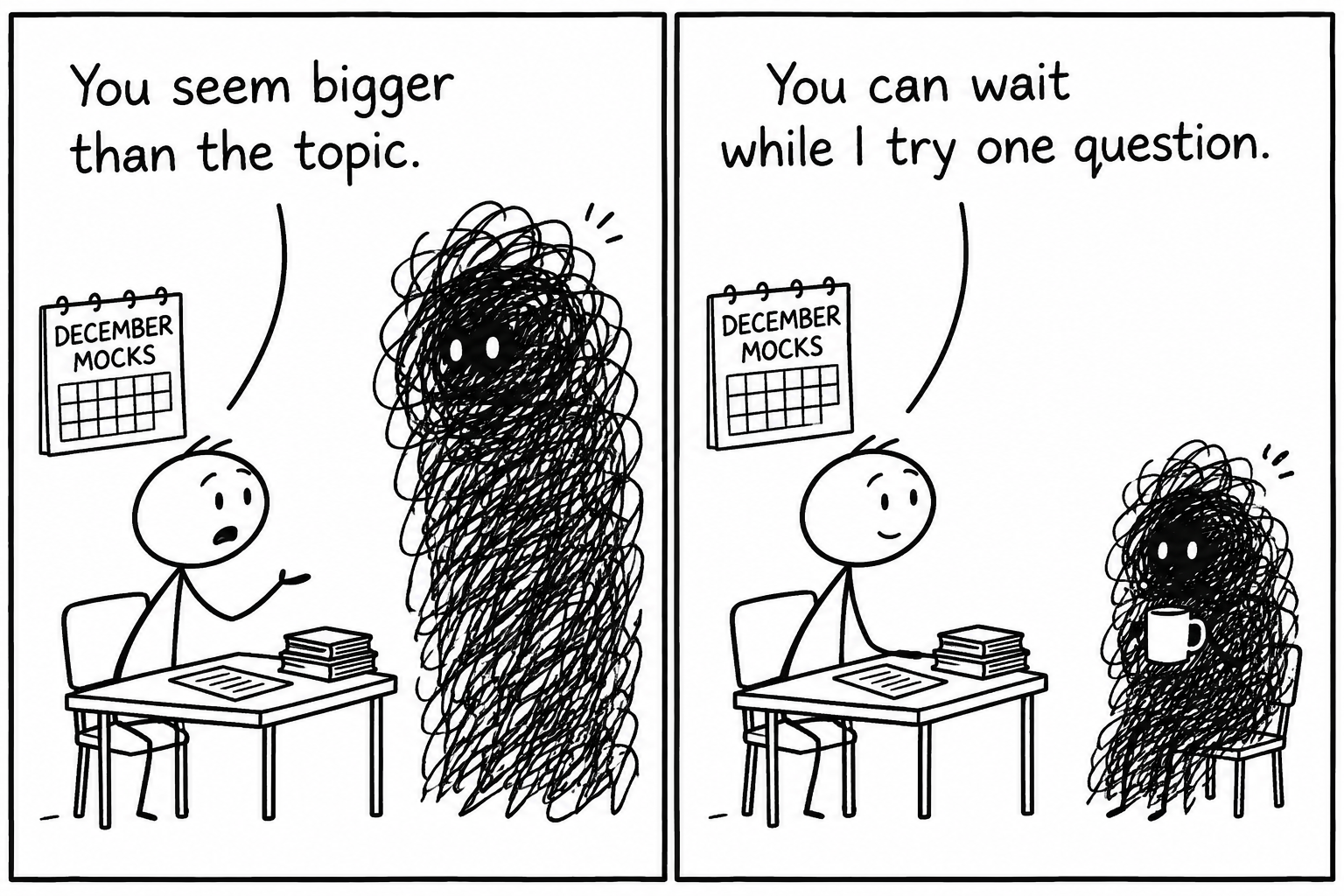 Stick-figure comic showing a student asking their exam anxiety to wait while they attempt one revision question
Exam-style question: a gradient from coordinates
Question: A straight line passes through A(−2,5)A(-2,5)A(−2,5) and B(4,2)B(4,2)B(4,2). Find the equation of the line perpendicular to ABABAB that passes through BBB.
This time, there is no equation to rearrange. Calculate the original gradient using:
m=y2−y1x2−x1m=\frac{y_2-y_1}{x_2-x_1}m=x2−x1y2−y1Keep the coordinate order consistent:
mAB=2−54−(−2)=−36=−12m_{AB}=\frac{2-5}{4-(-2)}=\frac{-3}{6}=-\frac{1}{2}mAB=4−(−2)2−5=6−3=−21The perpendicular gradient is therefore:
m=2m=2m=2The new line passes through B(4,2)B(4,2)B(4,2), so substitute that point into y=2x+cy=2x+cy=2x+c:
2=2×4+c2=2\times4+c2=2×4+c c=−6c=-6c=−6Hence:
y=2x−6\boxed{y=2x-6}y=2x−6Check the gradient relationship:
−12×2=−1-\frac{1}{2}\times2=-1−21×2=−1Then check the point:
2=2×4−62=2\times4-62=2×4−6Both checks work. Notice that you never needed to find the equation of ABABAB. Its gradient provided everything needed for the perpendicular step.
Common mistakes that can cost marks
The slips to watch for in perpendicular lines exam questions are usually small, but they affect everything that follows.
- Changing only the sign. You must also take the reciprocal. Check that the two gradients multiply to −1-1−1.
- Reading the gradient too early. Rearrange until yyy has coefficient 111 before identifying mmm.
- Subtracting coordinates inconsistently. If the numerator uses the second point minus the first, the denominator must use that same order.
- Reusing the original intercept. The perpendicular line generally has a different value of ccc. Calculate it using the required point.
- Stopping at the gradient. If the question asks for an equation, finding mmm is only part of the answer.
- Losing a negative sign during substitution. Write the substitution before simplifying, especially when coordinates are negative.
Show your intermediate working. It makes errors easier to locate and allows an examiner to assess your method against the mark scheme.
Turn mock revision into a focused routine
Return to that student preparing for December. Once the method makes sense, the next decision is what to practise independently.
Start with a question where the original equation is already in y=mx+cy=mx+cy=mx+c form. Then attempt one requiring rearrangement, followed by one using two coordinates. This separates three possible difficulties: understanding perpendicular gradients, rearranging equations, and calculating gradients accurately.
If you get stuck, use MathsGenie’s parallel and perpendicular lines videos. Pause before each step and attempt it yourself. Afterwards, close the explanation and redo the question from a blank page.
When marking your work, record the first incorrect step. “Used the original intercept” gives you a useful next action; “bad at graphs” does not. Revisit that specific skill in your next revision session, then try a fresh question without notes.
Use the GCSE maths revision resources to strengthen any gaps exposed by your practice. Select resources for your own exam board when preparing for the mock.
Build your targeted practice paper
Your aim before December is to recognise the starting point of a question and carry the method through accurately: original gradient, perpendicular gradient, required point, final equation.
Put that routine into practice with MathsGenie’s Mock Exam Builder. Build a targeted practice paper around perpendicular lines and related straight-line graph skills, attempt it independently, then review your working. Let the mistakes you actually make decide what you revise next.















