Perfectionism GCSE Food and Nutrition Revision Guide
Perfectionism GCSE Food and Nutrition revision advice to stop over-polishing notes, practise recall, use feedback and make steady exam progress today.
A revision timetable can look reassuringly full while very little learning is happening. One set of notes is rewritten three times. A flashcard is abandoned because the handwriting looks wrong. A difficult practice question is postponed until you feel fully prepared.
This is how perfectionism GCSE Food and Nutrition revision can become a trap. The answer is not to care less. It is to replace flawless preparation with useful action: retrieve knowledge from memory, answer questions under realistic conditions, check the feedback and return to weak areas.
That matters beyond Food Preparation and Nutrition. The same habits can quietly affect GCSE maths revision, where progress also depends on attempting questions before you feel completely ready.
A quick checklist for healthier revision
Ask yourself whether you are:
- spending longer organising resources than using them;
- repeatedly rewriting notes instead of testing your memory;
- avoiding questions that might expose a weakness;
- treating one mistake as evidence that an entire session failed;
- trying to revise every detail before completing any exam practice;
- building an ambitious timetable that leaves no room for interruptions;
- comparing the appearance of your work with somebody else's revision;
- refusing to move on until a topic feels completely secure.
One isolated habit is not necessarily a problem. The warning sign is a pattern in which high standards reduce the amount of retrieval, practice and feedback you complete.
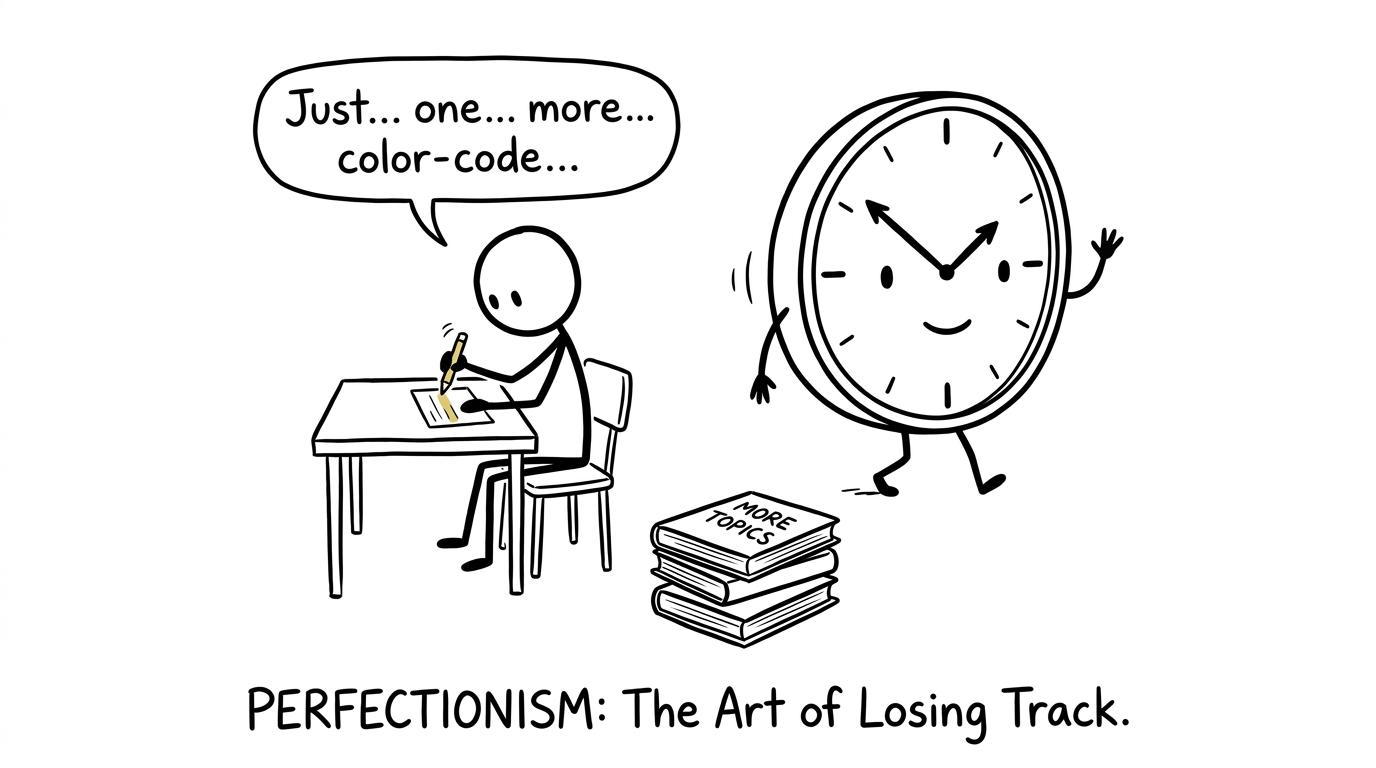 A student perfects one revision card while time walks away
What revision perfectionism actually looks like
Perfectionism is not simply working hard or wanting a high grade. Research commonly distinguishes ambitious personal standards from perfectionistic concerns, such as excessive fear of mistakes, harsh self-criticism and feeling that work is never good enough. High standards can provide direction. The difficulty begins when the fear surrounding those standards interferes with action.
In GCSE Food Preparation and Nutrition, that interference may look productive. You might create beautiful pages about nutrients, food provenance, food safety or functional properties. Yet if you cannot explain the ideas without looking at the page, the work has not tested what you can retrieve in an exam.
It can also appear during practical and non-exam assessment work. A student may spend too long refining one paragraph, photograph or design choice while delaying another part of the task. Your teacher and exam board instructions must guide any assessed work, but the broader principle remains useful: improvement requires decisions, evidence and feedback, not endless private polishing.
Specifications vary between AQA, OCR and Eduqas, particularly in wording, examination length and administrative detail. Use the specification for your own course rather than assuming another school's checklist applies to you.
Why perfectionism can resemble procrastination
Ordinary procrastination is fairly easy to recognise: the work is not being done. Perfectionistic procrastination is more deceptive because it often contains activity.
You may spend a whole session choosing headings, finding the ideal video or making a comprehensive plan. The activity reduces anxiety temporarily, but the task carrying the greatest risk of being wrong remains untouched. In that sense, perfectionism can do more harm than the procrastination it was meant to prevent. It consumes revision time while preserving the illusion of progress.
The underlying cycle is often simple:
- the task feels important;
- importance creates pressure to perform perfectly;
- pressure makes an imperfect attempt feel threatening;
- preparation replaces the attempt;
- delayed practice increases uncertainty;
- greater uncertainty creates still more pressure.
The cycle is broken by making the first action smaller, not by waiting for greater confidence.
Replace perfect revision with evidence of learning
A useful revision session should produce evidence about what you know. That evidence might be a completed question, a short explanation recalled from memory, a marked paper or a list of specific gaps.
Retrieve before you review
Close the textbook and write down what you remember about a defined area, such as protein function, heat transfer, bacterial growth conditions or sensory testing. Then compare your recall with a trusted source.
The imperfect first attempt is valuable because it reveals the boundary between familiarity and knowledge. Rereading can make information feel recognisable without proving that you could recall and apply it independently.
This is the same reason MathsGenie's GCSE revision lessons combine explanations with questions. Watching can introduce a method, but attempting questions reveals whether you can use it.
Set a stopping rule before starting
Perfectionism thrives when a task has no defined end. Replace “revise nutrition” with a concrete instruction such as:
- recall one subtopic without notes;
- answer a short set of questions;
- check each response;
- record no more than three gaps;
- choose the next action.
A stopping rule prevents one attractive task from swallowing the evening. If the task is note-making, decide in advance what the notes must help you do. Once they serve that purpose, move on.
Mark for information, not judgement
A mark scheme is not a verdict on your ability. It is a map of the distance between your current response and the response rewarded by the assessment.
Mark promptly and identify the type of gap. Did you lack subject knowledge, misread the command word, omit a linked explanation or run out of time? “Wrong” is too broad to guide revision. “I named the nutrient but did not explain its function” gives you something precise to practise.
MathsGenie's GCSE past papers and predicted maths papers provide the same feedback loop for exam preparation: attempt, mark, diagnose and revisit. Predicted papers are practice resources, not guarantees of what will appear in a live examination.
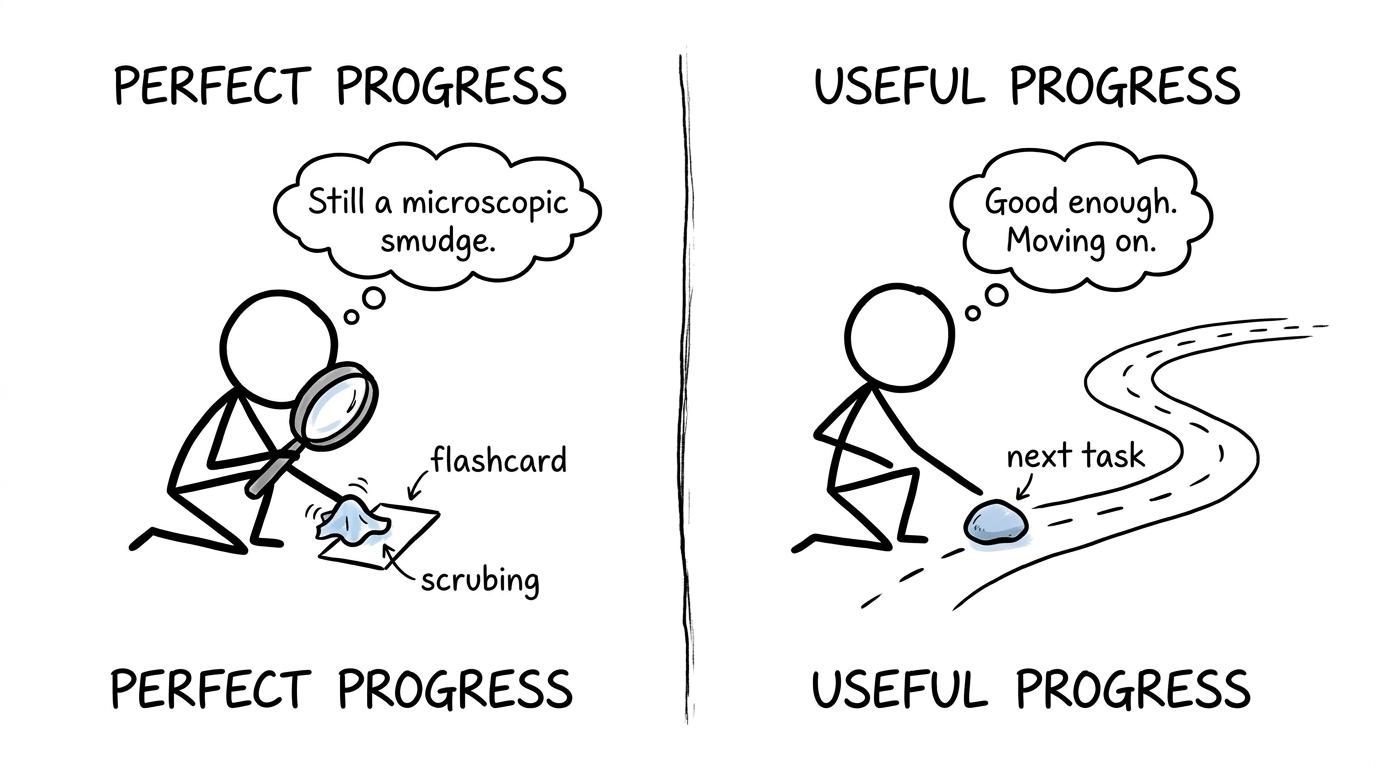 One student polishes forever while another takes the next useful step
Build a revision system that tolerates imperfect days
A rigid timetable assumes that every day will unfold exactly as planned. Real revision rarely does. Homework expands, practical tasks take longer and concentration varies.
Use a minimum target and an optional extension. The minimum should be small enough to begin on a difficult day but meaningful enough to produce evidence. Once completed, continue only if time and attention allow. This protects consistency without turning one disrupted evening into an abandoned week.
It also helps to separate tasks by purpose:
- Learn: clarify unfamiliar content using the specification, lesson materials or teacher guidance.
- Retrieve: recall definitions, processes and explanations without prompts.
- Apply: answer questions that require knowledge in an unfamiliar context.
- Review: check responses and schedule weak content again.
Do not expect one activity to perform every job. A video may clarify an idea, but it does not replace independent recall. A full paper can test coverage, but it may be inefficient when one narrow weakness needs attention.
For maths, this might mean selecting practice at an appropriate level from the grade 111 revision resources, grade 444 revision resources or grade 777 revision resources. These pages are revision pathways, not labels for what you are permanently capable of achieving.
Protect the maths inside Food and Nutrition
Food Preparation and Nutrition can require quantitative thinking, including interpreting data, using ratios, converting units and reading nutritional information. Perfectionism can make these questions feel unusually risky because an answer appears either right or wrong.
Resist the urge to watch several explanations before attempting anything. Choose the relevant skill, try a short set and inspect the error. MathsGenie's ratio and proportion lesson can support scaling and proportional reasoning, while the averages and range lesson can strengthen data-handling skills.
Use resources appropriate to your exam board and qualification. GCSE mathematics has foundation and higher tiers, while Food Preparation and Nutrition assessment structures are organised differently. Do not transfer tier language or paper assumptions from one subject to another.
Common mistakes that keep the cycle going
Making a perfect plan before doing any practice
Planning should decide what happens next. If designing the plan takes most of the available session, simplify it to one topic, one task and one review point.
Rewriting everything after one poor answer
A weak response does not always mean the whole topic is missing. Identify the smallest gap first. You may need one definition, a clearer chain of reasoning or closer attention to the command word.
Choosing only comfortable questions
Easy recall has a place, especially at the start of a session, but confidence built entirely on familiar material is fragile. Include questions that make you pause. The pause is where useful diagnosis begins.
Delaying papers until revision is “finished”
Revision is never perfectly finished. Papers help determine what should be revised next. Start with selected sections if a complete paper feels overwhelming, then build towards realistic timed practice.
Treating rest as failure
Fatigue can turn a reasonable task into an unproductive struggle. Rest, sleep and manageable breaks support attention; they are not prizes reserved for students who have completed an impossible list.
Using one disappointing mark as an identity
A mark describes one performance under particular conditions. It does not describe your ceiling. Review the errors, decide which are teachable and make the next practice task specific.
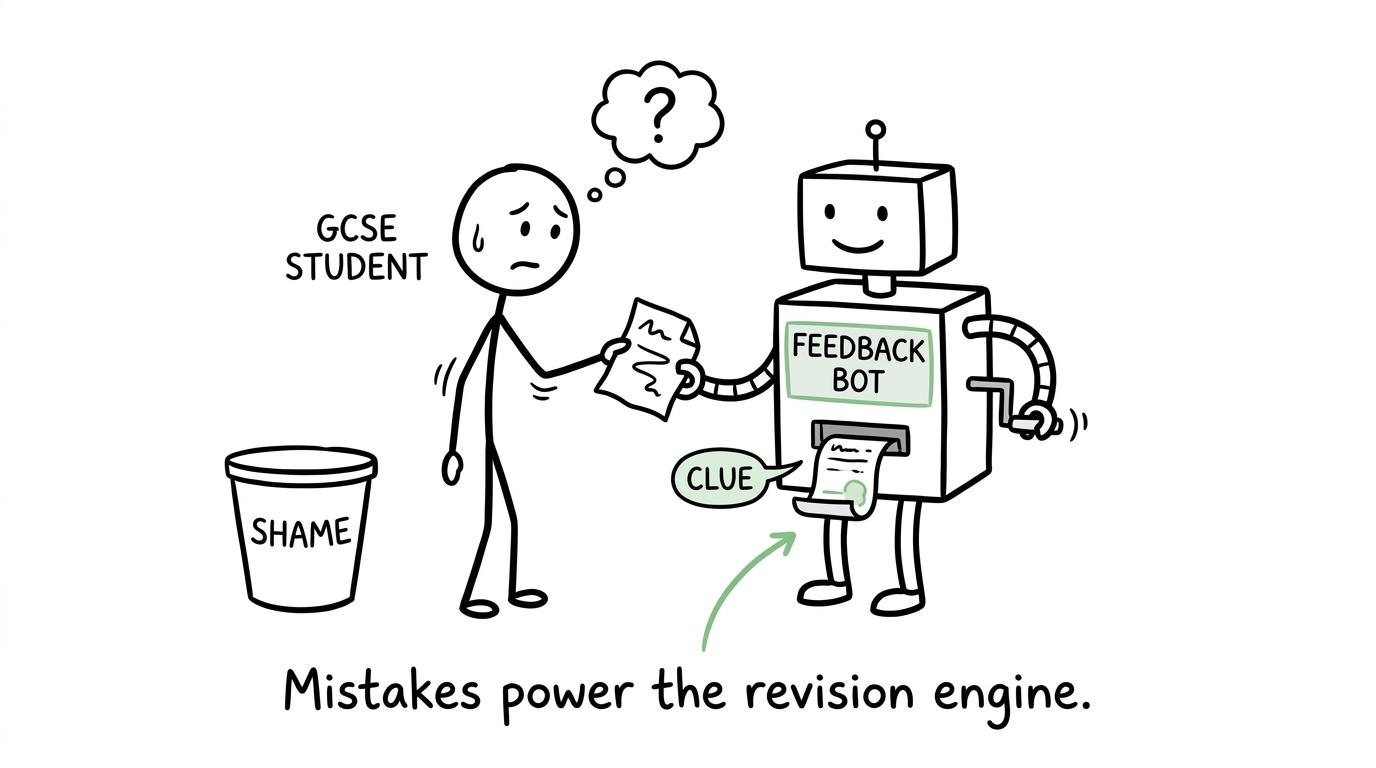 A friendly feedback machine turns rough answers into useful clues
When high standards become useful again
You do not need to remove ambition. You need to make ambition compatible with feedback.
Healthy standards sound like: “I want to improve the precision of my explanations, so I will answer, mark and revise them.” Unhelpful perfectionism sounds like: “I must understand everything before I risk answering.” The first creates information. The second protects you from information you need.
If anxiety, self-criticism or avoidance is regularly affecting your sleep, wellbeing or ability to work, speak to a trusted adult, teacher, form tutor or pastoral team. Revision techniques can reduce avoidable pressure, but they are not a substitute for appropriate support.
Progress begins with a visible attempt
The quiet danger of perfectionism is not that you care too much. It is that caring becomes entangled with avoiding mistakes, and revision without mistakes is usually revision without enough challenge.
Choose one useful action today. Recall a Food Preparation and Nutrition topic without notes. Attempt an exam question. Mark it honestly. Then bring the same approach to maths with MathsGenie's free GCSE revision, practice questions, video solutions, past papers and predicted papers.
Do not wait to feel perfectly prepared. Start, collect feedback and let the next attempt be better than the last.