

Percentage Increase and Decrease Exam Questions
Percentage increase and decrease exam questions explained with three GCSE worked examples, method marks, common errors and focused practice tips for exams.
Percentage questions can look harmless. The numbers are familiar, and the calculator work may take seconds. Yet one decision determines everything: are you finding the change, the final amount or the original amount?
In percentage increase and decrease exam questions, identify the starting value, choose the correct multiplier and check what the question asks for. These three GCSE examples show how to make those decisions and present working that can support method marks.
The percentage method to remember
Before calculating, identify:
- the original amount, which represents 100%100\%100%
- whether the amount increases or decreases
- whether you need the change, final amount or original amount
For an increase of p%p\%p%, the multiplier is:
1+p1001+\frac{p}{100}1+100pFor a decrease of p%p\%p%, the multiplier is:
1−p1001-\frac{p}{100}1−100p| Question type | Calculation |
|---|---|
| Increase an amount by p%p\%p% | Original×(1+p100)\text{Original}\times\left(1+\frac{p}{100}\right)Original×(1+100p) |
| Decrease an amount by p%p\%p% | Original×(1−p100)\text{Original}\times\left(1-\frac{p}{100}\right)Original×(1−100p) |
| Find percentage change | changeoriginal×100\frac{\text{change}}{\text{original}}\times100originalchange×100 |
| Find an original amount | Final÷multiplier\text{Final}\div\text{multiplier}Final÷multiplier |
Build confidence with the Percentage Change lesson, then try the Percentage Change Question Bank independently.
Question one: a straightforward percentage increase
A bicycle costs £240\pounds 240£240. Its price increases by 15%15\%15%. Work out the new price.
The word increases matters. You need the original price plus the increase.
Choose the multiplier
An increase of 15%15\%15% means the new price is 115%115\%115% of the original:
115%=1.15115\%=1.15115%=1.15Multiply the original price by this multiplier:
240×1.15=276240\times1.15=276240×1.15=276The new price is £276\boxed{\pounds 276}£276.
You could also calculate the increase separately:
240×0.15=36240\times0.15=36240×0.15=36 240+36=276240+36=276240+36=276A valid percentage calculation may earn method marks, depending on the question's mark scheme. Showing both stages makes your reasoning visible. Remember that £36\pounds 36£36 is the increase, while £276\pounds 276£276 is the new price.
Before accepting the answer, compare it with the starting price. An increase must produce a larger amount, and a modest percentage increase should not make the price several times larger. This check takes little time but can reveal a decimal entry error. You do not need to calculate the answer twice: use the meaning of the question to judge whether the size and direction of your result are both sensible.
Question two: a decrease inside a longer problem
A laptop costs £680\pounds 680£680. In a sale, the price is reduced by 15%15\%15%. Delivery costs £12\pounds 12£12. Work out the total amount paid.
Find the sale price before adding delivery, because the reduction applies to the laptop price.
Calculate the amount remaining
After a reduction of 15%15\%15%, the percentage remaining is:
100%−15%=85%100\%-15\%=85\%100%−15%=85%The multiplier is therefore 0.850.850.85:
680×0.85=578680\times0.85=578680×0.85=578Now include delivery:
578+12=590578+12=590578+12=590The total amount paid is £590\boxed{\pounds 590}£590.
Separate lines help an examiner follow your method. Even if the final addition goes wrong, the correct percentage calculation remains visible.
Calculating 680×0.15680\times0.15680×0.15 alone would give the discount, not the sale price. Revisit the Percentage Change revision guide if this distinction still feels uncertain.
Longer questions often test your reading as much as your arithmetic. Identify exactly which charge receives the percentage change before entering numbers into your calculator. Here, delivery is a separate fixed charge, so including it in the discounted amount would change the problem. Brief labels such as “sale price” and “total paid” keep the stages organised and make it easier to spot an omitted charge when checking your final answer.
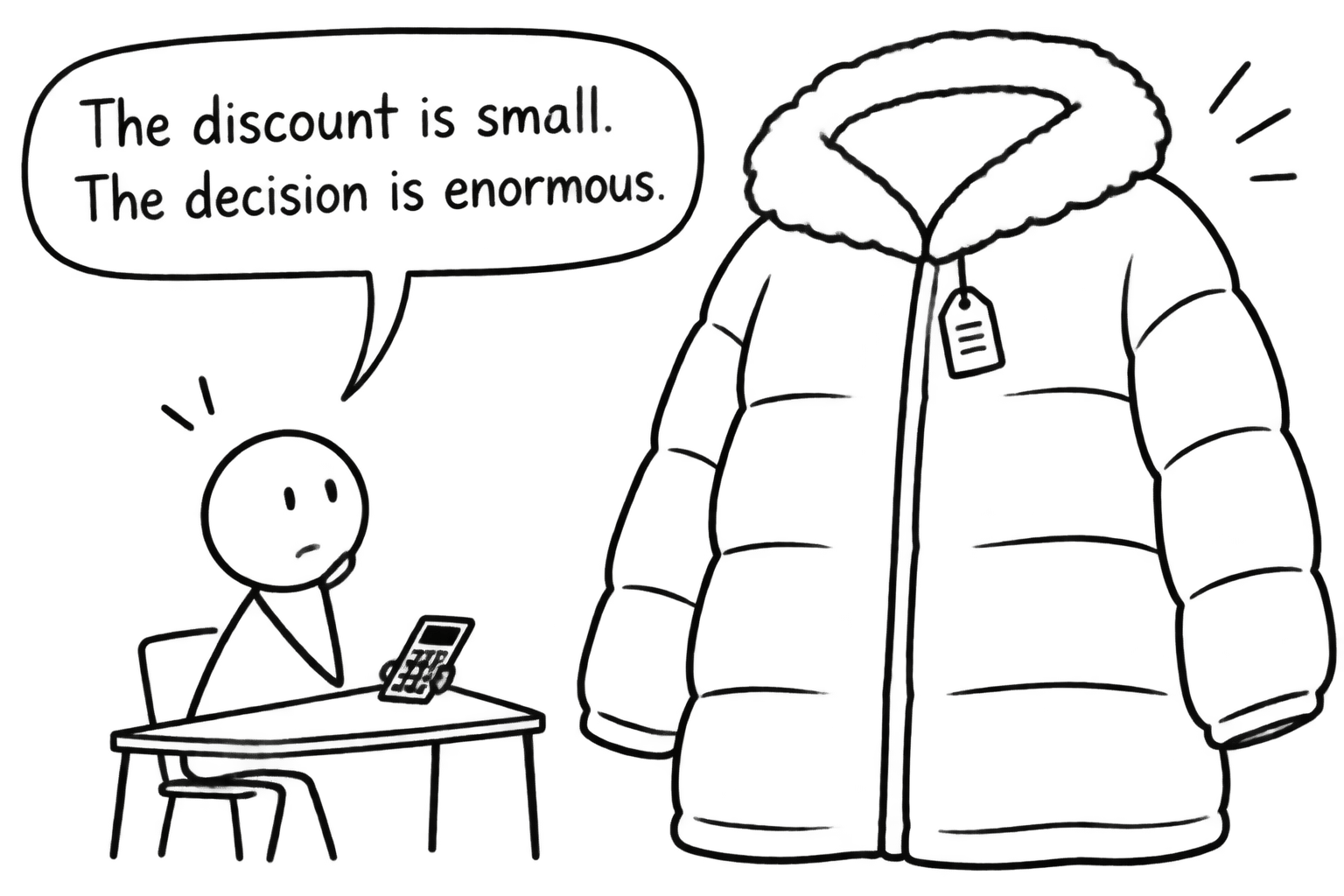 A student faces an enormous coat while considering a tiny discount
Question three: finding the original amount
A television is reduced in price by 12%12\%12%. Its sale price is £748\pounds 748£748. Work out the original price and the amount of the reduction.
Here, £748\pounds 748£748 is the amount left after the decrease. It does not represent 100%100\%100%.
Reverse the multiplier
First identify the percentage remaining:
100%−12%=88%100\%-12\%=88\%100%−12%=88%The sale price represents 88%88\%88% of the original. A direct decrease multiplies by 0.880.880.88, so reverse it by dividing:
748÷0.88=850748\div0.88=850748÷0.88=850The original price was £850\boxed{\pounds 850}£850.
Find the reduction by subtracting:
850−748=102850-748=102850−748=102The reduction was £102\boxed{\pounds 102}£102.
Writing the remaining percentage and the division shows how you recovered the original amount. Check by applying the decrease again:
850×0.88=748850\times0.88=748850×0.88=748Multiplying 748748748 by 1.121.121.12 would not undo the decrease: the percentages would use different starting amounts. The Reverse Percentages lesson and practice develops this method further.
Recognise what the question wants
Small differences in wording change the calculation:
- “Increased by” means add the increase or use an increase multiplier.
- “Reduced by” means subtract the reduction or use a decrease multiplier.
- “Percentage increase” asks for the change as a percentage of the original.
- “Original price” after a change means work backwards.
Underline the requested quantity before calculating. A correct calculation can still answer the wrong question.
Once single changes feel secure, try Repeated Percentage Change. If decimal conversions cause difficulty, revisit the Percentages revision guide.
Common mistakes in percentage questions
Using the percentage as the final multiplier
For a 20%20\%20% decrease, multiplying by 0.200.200.20 finds the reduction. To find the amount remaining, use 0.800.800.80, because 80%80\%80% remains.
Dividing by the final value
Percentage change uses the original amount as its reference:
percentage change=changeoriginal×100\text{percentage change}=\frac{\text{change}}{\text{original}}\times100percentage change=originalchange×100Reversing a decrease by adding the same percentage
The reduced amount has a different value from the original. Divide by the original multiplier to reverse the change.
Hiding working or rounding early
Write your multiplier and calculation before the answer. Keep intermediate values unrounded where possible, then round money to the nearest penny when necessary. Use £18.50\pounds 18.50£18.50 when representing that payment.
Turn practice into reliable marks
When tackling percentage increase and decrease past paper questions, label the original amount, write the multiplier and check the requested quantity. Before calculating, predict whether your answer should be larger or smaller than the given amount. This simple check can expose an incorrect operation.
Compare your working with the mark scheme or worked solution, rather than checking only the final answer. Identify whether any error came from interpreting the wording, choosing the multiplier or completing the arithmetic. Then attempt another question targeting that specific difficulty.
Return to a previously missed question after a gap, with the solution covered. Explain why your chosen multiplier matches the wording before calculating. If you can complete the arithmetic but cannot explain that choice, revisit the lesson. As confidence grows, mix direct changes with reverse percentage questions so that you practise selecting a method independently, rather than repeating one operation because every question on the page follows the same pattern.
Start with the MathsGenie Percentage Change Lessons and Question Bank. Use the free revision lessons to clarify the method, then practise independently until unfamiliar wording feels manageable.















