Parents Involved in GCSE Bengali Revision: Does It Help?
Parents involved GCSE Bengali revision: see when family support improves speaking and routines, and when pressure creates conflict or dependence at home.
There is a familiar moment in many homes during GCSE season. A parent asks whether revision is finished. The student hears criticism, even when the parent intended encouragement. Ten minutes later, nobody is thinking about Bengali, maths or the next exam.
So, should parents get involved in GCSE Bengali revision? Yes, but usually as organisers, listeners and calm supporters rather than substitute teachers. The best parents involved GCSE Bengali revision approach protects the student's independence while making useful practice easier. It helps with routines, speaking confidence and access to resources. It becomes counterproductive when support turns into constant correction, comparison or control.
That distinction matters especially for students balancing Bengali with GCSE maths and other subjects. Revision time is limited. Family support should reduce the number of decisions a student must make, not become another demand competing for attention.
A quick checklist for helpful parental involvement
Parents are most useful when they:
- ask the student what kind of help they want;
- understand the correct qualification, exam board and tier;
- provide short opportunities for speaking and listening;
- help create a realistic revision routine;
- protect quiet study time for Bengali, maths and other subjects;
- encourage the student to use teacher feedback and official mark schemes;
- notice effort and consistency rather than demanding a particular grade;
- step back when the student can manage independently.
A useful question is not, "How much revision have you done?" It is, "What would make today's revision easier to start?"
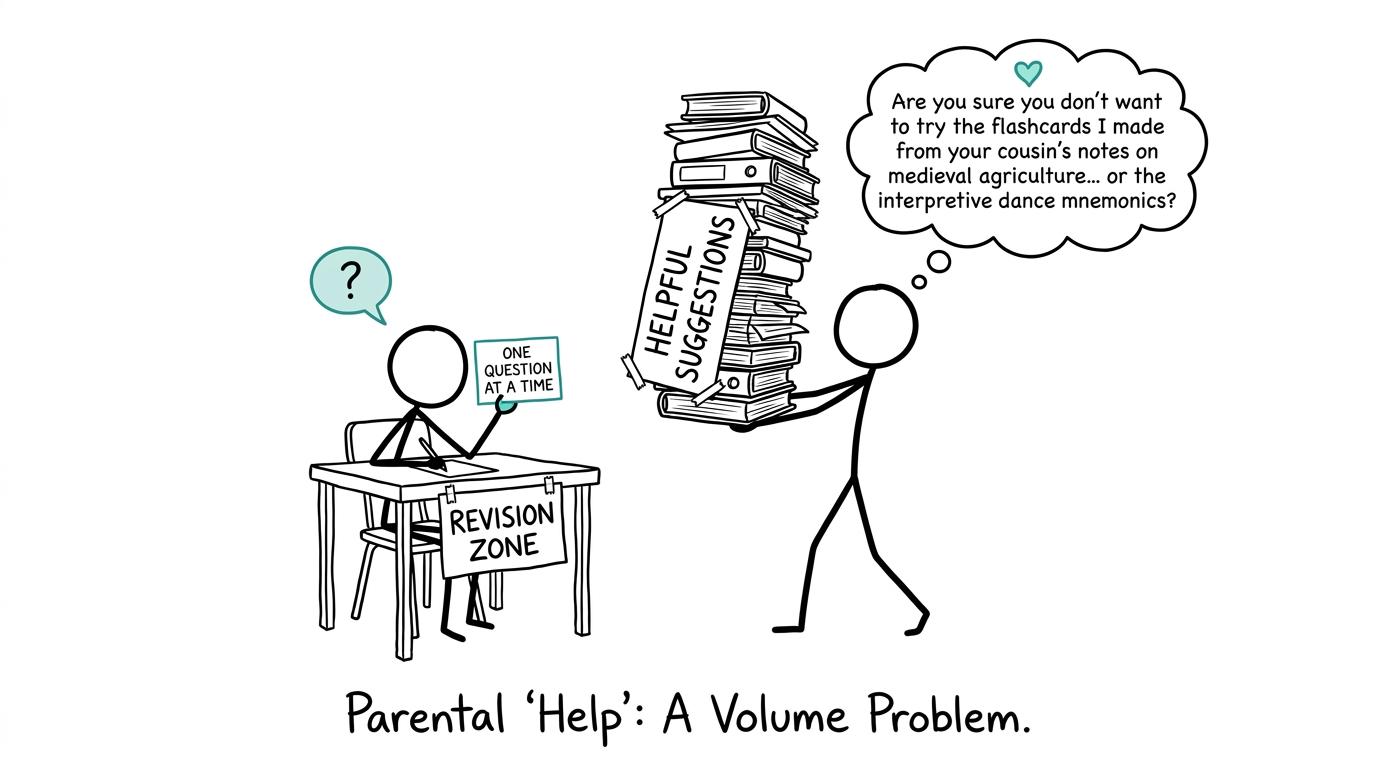 A student limits an enthusiastic parent's mountain of revision suggestions
Understand what GCSE Bengali actually assesses
Before helping, families need to confirm the exact qualification with the school. In England, the accredited GCSE Bengali specification is offered by AQA. OCR, Eduqas and Pearson Edexcel do not offer the equivalent accredited GCSE Bengali qualification, although Pearson has a separate International GCSE in Bangla. These qualifications should not be treated as interchangeable.
For AQA GCSE Bengali, students take all assessments at the end of the course and at the same tier. Foundation tier covers grades 111 to 555, while higher tier covers grades 444 to 999. The four assessed skills are:
- listening;
- speaking;
- reading;
- writing.
Each skill contributes approximately 25%25\%25% of the qualification. This means fluent family conversation can be valuable, but it cannot replace reading, accurate writing, translation work or familiarity with the exam format.
The specification also expects students to communicate across defined themes and to use language suited to the assessment. Everyday Bengali spoken at home may include regional forms, informal expressions or a mixture of languages. That home language is an asset, not a weakness. However, students must also learn the standard forms, vocabulary and task conventions expected by their teacher and exam board.
Parents should therefore begin by asking the school for the specification code, tier, assessment dates and recommended materials. If there is any uncertainty about acceptable vocabulary, spelling or register, the teacher's guidance should take priority over family preference.
Where parental involvement genuinely helps
Creating regular speaking opportunities
Speaking improves through use. A parent or relative who speaks Bengali can provide a real audience, ask follow-up questions and encourage answers that extend beyond a single word.
The parent does not need to recreate the full speaking assessment. Short conversations about school, future plans, family life or local issues can help students retrieve vocabulary under mild pressure. The student can ask to be corrected immediately, at the end, or only when meaning becomes unclear. Agreeing this beforehand prevents every conversation becoming an interruption.
A parent who does not speak Bengali can still help. They can read prompts supplied by the student, operate a timer, record an answer with permission or check whether all parts of a practice task were attempted. The student's teacher and mark scheme remain the authorities on assessment quality.
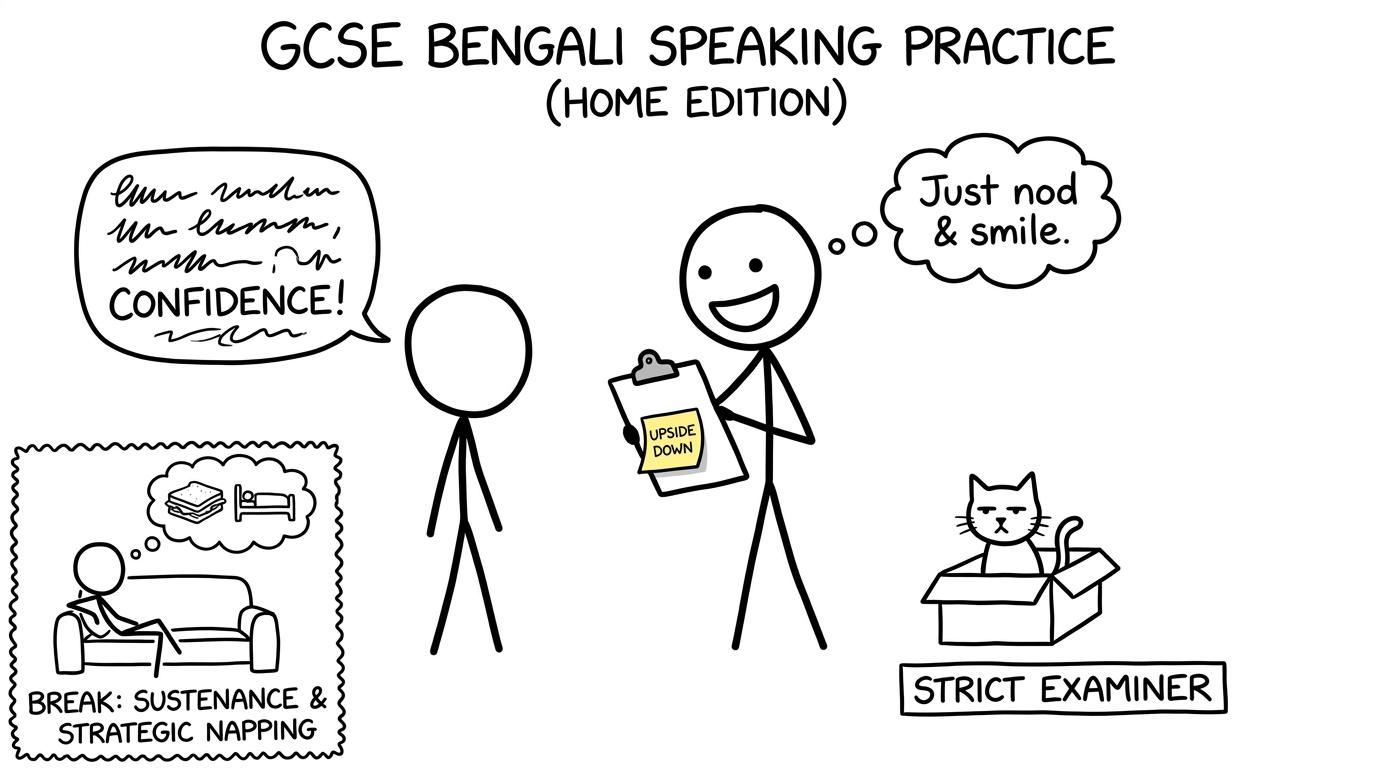 A GCSE student practises speaking while a cat becomes the strict mock examiner
Supporting routines without taking ownership
At secondary level, effective parental support should increasingly strengthen independent learning. That principle is consistent with Education Endowment Foundation guidance, which advises caution about parents becoming directly involved in secondary homework content when they may not know the required method or curriculum expectations.
A parent can help the student choose two or three Bengali sessions each week and place them around maths lessons, homework and rest. The student should still decide what happens inside each session.
The same structure works across subjects:
- retrieve knowledge without notes;
- complete a short task;
- check it against trusted feedback;
- record one specific weakness;
- return to that weakness later.
Students who need a manageable whole-week structure can adapt the GCSE maths revision timetable. A timetable is most useful when it reflects the student's actual school week rather than an ideal week imagined by somebody else.
For maths, the MathsGenie GCSE revision hub provides board-specific lessons, exam questions and papers. Using a clear resource hub for maths can free up planning time for Bengali, where materials may come directly from the school and AQA.
Protecting time and reducing practical friction
Some of the best parental help barely looks academic. It might mean finding a quiet room, keeping younger siblings occupied for twenty minutes, checking an exam date or making sure headphones work before listening practice.
These actions matter because starting is often the hardest part of revision. Removing one small obstacle can be more valuable than giving a long lecture about effort.
Parents can also help students avoid an unbalanced timetable. A student who enjoys spoken Bengali may keep practising conversation while avoiding written accuracy. Another may spend every evening on maths because its right-or-wrong answers feel easier to measure. A weekly check-in can reveal these patterns without turning the parent into a supervisor.
Listening after a difficult practice task
Not every low mark requires an immediate solution. Sometimes a student first needs enough distance to describe what went wrong.
Parents can ask:
- Was the problem knowledge, timing or understanding the question?
- Which part could you improve independently?
- Is there something you need to ask your teacher?
- What is the smallest useful next step?
This diagnostic habit transfers well to maths. After a paper, students can use the method in how to use GCSE maths past papers properly: mark carefully, identify the source of lost marks and repair a small number of weaknesses.
Where involvement creates more friction than progress
Correcting every sentence
Continuous correction can make a student reluctant to speak. It also gives every slip equal importance, although some errors affect communication or assessment more than others.
Use a correction agreement. The student might request feedback on pronunciation today and verb forms tomorrow. Parents should avoid debating language conventions when the student has been taught a specific exam-appropriate form. Record the disagreement and ask the teacher.
Confusing fluency with exam readiness
A student may speak naturally with family yet find formal reading or writing difficult. The reverse can also happen: a student may know the taught vocabulary but feel self-conscious speaking at home.
Neither situation proves laziness. GCSE Bengali assesses four distinct skills. Revision should respond to evidence from school tasks, mock assessments and teacher feedback rather than assumptions about what a Bengali-speaking student "should already know".
Comparing siblings or relatives
Comparison creates noise but provides little diagnostic information. Different students may have different exposure to Bengali, different literacy experience and different exam demands. A cousin's result does not reveal the next action this student should take.
Compare current work with previous work instead. Is the answer longer, clearer or more accurate? Can the student now respond without a prepared script? Progress becomes useful when it identifies what to practise next.
Taking over the revision plan
A plan imposed by a parent may produce short-term compliance but little independence. The aim is not to monitor every minute. It is to help the student build a system they can continue when nobody is watching.
MathsGenie's one-month GCSE maths revision plan shows how revision can move from focused topic work towards timed practice. Families can borrow that broad rhythm while allowing the student to select the Bengali tasks recommended by their teacher.
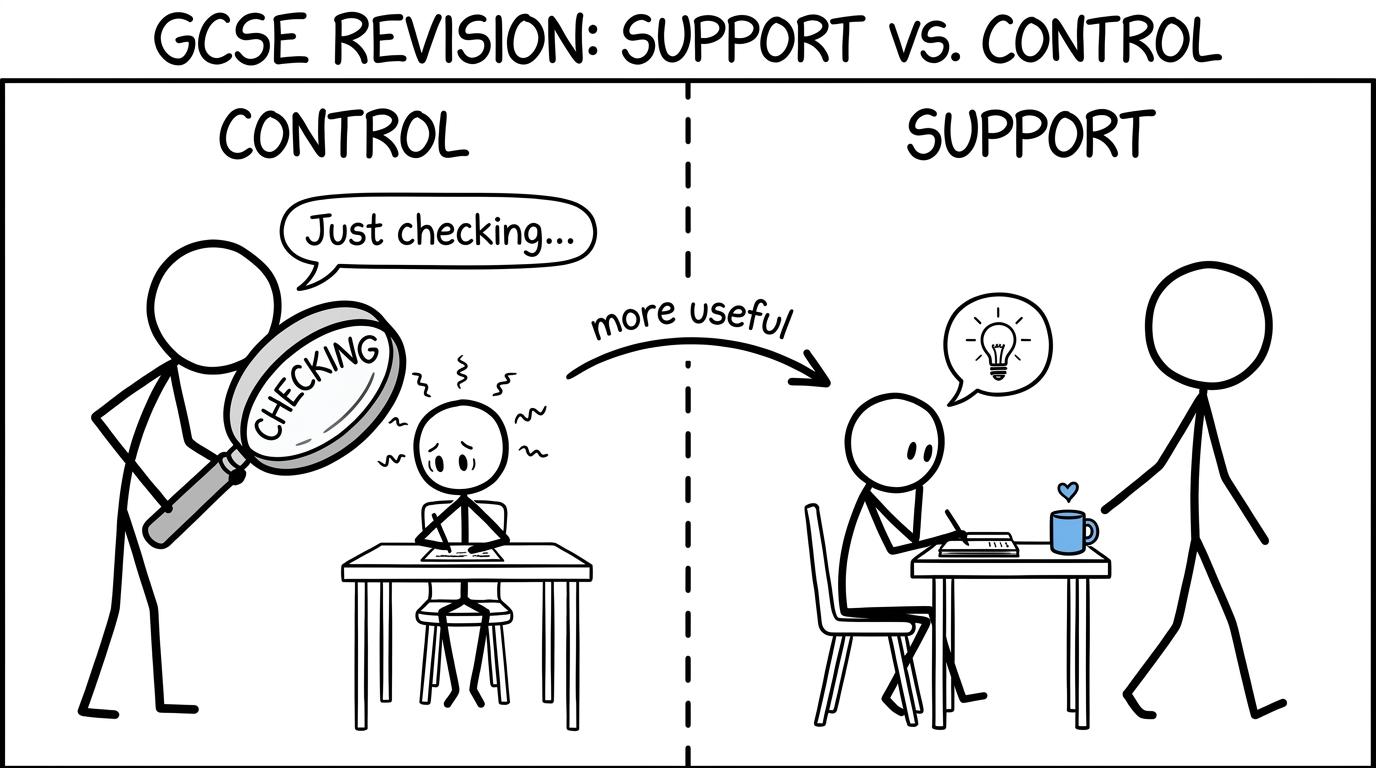 A hovering parent discovers that quiet support works better than constant checking
A low-friction family agreement
The most sustainable arrangement is often a brief weekly conversation. Keep it practical and write down only what both sides need to remember.
The student chooses:
- the Bengali skill that needs attention;
- the type of help requested;
- when corrections should be given;
- which questions must go to the teacher.
The parent agrees to:
- provide the requested support;
- avoid surprise testing;
- respect the end time;
- discuss progress at the agreed check-in rather than repeatedly asking.
For a student balancing several exams, the agreement might include one Bengali speaking session, one independent reading or writing session and a separate maths block. Maths practice can begin with a mini test or topic lesson before progressing to the Edexcel GCSE maths past papers or the appropriate board page.
Nearer the maths exams, students can add GCSE predicted papers and revision resources. Predicted papers should provide fresh practice, not replace official past papers. The same principle applies in Bengali: use exam-style resources to test learning, then return to the precise skill that needs repair.
Common mistakes families should avoid
Assuming home conversation covers the course. Speaking experience helps, but students still need listening, reading and writing practice aligned with their specification.
Using the wrong qualification materials. AQA GCSE Bengali and Pearson Edexcel International GCSE Bangla have different assessment structures. Confirm the entry with the school.
Marking beyond the parent's expertise. Parents can notice omissions or unclear communication, but formal assessment should follow teacher guidance and the correct mark scheme.
Turning every interaction into revision. Students need ordinary family conversations in which language is communication rather than a test.
Measuring time instead of learning. Two hours at a desk says little about what changed. Ask what the student can now do that they could not do before.
Leaving exam practice until the end. Short exposure to task formats can begin early. In maths, guidance on when to start GCSE past papers follows the same logic: start with manageable sections while there is still time to respond to weaknesses.
Replacing encouragement with pressure. High expectations can coexist with calm language, realistic planning and respect for the student's independence.
Support should make the student more independent
Parents should be involved in GCSE Bengali revision when their involvement gives the student structure, practice and confidence. They should step back when it creates arguments, dependence or conflicting advice.
The test is simple: after several weeks, can the student plan a session, identify a weakness and choose a sensible next step with less help than before? If so, parental involvement is doing its job.
The same goal applies to GCSE maths. Start with the free MathsGenie GCSE maths revision resources, choose the correct exam board and tier, and combine revision lessons with practice questions, mini tests, past papers, mark schemes and video solutions. Nearer the exams, use Edexcel predicted papers, or the relevant resources for your board, to expose the final gaps.
A good parent does not sit the exam from the edge of the room. They help create the conditions in which the student can walk into it prepared.