

Ordering Fractions Exam Questions: GCSE Guide
Ordering fractions exam questions become easier with one reliable method. Learn common denominators, method marks, mistakes and GCSE practice with confidence.
Ordering fractions can feel deceptively simple. Then an exam question presents three awkward denominators, asks for descending order and leaves just enough space to make you question everything. The reliable way to answer ordering fractions exam questions is to rewrite every fraction with a common denominator, compare the numerators, and copy the original fractions into the required order.
This guide follows a hypothetical student, Sam, through three exam-style questions of rising difficulty. At each stage, we will identify where method marks may come from and how to make the working easy for an examiner to follow.
The ordering fractions method
Use this checklist whenever you are asked to place fractions in order:
- Check whether the question asks for ascending or descending order.
- Find a common denominator, ideally the lowest common multiple of the denominators.
- Convert every fraction into an equivalent fraction.
- Compare the new numerators.
- Write the original fractions in the required order.
- Recheck the direction before moving on.
Ascending means smallest to largest. Descending means largest to smallest.
You can also convert fractions to decimals, but a common denominator usually produces exact values and creates clear written evidence of your method. The Maths Genie ordering fractions lesson builds this process one step at a time.
Question one: ordering with friendly denominators
Sam begins with a straightforward question.
Write these fractions in ascending order:
34,710,45\frac{3}{4},\quad \frac{7}{10},\quad \frac{4}{5}43,107,54The denominators are 444, 101010 and 555. Their lowest common multiple is 202020, so Sam rewrites each fraction with a denominator of 202020:
34=1520\frac{3}{4}=\frac{15}{20}43=2015 710=1420\frac{7}{10}=\frac{14}{20}107=2014 45=1620\frac{4}{5}=\frac{16}{20}54=2016Now the numerators can be compared directly:
14<15<1614<15<1614<15<16Therefore:
710<34<45\frac{7}{10}<\frac{3}{4}<\frac{4}{5}107<43<54The answer is:
710,34,45\boxed{\frac{7}{10},\quad \frac{3}{4},\quad \frac{4}{5}}107,43,54Where the marks may come from
For a short question, a typical mark scheme might award a method mark for producing useful equivalent fractions and an accuracy mark for the correct order. The exact allocation depends on the paper and exam board, so never assume that every question uses the same structure.
Sam's working matters. If the final list contained a copying mistake, the correct common-denominator conversions could still provide evidence of a valid method.
You can reinforce this first stage with the ordering fractions revision guide, which explains equivalent fractions alongside the ordering process.
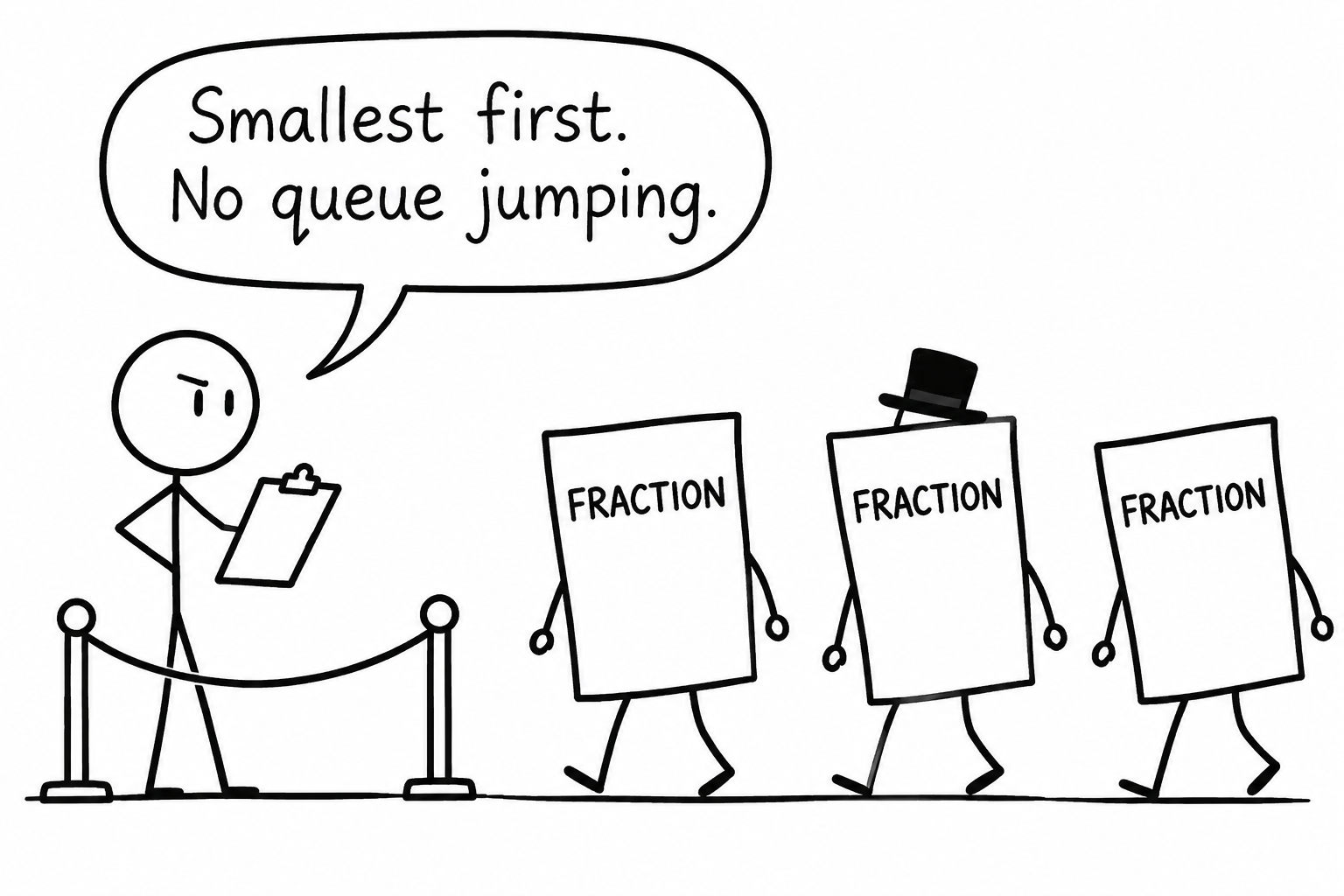 A stick-figure student manages a polite queue of fractions
Question two: descending order
The next question changes one word, but that word controls the entire answer.
Write these fractions in descending order:
56,79,1112\frac{5}{6},\quad \frac{7}{9},\quad \frac{11}{12}65,97,1211Sam underlines descending before calculating. The lowest common multiple of 666, 999 and 121212 is 363636:
56=3036\frac{5}{6}=\frac{30}{36}65=3630 79=2836\frac{7}{9}=\frac{28}{36}97=3628 1112=3336\frac{11}{12}=\frac{33}{36}1211=3633Because the question wants the largest fraction first, Sam compares the numerators from greatest to least:
33>30>2833>30>2833>30>28Therefore:
1112>56>79\frac{11}{12}>\frac{5}{6}>\frac{7}{9}1211>65>97The answer is:
1112,56,79\boxed{\frac{11}{12},\quad \frac{5}{6},\quad \frac{7}{9}}1211,65,97Where the marks may come from
A correct common denominator and three correctly converted fractions demonstrate the method. The ordered list then earns the accuracy credit where the mark scheme separates method and answer marks.
This is also why writing only a final list is risky. A correct answer may earn full marks, but a wrong answer with no working gives the examiner little evidence to reward. Clear equivalent fractions protect the method you used.
Once this routine feels manageable, use the Maths Genie Lessons and Question Bank to repeat it across easy, medium and harder questions without having to assemble your own practice set.
Question three: ordering negative fractions
Sam's third question introduces negative values.
Write these fractions in ascending order:
−34,−58,23,710-\frac{3}{4},\quad -\frac{5}{8},\quad \frac{2}{3},\quad \frac{7}{10}−43,−85,32,107The lowest common multiple of 444, 888, 333 and 101010 is 120120120. Sam converts every fraction:
−34=−90120-\frac{3}{4}=-\frac{90}{120}−43=−12090 −58=−75120-\frac{5}{8}=-\frac{75}{120}−85=−12075 23=80120\frac{2}{3}=\frac{80}{120}32=12080 710=84120\frac{7}{10}=\frac{84}{120}107=12084The numerators are now:
−90,−75,80,84-90,\quad -75,\quad 80,\quad 84−90,−75,80,84In ascending order:
−90<−75<80<84-90<-75<80<84−90<−75<80<84So the original fractions must be written as:
−34,−58,23,710\boxed{-\frac{3}{4},\quad -\frac{5}{8},\quad \frac{2}{3},\quad \frac{7}{10}}−43,−85,32,107The important idea is that the negative number farther from zero is smaller. Therefore, −34-\frac{3}{4}−43 is smaller than −58-\frac{5}{8}−85.
Where the marks may come from
This question creates several opportunities to show a valid method. A common denominator of 120120120, correctly converted numerators and a consistent comparison all provide useful evidence. The final mark depends on returning to the original fractions in the correct order.
If 120120120 feels large, that is not a problem. A common denominator does not have to be small to be valid. It only needs to be a multiple of every original denominator. The Maths Genie ordering fractions booklet provides space to practise setting out this working clearly.
How to approach ordering fractions past paper questions
Ordering fractions past paper questions sometimes appear alone and sometimes as part of a broader number problem. The surrounding context may change, but the underlying comparison does not.
When practising, use this routine:
- Attempt the question without notes.
- Show every equivalent fraction.
- Check the required direction.
- Compare your answer with the mark scheme or worked solution.
- Identify whether an error came from the method, arithmetic or final ordering.
- Repeat a similar question later rather than immediately copying the solution.
The purpose of a mark scheme is not merely to say whether an answer is right. It shows what mathematical evidence receives credit. Maths Genie's exam-style ordering fractions question lets you practise the topic in question-bank format, while Ordering Fractions Question Rush is useful when you want quicker decisions under pressure.
Common mistakes in the ordering fractions GCSE exam
Comparing numerators before matching denominators
The numerator alone does not determine the size of a fraction. For example, 555 is greater than 333, but that does not automatically make every fraction with numerator 555 larger than every fraction with numerator 333.
Changing only the denominator
If a denominator is multiplied by a number, the numerator must be multiplied by the same number:
34=3×54×5=1520\frac{3}{4}=\frac{3\times 5}{4\times 5}=\frac{15}{20}43=4×53×5=2015Writing 34=320\frac{3}{4}=\frac{3}{20}43=203 changes the value of the fraction.
Reversing ascending and descending order
A student can complete every conversion correctly and still lose the final accuracy mark by writing the list backwards. Underline the direction before beginning.
Giving the converted fractions as the final answer
Equivalent fractions are excellent working, but the final list should normally use the fractions given in the question unless instructed otherwise.
Mishandling negative fractions
Among negative values, the fraction with the greater magnitude is smaller. A number line can help: values farther left are smaller.
Turn the method into exam confidence
Sam's progress is not based on a shortcut. The questions become manageable because the same visible method survives each increase in difficulty. Knowing that method is the first step; following it reliably when the denominators become awkward takes deliberate practice.
Start with the Maths Genie ordering fractions Lessons and Question Bank and practise converting, comparing and ordering fractions before your next GCSE paper.















