Online GCSE English Language and Literature Revision Course
Online GCSE English language and literature revision course: decide whether paid teaching, feedback and structure beat free resources for your needs this year.
Revision creates a problem that looks simple from a distance: there is always more you could do. More quotations to learn. More practice papers to attempt. More algebra to revisit. When time is already divided between English, maths and several other subjects, an online GCSE English Language and Literature revision course may seem like the answer.
Sometimes it is. A good paid course can provide structure, expert feedback and accountability. But it is not automatically better than free resources. If you already know what to revise, complete regular timed practice and receive useful feedback from school, free materials may be enough.
The real question is not simply whether a course is good. It is whether the course solves a problem you genuinely have.
The short answer: when is a paid course worth it?
A paid English revision course is most likely to be worthwhile when you:
- struggle to organise Language and Literature revision;
- need individual feedback on analytical or creative writing;
- repeatedly misunderstand particular question types;
- revise more consistently when lessons are scheduled;
- have missed teaching through absence or changes of school;
- can confirm that the course matches your exam board and set texts.
Free resources are more likely to be sufficient when you:
- understand the content but need more practice;
- receive regular marking and feedback from your teacher;
- can follow a realistic revision timetable independently;
- have access to the correct specification, past papers and mark schemes;
- are willing to write complete answers rather than only watch videos.
A course therefore buys more than content. Its potential value lies in diagnosis, sequence, feedback and accountability. Paying merely for another library of recorded videos is harder to justify when so much useful material is already available without charge.
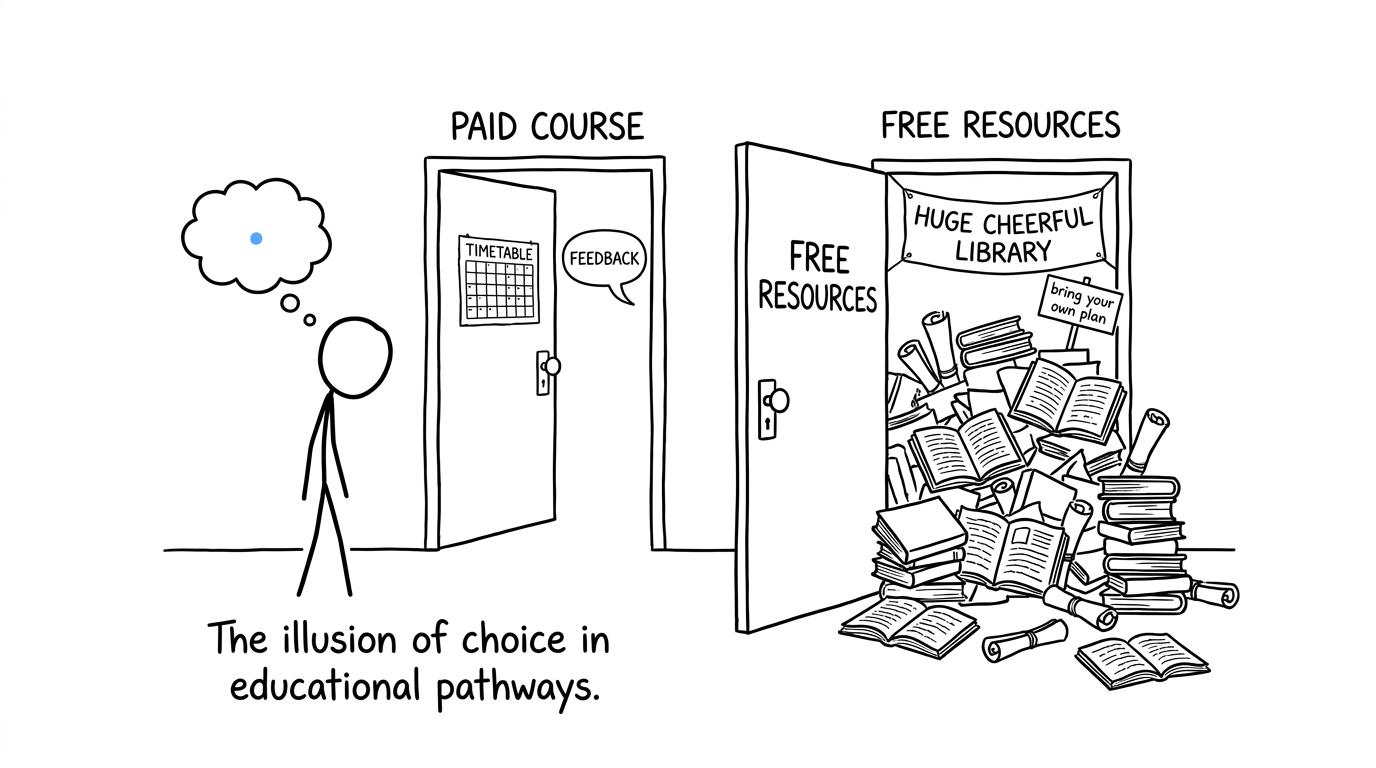 A student choosing between the structure of a paid course and the freedom of free resources
English Language and Literature require different revision
Before comparing courses, remember that GCSE English Language and GCSE English Literature are separate qualifications. Their precise assessments vary across AQA, Pearson Edexcel, OCR and Eduqas, so students should check their current exam-board specification rather than assume that every online lesson applies to them.
English Language generally develops transferable reading and writing skills. Revision needs to include analysing unfamiliar texts, comparing ideas where required, selecting evidence, explaining methods, planning writing and adapting language to purpose and audience.
English Literature is more dependent on the set texts chosen by your school. You need secure knowledge of plot, characters, themes, context and relevant quotations, alongside the ability to build an argument under timed conditions.
Unlike GCSE maths, English is not normally divided into foundation and higher tiers. That means a course advertised vaguely as suitable for “all GCSE English students” still needs careful inspection. Check whether it covers your qualification, your texts and the exact style of questions you will face.
What a strong online course should provide
A polished website and a long list of videos tell you little about whether a course will improve your work. Look instead for features that change what you do.
Accurate exam-board coverage
The provider should identify the exam board, specification and Literature texts covered. It should distinguish clearly between Language and Literature rather than presenting “GCSE English” as one interchangeable subject.
Course materials should also reflect current assessment requirements. If the sales page is unclear about specifications, mark schemes or the intended exam series, ask before paying.
Genuine feedback on written answers
Feedback is often the strongest reason to consider a paid course. English answers cannot be improved reliably by checking only whether certain words appeared. Useful feedback should explain:
- what the response does effectively;
- where the argument becomes unclear or unsupported;
- whether evidence is selected and analysed well;
- how organisation, vocabulary and accuracy affect communication;
- what specific action to take in the next answer.
Find out who marks the work, how often marking is available and whether feedback is individual. Automated comments or generic model answers may help, but they are not equivalent to a careful response to your own writing.
Active practice, not passive viewing
Watching an explanation can create the feeling of recognition without the ability to produce an answer independently. A worthwhile course should move repeatedly from instruction to planning, writing, self-assessment and redrafting.
This principle matters in maths too. A video on simultaneous equations may look perfectly clear until the first blank page appears. MathsGenie's GCSE maths revision lessons and practice questions combine explanations with questions because understanding has to survive without the video playing beside you.
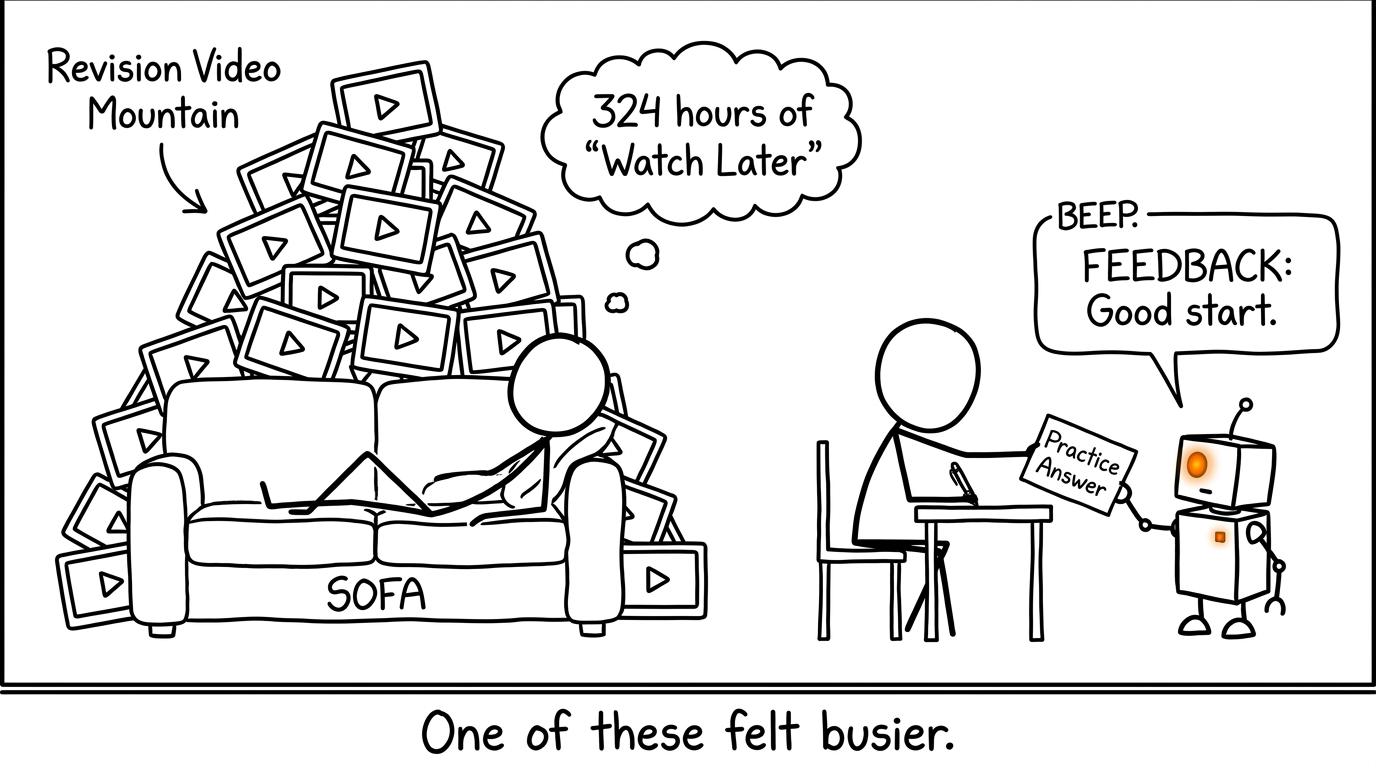 One student watches endless revision videos while another completes practice and receives feedback
A manageable timetable
A course should make your workload clearer, not simply larger. Look for recorded access when live attendance is impossible, sensible lesson lengths and a schedule that leaves room for independent writing.
Be cautious if a programme demands so much weekly time that maths and science practice disappear. English improvement matters, but the cost of a course includes the time displaced from other subjects as well as the fee.
Paid courses compared with free resources
Free resources can provide specifications, past papers, examiner materials, videos, revision notes and question practice. Your school may also offer intervention sessions, teacher feedback, libraries and revision clubs. Used deliberately, this can form a complete revision system.
The limitation is rarely the amount available. It is knowing what to use next. Free revision requires you to choose suitable material, create a timetable, complete uncomfortable practice and judge weaknesses honestly.
A paid course may remove some of those decisions. That is valuable when decision-making is causing delay. Yet payment does not create motivation automatically, and no course can replace writing answers under realistic conditions.
Educational evidence around tutoring, feedback and metacognitive strategies broadly supports the underlying ingredients of effective courses. However, the quality of implementation matters. A live class with little interaction may offer less value than free practice followed by precise feedback from a school teacher.
Questions to ask before paying
Do not let urgency make the decision. Ask the provider:
- Which exam boards and specifications are supported?
- Which Literature texts are taught?
- Are lessons live, recorded or both?
- How large are the groups?
- Who teaches and marks the work?
- How often can students submit answers?
- Is feedback individual and actionable?
- Are sample lessons or materials available?
- How long does access last?
- What is the cancellation or refund policy?
Be wary of guaranteed grades, unexplained testimonials or pressure to buy immediately. Outcomes depend on prior knowledge, attendance, practice, school teaching and many other factors. A responsible provider should explain what it offers without pretending that enrolment alone determines a result.
Protecting maths revision while improving English
For students preparing for GCSE maths, an English course must fit inside a wider plan. It should not consume every evening simply because its lessons arrive with notifications.
Start by identifying the non-negotiable work for each subject. English needs regular reading and writing practice. Maths needs repeated question practice, correction and return visits to weak topics. The subjects differ, but both improve when revision produces something that can be checked.
Use the MathsGenie GCSE maths revision hub to identify topics at the appropriate level. Then test broader exam readiness with GCSE maths past papers, using the accompanying mark schemes and video solutions to understand errors rather than merely record a score.
Closer to the exam, MathsGenie predicted papers can provide further exam-style practice. Predicted papers are practice resources, not promises about the exact questions that will appear, so they should complement specification-wide revision rather than replace it.
Students continuing beyond GCSE can also see how independent practice develops through the MathsGenie A Level maths resources. The habit worth building now is simple: learn, attempt, check, correct and revisit.
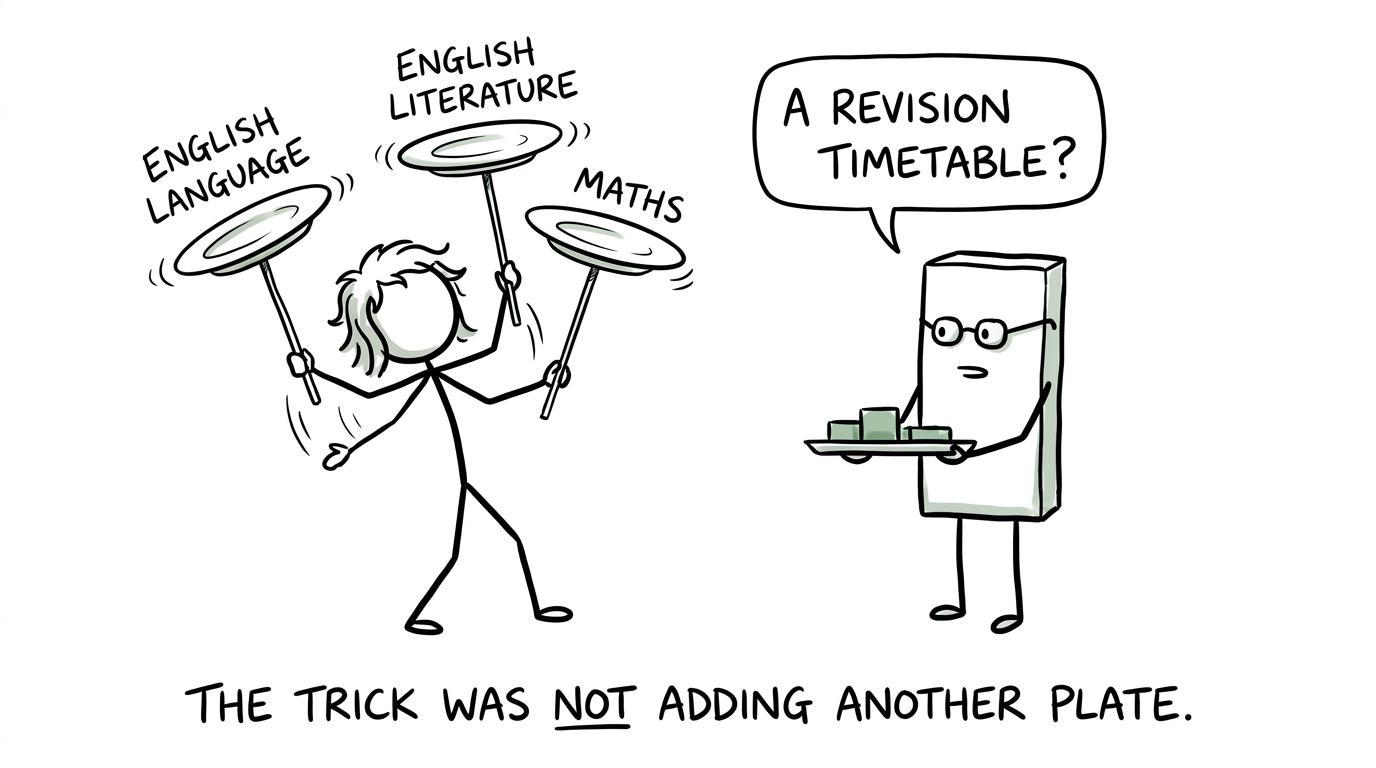 A student balances English Language, English Literature and maths while a revision timetable offers help
A sensible free-first approach
If you remain uncertain, begin with a short free trial of your own revision system. Gather the correct exam-board materials, choose one Language weakness and one Literature weakness, and schedule focused practice. Submit written work to your teacher where possible and record the feedback you receive.
After this trial, review the obstacle honestly. If the work was completed and improved, you may not need a course. If you repeatedly postponed it, could not interpret feedback or did not know how to progress, structured support may be a reasonable investment.
This approach avoids paying for a vague hope. You are buying a solution to an observed problem.
Common mistakes when choosing a revision course
Choosing by popularity rather than specification
A well-known teacher may still cover the wrong exam board or Literature texts. Relevance comes before popularity.
Paying mainly for recorded videos
Recorded teaching can be useful, but compare it with what is already available freely. The distinctive paid value should normally be interaction, marking, structure or support.
Confusing attendance with progress
Joining every live session does not guarantee improvement. Progress requires planning and writing answers without prompts, then acting on feedback.
Ignoring the total workload
A course that damages sleep or pushes out essential maths practice may reduce overall exam readiness. Include homework and independent tasks when judging the time commitment.
Expecting a course to guarantee a grade
No ethical provider can remove uncertainty from an examination. A course can improve preparation, but the student still has to retrieve knowledge, interpret the question and construct the response.
Make the choice that solves your actual problem
An online GCSE English Language and Literature revision course can be worth paying for when it supplies expert feedback, accurate specification coverage and a structure you will genuinely follow. It is less compelling when it simply packages information that you could access freely and leaves you to do the difficult part alone.
Choose English support carefully, then protect time for the rest of your timetable. For maths, begin with MathsGenie's free revision website, select a revision lesson, complete the practice questions and use mark schemes or video solutions to correct your thinking. Add mini tests, past papers and predicted papers as your confidence grows.
Good revision is not measured by how many resources you collect. It is measured by what you can do when the resource is closed and the blank page is in front of you.