

Online GCSE Design and Technology Revision Course
Online GCSE design and technology revision course: compare paid teaching with free resources, check what support matters, and decide before you spend money.
Revision becomes expensive surprisingly quickly. One difficult topic leads to a new guide, a subscription or a course promising to organise everything. The difficult question is not whether the course looks useful. It is whether it will change what you actually do.
An online GCSE Design and Technology revision course can be worth paying for if you need structured teaching, feedback and accountability. But if you already understand most of the content and can revise independently, free specifications, past papers, mark schemes and targeted maths resources may give you everything you need.
The value is rarely in having more videos. It is in getting the right explanation, followed by deliberate practice and useful feedback.
The short checklist before you pay
Ask these questions before joining any course:
- Does it cover your exact exam board: AQA, Edexcel, OCR or Eduqas?
- Does it separate written-exam preparation from non-exam assessment support?
- Are there practice questions, mark schemes and feedback, not just videos?
- Does it teach your chosen material area where the specification requires one?
- Can you preview a lesson or sample resource?
- Will the timetable fit around GCSE maths and your other subjects?
- Could free resources solve the same problem?
- Is there a clear cancellation or refund policy?
If several answers are unclear, wait. A polished course page is not evidence that the teaching matches your specification.
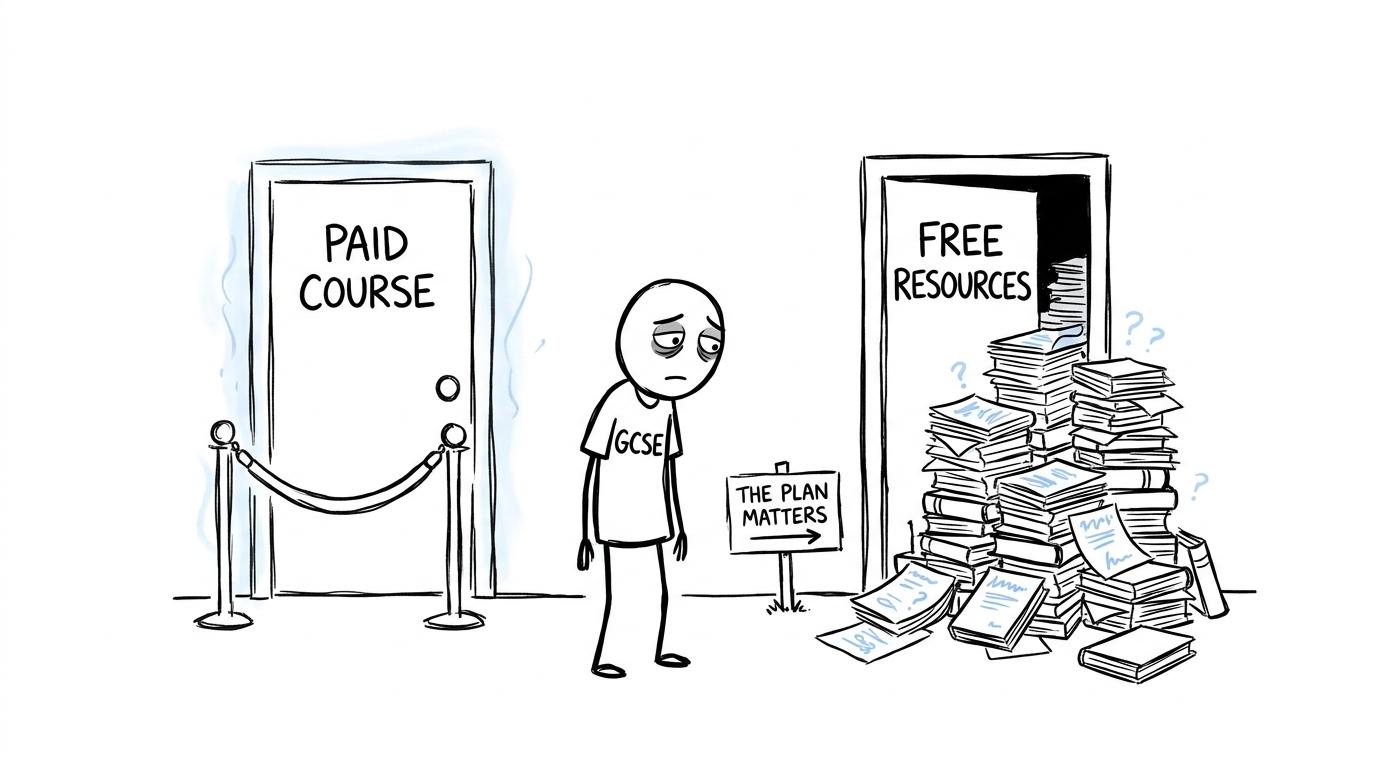 A student choosing between a paid course and free revision resources
What GCSE Design and Technology actually requires
GCSE Design and Technology is not simply a collection of facts about materials. Students must understand technical principles, designing and making principles, iterative development, manufacturing, evaluation and wider issues such as sustainability.
Across the regulated GCSE specifications, the assessment objectives have common weightings:
- AO1: identifying and investigating design possibilities: 10%10\%10%
- AO2: designing and making suitable prototypes: 30%30\%30%
- AO3: analysing and evaluating designs, outcomes and wider issues: 20%20\%20%
- AO4: applying knowledge of technical, designing and making principles: 40%40\%40%
For AQA, Edexcel, OCR and Eduqas, the qualification is divided equally between a written examination and non-exam assessment, with each contributing 50%50\%50%. The precise examination length, paper structure, specialist content and NEA arrangements vary, so a generic course can miss details that matter.
AQA, for example, specifies that at least 15%15\%15% of its written examination assesses maths and at least 10%10\%10% assesses science. Mathematical confidence is therefore part of D&T preparation, not a separate concern to revisit later.
That matters when deciding whether to buy a course. A worthwhile programme should map every lesson to the correct specification rather than offering broad videos labelled simply as “GCSE D&T”.
When a paid online course may be worth it
You need a route through the specification
Free resources can be excellent but scattered. A student may have useful notes, several playlists and a folder of papers while still being unsure what to revise tonight.
A well-designed course removes that decision. It places technical knowledge, specialist materials, designing principles and exam practice in a sensible sequence. This can be valuable when you have significant gaps or have missed lessons.
Structure is especially useful when it produces action: learn one idea, answer questions, mark them and revisit errors. You can apply the same logic to maths through a realistic GCSE maths revision timetable, keeping D&T preparation from consuming time needed for other exams.
You receive meaningful feedback
Feedback is one of the strongest reasons to pay. Recorded videos alone are often available free elsewhere. Personal or small-group feedback can reveal whether an answer lacks technical vocabulary, justification, application to the context or balanced evaluation.
Check what “feedback” means before enrolling. Automated scores on multiple-choice quizzes are different from a teacher explaining why an extended response would not reach the higher mark band.
For NEA work, support must also respect assessment rules. A course may teach the design process and help you understand assessment criteria, but it should not produce assessed ideas, text or decisions for you. Your school controls and authenticates the NEA, which is internally assessed and externally moderated. Your subject teacher remains the essential source of guidance about permitted assistance.
Accountability is your main difficulty
Sometimes the problem is not knowledge. It is starting.
Live sessions, deadlines and regular checks may justify the cost if they make you complete work consistently. Yet accountability only has value when you engage. Paying for access does not create progress by itself, just as downloading a past paper does not constitute revision.
A useful routine is the one explained in MathsGenie’s guide to revising GCSE maths without wasting time: learn, practise, mark, diagnose and re-test. The subject may change, but the revision logic does not.
When free resources are probably enough
A paid course is less likely to be necessary if your teacher has covered the specification thoroughly, you can identify your weaker areas and you are willing to mark practice honestly.
Free preparation can include:
- your exam board’s specification and official assessment materials
- class notes and teacher feedback
- past papers, sample papers and mark schemes
- retrieval cards for materials, processes and terminology
- timed plans for extended responses
- targeted maths revision for calculations and units
- an error log showing why each mark was lost
The decisive word is not “free”. It is “used”. A free paper that you complete, mark and analyse has more value than a paid library you rarely open.
MathsGenie provides free GCSE and A Level maths revision alongside practice questions and solutions. If you take Edexcel maths, the Edexcel GCSE maths past papers can help you build calculation accuracy under timed conditions. Students taking AQA can use the corresponding AQA GCSE maths past papers.
Past papers work best when mistakes determine your next session. The guide to using Edexcel GCSE maths past papers properly explains how to turn errors into targeted practice rather than merely recording a score.
The maths that supports D&T marks
D&T calculations may draw on ratios, percentages, area, volume, scale, tolerances, unit conversion, graphs and basic geometry. The mathematical method is usually not advanced, but questions become difficult when technical context and units are added.
Useful relationships may include percentage change:
Percentage change=changeoriginal value×100\text{Percentage change}=\frac{\text{change}}{\text{original value}}\times 100Percentage change=original valuechange×100Material calculations can also depend on familiar measures such as the area of a circle:
A=πr2A=\pi r^2A=πr2These are not separate “D&T versions” of maths. They are GCSE maths skills applied to manufacturing, materials and design decisions. Strengthening the underlying method is therefore more efficient than memorising isolated question types.
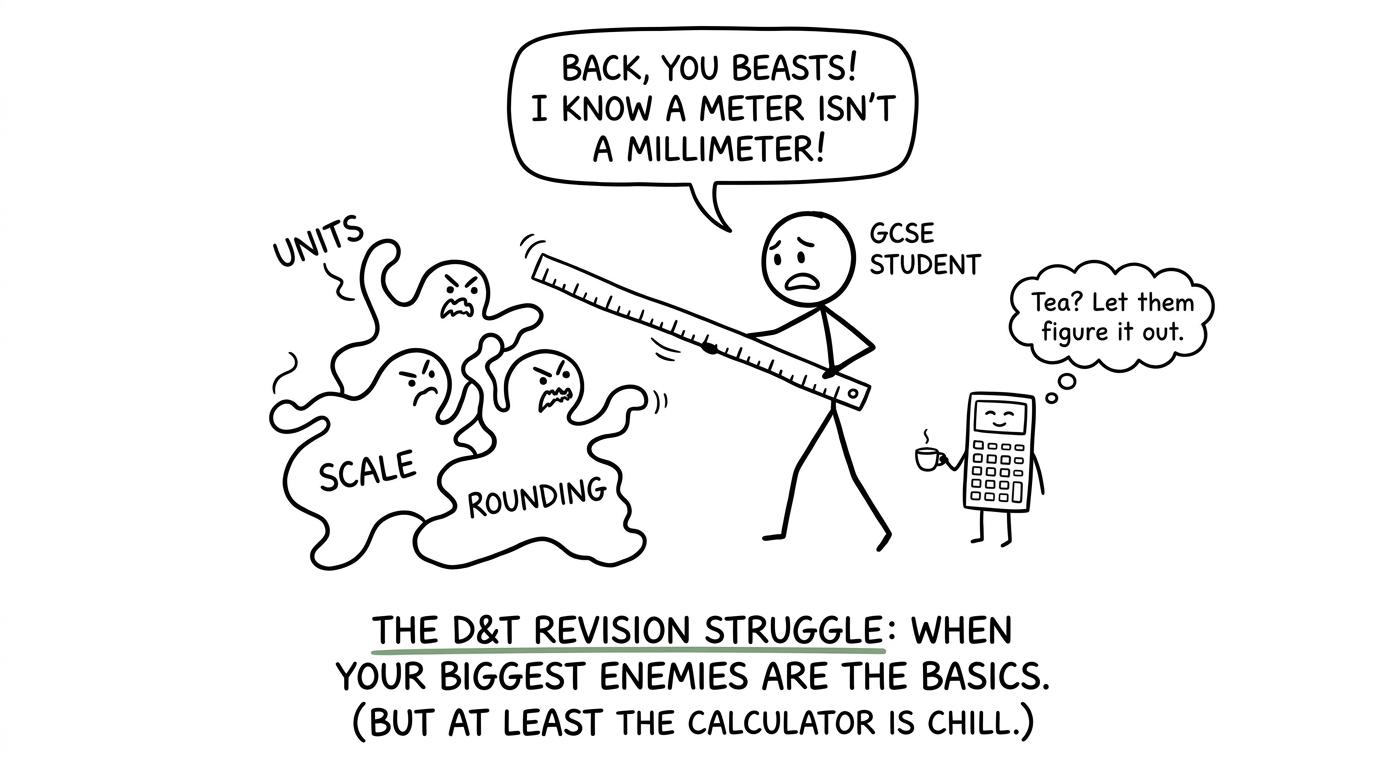 A student confronting units, scale and rounding monsters
When your maths course is Edexcel, GCSE maths predicted papers offer fresh exam-style practice once your topic knowledge is secure. They should complement official past papers, not replace them. MathsGenie’s guide to when you should start GCSE past papers can help you introduce timed practice gradually.
Paid course versus free revision
| Consideration | Paid online course | Free resources |
|---|---|---|
| Structure | Usually follows a planned sequence | You must build your own plan |
| Specification fit | Good only if the board and material area match | Official documents provide the most reliable checklist |
| Feedback | Potentially valuable if provided by a suitable teacher | Usually comes from school, self-marking or mark schemes |
| Flexibility | May involve fixed sessions or subscription periods | Easy to adapt around other GCSE subjects |
| Accountability | Live lessons and deadlines can help | Requires greater independence |
| Cost | Only justified if the added support is used | Financially accessible and often sufficient |
| NEA support | Must remain within assessment rules | Your school teacher remains the main authority |
The sensible comparison is not “paid equals better” against “free equals worse”. Compare the specific service with the specific gap you have.
If your gap is mathematical fluency, use free maths revision. If it is understanding your D&T specification, begin with the official specification and your teacher. If it is detailed feedback on written answers, a suitable taught course may add something genuinely different.
How to test a course before committing
Request or view a sample lesson and inspect it as carefully as you would inspect a prototype.
Look for clear explanations, accurate terminology and questions that require application rather than passive recall. Check that extended-response advice refers to analysis, context and justification rather than promising a universal answer template.
Then investigate the practical details:
- teacher qualifications or relevant experience
- live versus recorded delivery
- class size and access to questions
- the amount and type of marked work
- how long recordings remain available
- accessibility features
- total cost and renewal terms
- safeguards and communication arrangements for students
Finally, try a free revision week first. Follow a schedule, complete questions and mark your work. If the system fails because you cannot find explanations or obtain feedback, you have identified what a paid course needs to provide. If it works, you may have saved money without sacrificing progress.
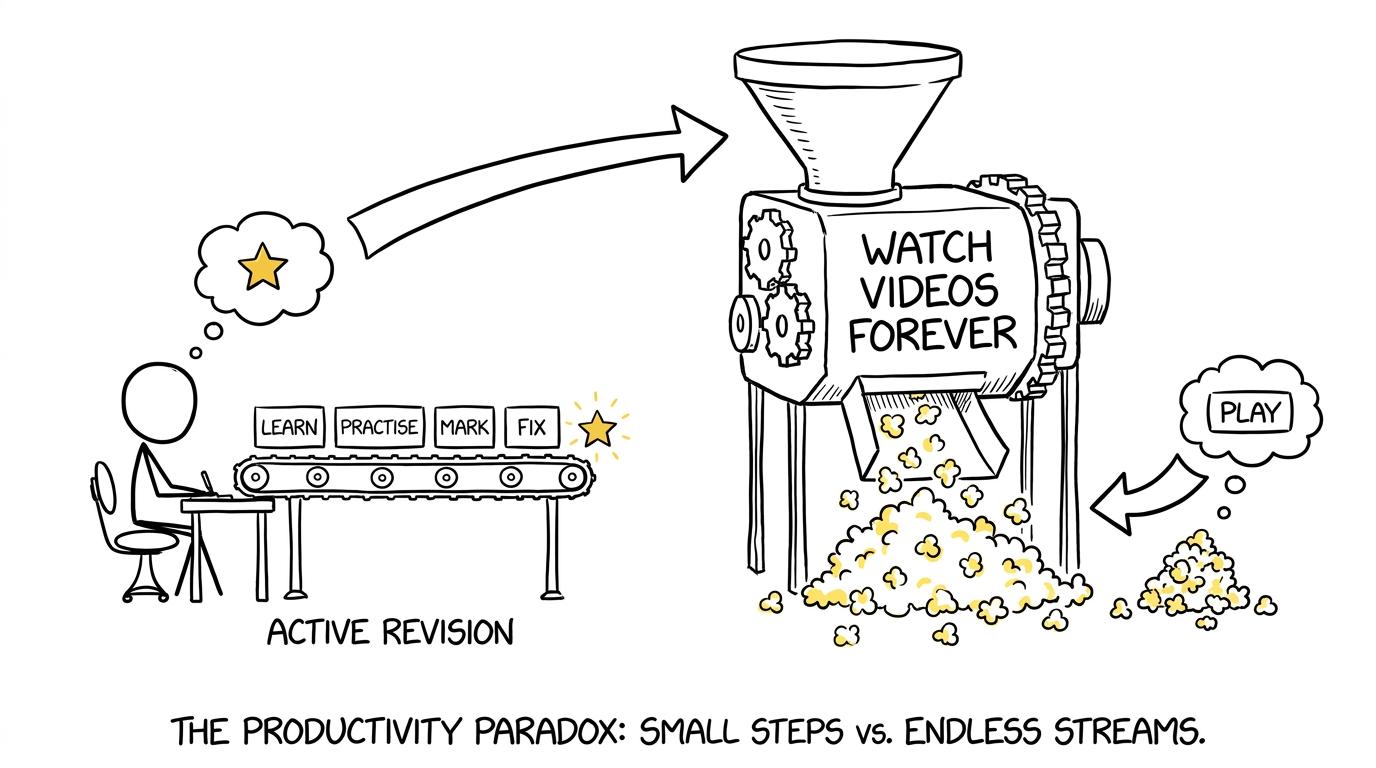 A revision conveyor belt producing learning instead of popcorn
Common mistakes when choosing revision support
Buying more content when you need more practice
Watching explanations feels productive because everything looks familiar. Examinations require retrieval and application without prompts. Choose resources that make you answer, mark and correct questions.
Ignoring the exam board
AQA, Edexcel, OCR and Eduqas share regulated assessment objectives, but their paper structures and specification details are not identical. Confirm the course version before paying.
Expecting a course to complete the NEA problem
No legitimate course should do assessed work for you. NEA decisions and evidence must be your own, completed under your school’s assessment arrangements.
Revising D&T while neglecting maths
A weak unit conversion or percentage calculation can cost marks even when your technical knowledge is sound. Keep maths in your weekly plan throughout the year.
Measuring value by hours of video
A large video library may simply create a larger backlog. Measure value through completed questions, corrected misconceptions and topics you can now explain independently.
Make the decision around your real bottleneck
An online GCSE Design and Technology revision course is worth joining when it solves a problem that free resources cannot solve easily, usually expert feedback, dependable structure or genuine accountability. It is not automatically worth paying for when it mainly repackages information already available through your school, exam board and free revision materials.
Start by identifying your weakest link. For the mathematical side of D&T and your wider GCSE preparation, make MathsGenie your free revision base. Use the revision lessons and practice questions to repair topic gaps, then move to past papers, mark schemes, video solutions and predicted papers to test whether those improvements hold under exam conditions.
Good revision is rarely about owning the most resources. It is about creating a small system you will repeat: learn, practise, mark and fix. Start that cycle on MathsGenie today.











