

Online GCSE Astronomy Revision Course: Worth It?
Online GCSE astronomy revision course guide: compare paid tuition with free resources and choose the support that genuinely improves your exam preparation.
Revision has a way of making every missing piece feel urgent. If your school offers limited astronomy teaching, or you are entering independently, an online GCSE astronomy revision course can look like the obvious solution. Sometimes it is. But paying for lessons is worthwhile only when the course solves a problem that free resources cannot solve just as well.
The short answer is this: a paid course may be worth it if you need structured teaching, individual feedback or properly supported observational work. If you already understand the specification, can organise your own revision and have an approved centre handling the required observations and exam entry, free resources may be enough.
The decision is not really about whether paid teaching is universally better. It is about what is currently stopping you from making progress.
Your quick decision checklist
Before enrolling, ask:
- Is the course explicitly aligned with the current Pearson Edexcel GCSE Astronomy specification?
- Does it cover both written papers rather than selected popular topics?
- Will a qualified person mark and explain your answers?
- Does it help arrange, supervise or certify the required observations?
- Are lessons live, recorded or both?
- Can you try a sample lesson before paying?
- Is the timetable realistic alongside GCSE maths and your other subjects?
- Are exam entry and any centre fees included or separate?
- Could free specification documents, videos and past papers meet the same need?
A course deserves its price when several of its answers are genuinely useful. A large video library alone is not necessarily a course. It may simply be a collection of explanations.
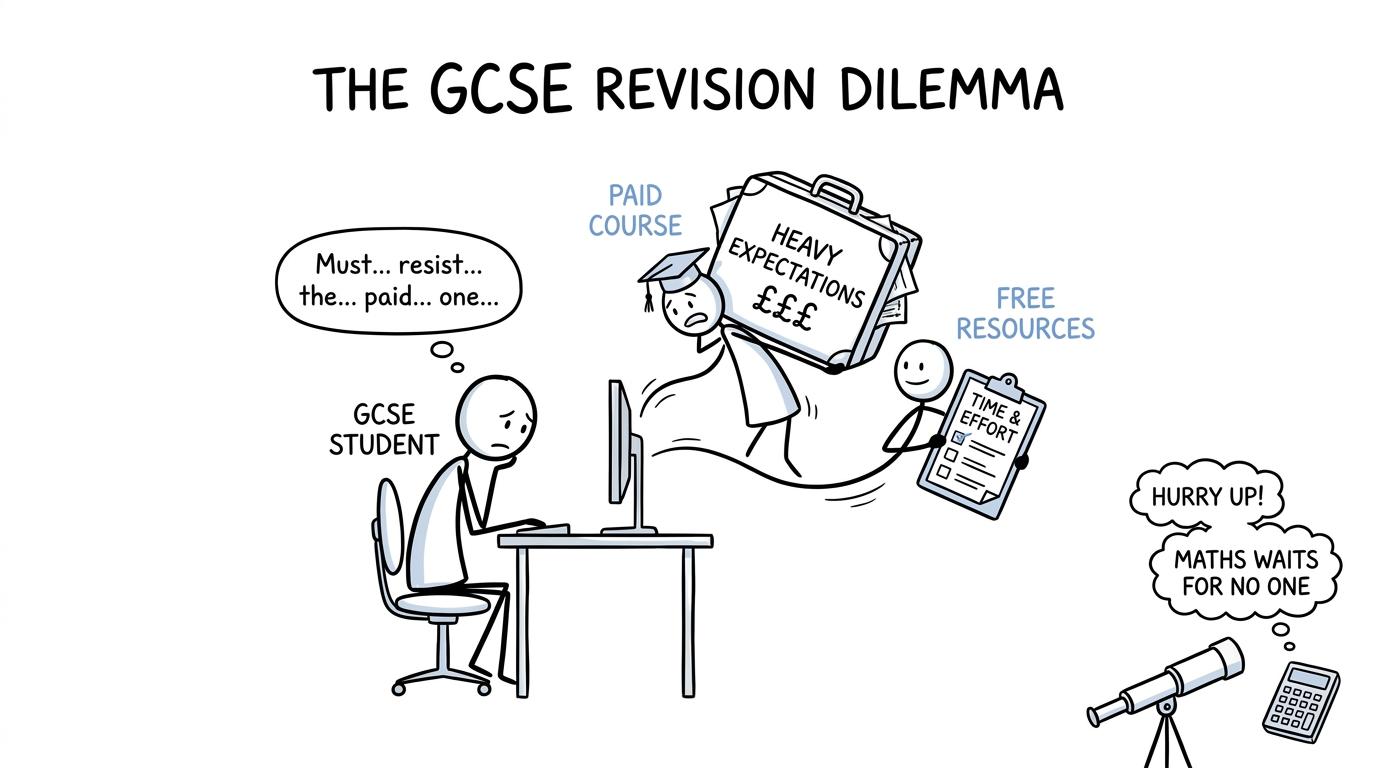 A student compares a paid course with free revision resources
What GCSE Astronomy actually requires
The current Pearson Edexcel GCSE Astronomy qualification is untiered, so there are no foundation and higher papers. It is graded from 999 to 111 and assessed through two externally examined papers:
- Paper 1: Naked-eye Astronomy
- Paper 2: Telescopic Astronomy
Each paper lasts 111 hour 454545 minutes, carries 100100100 marks and contributes 50%50\%50% of the qualification. Questions can include multiple-choice items, calculations, graphs, short answers and extended responses.
This matters when comparing courses. A programme concentrating on planets, stars and impressive telescope images may feel engaging while leaving substantial specification gaps. Effective revision must also address coordinate systems, time, observational methods, planetary motion, stellar evolution, cosmology and the interpretation of evidence.
At least 20%20\%20% of the marks across the qualification reward mathematical skills. Observational knowledge, skills and understanding account for at least 15%15\%15% of the available marks. Astronomy is therefore not just a memory subject. You must apply ideas, analyse data and evaluate methods.
There is also a practical requirement. Candidates must complete at least one unaided and one aided observation, and the entering centre must confirm completion. If you are learning outside school, establish how this will happen before buying a course. Access to lessons does not automatically provide an exam centre, observational supervision or valid certification.
When a paid online course can be worth it
You need a complete route through the specification
Independent revision becomes difficult when you do not know what to learn next. A strong course turns the specification into a sequence, sets deadlines and revisits earlier material.
That structure can be valuable if astronomy is not taught at your school. Instead of repeatedly choosing the most interesting topics, you receive planned coverage of all 161616 specification topics and both papers.
Structure, however, is valuable only when you follow it. Paying does not remove the need to retrieve facts, answer questions and correct mistakes.
You need feedback rather than more content
Free explanations are plentiful. Specific feedback is harder to obtain.
A tutor can identify whether an extended response lacks scientific detail, whether a graph has been interpreted incorrectly, or whether an evaluation needs a realistic improvement rather than a vague comment. This is where a paid course may offer something meaningfully different from free videos.
Look for marked assignments, clear response times and opportunities to ask questions. “Tutor support” should mean more than access to a general inbox.
You need support with observational work
Observational work is the strongest practical reason to consider a paid provider, particularly for private candidates. The official requirements involve designing, making, analysing and evaluating observations. Records should include relevant details such as conditions, equipment, location and timing.
Ask the provider precisely what it does. Does it organise suitable tasks? Does it provide access to aided observation equipment? Which registered centre confirms completion? What happens if poor weather interrupts the planned observation?
A reassuring description is not enough. You need a workable process.
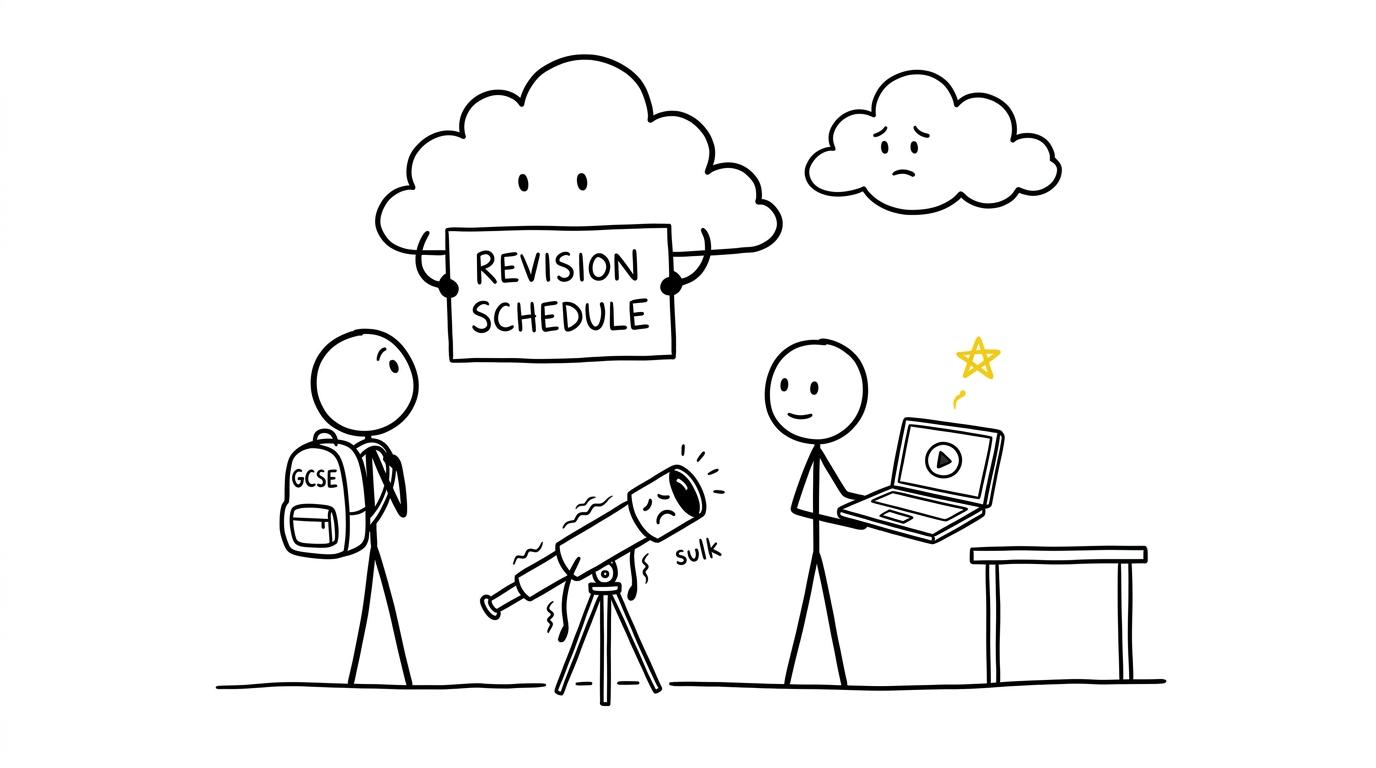 A revision schedule competes with cloudy observing conditions
You benefit from live accountability
Some students understand recorded lessons but rarely complete them. A regular class, deadline or tutor meeting can reduce that drift.
The important distinction is between access and accountability. Access means the lesson exists. Accountability means somebody notices whether you have attempted the questions, understood the corrections and returned to weak areas.
If accountability is the main benefit, check that the timetable fits your life. A live lesson that regularly clashes with GCSE maths revision provides little value, however good the teacher may be.
When free resources may be enough
Free revision can work extremely well when you already have four things: the correct specification, a realistic plan, question practice and reliable feedback through mark schemes or a teacher.
The strongest free approach is not random browsing. It is a repeated cycle:
- Choose one specification objective.
- Learn or retrieve the necessary knowledge.
- Answer questions without notes.
- Mark the work carefully.
- Record the exact reason for each lost mark.
- Return to the weakness after a short gap.
This is the same principle that makes proper past-paper review effective in maths. Completing material creates activity. Correcting it creates improvement.
Free resources are especially sensible if your school already supplies observational support and a teacher can answer occasional questions. In that situation, a commercial course may duplicate what you have.
They can also be enough for a disciplined independent learner. But independence should not be confused with isolation. You still need confirmation from your entering centre about observations, administration and exam entry.
Paid course versus free revision
| Consideration | Paid online course | Free-resource route |
|---|---|---|
| Specification order | Usually planned for you | You must build and monitor the plan |
| Explanations | Live or recorded teaching may be included | Available from official and educational materials |
| Personal feedback | Potentially valuable if genuinely included | Usually limited unless a teacher can help |
| Observational support | May be included, but must be verified | Must be arranged through your school or centre |
| Flexibility | Depends on live lesson times and access period | High, but requires self-discipline |
| Cost | Course, centre and exam fees may be separate | Learning materials may be free, but entry costs can remain |
| Accountability | Strong when assignments and check-ins are used | Must be created through your own timetable |
The word “paid” tells you how the resource is funded. It does not tell you whether it is complete, accurate or suitable.
The maths skills astronomy students should strengthen
Astronomy places maths inside scientific contexts. You may need to work with ratios, angles, graphs, units, significant figures and very large or small quantities. Formula and data information is supplied in the examination where specified, but you still need to substitute accurately and interpret the result.
MathsGenie can support this part of your preparation for free. The GCSE maths revision hub brings together revision lessons, questions, papers and solutions across Edexcel, AQA, OCR and Eduqas GCSE maths.
Particularly useful areas include:
- standard form revision and exam questions for astronomical scales;
- SOHCAHTOA trigonometry revision for work involving angles and right-angled triangles;
- graph interpretation, proportional reasoning and rearranging formulae through the AQA GCSE maths revision library.
Use the page matching your maths exam board where possible. MathsGenie’s resources strengthen the mathematical fluency needed in astronomy, but they do not replace astronomy-specific teaching or the mandatory observational arrangements.
How to assess a course before spending money
Begin with the problem, not the sales page. Write down what you need: perhaps complete teaching, marked answers, observation arrangements or simply a timetable. Then ask the provider for evidence that it supplies those things.
Check the following:
- Specification match: the course should name Pearson Edexcel GCSE Astronomy and the current qualification code.
- Full coverage: request a topic list showing both papers and observational skills.
- Teacher contact: establish who teaches, who marks and how quickly feedback arrives.
- Observation arrangements: ask which centre takes responsibility and what is included.
- Access period: make sure recordings and materials remain available until your examination.
- Cancellation terms: read them before enrolling.
- Sample quality: inspect a lesson, assignment and feedback example if available.
Avoid choosing through testimonials alone. A course can suit one student and frustrate another because the deciding factors are often pace, support and prior knowledge.
Build a balanced astronomy and maths revision plan
Astronomy should not quietly consume the time needed for your core GCSEs. Give each subject a defined place in your week.
A sensible session contains a knowledge target, active questions and review. MathsGenie’s one-week GCSE revision plan offers a useful model for short, focused blocks rather than long sessions with vague goals.
For maths, use mini tests and topic questions to identify weaknesses, then move towards timed papers. The guide to when to start GCSE past papers explains how to build from targeted work to full-paper practice. Nearer the exams, GCSE predicted papers can provide fresh maths questions, but they should complement rather than replace official past papers.
Apply the same logic to astronomy: learn, practise, mark, repair and retest.
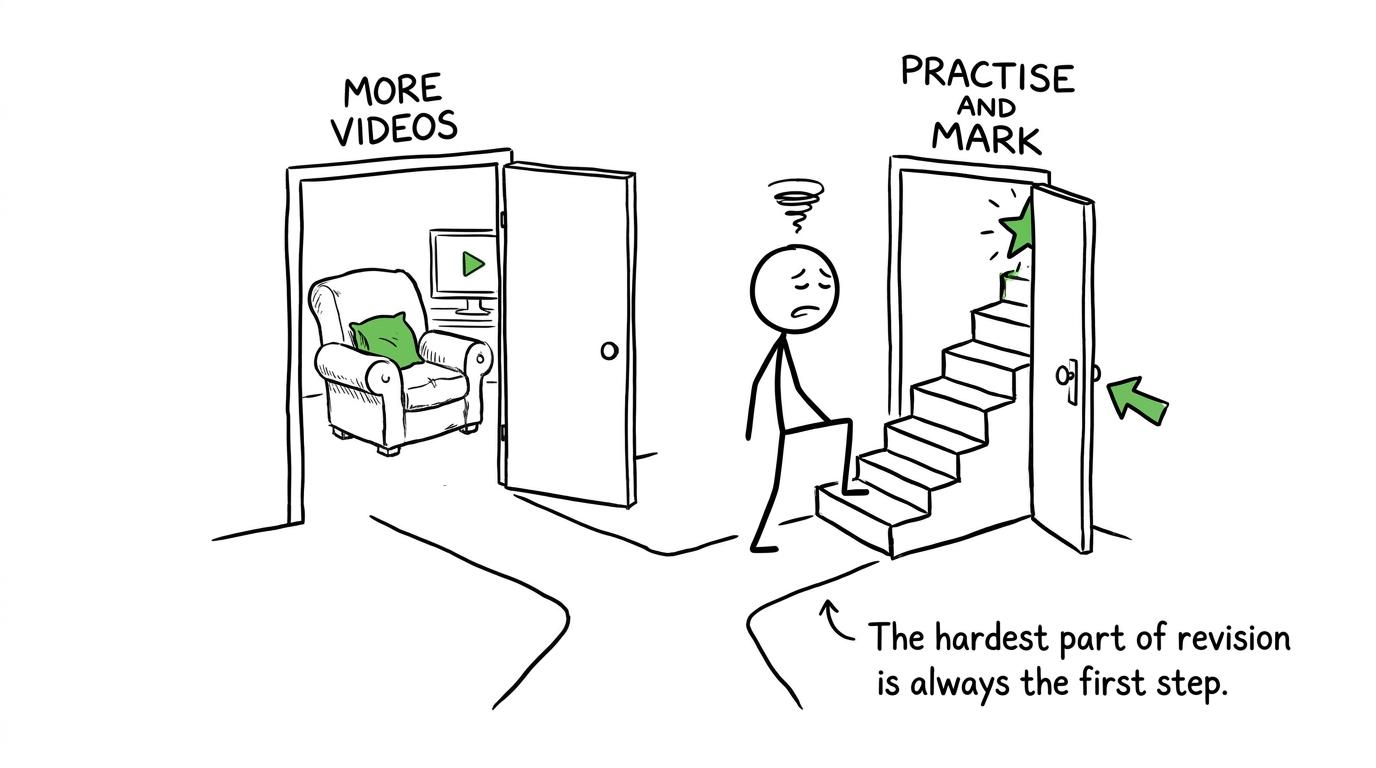 A student chooses active practice instead of watching more videos
Common mistakes when choosing astronomy revision support
Paying before confirming exam entry
A course provider and an examination centre are not necessarily the same organisation. Confirm where you will sit the papers and how your observations will be handled before committing money.
Assuming videos equal preparation
Watching can make a topic feel familiar without proving that you can answer an unfamiliar question. Every explanation should lead to retrieval, written practice and marking.
Ignoring the mathematical marks
At least 20%20\%20% of the qualification rewards mathematical skills. Weaknesses in standard form, graphs, ratios or calculator use can therefore affect your astronomy result even when your scientific knowledge is sound.
Choosing by price alone
The cheapest course can become expensive if it lacks feedback or observational support. The most expensive option can still be poor value if it duplicates free material. Compare outcomes and inclusions rather than price labels.
Revising favourite topics repeatedly
Black holes and planets may be memorable, but examinations sample a broad specification. Track coverage objectively and give neglected topics scheduled attention.
Is an online GCSE astronomy revision course worth it?
It is worth paying when the course provides structure, expert feedback, accountability or verified observational support that you genuinely need. It is probably unnecessary when you already have those elements through school, an examination centre and a disciplined free-resource plan.
Make the decision like a scientist: identify the problem, inspect the evidence and avoid assuming that cost guarantees quality.
Then protect the maths beneath the astronomy. Use MathsGenie’s free revision lessons and practice questions to repair individual skills, mini tests to check progress, and past papers with mark schemes and video solutions to build exam technique. Finish with predicted papers when you need fresh GCSE maths practice. The goal is not to collect more resources. It is to turn the right resources into marks.










