

An October Half-Term A-Level Maths Revision Plan
An October half-term A-Level Maths revision plan with topic triage, focused sessions, past-paper practice, rest and practical catch-up advice.
October half-term arrives at an awkward moment. You have covered enough A-Level Maths to see gaps appearing, but not enough to revise the whole course. That can make the week feel either too early to matter or too important to waste.
An October half-term A-Level Maths revision plan should do three things: identify weak topics, repair the most important ones and leave you rested enough to return to lessons ready to learn. It is not a miniature Easter revision campaign. For most students, two focused maths sessions on four or five days will be more useful than filling every waking hour.
Your half-term revision checklist
By the end of the week, aim to have:
- sorted your taught topics into secure, developing and weak;
- repaired two or three high-priority weaknesses;
- completed short sets of mixed exam questions;
- attempted one timed paper or suitable section;
- reviewed every mistake rather than merely recording a mark;
- protected at least one full rest day;
- created a short list of work to continue after half-term.
The goal is not to finish maths. It is to make the next stage clearer.
Start with topic triage, not a colourful timetable
Imagine opening six weeks of notes and trying to revise from page one. It feels organised, but chronology is not priority. The topic you met first may now be secure, while something from last Tuesday may already be causing trouble.
Begin with evidence. List only the topics you have actually been taught, across pure maths, statistics and mechanics where applicable. Then assign each one a status:
| Status | Evidence | Next action |
|---|---|---|
| Secure | You can answer unfamiliar questions without notes | Include in mixed practice |
| Developing | You understand the method but hesitate or make slips | Complete focused practice |
| Weak | You cannot choose or carry out a method independently | Relearn, then practise |
Use marked classwork, homework, mini tests and teacher feedback. A low mark caused by one careless sign error does not necessarily make the whole topic weak. Equally, recognising a worked solution is not the same as producing it independently.
Choose two or three weak topics with the greatest current importance. Useful questions include:
- Does this topic support work coming next?
- Does it appear repeatedly in recent homework?
- Is the problem missing knowledge, weak algebra or exam interpretation?
- Can I make meaningful progress on it during half-term?
This creates an A-Level revision plan based on need rather than guilt. MathsGenie's A-Level Maths revision resources can then help you match a weak area to lessons, practice questions and solutions.
A realistic seven-day structure
A half-term plan needs spare capacity. Travel, family plans and tired mornings are normal, so do not assume that every hour will unfold exactly as expected.
Here is a structure you can adapt:
| Day | Main session | Second session | Purpose |
|---|---|---|---|
| Saturday | Topic triage for 303030 minutes | Rest | Decide what matters |
| Sunday | Weak topic A | Exam questions on topic A | Learn, apply and check |
| Monday | Weak topic B | Mixed retrieval | Repair a second gap |
| Tuesday | Rest | Rest | Recover properly |
| Wednesday | Weak topic C or revisit A | Mixed exam questions | Strengthen and connect |
| Thursday | Timed paper or selected sections | Mark and classify errors | Test performance |
| Friday | Correct errors | Plan the next school week | Convert mistakes into action |
A main session might last 505050 minutes, followed by a proper break. The second can be 303030-454545 minutes. That is enough time to think carefully without turning half-term into seven school days at home.
If you are in Year 12, use only material you have covered. A full A-Level paper will contain too much unfamiliar content, so selected questions or relevant AS material may be more informative. If you are in Year 13 and have covered most of the course, a fuller paper may be appropriate. Always use your exam board's specification and your teacher's guidance to decide what is in scope.
You now have the structure; if drawing it around other subjects feels like another task, build your schedule in the MathsGenie Revision Planner.
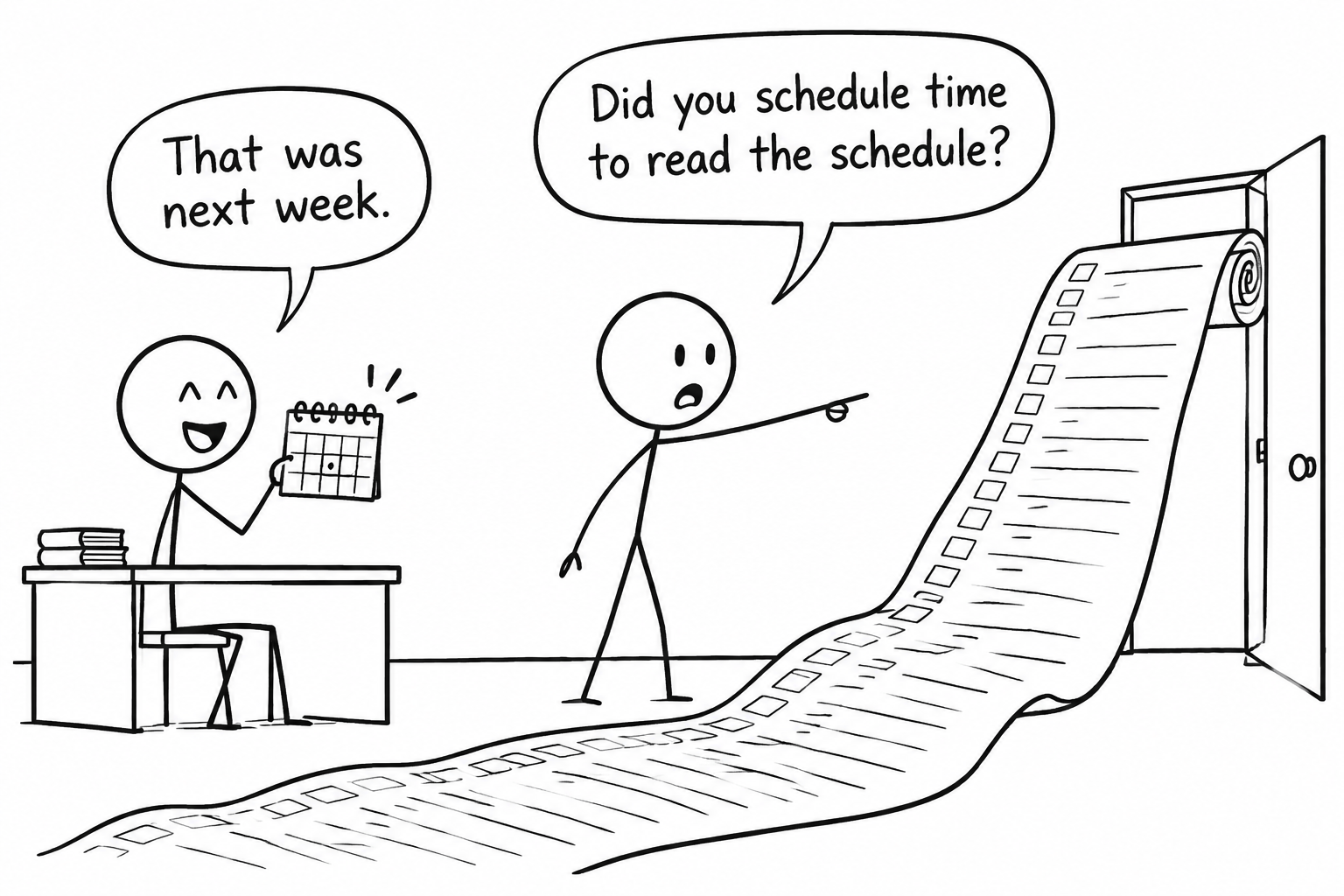 XKCD-style comic showing a student overwhelmed by an enormous revision timetable
What to do inside each revision session
A block labelled “calculus” is not yet a useful plan. Give every session a visible output.
Relearn briefly
Use a revision lesson, worked explanation or your class notes to reconstruct the method. Write down key conditions as well as procedures. For example, knowing a differentiation rule is less useful if you cannot recognise when it applies.
Keep this stage short. Watching solutions can create a comfortable illusion of fluency because the next step always looks sensible once somebody else has taken it.
Practise without support
Close the notes and answer questions. Start with direct practice, then move towards less familiar problems that require you to select a method. Maths is remembered by making decisions, not by repeatedly seeing correct decisions.
Mark the work carefully. Use mark schemes and video solutions to locate the first point where your reasoning changed direction. That first error is often more useful than the final mark.
Record one next step
Finish each session with a sentence such as:
- “I can use the chain rule, but I need more practice simplifying the result.”
- “I confused independent and mutually exclusive events.”
- “I need to draw a force diagram before forming equations.”
That note tells tomorrow's version of you where to begin.
Use past papers as diagnosis
Past papers are valuable, but October changes how you should use them. Unless you have covered enough content, completing a full paper may measure what has not yet been taught rather than what you need to improve.
Choose one of three approaches:
- Topic questions: best for learning or repairing a particular method.
- Selected paper sections: best when you want timed practice using covered content.
- A full paper: best when most content is familiar and you need evidence about stamina, timing and method selection.
MathsGenie provides A-Level Maths past papers alongside mark schemes and video solutions. Treat the mark as the start of the review, not the end. Classify each lost mark as a knowledge gap, method-choice error, algebraic slip, misreading or incomplete communication. Then redo the question without copying the solution.
October is generally too early to build revision around predicted papers. Their greatest value comes closer to examinations, after broad content coverage. At half-term, past questions linked to taught topics give cleaner evidence.
Protect rest without losing momentum
Rest days are not empty spaces left by an unsuccessful A-Level maths revision timetable. They are part of a sustainable one.
Keep at least one day completely free from maths. On working days, set a finishing time. A planned afternoon away is different from an afternoon spent feeling guilty beside an unopened textbook.
You can also separate demanding and lighter work. Learning a weak mechanics topic requires more attention than sorting an error log. Put difficult work at the time of day when you concentrate best, then use lower-energy periods for marking, corrections or planning.
The test of a timetable is not how ambitious it looks on Sunday night. It is whether you can still follow it on Thursday.
How to adjust when you fall behind
Missing a session is information, not a moral failure. Perhaps the block was too long, the topic was too broad or the week contained less free time than expected.
Do not push every missed task into the following day. That turns one delay into a growing backlog. Instead:
- keep the next scheduled priority;
- drop optional or repeated work first;
- reduce a broad task to one clear subtopic;
- move unfinished work to your post-half-term list;
- preserve the rest day unless there is a genuine reason to change it.
Suppose you miss Wednesday. Do not squeeze three sessions into Thursday. Keep the timed practice, shorten it to selected questions if necessary, and move the least important weak topic into next week's plan. A resilient schedule bends before it breaks.
For wider planning principles, use the revision timetable guide as a pillar resource for balancing practice, marking and realistic weekly capacity.
Common mistakes to avoid
Revising every topic equally. Secure topics need retrieval, not the same time as major gaps.
Planning by hours alone. “Revise for two hours” has no defined outcome. Name the topic, resource and question set.
Starting with a full paper too soon. If much of it is untaught, the result will not provide useful diagnostic evidence.
Marking without correcting. Reading a mark scheme explains what should have happened. Redoing the question tests whether you can now make it happen.
Sacrificing sleep or the rest day. More scheduled time does not guarantee more useful thinking.
Rewriting the whole timetable after one missed block. Preserve the priorities and reduce the workload instead.
Build the week you can actually follow
A thoughtful plan can turn October half-term from a vague promise into a small reset: important gaps identified, selected questions completed and the next school week made less uncertain. The remaining gap is consistency, because knowing what belongs in a timetable is easier than fitting it around rest, other subjects and real life.
You have seen how the seven-day structure works. Your turn: build your October half-term schedule in the Revision Planner.















