

Negative Indices GCSE Maths: Rules and Examples
Negative indices GCSE maths explained through clear worked examples, common mistakes and exam-style questions. Learn the reciprocal rule and practise it.
Negative indices GCSE maths: what does the minus mean?
You can know the index laws and still freeze when a power has a minus sign. Does the answer become negative? Do you multiply by a negative number? For negative indices GCSE maths questions, the key is to take the reciprocal, then apply the positive power.
Imagine a student called Sam who keeps writing a negative answer whenever the index is negative. Sam understands squaring and cubing. The mistake is smaller than that: treating the minus sign in the power as though it belongs to the answer.
The turning point comes when Sam learns to read a negative index as an instruction: take the reciprocal.
Your quick checklist
When you see a negative index:
- Identify the whole base, including any brackets.
- Take its reciprocal and change the index to positive.
- Evaluate the positive power.
- Check whether your answer should be positive or negative.
For a non-zero base aaa and a positive integer nnn:
a−n=1ana^{-n}=\frac{1}{a^n}a−n=an1Keep the MathsGenie fractional and negative indices lesson alongside your revision. The AQA version of the topic covers the same reciprocal principle.
Why a negative index means a reciprocal
Sam initially tries to memorise the rule as another isolated fact. It makes more sense when the powers form a pattern.
Each time the index decreases by one, divide by the base:
23=8,22=4,21=2,20=12^3=8,\qquad 2^2=4,\qquad 2^1=2,\qquad 2^0=123=8,22=4,21=2,20=1Keep dividing by two:
2−1=12,2−2=14,2−3=182^{-1}=\frac{1}{2},\qquad 2^{-2}=\frac{1}{4},\qquad 2^{-3}=\frac{1}{8}2−1=21,2−2=41,2−3=81Nothing suddenly becomes negative. The same division pattern continues beyond the zero power.
A reciprocal is the number you multiply by to get one. For a non-zero number aaa, its reciprocal is 1a\frac{1}{a}a1. For a fraction, taking the reciprocal swaps its numerator and denominator.
Sam now has a reason for the rule. The negative index describes the reciprocal of a power; it does not tell you the sign of the answer.
If the surrounding index rules feel uncertain, the MathsGenie indices lesson connects multiplying powers, dividing powers and zero powers.
Negative indices worked examples
A whole-number base
Evaluate 5−25^{-2}5−2.
First, rewrite the expression using a reciprocal:
5−2=1525^{-2}=\frac{1}{5^2}5−2=521Then calculate the square:
152=125\frac{1}{5^2}=\frac{1}{25}521=251Sam's old answer would have been −25-25−25. Writing the reciprocal line makes the actual operation visible and prevents that shortcut.
A fractional base
Evaluate (23)−3\left(\frac{2}{3}\right)^{-3}(32)−3.
The base is the entire fraction. Take its reciprocal and make the index positive:
(23)−3=(32)3\left(\frac{2}{3}\right)^{-3}=\left(\frac{3}{2}\right)^3(32)−3=(23)3Cube both the numerator and denominator:
(32)3=3323=278\left(\frac{3}{2}\right)^3=\frac{3^3}{2^3}=\frac{27}{8}(23)3=2333=827This answer is greater than one. That is sensible: the reciprocal of a positive fraction smaller than one is greater than one.
An algebraic expression
Write 4x−34x^{-3}4x−3 without negative indices, where x≠0x\ne0x=0.
The negative index applies to xxx, so rewrite that factor:
4x−3=4×1x3=4x34x^{-3}=4\times\frac{1}{x^3}=\frac{4}{x^3}4x−3=4×x31=x34The coefficient stays in the numerator. Compare this with brackets around the whole expression:
(4x)−3=1(4x)3=164x3(4x)^{-3}=\frac{1}{(4x)^3}=\frac{1}{64x^3}(4x)−3=(4x)31=64x31These expressions have different bases. Before calculating, Sam underlines exactly what the index applies to. That small habit prevents a much larger error.
Build on this reciprocal-first method with MathsGenie's Lessons and Question Bank on the negative indices topic page, then try each question before revealing help.
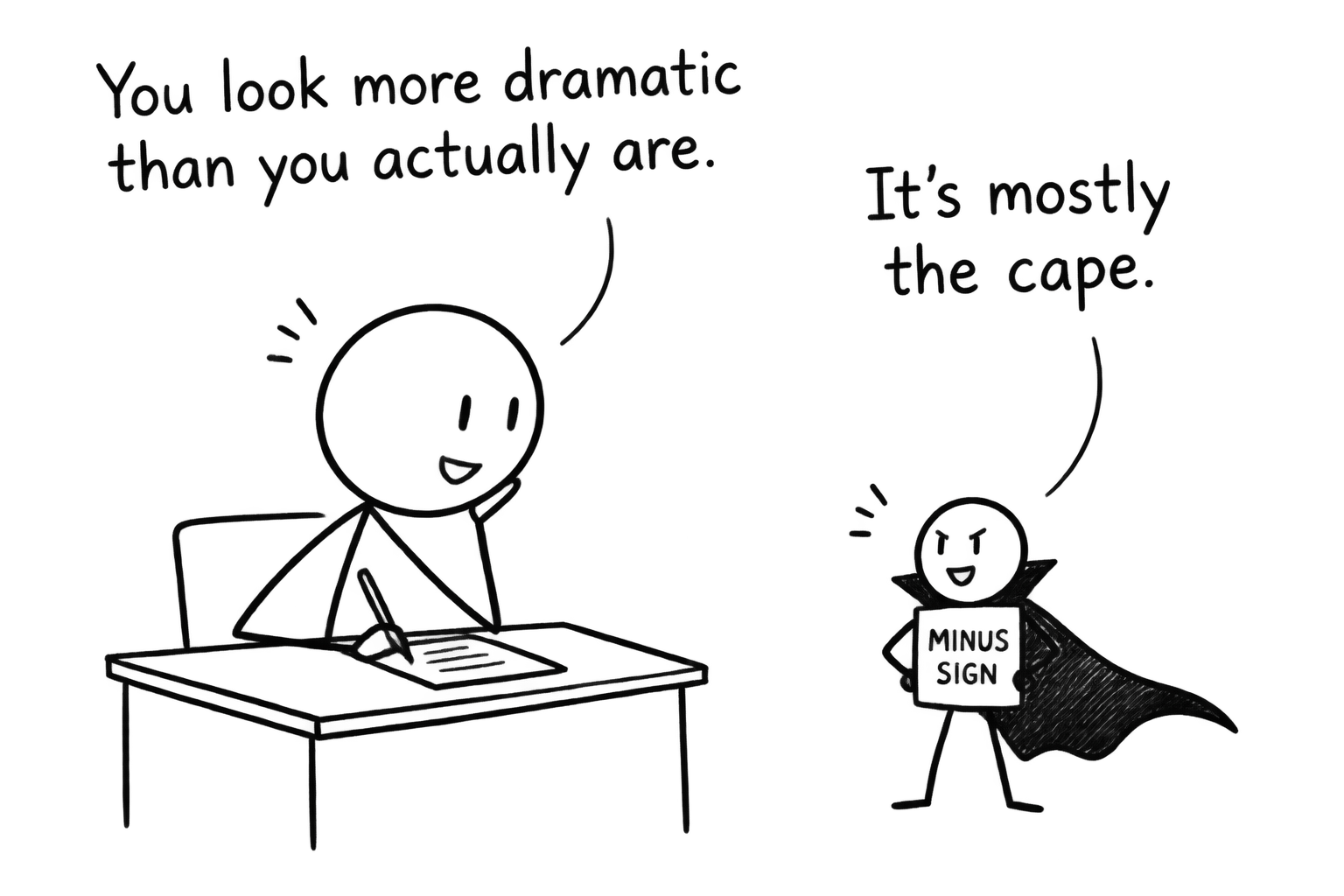 Stick-figure revision comic showing a student confronting a minus sign wearing a dramatic villain cape
Combining negative indices with index laws
A question can involve both negative indices and the usual index laws. You do not need a separate collection of rules.
For the same non-zero base:
am×an=am+na^m\times a^n=a^{m+n}am×an=am+n am÷an=am−na^m\div a^n=a^{m-n}am÷an=am−nFor example, simplify x3÷x7x^3\div x^7x3÷x7, giving your answer with positive indices, where x≠0x\ne0x=0.
Subtract the indices:
x3÷x7=x3−7=x−4x^3\div x^7=x^{3-7}=x^{-4}x3÷x7=x3−7=x−4Then rewrite the negative power:
x−4=1x4x^{-4}=\frac{1}{x^4}x−4=x41Sam's method now has two stages: use the appropriate index law, then check the requested answer form. This matters because an expression can be mathematically correct while still needing rewriting to meet the instruction “with positive indices”.
The fractional and negative indices revision guide provides a focused reference when you need to revisit the topic.
Common mistakes with negative indices
Making the answer negative
For a positive base, a negative index still gives a positive result:
3−2=193^{-2}=\frac{1}{9}3−2=91The minus sign belongs to the exponent. Read it as a reciprocal instruction before calculating anything.
Multiplying the base by the index
An index is not a multiplier:
4−2≠4×(−2)4^{-2}\ne4\times(-2)4−2=4×(−2)Rewrite it as 142\frac{1}{4^2}421 first. That line separates the reciprocal step from evaluating the power.
Ignoring brackets around a negative base
Compare:
(−2)−2=1(−2)2=14(-2)^{-2}=\frac{1}{(-2)^2}=\frac{1}{4}(−2)−2=(−2)21=41 −2−2=−122=−14-2^{-2}=-\frac{1}{2^2}=-\frac{1}{4}−2−2=−221=−41In the first expression, the base includes the negative sign. In the second, the minus sits outside the power. Brackets change what is being raised to the power.
Applying the rule to zero
The reciprocal rule requires a non-zero base. An expression such as 0−10^{-1}0−1 would require division by zero, so it is undefined.
Negative indices questions: exam-style practice
Try these original practice questions without looking at the answers. Show a reciprocal step whenever you evaluate a negative power.
- Question A: Evaluate 7−17^{-1}7−1.
- Question B: Evaluate 3−33^{-3}3−3.
- Question C: Evaluate (35)−2\left(\frac{3}{5}\right)^{-2}(53)−2.
- Question D: Write 6y−26y^{-2}6y−2 with positive indices, where y≠0y\ne0y=0.
- Question E: Simplify a2÷a5a^2\div a^5a2÷a5, giving your answer with positive indices, where a≠0a\ne0a=0.
Answers and checks
Question A:
7−1=177^{-1}=\frac{1}{7}7−1=71Question B:
3−3=133=1273^{-3}=\frac{1}{3^3}=\frac{1}{27}3−3=331=271Question C:
(35)−2=(53)2=259\left(\frac{3}{5}\right)^{-2}=\left(\frac{5}{3}\right)^2=\frac{25}{9}(53)−2=(35)2=925Question D:
6y−2=6y26y^{-2}=\frac{6}{y^2}6y−2=y26Question E:
a2÷a5=a−3=1a3a^2\div a^5=a^{-3}=\frac{1}{a^3}a2÷a5=a−3=a31When checking, identify the first line where your method differs. A wrong reciprocal needs a different correction from an arithmetic slip. Then cover the answer and retry the question from the beginning.
For a longer set, the MathsGenie fractional and negative indices question booklet includes questions with answers. Revisit a mixture later, so you practise recognising the method as well as carrying it out.
Turn the reciprocal rule into a habit
In our imagined student's revision, the change is modest but useful: Sam starts writing the reciprocal line instead of guessing what the minus sign means. You have the same method now; the remaining gap is applying it consistently when fractions, brackets and algebra appear. Start your next revision session with MathsGenie's Lessons and Question Bank for negative indices, and practise until you can choose the reciprocal step without prompting.















