Fractional and Negative Indices
x

Revision notes for Edexcel GCSE Maths Fractional and Negative Indices. Open the guide for explanations and worked examples. Written against the Edexcel GCSE Maths (1MA1) specification, so the content matches what's examinable rather than general Maths background.

Fractional and Negative Indices

What you'll learn

  • How to evaluate powers like 7−17^{-1}7−1 and (35)−1\left(\frac{3}{5}\right)^{-1}(53​)−1.
  • How powers like 12112121^{\frac{1}{2}}12121​ and 21613216^{\frac{1}{3}}21631​ link to square and cube calculations.
  • How to handle powers such as 272327^{\frac{2}{3}}2732​ and 16−3216^{-\frac{3}{2}}16−23​.
  • How to rewrite expressions using rules for powers.

1. Starting point: bases and indices

A power is a compact way of writing repeated multiplication.

For example, 242^424 means 2 multiplied by itself 4 times.

Definition

Base and index

  • In ana^nan, the base is aaa: the number or expression being powered.
  • The index is nnn: the small number telling you the power. The plural of index is indices.

The key index laws you need are:

The three main index laws shown as a visual reminder: multiply adds indices, divide subtracts indices, and a power of a power multiplies indices.

am⋅an=am+n,aman=am−n,(am)n=amna^m \cdot a^n = a^{m+n}, \qquad \frac{a^m}{a^n}=a^{m-n}, \qquad (a^m)^n=a^{mn}am⋅an=am+n,anam​=am−n,(am)n=amn

These work directly when the base is the same.

Example

Rewriting powers with the same base

Suppose x=2px=2^px=2p and y=2qy=2^qy=2q. Express 2p+q2^{p+q}2p+q and 2q−22^{q-2}2q−2 in terms of xxx and/or yyy.

  1. Split 2p+q2^{p+q}2p+q using the multiplying law.

    2p+q=2p⋅2q2^{p+q}=2^p\cdot 2^q2p+q=2p⋅2q
  2. Substitute x=2px=2^px=2p and y=2qy=2^qy=2q.

    2p+q=xy2^{p+q}=xy2p+q=xy
  3. Split 2q−22^{q-2}2q−2 using the dividing law.

    2q−2=2q22=y42^{q-2}=\frac{2^q}{2^2}=\frac{y}{4}2q−2=222q​=4y​

2. Negative indices mean reciprocals

Definition

Reciprocal

The reciprocal of a non-zero number is 1 divided by that number. In symbols, a−1=1aa^{-1}=\frac{1}{a}a−1=a1​ for a≠0a\neq0a=0.

So a negative index does not mean “make the answer negative”. It means “put it over 1”.

The general rule is:

a−n=1ana^{-n}=\frac{1}{a^n}a−n=an1​
Example

Finding values with a negative index

Find the value of 6−16^{-1}6−1 and (37)−1\left(\frac{3}{7}\right)^{-1}(73​)−1.

A negative index of -1 means take the reciprocal, so a number or fraction is turned into 1 divided by that base.

  1. A power of -1 means “find the reciprocal”.

    6−1=166^{-1}=\frac{1}{6}6−1=61​
  2. For a fraction, the reciprocal is found by flipping the numerator and denominator.

    (37)−1=73\left(\frac{3}{7}\right)^{-1}=\frac{7}{3}(73​)−1=37​
Common Mistake

Negative index does not mean negative answer

Do not turn 6−16^{-1}6−1 into -6. The correct value is 16\frac{1}{6}61​.

Common Mistake

Zero is different

Negative index rules need a non-zero base. For example, 0−10^{-1}0−1 would mean 10\frac{1}{0}01​, which is undefined.

3. Fractional indices as roots

Definition

Root

A root is the opposite of a power. a\sqrt{a}a​ is the number whose square is aaa, and a3\sqrt[3]{a}3a​ is the number whose cube is aaa.

The most common fractional indices are:

a12=a,a13=a3a^{\frac{1}{2}}=\sqrt{a}, \qquad a^{\frac{1}{3}}=\sqrt[3]{a}a21​=a​,a31​=3a​

So the denominator of the fraction tells you the type of root.

Example

Evaluating powers of one half and one third

Find the value of 14412144^{\frac{1}{2}}14421​ and 21613216^{\frac{1}{3}}21631​.

The denominator of a fractional index identifies the root: 2 means square root and 3 means cube root.

  1. A power of 12\frac{1}{2}21​ means square root.

    14412=144=12144^{\frac{1}{2}}=\sqrt{144}=1214421​=144​=12
  2. A power of 13\frac{1}{3}31​ means cube root.

    21613=2163=6216^{\frac{1}{3}}=\sqrt[3]{216}=621631​=3216​=6
Tip

Square roots in GCSE questions

When you are asked to “find the value” of something like 491249^{\frac{1}{2}}4921​, use the positive square root, so the answer is 7.

4. General fractional indices

Definition

Fractional index

A fractional index is a power written as a fraction. For positive aaa, the rule is amn=(an)ma^{\frac{m}{n}}=\left(\sqrt[n]{a}\right)^manm​=(na​)m.

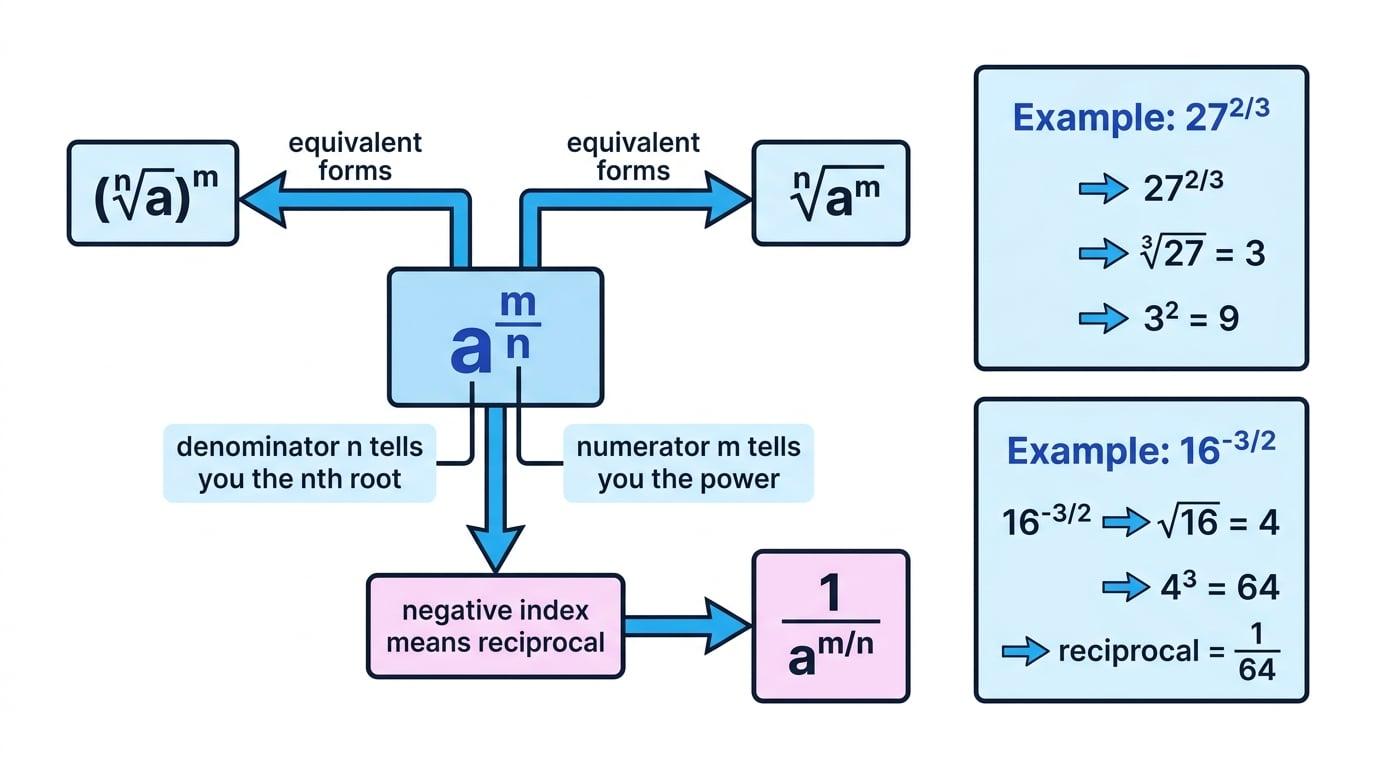
The denominator tells you the root. The numerator tells you the power.

Key Idea

Root first is usually easier

For amna^{\frac{m}{n}}anm​, take the nnnth root first, then raise the result to the power mmm.

A fractional index can be read as a two-step process: denominator gives the root first, then numerator gives the power.

Example

Evaluating a fractional index

Find the value of 272327^{\frac{2}{3}}2732​.

For 27 to the power two-thirds, take the cube root first and then square the result.

  1. The denominator is 3, so take the cube root first.

    273=3\sqrt[3]{27}=3327​=3
  2. The numerator is 2, so square the result.

    2723=(273)2=32=927^{\frac{2}{3}}=\left(\sqrt[3]{27}\right)^2=3^2=92732​=(327​)2=32=9

5. Negative fractional indices

A negative fractional index combines both ideas:

  • the fraction means root and power
  • the negative sign means reciprocal
Tip

Order to use

For a−mna^{-\frac{m}{n}}a−nm​, do the positive fractional power first, then take the reciprocal.

Example

Evaluating a negative fractional index

Find the value of 16−3216^{-\frac{3}{2}}16−23​.

A negative fractional index combines the root-and-power step with a final reciprocal step.

  1. Ignore the negative sign at first and work out 163216^{\frac{3}{2}}1623​.

    1632=(16)316^{\frac{3}{2}}=\left(\sqrt{16}\right)^31623​=(16​)3
  2. Take the square root, then cube.

    (16)3=43=64\left(\sqrt{16}\right)^3=4^3=64(16​)3=43=64
  3. The negative index means take the reciprocal.

    16−32=16416^{-\frac{3}{2}}=\frac{1}{64}16−23​=641​

6. Fractions inside brackets

When the base is a fraction in brackets, the whole fraction is being powered.

Example

Negative fractional index with a fraction

Find the value of (2764)−23\left(\frac{27}{64}\right)^{-\frac{2}{3}}(6427​)−32​.

The brackets show that the whole fraction is the base, so the cube root and square apply to both numerator and denominator before taking the reciprocal.

  1. First work out the positive fractional power.

    (2764)23=(27643)2\left(\frac{27}{64}\right)^{\frac{2}{3}}=\left(\sqrt[3]{\frac{27}{64}}\right)^2(6427​)32​=(36427​​)2
  2. Cube root the numerator and denominator.

    27643=34\sqrt[3]{\frac{27}{64}}=\frac{3}{4}36427​​=43​
  3. Square the result.

    (34)2=916\left(\frac{3}{4}\right)^2=\frac{9}{16}(43​)2=169​
  4. Use the negative index to take the reciprocal.

    (2764)−23=169\left(\frac{27}{64}\right)^{-\frac{2}{3}}=\frac{16}{9}(6427​)−32​=916​
Common Mistake

Missing the brackets

In (2764)−23\left(\frac{27}{64}\right)^{-\frac{2}{3}}(6427​)−32​, the whole fraction is the base. Keep the brackets in your working so you do not only power part of the fraction.

7. Brackets with variables

If a power is outside brackets, it applies to everything being multiplied inside the brackets.

For example, (ab)n=anbn(ab)^n=a^n b^n(ab)n=anbn.

Example

Fractional index with a variable

Find the value of (27x6)23(27x^6)^{\frac{2}{3}}(27x6)32​.

  1. The denominator is 3, so take the cube root first.

    27x63=3x2\sqrt[3]{27x^6}=3x^2327x6​=3x2
  2. The numerator is 2, so square the result.

    (27x6)23=(3x2)2=9x4(27x^6)^{\frac{2}{3}}=(3x^2)^2=9x^4(27x6)32​=(3x2)2=9x4

8. Roots with powers of 10

Sometimes it is easier to split a root into smaller parts, especially with powers of 10.

Example

Using roots with powers of 10

Find the value of 81⋅1084\sqrt[4]{81\cdot10^8}481⋅108​.

  1. Split the fourth root into two useful parts.

    81⋅1084=814⋅1084\sqrt[4]{81\cdot10^8}=\sqrt[4]{81}\cdot\sqrt[4]{10^8}481⋅108​=481​⋅4108​
  2. Work out each fourth root.

    814=3,1084=102\sqrt[4]{81}=3, \qquad \sqrt[4]{10^8}=10^2481​=3,4108​=102
  3. Multiply the results.

    3⋅102=3003\cdot10^2=3003⋅102=300

9. Finding an unknown index

To find a missing index, try to write both sides using the same base. Then compare the indices.

Example

Solving for an unknown index

Given that 9n=279^n=279n=27, find nnn.

Writing both sides with the same base lets you compare the indices directly.

  1. Rewrite both numbers as powers of 3.

    9=32,27=339=3^2, \qquad 27=3^39=32,27=33
  2. Substitute these into the equation.

    (32)n=33(3^2)^n=3^3(32)n=33
  3. Use the power law.

    32n=333^{2n}=3^332n=33
  4. Match the indices and solve.

    2n=3⇒n=322n=3 \Rightarrow n=\frac{3}{2}2n=3⇒n=23​
Example

Writing a root as a power

Given that 28=2n2\sqrt{8}=2^n28​=2n, find nnn.

  1. Write 8 as a power of 2.

    8=23\sqrt{8}=\sqrt{2^3}8​=23​
  2. Change the square root into a power of 12\frac{1}{2}21​.

    23=(23)12=232\sqrt{2^3}=(2^3)^{\frac{1}{2}}=2^{\frac{3}{2}}23​=(23)21​=223​
  3. Multiply powers with the same base by adding indices.

    28=21⋅232=2522\sqrt{8}=2^1\cdot2^{\frac{3}{2}}=2^{\frac{5}{2}}28​=21⋅223​=225​
  4. Match with 2n2^n2n.

    n=52n=\frac{5}{2}n=25​
Exam technique

In the exam

  1. Look at the sign of the index first: a negative index means reciprocal.

  2. For a fractional index, use “denominator = root, numerator = power”.

  3. If an unknown index is involved, rewrite numbers using the same base before comparing indices.

Self review

Check yourself

  • Can you explain why 5−15^{-1}5−1 is not -5?

  • Can you work out 64−2364^{-\frac{2}{3}}64−32​ by doing the cube root first?

  • If x=3px=3^px=3p, can you express 3p+23^{p+2}3p+2 in terms of xxx?

Recap questions

Test yourself with 5 quick questions on this guide. Answer them all correctly to complete it.

You've reached the end

Test yourself on this topic, or move on to the next guide.

Practice questionsTake a quick quiz on this topicFlashcardsSelf-test with active recall
The Product Rule for CountingUp next

How was this guide?

Fractional and Negative Indices Revision Guide

  1. GCSE
  2. /Maths
  3. /Fractional and Negative Indices