

Multiples and Factors GCSE Maths: Examples and Questions
Multiples and factors GCSE maths explained with clear worked examples, common mistakes and exam-style questions. Learn factor pairs, HCF and LCM today.
It is frustrating to know your times tables and still lose marks because you have mixed up two words. For multiples and factors GCSE maths, the distinction is this: a factor divides a number exactly, while a multiple comes from multiplying that number by an integer. Factors help you break a number into equal groups; multiples help you count forwards in those groups.
Imagine a student who keeps swapping the labels. Asked for factors, they write a times table. Asked for multiples, they start dividing. The arithmetic is often right, but it answers the wrong question. What helps is connecting each word to an action, then checking that action before calculating.
Your factors and multiples checklist
By the end of this lesson, you should be able to:
- Find every positive factor using factor pairs.
- List positive multiples using a times table.
- Identify common factors and common multiples.
- Find the highest common factor (HCF) and lowest common multiple (LCM).
- Decide which idea a worded question needs.
These ideas appear in GCSE number content at both foundation and higher tier. They also support simplifying fractions, working with ratios and finding common denominators.
Factors divide; multiples multiply
A factor divides a number exactly, leaving no remainder. For GCSE questions asking you to list factors of a positive integer, you will usually list its positive factors.
A multiple is the result of multiplying a number by an integer. When a question asks for the first few positive multiples, start with the number itself and continue through its times table.
Our imagined student needs a short prompt before writing anything:
“Am I finding numbers that divide this number, or counting in steps of this number?”
That question is more reliable than remembering that factors are “small” and multiples are “big”. The original number belongs to both lists, so size alone cannot separate them.
The MathsGenie factors and multiples lesson develops this distinction before moving into questions.
Multiples and factors worked examples
Find all the factors
Question: Write down all the positive factors of 242424.
Start with the smallest positive integer and find multiplication pairs:
1×24=241 \times 24 = 241×24=24 2×12=242 \times 12 = 242×12=24 3×8=243 \times 8 = 243×8=24 4×6=244 \times 6 = 244×6=24Neither 555 nor any integer between 444 and 666 gives another pair. Once you reach 666, you have already found its partner, 444. Continuing would repeat earlier pairs.
Now put the factors in ascending order:
1, 2, 3, 4, 6, 8, 12, 241,\ 2,\ 3,\ 4,\ 6,\ 8,\ 12,\ 241, 2, 3, 4, 6, 8, 12, 24Working in pairs prevents a common problem: spotting the smaller factors but forgetting their larger partners. Every pair must multiply back to the original number.
List positive multiples
Question: Write down the first five positive multiples of 777.
Multiply 777 by each integer from 111 to 555:
7×1=7,7×2=14,7×3=217 \times 1 = 7,\quad 7 \times 2 = 14,\quad 7 \times 3 = 217×1=7,7×2=14,7×3=21 7×4=28,7×5=357 \times 4 = 28,\quad 7 \times 5 = 357×4=28,7×5=35The answer is:
7, 14, 21, 28, 357,\ 14,\ 21,\ 28,\ 357, 14, 21, 28, 35Check the spacing: each term is 777 more than the previous term. Unlike a list of positive factors, a list of positive multiples continues indefinitely.
Our student now has two distinct routines: factor pairs for factors, repeated equal steps for multiples.
Start with the GCSE Question Bank alongside Lessons to practise choosing between those two routines without setting up your own question list.
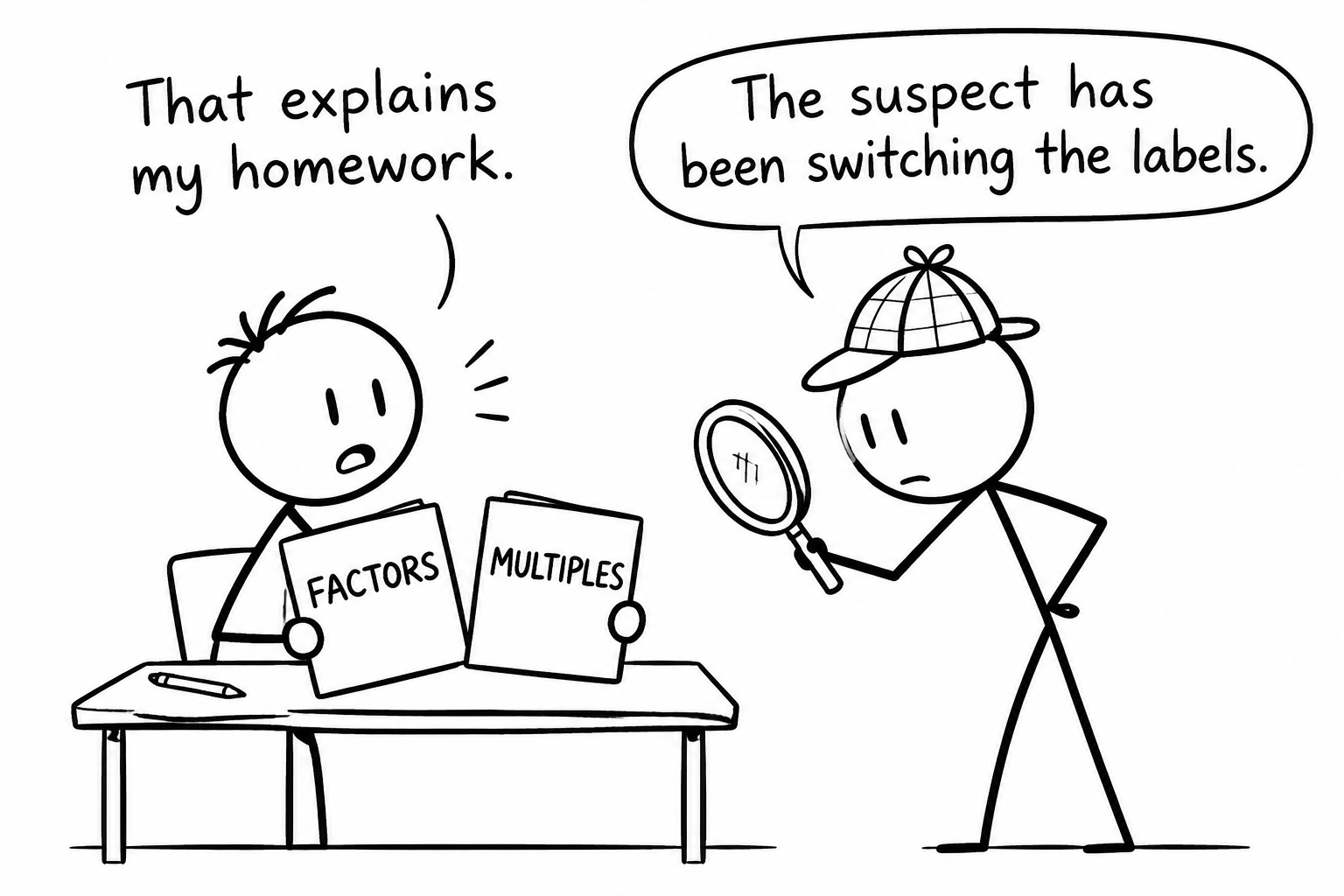 Stick-figure student and detective investigate folders labelled factors and multiples
Finding common factors and common multiples
“Common” means shared. The extra word tells you to compare the numbers rather than work with just one.
Highest common factor
Question: Find the HCF of 181818 and 242424.
First list their positive factors:
Factors of 18:1, 2, 3, 6, 9, 18\text{Factors of }18:\quad 1,\ 2,\ 3,\ 6,\ 9,\ 18Factors of 18:1, 2, 3, 6, 9, 18 Factors of 24:1, 2, 3, 4, 6, 8, 12, 24\text{Factors of }24:\quad 1,\ 2,\ 3,\ 4,\ 6,\ 8,\ 12,\ 24Factors of 24:1, 2, 3, 4, 6, 8, 12, 24The common factors are 111, 222, 333 and 666. Choose the greatest:
HCF(18,24)=6\operatorname{HCF}(18,24)=6HCF(18,24)=6This is useful when sharing quantities into the greatest possible number of identical groups with nothing left over.
Lowest common multiple
Question: Find the LCM of 666 and 888.
List positive multiples until you find the first shared value:
Multiples of 6:6, 12, 18, 24,…\text{Multiples of }6:\quad 6,\ 12,\ 18,\ 24,\ldotsMultiples of 6:6, 12, 18, 24,… Multiples of 8:8, 16, 24,…\text{Multiples of }8:\quad 8,\ 16,\ 24,\ldotsMultiples of 8:8, 16, 24,…The first shared positive multiple is 242424, so:
LCM(6,8)=24\operatorname{LCM}(6,8)=24LCM(6,8)=24LCM often helps with repeating events, such as finding when two regular cycles next coincide. Read the situation carefully: the question must establish that the cycles start together.
For larger numbers, prime factorisation provides a more organised method. Continue with the prime factors, HCF and LCM lesson once listing feels secure.
Common mistakes and useful checks
Answering the opposite question
Before calculating, underline “factors” or “multiples”. Write a tiny reminder beside it: “divides exactly” or “times table”. This interrupts the habit of rushing straight into arithmetic.
Missing the first and last factors
Every positive integer has 111 and itself as factors. Start your factor pairs there. For a square number, write its repeated middle factor only once in the final list.
Treating the original number as a clue
A positive integer is both a factor and a multiple of itself. Finding it in your answer does not tell you whether you chose the correct method. Check how you produced the other entries.
Including zero in positive multiples
Zero is a multiple because n×0=0n \times 0 = 0n×0=0. However, it is not positive. If the question asks for positive multiples, begin with the number itself. The LCM is also the least positive common multiple.
Choosing HCF or LCM from one word
Words such as “largest” and “smallest” help, but the structure matters more. Equal groups with no leftovers suggest factors. Repeating quantities meeting again suggest multiples. The factors and multiples revision guide gives you another way to revisit the definitions.
Multiples and factors questions
Try these exam-style questions without looking back. Write your method as well as your answer.
- List all the positive factors of 303030.
- Write the first four positive multiples of 999.
- Find the HCF of 202020 and 323232.
- Find the LCM of 444 and 101010.
- A teacher has 181818 pencils and 303030 pens. They make the greatest possible number of identical packs, using every item. How many packs can they make?
Check your answers
The factors of 303030 are 1, 2, 3, 5, 6, 10, 15, 301,\ 2,\ 3,\ 5,\ 6,\ 10,\ 15,\ 301, 2, 3, 5, 6, 10, 15, 30.
The positive multiples are 9, 18, 27, 369,\ 18,\ 27,\ 369, 18, 27, 36.
The HCF is 444, and the LCM is 202020.
The teacher can make 666 packs because HCF(18,30)=6\operatorname{HCF}(18,30)=6HCF(18,30)=6. Each pack contains 333 pencils and 555 pens.
If an answer differs, identify whether you misread the task, missed a factor pair or made an arithmetic slip. Correct that specific error, then attempt the question again without copying.
Turn the distinction into a habit
Our imagined student's turning point is checking the operation before doing the arithmetic; consistent practice makes that pause easier to remember. You now have the method, and the next step is applying it when questions arrive in a different order. Start with MathsGenie's Lessons and Question Bank to practise recognising factors and multiples before you calculate.















