What you'll learn
- Spot a multiple: a number in a times table, which is a list made by counting in equal jumps.
- Find a factor: a number that divides another number exactly, with nothing left over.
- Recognise prime numbers: numbers bigger than 1 with exactly two factors.
- Choose correct answers from a short list using simple checks.
Multiples: numbers in a times table
Multiple
A multiple of a number is an answer in that number’s times table. For example, multiples of 5 include 5, 10, 15, 20 and 25.


To find multiples, count up in equal jumps. For multiples of 6, you count 6, 12, 18, 24, 30, and so on.
Multiples go on
Multiples keep going forever. If you only need one multiple, there may be lots of correct answers.
Find one multiple in a gap
Find one multiple of 6 between 25 and 35.


-
Count in 6s: 6, 12, 18, 24, 30, 36.
-
Look for a number bigger than 25 and smaller than 35.
-
The number that fits is 30, so a correct answer is 30.
Between
If a question says “between 25 and 35”, choose a number inside the gap. Do not use 25 or 35 unless the question clearly allows the end numbers.
Even and odd numbers
Even and odd
An even number ends in 0, 2, 4, 6 or 8. An odd number ends in 1, 3, 5, 7 or 9.


Find the first even multiple
Find the first even multiple of 7.
-
Count up in 7s: 7, 14, 21, 28.
-
Check the last digit. 7 is odd, but 14 is even.
-
The first even multiple of 7 is 14.
Start counting from the number
For “first multiple” questions, start with the number itself: 7, 14, 21, and so on.
Factors: numbers that divide exactly
Factor
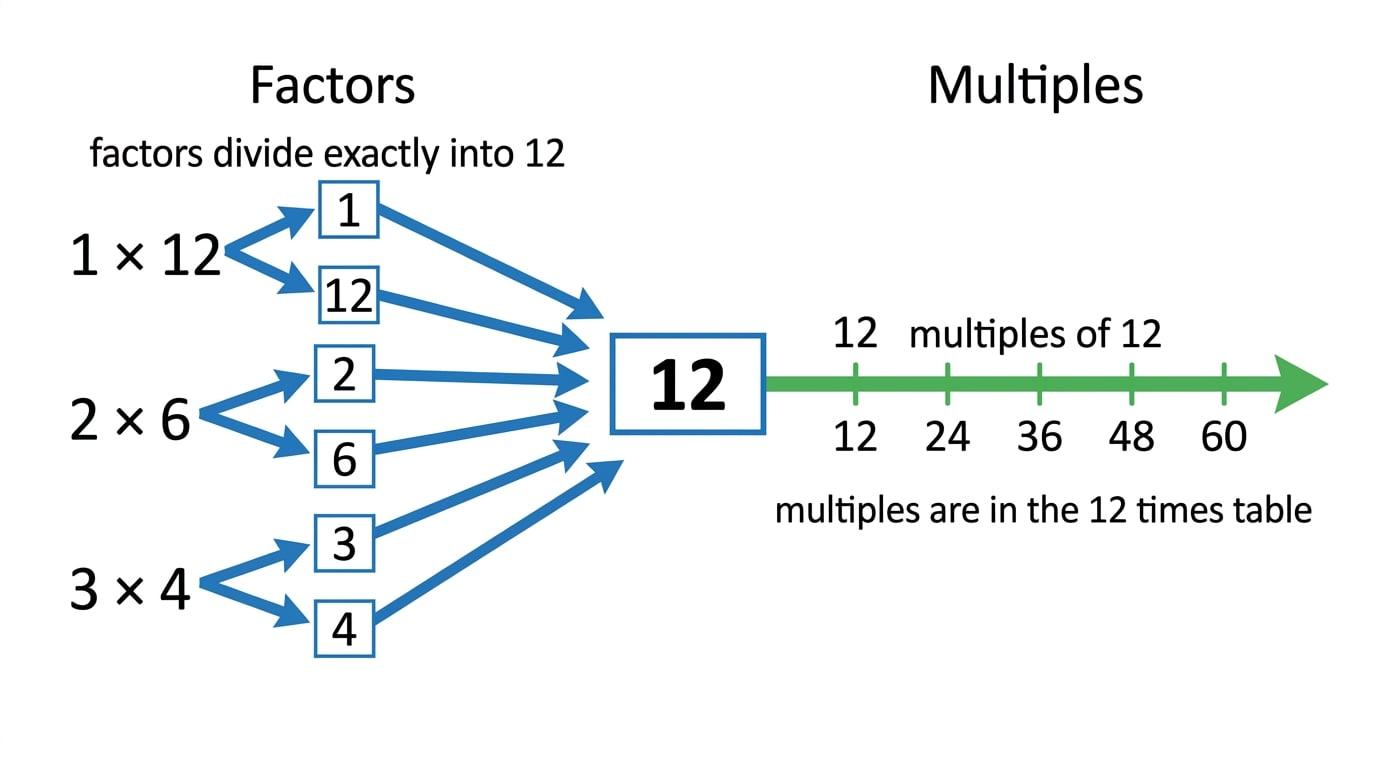
A factor of a number divides into it exactly, with nothing left over. For example, 3 is a factor of 18 because 18 divided by 3 gives 6 exactly.


Factors are often found in pairs. For example, 2 and 6 are both factors of 12 because they multiply together to make 12.
List all the factors
Write down all the factors of 12.


-
Start with 1 and 12.
-
Check 2: 12 divided by 2 gives 6, so 2 and 6 are factors.
-
Check 3: 12 divided by 3 gives 4, so 3 and 4 are factors.
-
Put the factors in order: 1, 2, 3, 4, 6 and 12.
Mixing up factors and multiples
A factor goes into the number. A multiple is in the number’s times table. For 12, 3 is a factor, but 24 is a multiple.
Prime numbers
Prime number
A prime number is a number bigger than 1 with exactly two factors: 1 and itself.


The first few prime numbers are 2, 3, 5, 7, 11, 13, 17 and 19.
Find prime numbers in a range
Find all the prime numbers between 30 and 40.

-
Check the numbers from 31 to 39.
-
Cross out the even numbers: 32, 34, 36 and 38.
-
Cross out 33 and 39 because they can be divided by 3 exactly. Cross out 35 because it can be divided by 5 exactly.
-
The numbers left are 31 and 37, so the prime numbers are 31 and 37.
1 is not prime
1 has only one factor: itself. A prime number must have exactly two factors, so 1 is not prime.
The only even prime
2 is the only even prime number. Every other even number has 2 as a factor, so it cannot be prime.
Square numbers
Square number
A square number is made by multiplying a number by itself. Small square numbers include 1, 4, 9, 16, 25, 36 and 49.

Choose a square number from a list
From the numbers 18, 20, 22, 25, 28 and 30, choose the square number.
-
Remember the small square numbers: 1, 4, 9, 16, 25 and 36.
-
Compare these with the numbers in the list.
-
The square number in the list is 25.
Choosing answers from a list
Sometimes you are given a list of numbers and asked to choose answers from it. Read carefully: if it says “from the list”, your answer must be in the list.
Use the given list
Do not invent a new number if a list is given. Even if another number would work, your answer must come from the list.
Use a list of numbers
From the numbers 4, 11, 12, 15, 18, 25 and 29, choose:
-
For a factor of 20, choose 4 because 20 divided by 4 gives 5 exactly.
-
For a multiple of 6, 12 or 18 would work, so one correct answer is 12.
-
For all the prime numbers, choose 11 and 29.
Combining clues
Some questions give more than one clue. The answer must match every clue, not just one of them.
Use all the clues
A number is odd. It is a factor of 30 and a multiple of 5. Find the two possible numbers.


-
List the factors of 30: 1, 2, 3, 5, 6, 10, 15 and 30.
-
Keep only the odd ones: 1, 3, 5 and 15.
-
From those, keep the multiples of 5: 5 and 15.
-
The two possible numbers are 5 and 15.
Adding prime numbers
Sum
The sum of two numbers is the answer you get when you add them.
Odd totals
For an odd total made from two prime numbers, try 2 first because 2 is the only even prime number.
Two primes with a given sum
Find two prime numbers with a sum of 21.
-
21 is odd, so try using 2 as one of the prime numbers.
-
Take 2 away from 21. The other number is 19.
-
19 is prime.
-
So the two prime numbers are 2 and 19.
In the exam
-
Underline key words such as factor, multiple, prime, even, odd and between.
-
If a list of numbers is given, make sure every answer comes from that list.
-
Check how many answers are needed: one, two, or all of them.
Check yourself
-
Can you list three multiples of 8?
-
Can you write all the factors of 16?
-
Can you explain why 21 is not a prime number?