Moving Sets GCSE Art and Design: Does It Matter?
Moving sets GCSE Art and Design explained: learn whether a class change affects your grade, what happens to existing work and how to adapt confidently.
A message saying that you are changing class can make months of work suddenly feel uncertain. Will the new teacher value the same ideas? Does moving down mean your predicted grade must fall? Is the portfolio you have already produced still valid?
The short answer is reassuring: moving sets GCSE Art and Design does not directly determine your final grade. GCSE Art and Design is not divided into foundation and higher tiers. Your grade is based on the assessed evidence in your portfolio and externally set assignment, judged against the exam board's assessment objectives. A set change can affect your routine, feedback and access to materials, but the name or perceived level of your class is not itself an assessment criterion.
The useful question, then, is not simply whether you moved. It is whether the move changes the support, time or opportunities you have to produce strong evidence.
The quick answer and action checklist
If you change Art and Design sets partway through your GCSE, establish the following as soon as possible:
- whether you are staying within the same Art and Design title, such as Fine Art, Photography or Graphic Communication;
- which projects and portfolio pages will still be submitted;
- whether the new group is following a different theme or schedule;
- which assessment objectives your existing work already covers;
- what unfinished work should be completed first;
- how access to specialist materials, equipment and supervised sessions will work;
- when your next formal feedback or progress review will take place.
Do not assume that moving down automatically lowers your grade, or that moving up automatically raises it. Ask for specific information about your assessed work.
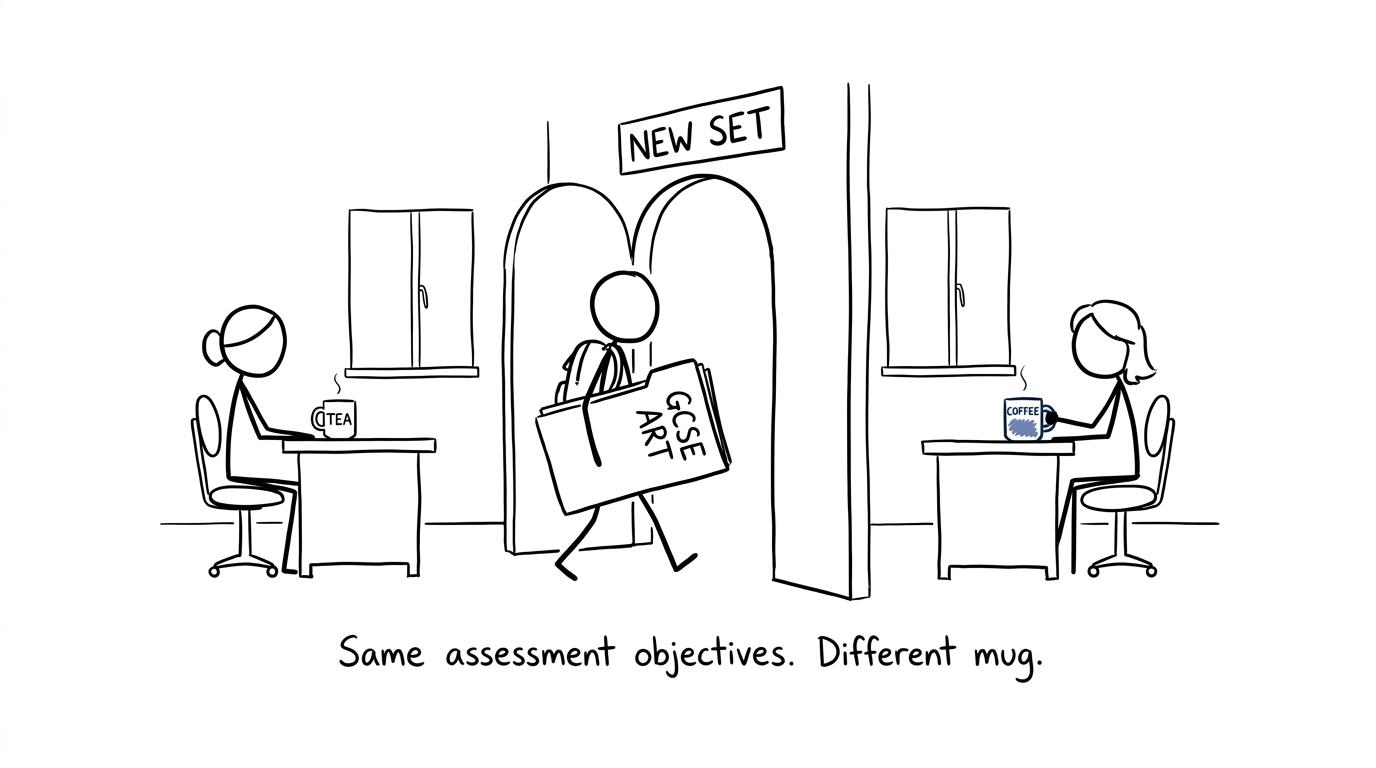 A student discovers that changing Art and Design sets changes the teacher's mug, not the assessment objectives
Why an Art and Design set is not the same as a maths tier
In GCSE maths, foundation and higher tier are formal examination routes. They affect the papers taken and the range of grades available. Students can use the GCSE maths revision hub to select resources that match their board and tier.
GCSE Art and Design works differently. Schools may create sets or teaching groups for timetabling, class size, working pace, behaviour, available rooms or the type of support students need. Those groups are school arrangements rather than nationally defined examination tiers.
Exam boards including AQA, Pearson Edexcel, OCR and Eduqas assess work against four regulated assessment objectives:
- AO1: developing ideas through investigations and showing critical understanding of sources;
- AO2: refining work through exploration, selection and experimentation;
- AO3: recording ideas, observations and insights as work progresses;
- AO4: presenting a personal and meaningful response that realises intentions.
Each objective contributes 25%25\%25% of the overall assessment:
25%+25%+25%+25%=100%.25\% + 25\% + 25\% + 25\% = 100\%.25%+25%+25%+25%=100%.Your class label is absent from that calculation. So are phrases such as “top set” and “lower set”. What matters is the quality and relevance of the evidence submitted for assessment.
Can moving sets change your final Art and Design grade?
Not automatically. The move itself carries no mark increase or penalty. However, it can have an indirect effect if it changes how effectively you complete the course.
What should remain unchanged
Your work should still be assessed using the same exam-board criteria as other students taking the same qualification and title. A new teacher cannot legitimately replace the published assessment objectives with personal preferences.
Completed work does not normally become worthless merely because you enter another class. Sketchbook pages, experiments, photographs, artist research, refinements and final outcomes may remain valuable evidence. Ask your teacher to confirm exactly what will form the final portfolio rather than discarding or remaking anything yourself.
Your set also does not appear as an additional factor in the final grade. Schools mark and standardise work according to their board's arrangements, with external moderation or assessment used as required by the specification.
What may genuinely change
A different class may be at another point in its project. It might use different artists, materials, themes or lesson sequences. Your new teacher may also identify gaps that were not previously obvious.
The practical risks are therefore about continuity:
- missing an important demonstration or workshop;
- losing access to equipment used by the previous class;
- receiving conflicting advice about presentation;
- spending too long repeating research instead of developing ideas;
- having less time to complete an unfinished outcome;
- misunderstanding which pages will be selected for submission.
These issues can influence the evidence you produce. They are not proof that the set itself controls your grade.
What happens to work completed before the move?
Begin from the assumption that existing work is evidence to be reviewed, not clutter to be abandoned. Keep original pieces, digital files, photographs, annotations and teacher feedback together until your school confirms what is required.
Ask your new teacher to map the work against AO1 to AO4. For instance, an attractive final piece may contribute strongly to AO4 but cannot replace a visible journey of investigation, experimentation and recording. Equally, pages of artist research are not enough if they never influence the development of your own ideas.
The most important distinction is between changing teaching groups and changing Art and Design titles. Moving from one Fine Art class to another is generally a continuity issue. Moving from Fine Art to Photography, Textile Design or another endorsed title is more substantial because the course content and valid body of evidence may differ. If the title is changing, ask your teacher or examinations officer to explain in writing what can transfer and what additional evidence is needed.
How to adapt after moving up or down a set
The first few lessons after a change can feel like arriving halfway through a film. The temptation is to copy what everyone else is doing. A better response is to find your precise position in the assessment journey.
Request a short portfolio review
Bring your complete folder, sketchbook and digital work. Ask for three specific answers:
- Which assessment objective is currently strongest?
- Where is evidence missing or underdeveloped?
- What is the highest-priority task for the next two weeks?
Specific feedback is more useful than being told simply to “add detail” or “do more”. Write down the agreed actions so that changing verbal advice does not pull the project in several directions.
Build a transfer map
Create a one-page list containing:
- completed work that will be retained;
- unfinished work worth developing;
- missing evidence for each assessment objective;
- materials or equipment that must be booked;
- relevant internal deadlines;
- the next review date.
This prevents uncertainty from becoming wasted effort. It also gives you something concrete to discuss if instructions from different teachers conflict.
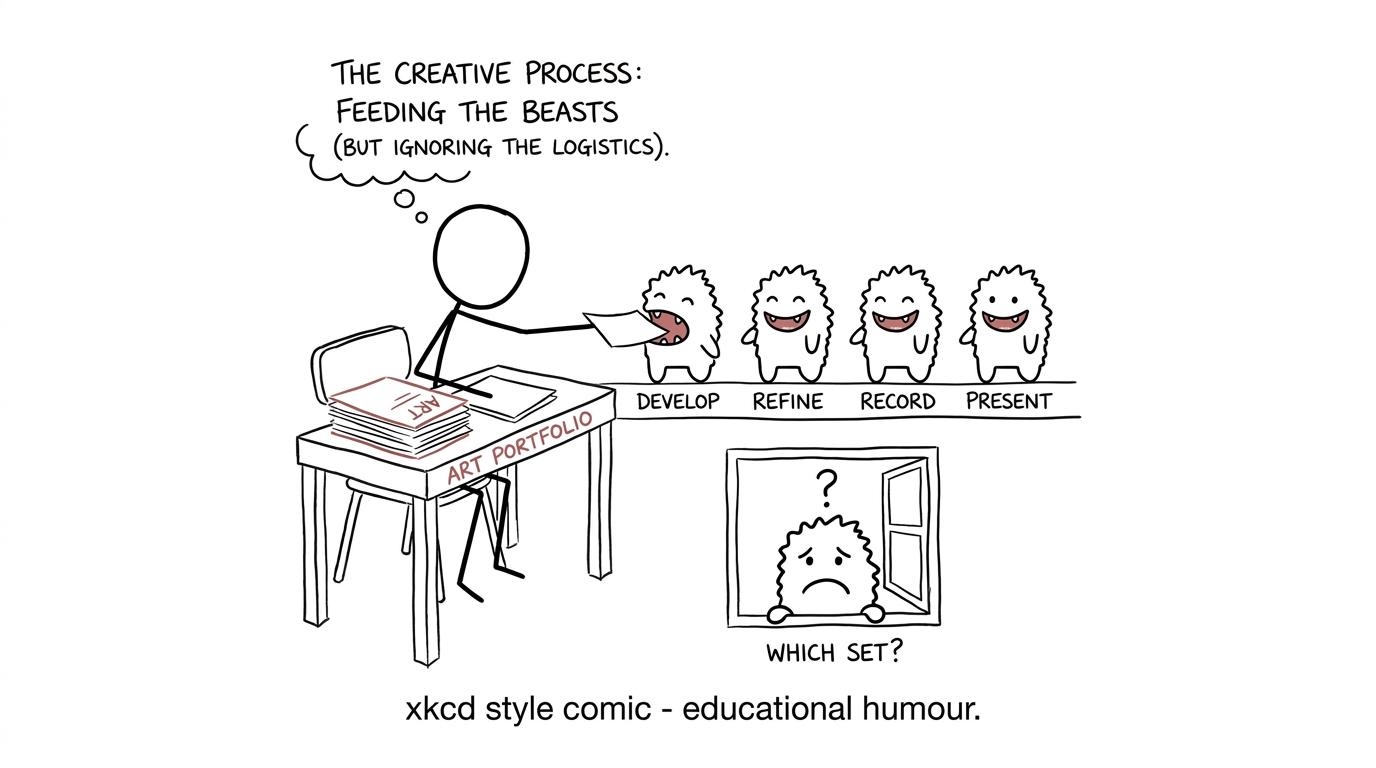 Four assessment-objective monsters receive portfolio evidence while the set label waits outside
Preserve your personal journey
A coherent portfolio should show how your own intentions developed. Do not erase that journey merely to make your pages look identical to those of the new class.
Respond to useful new feedback, but maintain clear links between research, experiments, decisions and outcomes. Annotation should explain what you discovered, why you changed direction and how a source influenced your choices. Description alone is less helpful than thoughtful evaluation.
Protect time for your other GCSEs
A set move can quietly consume revision time because uncertainty encourages endless redrafting. Agree boundaries with your teacher: what must be completed, what could be improved and what should now be left alone.
Use the same principle in maths revision. Diagnose the gap, choose the next task and review it afterwards. The MathsGenie one-month revision plan can help you organise revision around coursework demands, while the GCSE self-assessment resources help identify the topics that genuinely need attention.
Moving down a set does not define your potential
Being moved down can feel like a verdict, even where the decision was based on timetable constraints, class balance or support needs. Try to separate the emotional message you hear from the academic facts you can verify.
Your next action should be based on evidence. Ask what is missing from your portfolio and what improvement would make the greatest difference. A smaller or more supported group may even give you more opportunity for focused feedback. That possibility is not guaranteed, but neither is a lower outcome.
If the decision worries you, speak to your subject teacher, head of department or pastoral lead. Ask how the move was decided and how your progress will be monitored. A calm, specific question usually produces more useful information than arguing about the label attached to the group.
Moving up still requires careful adaptation
Moving up may sound entirely positive, but it does not award marks by itself. A faster class can introduce pressure to rush, compare work or imitate students whose projects are already well developed.
Keep using your own assessment plan. Find out what the group has covered, collect any missed resources and ask which differences matter for assessment. Strong work is not simply a larger quantity of pages. It is purposeful evidence showing investigation, refinement, recording and a meaningful response.
The same lesson applies to maths. Moving teaching groups does not replace deliberate practice. Use free MathsGenie GCSE revision to work at the level your exam requires rather than judging yourself by the speed of the room around you.
Common mistakes after changing Art and Design sets
Starting the portfolio again without approval
This can destroy useful evidence and consume time needed for refinement. Preserve everything and obtain a clear portfolio plan first.
Assuming the new teacher dislikes your project
Different feedback does not necessarily mean earlier work was wrong. Ask which assessment objective the advice addresses and what evidence the proposed change would add.
Copying the new class's project
Their work may follow a different route or starting point. Your response must remain personal and meaningful rather than becoming a hurried imitation.
Focusing only on polished final pieces
Technical finish matters, but all four assessment objectives are equally weighted. Development, experimentation and relevant recording must be visible too.
Letting Art and Design absorb every revision evening
Coursework expands to fill the time you give it. Set realistic stopping points and keep maths revision active through short, focused sessions. If an exam is close, use the GCSE maths night-before plan rather than attempting unfocused last-minute revision.
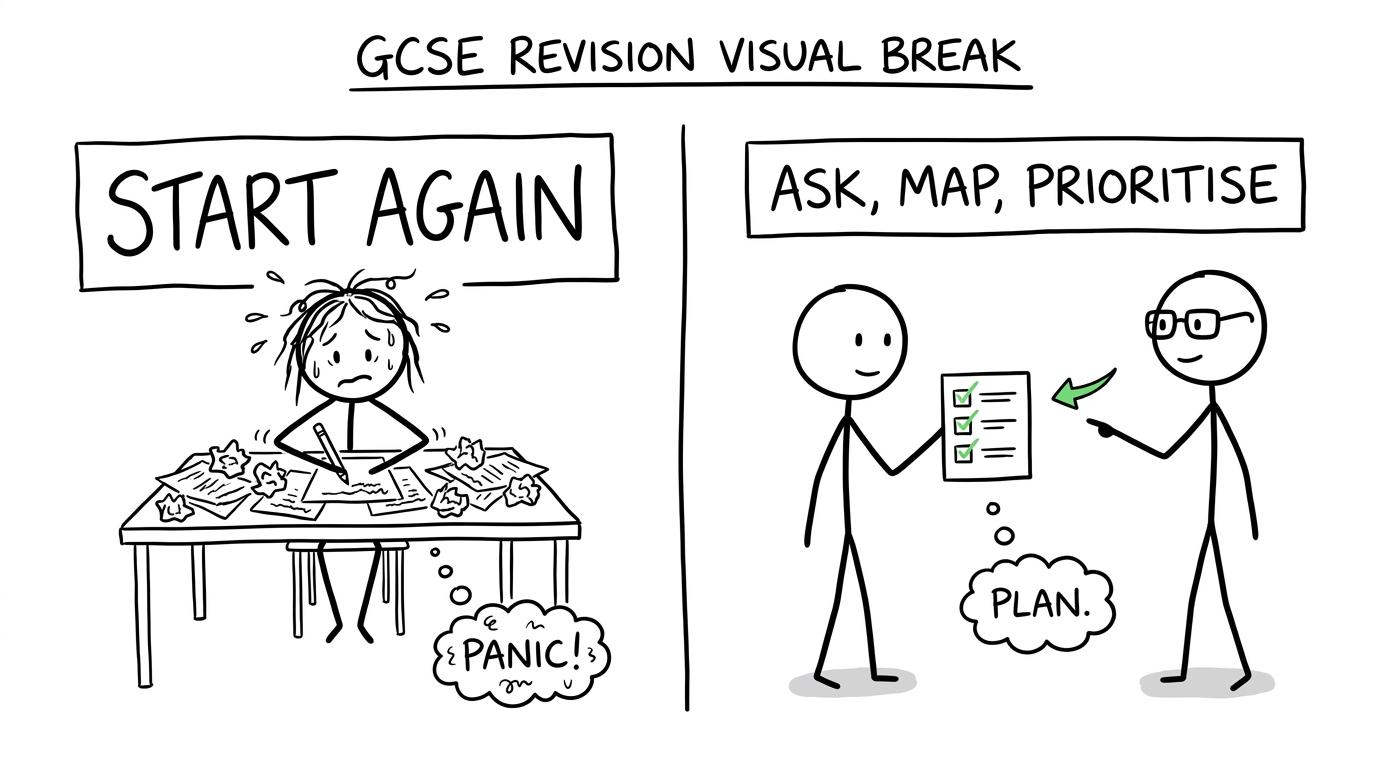 One student tries to restart everything while another calmly uses a transfer checklist
When should you ask for further help?
Raise the issue promptly if you do not know which work is being assessed, cannot access essential materials, receive contradictory instructions, or believe the move has left you without reasonable teaching time. Keep questions factual and bring your portfolio plan to the conversation.
If your concern involves access arrangements, illness, disability or circumstances that have seriously affected assessment, speak to the school's examinations officer. Do not rely on informal assumptions about special consideration or deadline changes because formal rules and evidence requirements apply.
Your set is a circumstance, not an assessment objective
Moving classes can change the route through GCSE Art and Design, but it does not rewrite the destination. Your final outcome depends on the evidence assessed against AO1, AO2, AO3 and AO4, not the status attached to your classroom.
Confirm what transfers, map your evidence, prioritise genuine gaps and protect your wider revision timetable. Then turn the same calm process towards maths. Start at the MathsGenie GCSE maths revision hub, use revision lessons and practice questions to repair weak topics, and progress to mini tests, past papers, predicted papers, mark schemes and video solutions. One class move need not control either your Art and Design outcome or the rest of your GCSE journey.