

Most Common GCSE Maths Questions (and How to Nail Them)
GCSE maths revision guide to the most common question types: fractions, algebra, graphs, angles and more, with worked examples and tips.
You sit down with a fresh GCSE paper and it feels like it could ask anything. But the longer you revise, the more you notice a quiet truth: GCSE maths is not infinite. It’s a small set of common GCSE question types, asked in slightly different outfits by Edexcel, AQA, OCR and Eduqas. The students who improve fastest aren’t the ones who “know everything”; they’re the ones who recognise the shape of the question, choose the right method, and collect marks calmly.
This post is a practical guide to the most common GCSE maths questions, with worked examples and the habits that turn revision into grades.
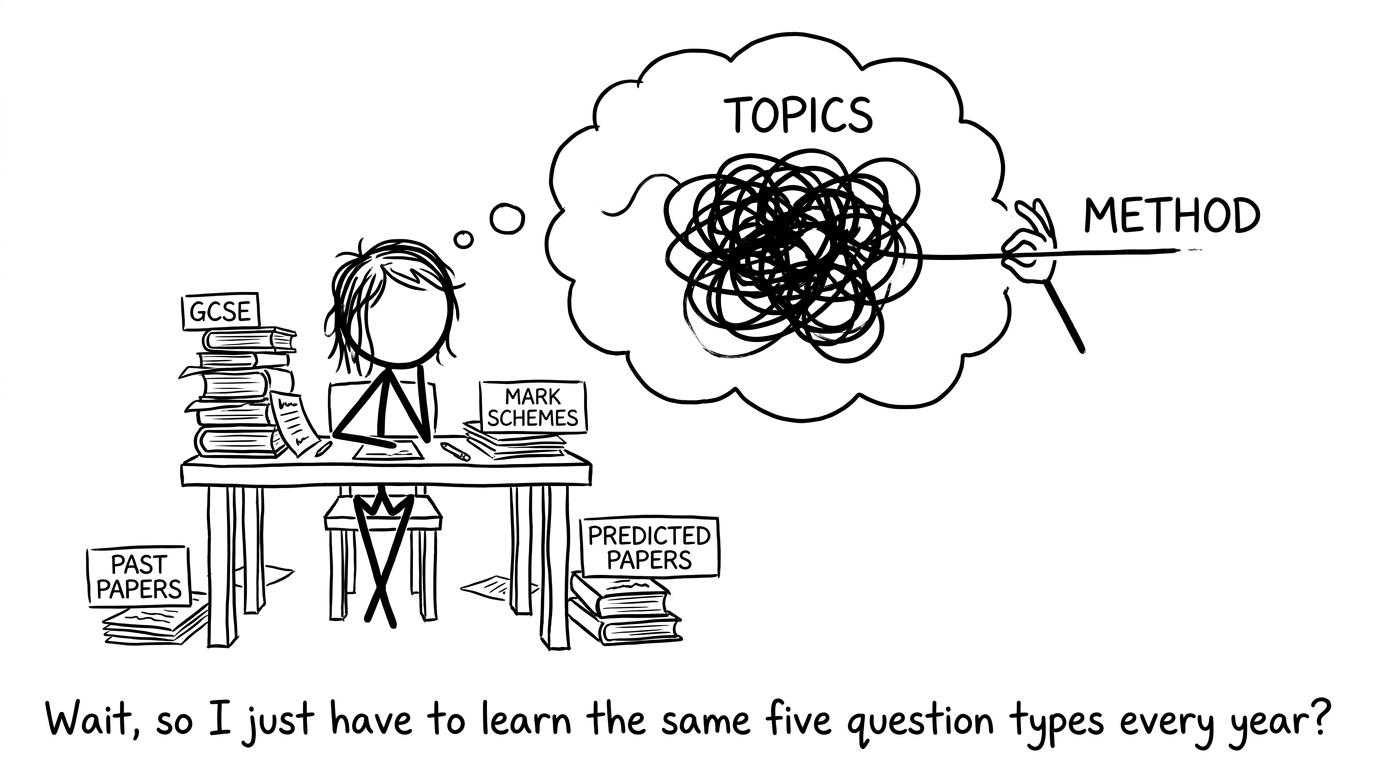 Student untangling GCSE topics knot
A quick checklist for common GCSE question types
Before you go topic-by-topic, use this as a simple GCSE filter. If a question appears often in papers, it usually has three features: it’s easy to mark, it tests a core skill, and it links to multiple topics.
Here are the GCSE staples to prioritise:
- Fractions, decimals and percentages (including percentage change and reverse percentages)
- Ratio and proportion (sharing, scaling recipes, best buys)
- Algebra manipulation (expand, factorise, simplify)
- Linear equations and rearranging formulae
- Graphs (straight lines and interpreting gradients/intercepts)
- Angles (parallel lines, polygons)
- Pythagoras and trigonometry (mainly higher tier, but Pythagoras appears widely)
- HCF/LCM and prime factors
For each one, do this: learn the method, practise exam questions, then check against a mark scheme.
Useful Maths Genie pages to build that loop:
- AQA GCSE Maths papers
- AQA GCSE Maths revision home
- Predicted GCSE revision papers and resources
- GCSE revision for Summer 2025 (Likely topics list)
Fractions, decimals and percentages: the GCSE comfort blanket
If GCSE papers had a signature, it would be a percentage problem dressed up as “money saved”, “sale price”, or “percentage of an amount”. You’ll see it on foundation and higher because it’s a reliable way to separate careful working from guessing.
Maths Genie support:
- Fractions, decimals and percentages (Grade 2 content)
- Fractions, decimals and percentages exam questions (PDF)
Worked example: percentage change
A laptop costs £480. It is reduced by 15%15\%15%. Find the sale price.
A reduction of 15%15\%15% means you pay 85%85\%85% of the original:
Sale price=0.85×480=408 \text{Sale price} = 0.85 \times 480 = 408 Sale price=0.85×480=408So the sale price is £408.
A GCSE habit that helps here: write the multiplier first. It prevents the classic “find 15%15\%15% then add it” mistake.
Worked example: reverse percentage (original value)
After a 20%20\%20% increase, the price is £84. Find the original price.
A 20%20\%20% increase means:
New=1.2×Original \text{New} = 1.2 \times \text{Original} New=1.2×OriginalSo:
Original=841.2=70 \text{Original} = \frac{84}{1.2} = 70 Original=1.284=70The original price was £70.
Ratio and proportion: where GCSE marks hide in plain sight
Ratio questions look wordy, but they’re often short methods. Exam boards love them because they test proportional reasoning, arithmetic, and the ability to interpret context.
Worked example: sharing in a ratio
£72 is shared between A and B in the ratio 5:75:75:7. Find B’s share.
Total parts =5+7=12= 5+7 = 12=5+7=12.
One part =7212=6= \frac{72}{12} = 6=1272=6.
B has 777 parts:
7×6=42 7 \times 6 = 42 7×6=42So B receives £42.
A GCSE tip: always write “total parts” as a line. It’s the clearest bit of working for method marks.
Algebra manipulation: the GCSE engine room
Algebra appears everywhere in GCSE: simplifying to make later steps possible. Most students lose marks here not because it’s hard, but because it’s rushed.
Worked example: expanding and simplifying
Simplify 3(2x−5)−2(x+4)3(2x-5) - 2(x+4)3(2x−5)−2(x+4).
Expand carefully:
3(2x−5)=6x−15 3(2x-5) = 6x - 15 3(2x−5)=6x−15 −2(x+4)=−2x−8 -2(x+4) = -2x - 8 −2(x+4)=−2x−8Combine like terms:
6x−15−2x−8=4x−23 6x - 15 - 2x - 8 = 4x - 23 6x−15−2x−8=4x−23So the answer is 4x−23\boxed{4x-23}4x−23.
Worked example: factorising a quadratic
Factorise x2+7x+12x^2 + 7x + 12x2+7x+12.
We need two numbers that multiply to 121212 and add to 777: 333 and 444.
x2+7x+12=(x+3)(x+4) x^2 + 7x + 12 = (x+3)(x+4) x2+7x+12=(x+3)(x+4)This is one of the most common GCSE question styles because it links to solving equations and graph roots.
Linear equations and rearranging formulae: predictable GCSE structure
The GCSE pattern is often: simplify first, then solve. Or rearrange first, then substitute.
Worked example: linear equation
Solve 5(2x−1)=3x+115(2x-1)=3x+115(2x−1)=3x+11.
Expand:
10x−5=3x+11 10x - 5 = 3x + 11 10x−5=3x+11Collect terms:
10x−3x=11+5 10x - 3x = 11 + 5 10x−3x=11+5 7x=16 7x = 16 7x=16Divide by 777:
x=167 x = \frac{16}{7} x=716You’ll often get fractions like this in GCSE higher tier papers, and it’s completely fine.
Worked example: rearranging a formula
Make xxx the subject of y=4x−3y = 4x - 3y=4x−3.
Add 333:
y+3=4x y+3 = 4x y+3=4xDivide by 444:
x=y+34 x = \frac{y+3}{4} x=4y+3A GCSE mark scheme usually rewards clean algebra lines here. Don’t try to do it in your head.
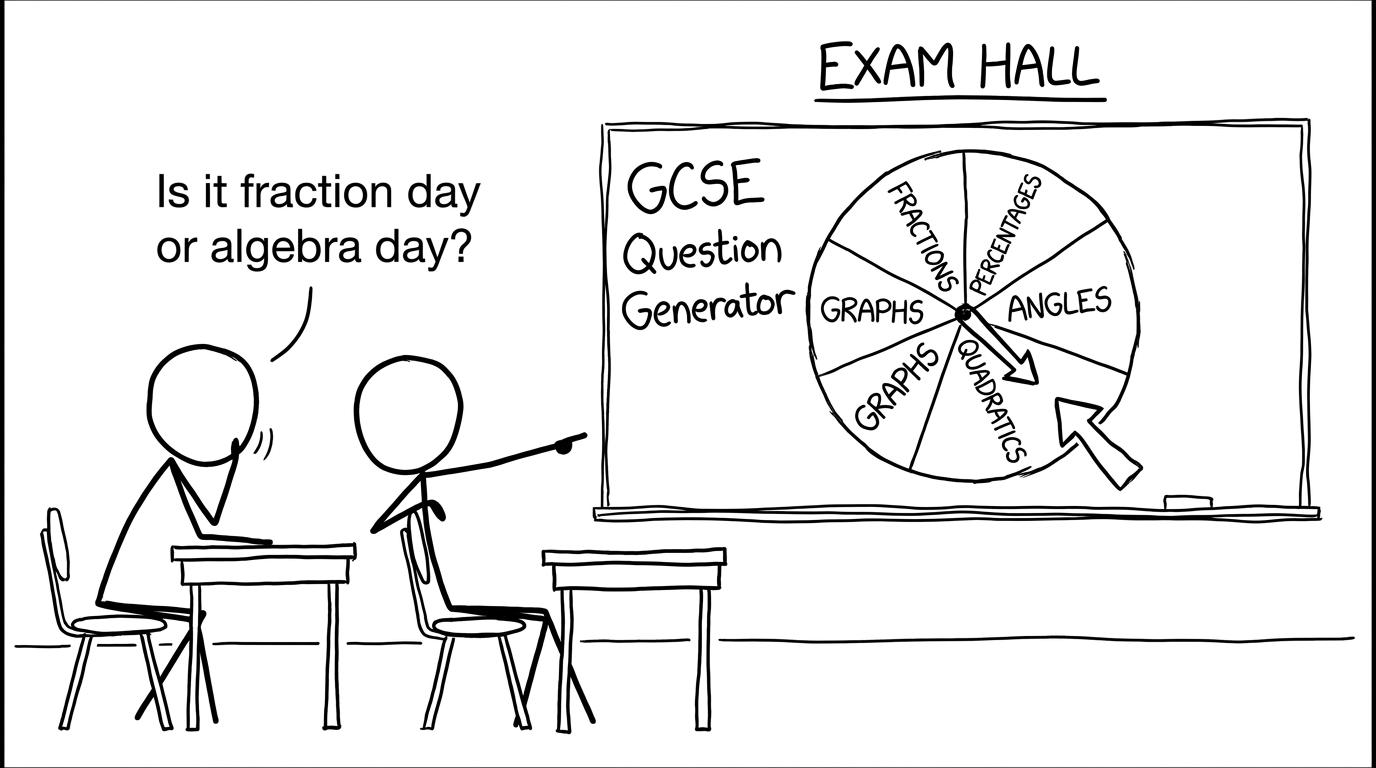 Exam hall spinning wheel of topics
Graphs and straight lines: the GCSE “interpretation” questions
Even when the algebra is simple, GCSE graphs reward interpretation: what does the gradient mean, where is the intercept, what happens if you change a coefficient?
Worked example: find gradient from two points
A line passes through (2,5)(2,5)(2,5) and (8,17)(8,17)(8,17). Find the gradient.
Use:
m=y2−y1x2−x1 m = \frac{y_2-y_1}{x_2-x_1} m=x2−x1y2−y1So:
m=17−58−2=126=2 m = \frac{17-5}{8-2} = \frac{12}{6} = 2 m=8−217−5=612=2Gradient =2= 2=2.
GCSE papers then often ask for the equation. Using y=mx+cy=mx+cy=mx+c and point (2,5)(2,5)(2,5):
5=2(2)+c⇒c=1 5 = 2(2) + c \Rightarrow c = 1 5=2(2)+c⇒c=1So the equation is:
y=2x+1 y = 2x + 1 y=2x+1Angles: a GCSE favourite because it’s quick to mark
Angles questions appear constantly across exam boards because they test geometry facts and careful reasoning.
Worked example: angles in a polygon
Find the sum of interior angles of a 999-sided polygon.
Use:
Sum=(n−2)×180 \text{Sum} = (n-2)\times 180 Sum=(n−2)×180With n=9n=9n=9:
Sum=(9−2)×180=7×180=1260 \text{Sum} = (9-2)\times 180 = 7\times 180 = 1260 Sum=(9−2)×180=7×180=1260So the sum is 1260∘1260^\circ1260∘.
GCSE advice: write the formula. Even if you slip on arithmetic, the method mark is there.
HCF, LCM and prime factors: the GCSE topic that comes back every year
These questions are common because they can be asked in a basic form (find HCF) or a context form (buses, flashing lights). They also appear as early questions that students should secure.
Maths Genie exam practice:
Worked example: LCM by listing multiples
Find the LCM of 121212 and 181818.
Multiples of 121212: 12,24,36,48,60,72,…12, 24, 36, 48, 60, 72, \dots12,24,36,48,60,72,…
Multiples of 181818: 18,36,54,72,…18, 36, 54, 72, \dots18,36,54,72,…
The first common multiple is 363636, so:
LCM(12,18)=36 \text{LCM}(12,18)=36 LCM(12,18)=36In higher tier GCSE, you may be expected to use prime factors, but listing is still valid when numbers are manageable.
Common mistakes in GCSE maths (and how to stop making them)
These are the errors that show up again and again in GCSE mark schemes, not because students “don’t know the topic”, but because they skip a small discipline.
Treating percentages additively instead of multiplicatively
A 20%20\%20% decrease is not “minus 20”. It’s multiplying by 0.80.80.8. A 20%20\%20% increase is multiplying by 1.21.21.2. When you think in multipliers, reverse percentage questions become routine.
Losing minus signs in algebra
Most algebra errors are sign errors. A useful GCSE habit is to expand one bracket per line, then combine at the end. If you try to do expansion and collecting simultaneously, you increase the chance of dropping a negative.
Not showing enough working for method marks
GCSE mark schemes often give marks for method even if the final answer is wrong. If your page only contains an answer, there’s nothing to reward. Write the key line: the equation you used, the substitution, or the formula.
Units and rounding
If the question says “give your answer to 333 significant figures” and you give a full decimal, you risk losing the final accuracy mark. If it asks for money, include £. If it’s an angle, include ∘^\circ∘. These are small GCSE habits that add up.
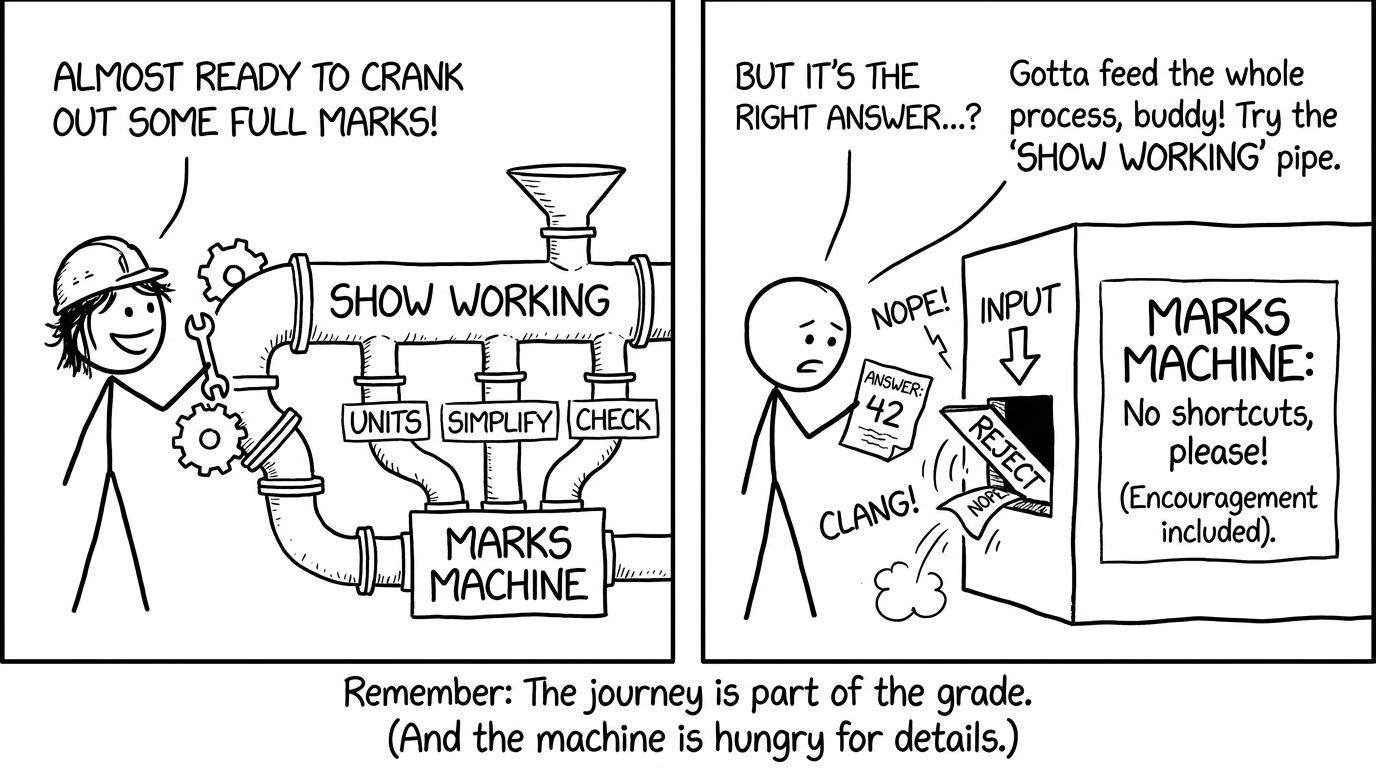 Marks machine rejects answer-only slip
Bringing it together: turn common GCSE questions into automatic marks
The point of learning the most common GCSE maths questions isn’t to guess what will be on your paper. It’s to become the kind of student who can handle whatever appears because the foundations are strong. When you can do percentages, algebra, graphs, angles, and number properties without panic, the rest of the paper becomes navigable.
If you want a simple next step, use Maths Genie as your revision engine:
- Start with a revision lesson, then practise the matching exam questions
- Use Predicted GCSE revision papers and resources to focus on likely topics
- Use AQA GCSE Maths papers (or your exam board’s papers) with mark schemes to learn what earns marks
- Check the GCSE revision for Summer 2025 (Likely topics list) to organise your next week
Make the common GCSE questions your comfort zone. Then, when the paper tries to surprise you, it won’t feel like a trap; it’ll feel like another version of something you’ve already mastered.










