

Mixed Numbers GCSE Maths: Examples and Questions
Mixed numbers GCSE maths explained with clear worked examples, common mistakes and exam-style questions. Learn to convert and calculate with confidence.
Why mixed numbers suddenly become confusing
Imagine a student who can calculate with ordinary fractions but keeps losing marks when a whole number appears beside one. They remember several rules, apply them in the wrong order, and start again. If that sounds familiar, this guide to mixed numbers GCSE maths gives you a reliable approach: understand what the number means, convert when needed, then calculate with fractions.
A mixed number combines a whole number and a proper fraction. For example, 2342\frac{3}{4}243 means two wholes plus three quarters. That small word, plus, is often where understanding begins.
You will practise converting between forms, using all four operations and checking whether your answer makes sense.
Mixed numbers at a glance
Before calculating, keep these ideas in view:
- A mixed number contains a whole number and a proper fraction.
- An improper fraction has a numerator greater than or equal to its denominator.
- Both forms can represent exactly the same value.
- Converting to improper fractions gives you a consistent method for calculations.
- Simplify your answer and follow any instructions about its final form.
These skills belong to GCSE number work. MathsGenie's matching Fractions lesson brings together revision resources covering mixed numbers and fraction calculations.
Understand the number before learning the rule
Return to our imagined student. They see 2342\frac{3}{4}243 and multiply the whole number by the fraction. The notation looks like multiplication in algebra, so the mistake has a reason.
Mixed-number notation works differently:
234=2+342\frac{3}{4}=2+\frac{3}{4}243=2+43Each whole contains four quarters. Two wholes therefore contain eight quarters, with another three quarters beside them:
234=1142\frac{3}{4}=\frac{11}{4}243=411The value has stayed the same. Only its appearance has changed. A mixed number makes the whole part easy to see; an improper fraction makes calculations easier to organise.
Mixed numbers worked examples: changing form
Convert a mixed number to an improper fraction
Convert 3253\frac{2}{5}352 to an improper fraction.
Multiply the whole number by the denominator. This counts how many fifths are in the whole part:
3×5=153\times5=153×5=15Add the numerator. Include the extra fifths:
15+2=1715+2=1715+2=17Keep the denominator:
325=1753\frac{2}{5}=\frac{17}{5}352=517The denominator stays unchanged because you are still counting fifths. The compact version is:
325=3×5+25=1753\frac{2}{5}=\frac{3\times5+2}{5}=\frac{17}{5}352=53×5+2=517Convert an improper fraction to a mixed number
Convert 236\frac{23}{6}623 to a mixed number.
Divide the numerator by the denominator:
23÷6=3 remainder 523\div6=3\text{ remainder }523÷6=3 remainder 5The quotient becomes the whole number. The remainder becomes the numerator, and the denominator stays the same:
236=356\frac{23}{6}=3\frac{5}{6}623=365Check by converting back:
3×6+56=236\frac{3\times6+5}{6}=\frac{23}{6}63×6+5=623For our imagined student, this check provides something useful: a way to catch an error before carrying it into the next calculation.
Calculate with mixed numbers
Converting first is a dependable method for all four operations. Addition and subtraction can sometimes be quicker using the whole parts separately, but improper fractions help keep your method consistent.
Adding mixed numbers
Calculate 123+2141\frac{2}{3}+2\frac{1}{4}132+241.
Convert both numbers:
53+94\frac{5}{3}+\frac{9}{4}35+49Use a common denominator:
2012+2712=4712\frac{20}{12}+\frac{27}{12}=\frac{47}{12}1220+1227=1247Convert back:
4712=31112\frac{47}{12}=3\frac{11}{12}1247=31211Only add the numerators once the denominators match. The denominator names the size of the pieces you are counting.
Subtracting mixed numbers
Calculate 415−1344\frac{1}{5}-1\frac{3}{4}451−143.
Convert, then find a common denominator:
215−74=8420−3520=4920=2920\frac{21}{5}-\frac{7}{4} =\frac{84}{20}-\frac{35}{20} =\frac{49}{20} =2\frac{9}{20}521−47=2084−2035=2049=2209This avoids having to exchange a whole when the first fractional part is smaller than the second.
Multiplying mixed numbers
Calculate 112×2231\frac{1}{2}\times2\frac{2}{3}121×232.
Convert both numbers:
32×83\frac{3}{2}\times\frac{8}{3}23×38Cancel common factors between numerators and denominators, then multiply:
3×82×3=82=4\frac{3\times8}{2\times3}=\frac{8}{2}=42×33×8=28=4You do not need a common denominator for multiplication.
Dividing mixed numbers
Calculate 214÷1122\frac{1}{4}\div1\frac{1}{2}241÷121.
Convert first:
94÷32\frac{9}{4}\div\frac{3}{2}49÷23Multiply by the reciprocal of the second fraction:
94×23=1812=32=112\frac{9}{4}\times\frac{2}{3}=\frac{18}{12}=\frac{3}{2}=1\frac{1}{2}49×32=1218=23=121The reciprocal is the fraction turned upside down. Convert the mixed number before finding its reciprocal.
Practise this convert-first routine with the Fractions Lessons and Fractions Question Bank so you can move from following the steps to choosing them yourself.
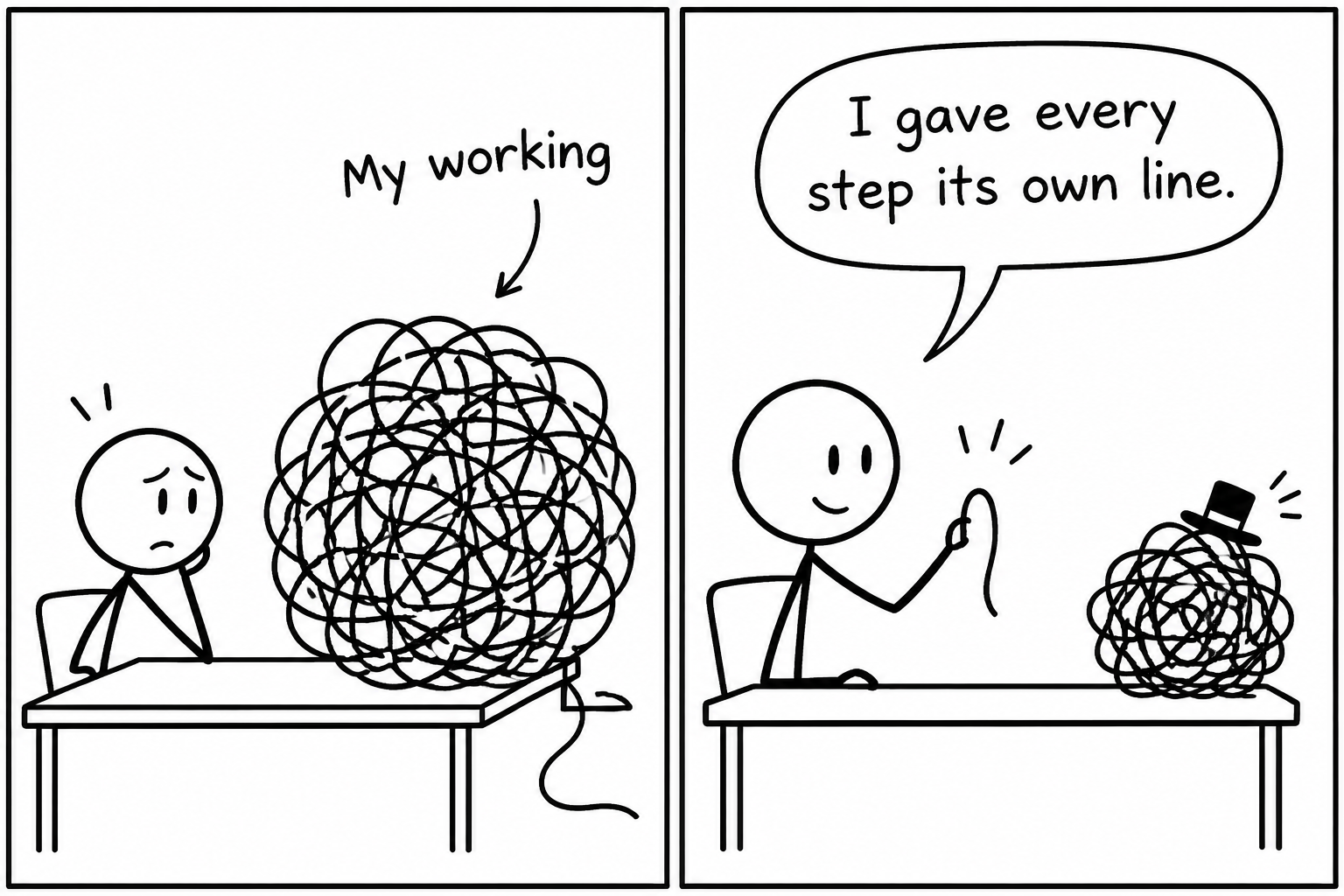 A stick-figure student gives a tangled ball of working its retirement after learning to write each step on a separate line.
Common mistakes and how to catch them
Multiplying the whole number by the numerator. When converting, multiply the whole number by the denominator, then add the numerator. You are counting how many fractional pieces make up the wholes.
Adding denominators. For addition and subtraction, first create matching denominators. Their value stays unchanged when you combine the numerators.
Flipping the wrong fraction. In division, take the reciprocal of the second fraction only. Write the conversion line before changing division to multiplication.
Stopping before simplifying. Check for common factors in your final numerator and denominator. A mixed number's fractional part should also be in its simplest form.
Ignoring the question's instructions. Mixed numbers and improper fractions can be equally exact. If the question requests a mixed number, give that form.
Our imagined student's turning point is modest: each line now has one job. Convert, calculate, simplify. When something goes wrong, they can identify the line that needs fixing.
Mixed numbers questions: exam-style practice
Try these without looking at the worked examples. Show your working and simplify each answer.
- Convert 5385\frac{3}{8}583 to an improper fraction.
- Convert 376\frac{37}{6}637 to a mixed number.
- Calculate 213+1562\frac{1}{3}+1\frac{5}{6}231+165.
- Calculate 312−1343\frac{1}{2}-1\frac{3}{4}321−143.
- Calculate 125×2171\frac{2}{5}\times2\frac{1}{7}152×271.
- A ribbon is 3343\frac{3}{4}343 metres long. Each piece must be 58\frac{5}{8}85 metres long. How many pieces can be cut without waste?
Check your answers
In order, the answers are:
438,616,416,134,3,6 pieces\frac{43}{8},\quad6\frac{1}{6},\quad4\frac{1}{6},\quad1\frac{3}{4},\quad3,\quad6\text{ pieces}843,661,461,143,3,6 piecesIf an answer differs, compare your conversion first, then your operation. For the ribbon question, dividing the total length by the length of each piece tells you how many pieces fit.
The same fraction principles apply across exam boards; students following AQA can use the matching AQA Fractions lesson.
Turn the method into a habit
Knowing the steps is the beginning; recognising which step comes next takes practice. Like our imagined student, you can make mistakes easier to fix by keeping each conversion and calculation visible. Start with mixed numbers in MathsGenie's Lessons, then use the Question Bank to practise the method independently.















