Adding, Subtracting, Multiplying and Dividing Fractions
When fractions have the same denominator we can add them together (or subtract one from the other).
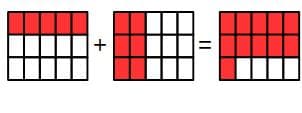
If we add one fifth and add two fifths we will have three fifths
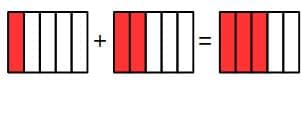
1⁄5 + 2⁄5 = 3⁄5
If we have 3 quarters and we take away 2 quarters we have 1 quarter left
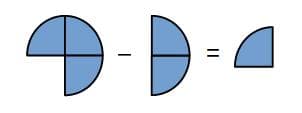
3⁄4 − 2⁄4 = 1⁄4
Try these:
When we do not have fractions with the same denominator we need to make the denominators the same before we can add them (or take them away).
We can make denominators the same using equivalent fractions.
Example: 1⁄3 + 2⁄5
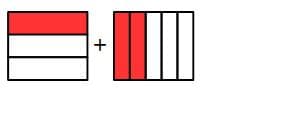
To add these fractions we need to make the denominators the same.
To make the denominators the same we need to find a number that is in both the 3 and the 5 times tables. 15 is the lowest number in both the 3 and 5 times tables.
We need to multiply the denominator of 1⁄3 by 5 to make it 15. We need to multiply the numerator by 5 as well to keep the fraction equivalent to 1⁄3
We multiply the numerator and denominator of 2⁄5 by 3.
1 × 5⁄3 × 5 + 2 × 3⁄5 × 3
5⁄15 + 6⁄15
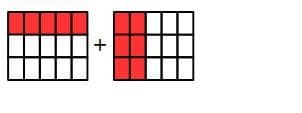
Now both fractions have the same denominators we can add them:
5⁄15 + 6⁄15 = 11⁄15
Example: 3⁄4 − 1⁄6
To subtract these fractions we need to make the denominators the same.
To make the denominators the same we need a number that is in the 4 and 6 times tables. The smallest number in the 4 and 6 times tables is 12 (If we used another number in both times tables the answer would still be correct, the working out would just be more difficult).
We need to multiply the numerator and denominator of 3⁄4 by 3
We need to multiply the numerator and denominator of 1⁄6 by 2
3 × 3⁄4 × 3 − 1 × 2⁄6 × 2
9⁄12 − 2⁄12
Now both fractions have the same denominators we can subtract them:
9⁄12 − 2⁄12 = 7⁄12
Try these:
All answers are given in their simplest form
To multiply fractions we multiply the numerators and multiply the denominators.
Example: 3⁄4 × 2⁄5
We multiply the numerators and multiply the denominators
3 × 2⁄4 × 5
6⁄20
We can simplify our answer by dividing the numerator and the denominator by 2
6⁄20 = 3⁄10
When we have mixed numbers we need to convert them to top heavy fractions (improper) before we can multiply them
Example: 12⁄3 × 2⁄7
One whole is the same as three thirds.
3 thirds and 2 thirds make 5 thirds.
12⁄3 = 3⁄3 + 2⁄3 = 5⁄3
5⁄3 × 2⁄7
We can now multiply the numerators and multiply the denominators
5 × 2⁄3 × 7 = 10⁄21
Try these:
All answers are given in their simplest form
Division is the opposite operation to multiplication
Multiplying by 2⁄3 is the same as dividing by 3⁄2
Multiplying by 4⁄5 is the same as dividing by 5⁄4
We can divide fractions by multiplying the first fraction by the second fraction flipped over (the reciprocal of the second fraction).
Example: 2⁄5 ÷ 2⁄3
2⁄5 ÷ 2⁄3 is the same as 2⁄5 × 3⁄2
2⁄5 × 3⁄2 = 2 × 3⁄5 × 2 = 6⁄10
We can simplify the answer by dividing the top and bottom by 2
6⁄10 = 3⁄5
When we have mixed numbers we need to convert them to improper fractions before dividing the fractions
Example: 3⁄4 ÷ 21⁄5
We need to convert 21⁄5 to a top heavy fraction first
2 is the same as 10⁄5
10⁄5 + 1⁄5 = 11⁄5
We now have:
3⁄4 ÷ 11⁄5
Dividing by 11⁄5 is the same as multiplying by 5⁄11
3⁄4 ÷ 11⁄5 = 3⁄4 × 5⁄11
3⁄4 × 5⁄11 = 3 × 5⁄4 × 11 = 15⁄44
Try these:
All answers are given in their simplest form
