

Miss GCSE ICT Exam: Illness and Special Consideration
Miss GCSE ICT exam illness worries? Learn what to report, how special consideration works, how grades may be calculated and what you should do next.
Missing an exam can feel frightening because the timetable looks absolute. One date. One room. One chance. Yet if you miss GCSE ICT exam illness is the reason, an unavoidable absence does not automatically mean receiving no grade. Tell your school or exam centre immediately. Its exams officer can consider an application for special consideration, and the exam board may calculate your result from the other assessment components you completed.
There are conditions. The illness must materially affect your ability to take the assessment, the centre must support the application, and you normally need to have completed enough of the qualification already. You cannot apply directly to the exam board yourself.
The immediate checklist
If you are too ill to attend a GCSE ICT examination or assessment:
- Contact your school or exam centre as soon as possible, preferably before the exam starts.
- Ask for the exams officer and follow the centre's absence procedure.
- Explain clearly when the illness began and how it prevents you from attending.
- Keep any evidence the centre requests, such as medical information or a record of contact.
- Confirm whether the centre will submit a special consideration application.
- Attend any remaining components when you are well enough to do so.
- Check the precise title and awarding organisation of your qualification.
That final point matters. Students and schools sometimes use “ICT” informally for several qualifications, including GCSE Computer Science, Digital Technology and vocational digital or information technology courses. Their assessment structures and awarding rules are not necessarily identical.
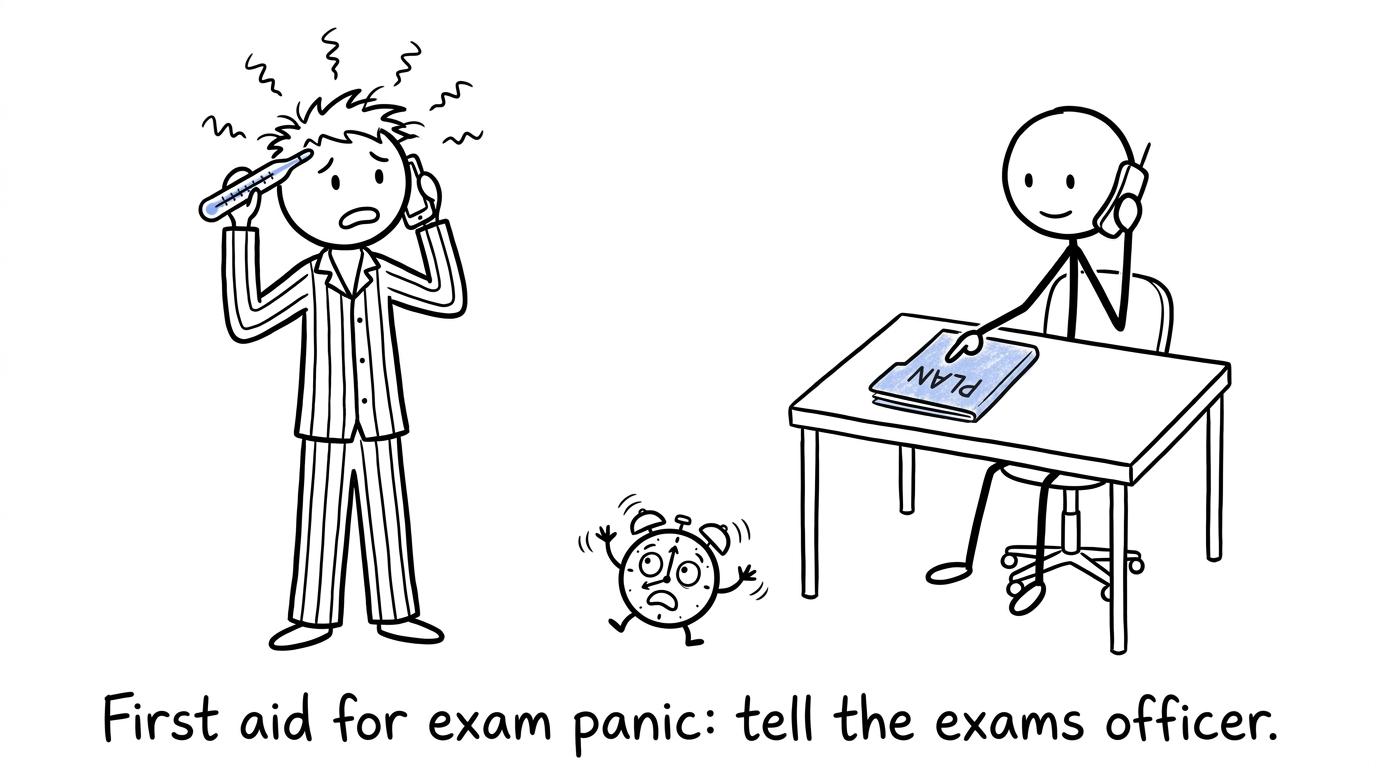 A worried student contacts the exams officer while an alarm clock panics
What special consideration actually means
Special consideration is support provided after, or in connection with, an assessment when a temporary illness, injury or other event outside a candidate's control has materially affected their ability to participate or perform normally.
Under the Joint Council for Qualifications guidance for the 2025/26 academic year, candidates generally need to have been fully prepared for the assessment and covered the course. Temporary illness at the time of an exam can be eligible. Missing revision because of an earlier illness is not normally enough by itself, although a long-term condition that becomes significantly worse at the time of the assessment may require separate consideration.
Special consideration is not a replacement examination and it does not guarantee a particular grade. It is a regulated attempt to reduce the disadvantage caused by circumstances you could not control.
If you miss the examination completely
Your exams officer records the acceptable absence and applies to the awarding organisation. If the application is accepted and you have completed the required proportion of the qualification, the board may use enhanced grading to determine a result.
For linear GCSE qualifications offered by AQA, OCR, Pearson Edexcel and WJEC, the JCQ guidance normally requires the candidate to have completed at least one whole component worth a minimum of 15%15\%15% of the total assessment. Different requirements can apply to CCEA qualifications and to vocational or single-component courses, so your centre must check the relevant specification and awarding organisation's rules.
The calculated outcome is not simply your predicted grade, mock result or teacher's preferred mark. Broadly, the board considers how you performed in the completed components relative to other candidates and uses the available assessment evidence to estimate the missing contribution. The exact calculation is performed by the awarding organisation, not your school.
If you miss every examination and internally assessed component for the subject, there is usually insufficient assessment evidence to award the qualification through this process.
If you attend but become ill
A different form of special consideration may apply if you sit the paper but illness materially reduces your performance. Tell an invigilator immediately rather than waiting until results day. The centre should record what happened, including whether you had to leave early.
For a candidate who was present but disadvantaged, an exam board may apply a small mark adjustment to the affected component. Under JCQ rules, the maximum is 5%5\%5% of the total raw marks available for that component. This does not mean five percentage points are automatically added to your final grade. The adjustment depends on the nature, timing and seriousness of the circumstances, and many accepted cases receive less than the maximum.
Will you sit the GCSE ICT exam on another day?
Usually, you cannot take the same nationally timetabled paper privately a few days later. Allowing one candidate to see a live paper after everyone else has taken it would undermine the security of the assessment.
The contingency day in the national summer timetable is also not a personal make-up day for ordinary individual illness. It exists for exceptional national or widespread disruption when an examination cannot take place as scheduled.
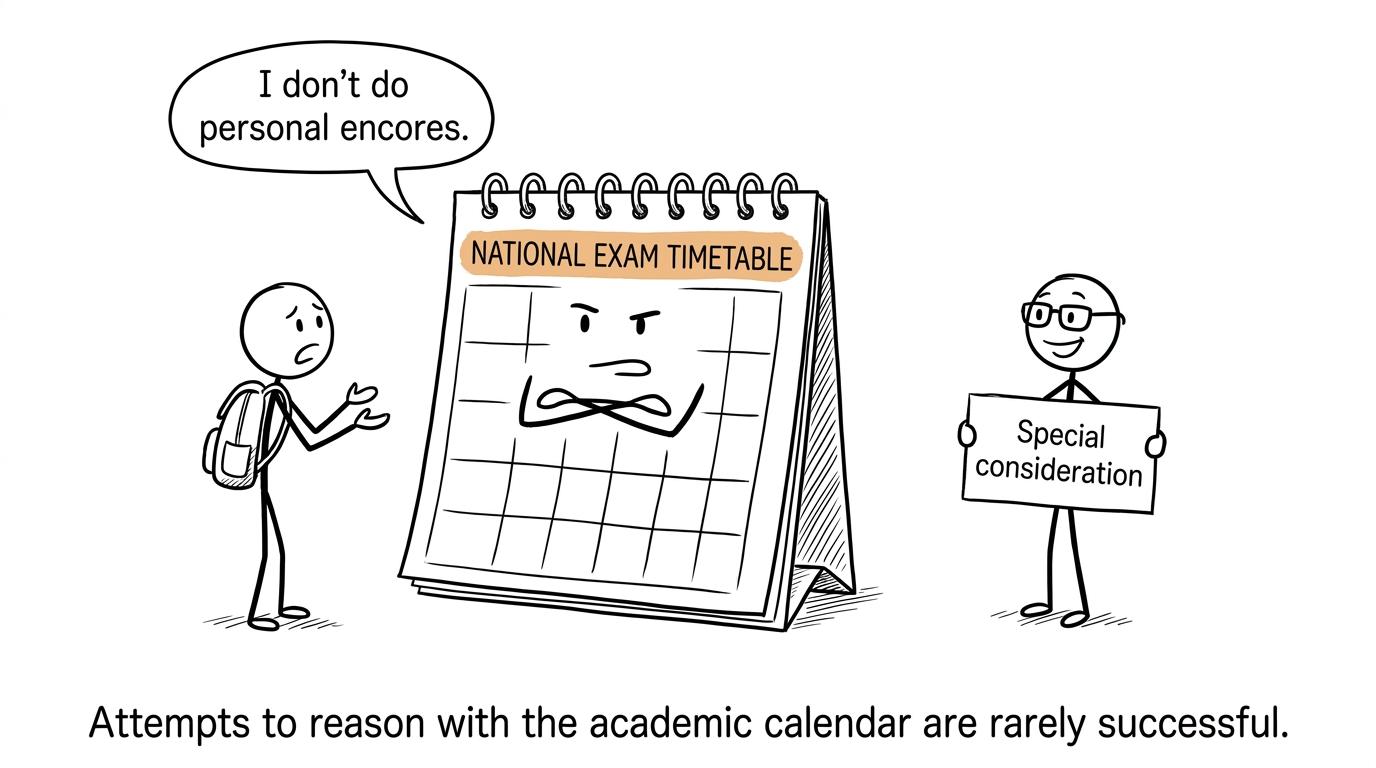 A student attempts to negotiate a private encore with the national exam timetable
If special consideration cannot produce a grade, you may need to enter in a later available series. Availability depends on the exact qualification and awarding organisation. Unlike GCSE English Language and GCSE Maths, many ICT-related or Computer Science qualifications do not have a routine November resit opportunity. Your exams officer can confirm the next series and whether the specification is still available.
Who applies and what evidence is needed?
Your school, college or private candidate exam centre submits the application. A parent, carer or student cannot bypass the centre and apply directly to AQA, Edexcel, OCR, Eduqas or another awarding organisation.
Contact the centre promptly because special consideration is intended for circumstances affecting you at the time of assessment, and awarding organisations set submission deadlines. Give an honest, specific account. Your centre will decide what evidence is appropriate under its procedure and the board's requirements. Do not assume that every illness requires the same document, but keep medical messages, appointment records and other relevant information in case they are requested.
Ask the exams officer to confirm:
- the qualification's full title and entry code;
- which component you missed;
- whether your absence is being treated as acceptable;
- whether an application has been submitted;
- whether further evidence is required; and
- whether you have completed enough assessment for enhanced grading.
Private candidates should contact the centre that made their entry. The same principle applies: the centre manages the application.
What if illness affects coursework or a practical assessment?
Some digital qualifications include non-exam assessment, controlled tasks or practical components. If a temporary illness prevents you from completing all the required work, tell your teacher before the deadline wherever possible.
In some subjects, an awarding organisation may accept a reduced quantity of work where the candidate was fully prepared but became unable to finish because of an eligible circumstance. However, all assessment objectives normally need to have been covered at least once, and this option is not available in every specification. A centre must not simply invent marks or alter your assessment result itself.
This is another reason to identify your exact qualification. The rules for a GCSE Computer Science written paper may not match those for a vocational ICT task.
Keep the rest of your exam season steady
Illness in the middle of GCSEs can make every remaining subject feel uncertain. The useful response is not to compensate with an exhausting revision marathon. Recover first, confirm the administrative steps, and then rebuild a manageable routine.
Use the MathsGenie revision planner to move missed sessions rather than squeezing all of them into one evening. When you feel better, the GCSE Maths revision hub lets you choose your board and return to focused revision lessons and practice questions.
A sensible return might involve one short topic session followed by a mini test. The 20-minute GCSE maths revision routine is particularly useful when your energy is still limited. If examinations are close, follow the calm decisions in the GCSE maths night-before plan rather than trying to relearn an entire specification.
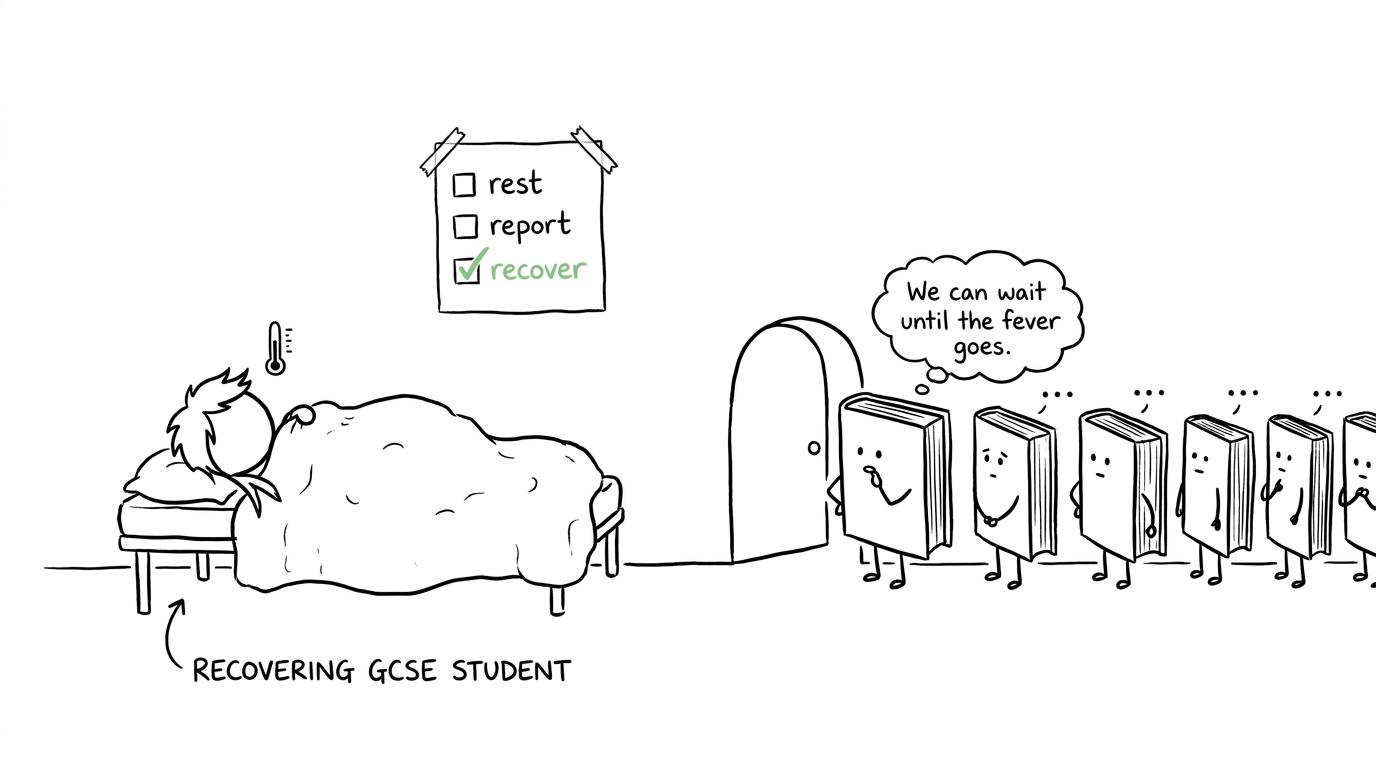 Revision books politely wait while an ill student rests
Once you are well, use GCSE predicted papers to rehearse unfamiliar questions and Edexcel GCSE Maths past papers for timed practice if that is your board. Mark schemes and video solutions should guide the next revision session, not merely produce a score.
Common mistakes to avoid
Waiting until results day
Special consideration should be raised at the time of the assessment. Tell the centre immediately, even if you do not yet have every piece of supporting information.
Assuming absence automatically produces a predicted grade
The process is not automatic, and predicted grades do not simply replace missing papers. The centre applies, the awarding organisation decides eligibility, and sufficient completed assessment is required.
Calling every digital qualification GCSE ICT
Check the certificate title, exam board, specification and component. A vocational award may follow different rules from a GCSE governed by the standard JCQ process.
Attending while seriously unwell without telling anyone
If you attend, inform an invigilator as soon as illness affects you. A record made during the examination is much more useful than an unexplained concern raised weeks later. In a serious illness, follow medical advice rather than treating attendance as a test of determination.
Assuming the maximum adjustment is guaranteed
The 5%5\%5% figure is a ceiling on the raw marks available for an affected component when a candidate is present but disadvantaged. It is not an automatic bonus and is not the method used for an accepted absence.
Letting one missed exam derail every other subject
Administration and revision are separate problems. Let the exams officer handle the application while you protect your recovery and restart gradually. If a later entry becomes necessary, the GCSE maths resit revision plan explains how to diagnose gaps without beginning from zero.
The next calm step
If illness prevents you from sitting GCSE ICT, contact your exam centre now. Ask for the exams officer, establish the exact qualification, provide the requested information and confirm whether special consideration will be submitted. You may still receive a grade if the absence is accepted and enough of the assessment has been completed, but the decision belongs to the awarding organisation.
Then return your attention to what remains controllable. Use MathsGenie's free revision lessons and practice questions to repair individual maths topics, mini tests to rebuild confidence, and past papers, predicted papers, mark schemes and video solutions to prepare under realistic conditions. A disrupted day need not become a disrupted exam season.










