

A May Half-Term GCSE Maths Revision Plan
A May half-term GCSE maths revision plan with topic triage, daily sessions, past papers, rest and practical advice for catching up calmly.
May half-term can feel less like a holiday and more like a countdown. Some GCSE Maths papers may already be behind you, while others are getting close. You know revision matters, but deciding what to revise can consume the time meant for doing it.
A May half-term GCSE Maths revision plan should be simple: identify the topics still costing you marks, practise them actively, complete papers under exam conditions and leave enough space to rest. You do not need seven heroic days. You need a week you can actually follow.
Your half-term checklist
By the end of the week, aim to have:
- identified three high-priority and three medium-priority topics;
- completed focused practice on your weakest areas;
- attempted two full past papers;
- marked every paper and corrected the important errors;
- revisited topics rather than practising each one only once;
- kept at least one full rest day;
- prepared a short plan for the remaining exam days.
If you want the wider strategy behind this week, begin with the GCSE Maths revision timetable guide. Half-term is one concentrated part of that longer journey.
Start with topic triage, not your favourite chapter
Imagine a student sitting down on Saturday morning with a neat notebook and six available hours. They begin with fractions because fractions feel comfortable. The pages fill quickly, which feels productive, but the difficult vector question from their last paper remains untouched.
This is the quiet trap of revision: confidence can imitate progress.
Before building your GCSE maths revision timetable, divide topics into three groups:
| Priority | What it means | What to do |
|---|---|---|
| Red | You cannot start the question or repeatedly lose most marks | Learn the method, then answer practice questions |
| Amber | You understand the idea but make errors or need prompts | Complete mixed questions and revisit later |
| Green | You can answer independently and accurately | Use brief retrieval and paper practice |
Use a recent mock, marked past paper or teacher feedback as evidence. Choose no more than three red topics initially. A list of fifteen weaknesses is an inventory, not a plan.
Be specific. “Algebra” is too broad, while “solving quadratic equations by factorising” gives you a clear task. MathsGenie’s GCSE revision resources organise topics by grade and provide revision lessons, videos and practice questions, making it easier to turn a vague weakness into something you can work on.
A realistic seven-day structure
A useful day contains two or three focused sessions rather than uninterrupted revision from morning to evening. Each session can last roughly 40-60 minutes, followed by a proper break. Adjust the length to suit your concentration and other subjects.
| Day | Main session | Second session | Short review |
|---|---|---|---|
| Saturday | Diagnose weaknesses from a marked paper | Red topic one | Correct mistakes |
| Sunday | Red topic two | Mixed amber questions | Recall Saturday’s method |
| Monday | Full past paper under timed conditions | Mark the paper | Record errors |
| Tuesday | Rest day | Rest day | Optional five-minute plan check |
| Wednesday | Repair topics exposed by Monday’s paper | Red topic three | Reattempt two errors |
| Thursday | Full past paper under timed conditions | Mark the paper | Compare error patterns |
| Friday | Final weak-topic practice | Formula and method recall | Plan the next exam week |
This is a framework, not a punishment. If you have family plans on Monday, move the paper. If you concentrate better later in the day, start later. The order matters more than the clock: diagnose, practise, test, correct and revisit.
Setting all of this up can feel like revision before the revision, so you can build a day-by-day schedule in the Revision Planner once you know your priorities.
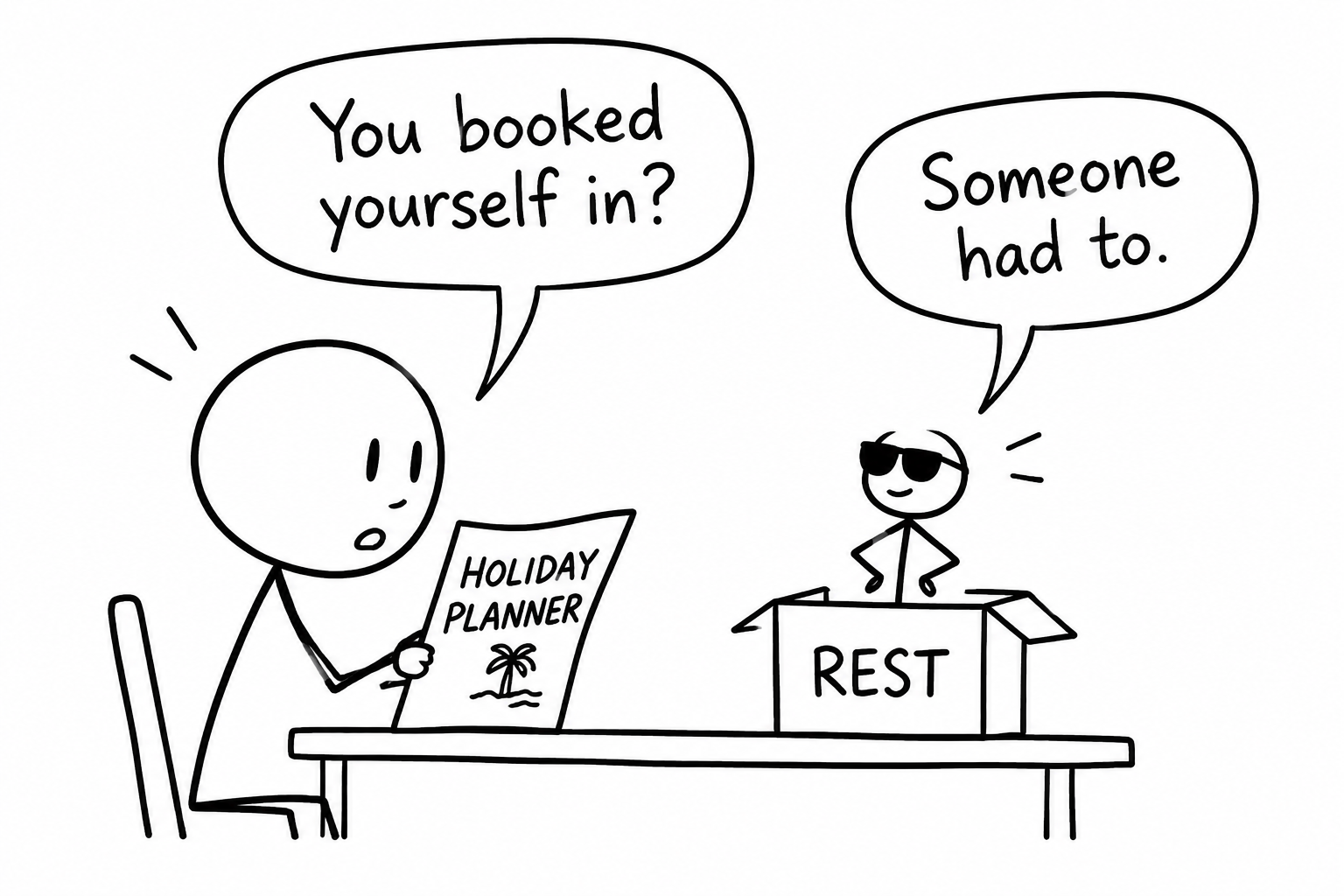 A stick figure discovers that rest has booked itself into the half-term revision plan
Make each topic session active
Reading notes may remind you that a method exists. It does not prove that you can use it when the question is unfamiliar.
For each red-topic session, use this sequence:
- Learn: watch or read one concise revision lesson.
- Attempt: answer questions without copying the method.
- Mark: use the mark scheme or video solution carefully.
- Correct: write a complete corrected solution.
- Return: attempt another question on the topic one or two days later.
The final step matters. A method can feel obvious immediately after a video because it is still in working memory. Returning later checks whether the learning stayed.
MathsGenie’s GCSE Maths revision resources bring together topic practice, video solutions and mini tests. Choose work for your tier and specification rather than attempting difficult questions simply because they look impressive.
Use past papers as evidence
Past papers are not just final rehearsals. They tell you where your next revision hour should go.
Complete Monday’s and Thursday’s papers in conditions resembling the exam. Use the correct time allowance shown on your paper, put away notes and follow the calculator instructions. Select papers for your exam board, whether that is Edexcel, AQA, OCR or Eduqas, and make sure you use the correct foundation or higher tier.
MathsGenie provides GCSE Maths past papers alongside mark schemes and worked video solutions. Predicted papers can offer further practice, but official past papers remain valuable because they show how your specification has previously been assessed.
After marking, classify each lost mark:
- Knowledge: you did not know the method.
- Application: you knew the skill but did not recognise when to use it.
- Accuracy: arithmetic, algebra or rounding caused the error.
- Exam technique: you misread the question, omitted working or gave the wrong form.
Then choose the next action. A knowledge gap needs a lesson and practice questions. An accuracy error needs slower working and checking. Repeatedly writing “silly mistake” explains nothing and changes nothing.
Why your rest day belongs in the plan
Rest is not what happens when revision goes wrong. It is part of a sustainable GCSE revision plan.
Protect one complete day, or two half-days if that fits your household better. Do something away from the desk, sleep properly and let the week breathe. Without planned rest, students often create an ambitious timetable, miss part of it and spend the remaining days feeling behind.
A smaller completed plan is more useful than a perfect abandoned one.
What to do when you fall behind
Suppose Wednesday arrives and Monday’s paper is still unfinished. Do not squeeze Monday, Tuesday and Wednesday into one exhausting day. That preserves the timetable on paper while destroying its purpose.
Use three rules:
- keep the next past-paper session;
- keep the rest day;
- reduce lower-priority green-topic work first.
Move one red topic into Friday’s session or the following week. If necessary, replace a full extra session with 20 minutes of correction. Never skip marking merely to say that a paper is complete. An unmarked paper gives you practice, but it withholds the diagnosis.
Review the plan each evening for two minutes. Ask what was completed, what the evidence revealed and what now matters most. Your plan should respond to your performance rather than demanding obedience to decisions made before the week began.
Common half-term revision mistakes
Planning every hour
A timetable with no gaps assumes unlimited energy and no interruptions. Leave space between sessions and keep one flexible block for work that takes longer than expected.
Revising only comfortable topics
Green topics create reassuring ticks. Red topics create marks if you repair them. Begin most days with the task you are most tempted to postpone.
Completing papers without corrections
The score is only the headline. The useful information lies in why each mark disappeared. Correct errors while the reasoning is still fresh, then reattempt selected questions later.
Ignoring your tier and exam board
Foundation and higher papers assess different content and grades. Use resources that match your entry, exam board and current specification. Ask your teacher if you are uncertain about any of these.
Sacrificing sleep to catch up
Late-night revision can make tomorrow’s work slower and less accurate. Cut a low-priority task instead. Revision is not improved by making the next day harder.
Build your May half-term schedule
You now have the structure: triage your topics, practise actively, complete two papers, correct the evidence and protect your rest. The remaining challenge is turning those intentions into a schedule you will see and follow while fixed exam dates move closer.
Your turn. Build your May half-term schedule in the MathsGenie Revision Planner.















