Is GCSE Biblical Hebrew Hard? What Students Say
Is GCSE Biblical Hebrew hard? Get an honest answer on grammar, translation, set texts and student experiences, plus a practical revision plan.

A new alphabet. Right-to-left reading. Unseen translation. Ancient texts whose smallest details can change the meaning of a sentence. It is reasonable to ask: is GCSE Biblical Hebrew hard?
The straight answer is yes; it is a demanding GCSE, particularly if you begin without much Hebrew. But demanding is not the same as unmanageable. Students who have learnt Biblical Hebrew commonly describe a steep beginning followed by a more orderly experience once the alphabet, vocabulary and grammatical patterns become familiar.
That distinction matters. The course often feels hardest before your knowledge has had time to connect. Later, what looked like a wall begins to resemble a system.
The quick verdict
GCSE Biblical Hebrew is likely to feel challenging because you must:
- read a different script fluently and from right to left;
- recognise vocabulary, prefixes, suffixes and changing verb forms;
- translate unseen passages into clear English;
- understand and analyse prescribed literature;
- remember precise textual details under timed conditions.
However, it may suit you if you enjoy patterns, careful interpretation and rule-based learning. Those are qualities many maths students already practise.
Before judging the subject, look at an actual paper and mark scheme through the Edexcel GCSE Biblical Hebrew revision page. The paper gives you better evidence than the subject's unfamiliar name.
 A student facing language and literature revision piles while a tortoise recommends taking one page at a time
What does the GCSE actually involve?
The current Pearson Edexcel GCSE in Biblical Hebrew has two externally examined components. Each lasts 222 hours, carries 100100100 marks and contributes 50%50\%50% of the qualification.
| Component | Main demands | Weighting |
|---|---|---|
| Language | Understanding unseen passages, translation into English and either grammar questions or simple translation into pointed Biblical Hebrew | 50%50\%50% |
| Literature | Knowledge, translation and analysis of prescribed texts, including comparison of themes | 50%50\%50% |
There is no separate foundation or higher tier. The final result uses the GCSE grade scale from 999 to 111.
For examinations from 2026 to 2028, the prescribed literature covers Joseph's rise to power in Genesis and the miracles of Elisha in Kings. Students should always check the current specification with their teacher because set texts apply to particular examination years.
This structure explains why the course cannot be reduced to vocabulary learning. Half of the GCSE assesses language, while the other half asks you to understand literature and respond thoughtfully to it.
What students really say about the difficulty
There is no large, representative survey asking GCSE candidates to rate Biblical Hebrew. It is a relatively uncommon subject, and public comments often come from adult learners or students learning at other levels. Online opinions should therefore be treated as individual experiences, not statistics.
Even with that limitation, several themes recur.
The beginning can feel unusually steep
Learners regularly identify the script as the first barrier. Reading from right to left, distinguishing unfamiliar characters and processing vowel points can initially make every word feel slow.
That slowness is not proof that you lack ability. At the beginning, your brain is performing several separate jobs: identifying a character, recalling its sound, recognising a word and then interpreting the sentence. With frequent reading practice, some of those decisions become automatic.
Verbs and attached word elements cause difficulty
Students often mention verb forms, prefixes and suffixes as the point where simple recognition turns into grammatical analysis. A short-looking word can contain several pieces of information.
This impression is supported by official examiner feedback. Pearson has previously highlighted problems including weak verb knowledge, failure to recognise the vav conversive, uncertain contextual vocabulary and inaccurate English-to-Hebrew composition. Examiners have also stressed the importance of translating unseen passages into clear, intelligible English.
In other words, the difficult areas students discuss are not imaginary. They appear in assessed work too.
The rules can eventually make the subject feel systematic
Some learners compare Biblical Hebrew to maths because grammatical patterns can be learnt and applied methodically. That comparison has limits; languages contain context, idiom and exceptions, but it captures something useful.
If you like identifying structures and checking how small details affect an answer, the subject may feel more logical than expected. The early uncertainty gradually becomes pattern recognition.
Regular practice matters more than occasional intensity
Students who describe the subject as manageable tend to emphasise learning step by step. This is plausible because fluent recognition grows through repeated contact. One exhausting session cannot replace seeing vocabulary and forms across several days.
A useful conclusion from student accounts is therefore not simply that Biblical Hebrew is hard or easy. It is that the subject punishes long gaps and rewards consistency.
Which parts are hardest?
Reading accurately at useful speed
Knowing the alphabet is not the same as reading fluently. In an examination, you need enough automatic recognition to leave time for comprehension and translation.
Short daily reading is usually more helpful than repeatedly relearning the alphabet after a gap. Read aloud if your teacher recommends it, trace word boundaries and check characters you regularly confuse.
Learning vocabulary in context
A memorised English meaning may not fit every sentence. Examiner feedback has advised candidates to know when a particular translation is appropriate to the context.
Revise vocabulary both ways, but also record a short phrase or textual location. The aim is not merely to recognise a flashcard. It is to understand what the word is doing in a passage.
Analysing unfamiliar verb forms
Verb knowledge is cumulative. If earlier forms remain uncertain, later translation becomes slower because every word feels like a new puzzle.
Build a compact verb checklist with your teacher. When reviewing an error, identify precisely what you missed: the root, person, number, gender, aspect or an attached element. “I got the verb wrong” is too vague to improve.
Moving from literal Hebrew to natural English
A translation must preserve the original meaning while reading coherently in English. A rigid word-for-word version can become misleading or unclear.
Practise in two stages: first establish the grammatical structure; then read your English independently. Ask whether it sounds like a complete, intelligible sentence without adding ideas that the text does not support.
Remembering and discussing the set texts
The literature paper requires more than retelling a narrative. You need secure textual knowledge, accurate translation and an ability to comment on language, context and themes.
Organise notes around passages and themes rather than producing one enormous document. Retrieval questions, brief plans and closed-book summaries reveal gaps more honestly than highlighting.
Is Biblical Hebrew harder than GCSE maths?
There is no universal answer because the subjects demand different forms of thinking. Biblical Hebrew places more weight on vocabulary, textual memory and linguistic interpretation. GCSE maths places more weight on numerical fluency, selecting methods and multi-step problem-solving.
They do share a hidden skill: precision. A small grammatical feature can alter a translation, just as a missed negative sign can alter a calculation. Both subjects become easier when mistakes are classified rather than dismissed as careless.
If you are preparing for Edexcel, AQA, OCR or Eduqas maths alongside Hebrew, keep the resources separate but use the same revision loop:
- attempt a focused task;
- mark it promptly;
- identify the exact weakness;
- practise that weakness;
- retest it without notes.
Start maths sessions from the GCSE Maths revision hub. For board-specific exam practice, use AQA GCSE Maths past papers, OCR GCSE Maths past papers or the Eduqas GCSE Maths revision hub.
 A student building stepping stones between maths and language revision while a panic cloud objects
A realistic Biblical Hebrew revision checklist
A calm plan should cover both halves of the qualification.
- Read briefly every day. Build script recognition before worrying about speed.
- Retrieve vocabulary from memory. Do not rely only on rereading lists.
- Analyse verbs deliberately. Name the feature that determines your translation.
- Translate unseen prose regularly. This prevents familiarity with set texts from creating false confidence.
- Learn prescribed passages actively. Use closed-book recall, translation and short analytical plans.
- Mark with the official scheme. Notice exactly which details earn marks.
- Keep an error log. Separate vocabulary, grammar, translation, literature and timing errors.
- Return to mistakes. Reattempt difficult material after a gap rather than merely reading the correction.
Use past papers gradually. Begin with individual sections, then move towards complete timed papers once your knowledge is secure. Maths students can apply the same approach using this guide to starting GCSE past papers at the right time.
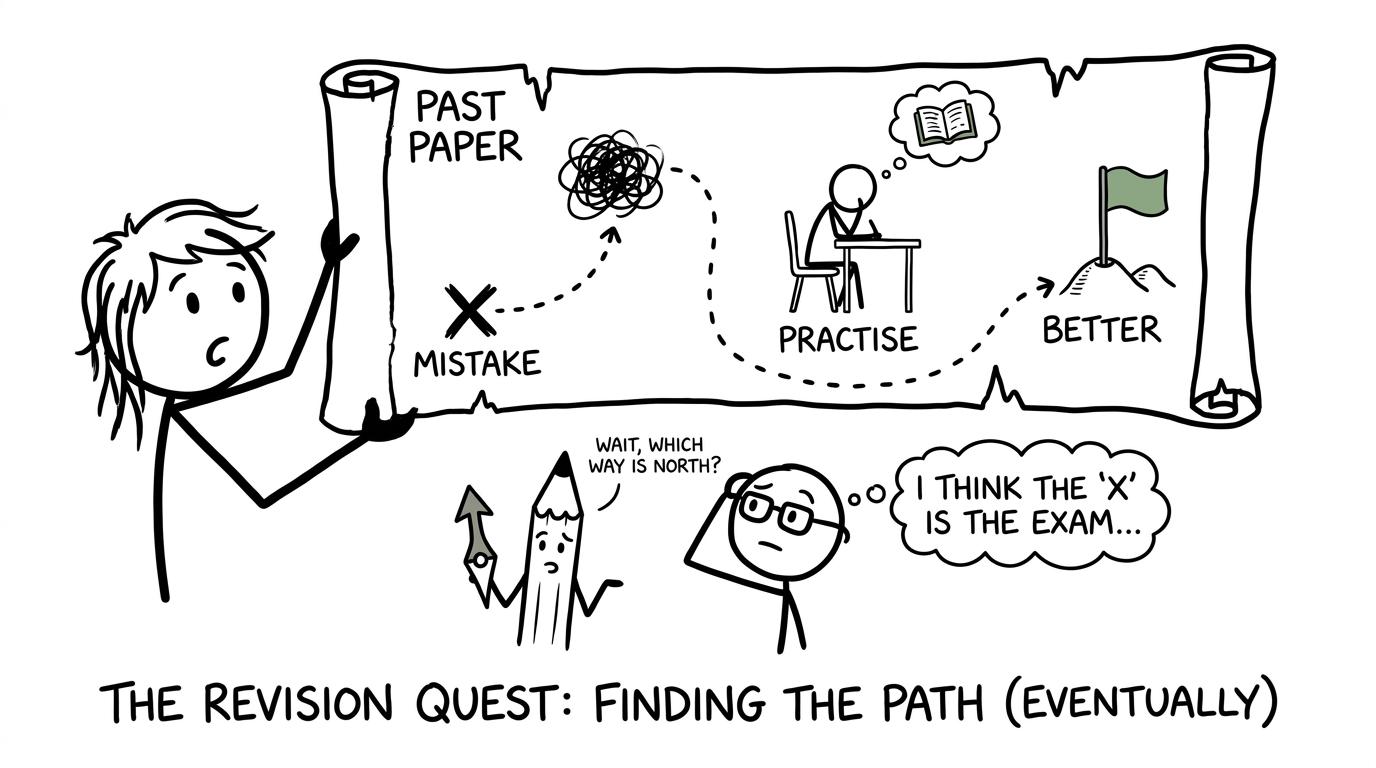 A past paper drawn as a treasure map leading from mistakes through practice to improvement
Common mistakes that make the GCSE feel harder
Treating Modern and Biblical Hebrew as interchangeable
Existing Modern Hebrew knowledge can help with script and vocabulary, but the grammar and accepted forms are not identical. Pearson examiner feedback has warned that Modern Hebrew can disadvantage candidates in English-to-Biblical-Hebrew composition when modern structures replace the required biblical forms.
Memorising one translation for every word
Context matters. Learn the core meaning, but train yourself to choose English that fits the passage.
Avoiding unseen translation
Repeatedly revising familiar literature feels comfortable. It does not fully prepare you for the language component. Unseen work should appear throughout revision, not only in the final week.
Reviewing errors without reattempting them
Reading a mark scheme creates recognition, not necessarily recall. Close the solution and produce the corrected response independently.
The same principle strengthens maths revision. MathsGenie's guide to using GCSE past papers properly explains how to turn each lost mark into targeted practice.
Using old grade boundaries as targets
Grade boundaries change between examination series. They describe a particular paper's results; they do not guarantee the boundary for a future paper. Use the GCSE Biblical Hebrew grade boundaries for context, then focus on improving your raw mark across multiple papers.
So, is GCSE Biblical Hebrew hard?
Yes, especially at the start. The script is unfamiliar to many students, verb structures demand precision, unseen translation tests genuine understanding and the literature component requires detailed knowledge.
But the fairest description is challenging and learnable. Student comments repeatedly point to an awkward opening stage, difficult verbs and the value of gradual practice. Official examiner feedback identifies many of the same pressure points. None of them requires mysterious talent. They require structured repetition and honest correction.
Begin with the MathsGenie Biblical Hebrew revision resources, inspect the papers and mark schemes, and ask your teacher which current set texts and composition option your class is preparing.
Then protect your maths preparation as well. Use MathsGenie's free revision lessons and practice questions to repair individual topics, past papers and mark schemes to understand the examination, video solutions when a method remains unclear, and Edexcel GCSE Maths predicted papers or mini tests to check whether the learning has stayed.
Hard subjects rarely become easy all at once. They become familiar one accurately corrected mistake at a time.