Is GCSE Arabic Hard? What Students Really Say
Is GCSE Arabic hard? Get an honest answer based on student experiences, the current Edexcel assessment and the skills that make the course challenging.
A language can feel familiar until an exam asks you to use it precisely. You may understand conversations at home, recognise plenty of vocabulary and still find a formal reading passage unexpectedly difficult. That gap explains why the answer to is GCSE Arabic hard is not a simple yes or no.
The straight answer is this: GCSE Arabic can be demanding, including for some students who speak Arabic at home. The main challenges are Modern Standard Arabic, formal vocabulary, accurate writing and switching between four separately assessed skills. However, students with secure reading and writing skills, regular exposure to standard Arabic and enough past-paper practice often find it manageable.
Student comments vary sharply. Some describe the qualification as straightforward; others say reading or writing caught them out despite conversational fluency. That disagreement is useful. It shows that difficulty depends less on whether you call yourself fluent and more on what you can actually do under exam conditions.
GCSE Arabic difficulty at a glance
Before choosing the subject or planning your revision, ask yourself:
- Can you read Modern Standard Arabic without relying heavily on context?
- Can you write accurately rather than only understand spoken Arabic?
- Do you know formal vocabulary across school, work, travel and global issues?
- Can you respond in the variety of Arabic expected by the assessment?
- Are you prepared to practise listening, speaking, reading and writing separately?
- Can you fit Arabic revision around compulsory subjects such as GCSE maths?
More confident answers usually mean a more manageable course. If several answers are no, GCSE Arabic is still possible, but it will require structured teaching and consistent practice.
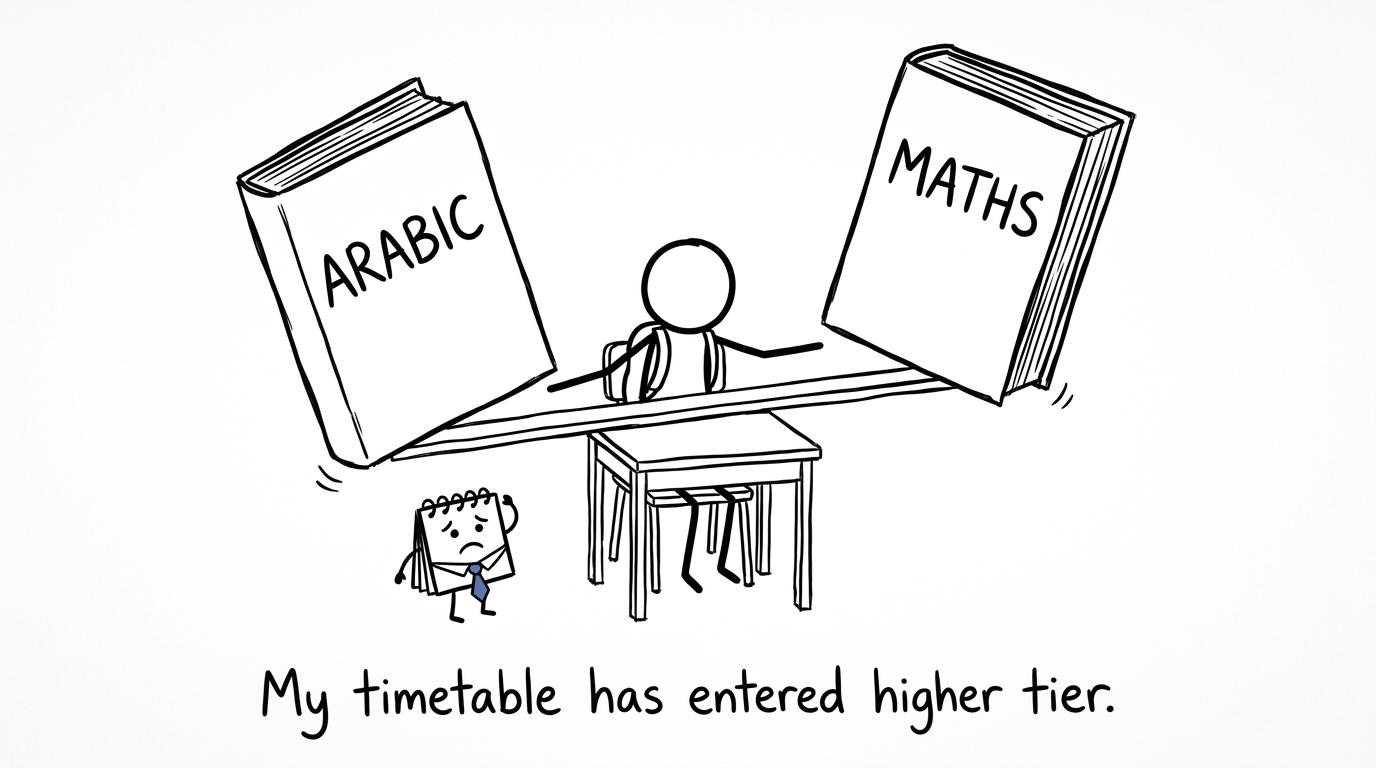 A student balancing Arabic and maths revision books on a seesaw
What GCSE Arabic actually assesses
The current Pearson Edexcel GCSE Arabic qualification assesses four skills: listening, speaking, reading and writing. Each contributes 25%25\%25% of the qualification, so no single skill can safely be ignored.
Students enter either foundation or higher tier and must take the same tier across all four papers. Foundation targets grades 111 to 555, while higher provides access to grades 444 to 999, subject to the usual tiering rules. Dictionaries are not permitted.
The papers draw on themes including identity and culture, local area and travel, school, future study and work, and international issues. Reading can include different text types, while writing requires students to communicate ideas and opinions. Translation is also assessed.
The speaking assessment is not simply a casual conversation. It includes structured tasks, and the listening paper tests understanding of standard spoken Arabic. Students should check the current Pearson specification and instructions supplied by their school because administrative details and assessment windows can change.
GCSE Arabic should not be confused with International GCSE Arabic First Language. That is a different qualification with a different assessment structure. Confirm the exact course code with your teacher or exam centre before using any paper for revision.
What students who have taken it tend to say
Online student discussions are anecdotal rather than representative research. People who post after an unusually easy or difficult paper may be more likely to comment, and nobody can independently verify every claimed grade. Even so, recurring themes across discussions reveal where students commonly feel the pressure.
Speaking Arabic at home does not guarantee an easy grade
A frequent observation is that home fluency and examination fluency are different things. A student may communicate naturally in an Egyptian, Levantine, Gulf, Maghrebi or another regional variety, yet have less experience reading and writing Modern Standard Arabic.
This is not a small technical distinction. It can affect vocabulary, grammar, spelling and register. Several students describe needing to replace the words they use at home with the standard forms expected in formal tasks.
An older British Council research report, based on student and teacher evidence rather than isolated online comments, found the same broad issue. Heritage learners often benefited from prior exposure, particularly in receptive skills, but some found switching from a spoken variety to standard Arabic challenging. The report also recorded students describing writing and vocabulary as significant difficulties.
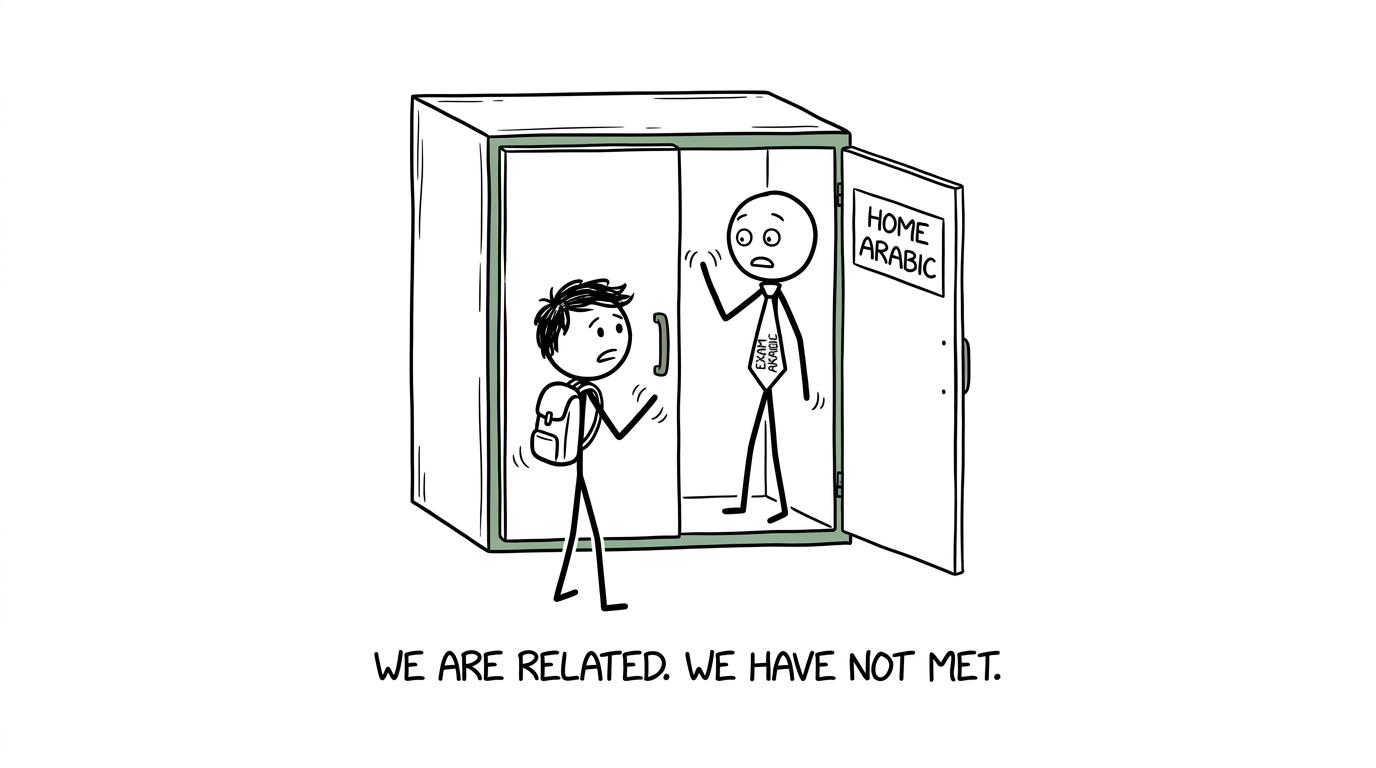 Home Arabic meets formal exam Arabic in an awkward comic introduction
Reading and writing divide opinion
Some students report that writing is predictable once they have prepared adaptable structures and vocabulary. Others identify it as the hardest paper because accurate spelling, grammar and formal expression must all happen at once.
Reading creates a similar split. Strong readers may move through familiar topics comfortably. Students who mainly hear Arabic at home can find longer formal texts slower than expected. Synonyms and unfamiliar vocabulary may obscure a sentence even when its general topic seems obvious.
The sensible conclusion is not that one paper is universally hardest. It is that each student needs evidence from timed practice. Your weakest skill is the one that repeatedly costs you marks, not the one other people complain about most.
Past papers reduce the surprise
One of the clearest themes in student advice is the value of practising real paper formats. Students frequently recommend using past questions for reading and listening, rehearsing likely speaking situations and getting written work marked where possible.
That advice is convincing because language exams test retrieval under pressure. Knowing a word when you see it in notes is different from recognising it once in an audio recording. Being able to explain an opinion slowly is different from doing so during a timed speaking assessment.
The same principle applies to maths. MathsGenie's guide to when to start GCSE past papers explains why paper practice works best in phases rather than as a last-minute event.
So, is GCSE Arabic hard for you?
The most honest assessment depends on your starting point.
If you already read and write standard Arabic
You may find the course relatively accessible, but you still need to learn the paper format. Check whether your grammar, spelling and translation are as strong as your general understanding. Familiarity can produce overconfidence, especially when a question contains several bullet points or requires a particular tense.
If you speak a dialect but rarely use formal Arabic
You have a valuable foundation in listening, pronunciation and vocabulary, but you may need substantial work on reading, formal expression and spelling. Do not treat this as evidence that you are "bad at Arabic". You are adapting knowledge from one context to another.
If Arabic is a new language for you
The course is likely to be challenging because you must develop a new script, vocabulary, grammar and four examination skills. Regular teaching matters. Short, frequent sessions are usually more useful than occasional revision marathons because vocabulary and structures need repeated retrieval.
If Arabic is an extra GCSE taken outside school
The hidden difficulty may be organisation. You need suitable teaching, feedback on writing and speaking, access to the correct assessment, and an exam centre able to conduct the speaking component. Confirm these arrangements early rather than assuming any private centre can accommodate the qualification.
A practical revision approach
Treat Arabic as four connected subjects rather than one large one. Each week should include some listening, speaking, reading and writing, with more time allocated to the skill producing the weakest evidence.
A useful cycle is:
- learn a small, relevant vocabulary set;
- retrieve it without looking;
- use it in speaking or writing;
- attempt an exam-style task;
- check the mark scheme or obtain teacher feedback;
- record the exact error;
- repeat the task later without notes.
For speaking, rehearse flexible answers rather than memorising one rigid script that may not fit the question. For writing, practise accurate sentences across different time frames and ensure every requested bullet point is addressed. For listening, read the question carefully before the recording and train yourself to recover after missing a phrase. For reading, use surrounding words and grammar to infer meaning without inventing details.
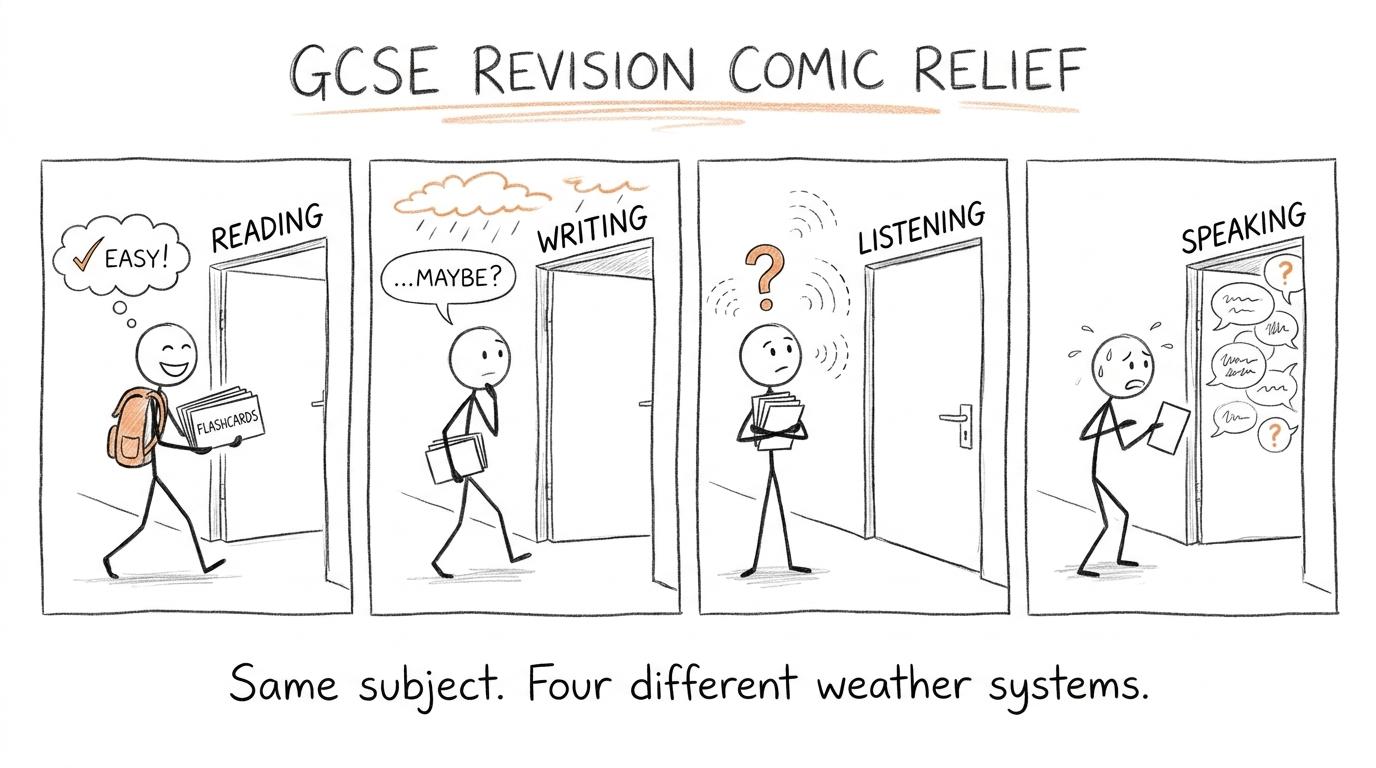 Four GCSE Arabic skills shown as different weather systems
Balancing Arabic with GCSE maths revision
Arabic may be an additional qualification, but maths remains a core GCSE. The danger is allowing the more unfamiliar subject to consume every revision session while maths weaknesses quietly remain untouched.
Build a weekly plan that gives both subjects protected time. The GCSE maths revision timetable guide offers a realistic structure for lessons, targeted questions and timed papers. If exams are close, the one-month GCSE maths revision plan can help you prioritise without trying to revise everything every evening.
Use Arabic vocabulary practice for short daily retrieval sessions. Keep longer blocks for writing, listening and full tasks. Then use the MathsGenie GCSE maths revision hub to choose revision lessons and questions at the right grade and tier.
When a full maths paper feels too large, Edexcel GCSE maths mini tests offer focused timed practice. As you build stamina, move to Edexcel GCSE maths past papers, using the mark schemes and available solutions to identify precise gaps. The same attempt, mark, correct and repeat cycle should shape your Arabic preparation.
Common mistakes when preparing for GCSE Arabic
Assuming home fluency covers every skill
Conversation is an advantage, not proof of examination readiness. Test your formal reading, spelling, writing and translation early.
Revising vocabulary without using it
Recognition alone is fragile. Produce the words in sentences, spoken responses and timed writing so that retrieval becomes dependable.
Memorising answers that do not fit the prompt
Prepared phrases can support fluency, but an elegant response that ignores a bullet point may not earn the expected marks. Answer the exact task first.
Ignoring one quarter of the qualification
Each of the four skills contributes 25%25\%25%. Avoiding listening because it feels uncomfortable or neglecting speaking until the assessment window creates an unnecessary weakness.
Using the wrong qualification's papers
GCSE Arabic and International GCSE Arabic are not interchangeable. Match every resource to your course code, tier and current specification.
Letting an extra GCSE displace core revision
A strong Arabic plan should coexist with maths, English and science. Use a visible timetable and adjust it using evidence from marked work, not whichever subject feels most urgent that evening.
The honest verdict
GCSE Arabic is not automatically easy for Arabic-speaking students, nor is it impossibly hard for everyone else. It becomes difficult when there is a gap between conversational familiarity and the formal language required for reading, writing, translation and structured speaking. Students' experiences repeatedly point to that distinction.
Find your gap early. Use the correct specification, attempt each skill under realistic conditions and seek feedback rather than relying on a general feeling of fluency. Then protect the rest of your GCSE timetable.
For maths, make MathsGenie your free revision base. Start with revision lessons and practice questions, check your work with mark schemes and video solutions, then build towards mini tests, past papers and predicted papers. A difficult subject feels less mysterious once every revision session has a clear next step.