

How to Use Spaced Repetition for A-Level Maths
How to use spaced repetition for A-Level Maths: build a weekly cycle combining retrieval, problem-solving, feedback and focused exam practice.
A student can spend an entire evening rereading integration notes and finish with a reassuring sense of familiarity. Then, two weeks later, the first line of an exam question feels strangely unfamiliar.
That gap is the problem spaced repetition tries to solve. How to use spaced repetition for A-Level Maths comes down to a simple cycle: attempt a topic from memory, check your work, correct the gaps, then return to it after increasingly long intervals. For maths, that means retrieving methods by solving questions, not simply memorising flashcards.
Imagine a hypothetical student, Sam, who swaps repeated reading for this cycle. The total revision time need not increase. What changes is when Sam revisits each topic and what happens during the session.
Your spaced repetition checklist
A practical system needs five parts:
- Divide the specification into manageable topics.
- Begin each review without notes.
- Retrieve knowledge by answering questions.
- Check answers promptly and record errors.
- Revisit weaker topics sooner than secure ones.
- Mix topics once the individual methods are reasonably secure.
You can find topics and exam practice for different specifications through the A-Level Maths revision hub, including dedicated resources for Edexcel A-Level Maths, AQA A-Level Maths and OCR A-Level Maths.
What the research says about spaced repetition
Spacing means distributing encounters with material across separate sessions rather than concentrating them into one block. Retrieval practice means trying to bring knowledge back without first looking at the answer.
Research reviews have repeatedly found benefits from both approaches. A recent meta-analysis focused specifically on mathematics concluded that spaced practice can improve learning for isolated mathematical skills and for material embedded within a course. However, effects vary between studies, tasks and schedules. Spacing is a useful principle, not a guaranteed grade increase.
There is an important difficulty built into the method. Rereading feels fluent because the explanation is already in front of you. Retrieval feels slower because you must reconstruct the idea. That struggle can reveal what you actually know.
Sam's old routine produced smooth evenings. The new routine produces occasional blank pages. Those blank pages are more informative: they show which definitions, formulae or procedures need another encounter.
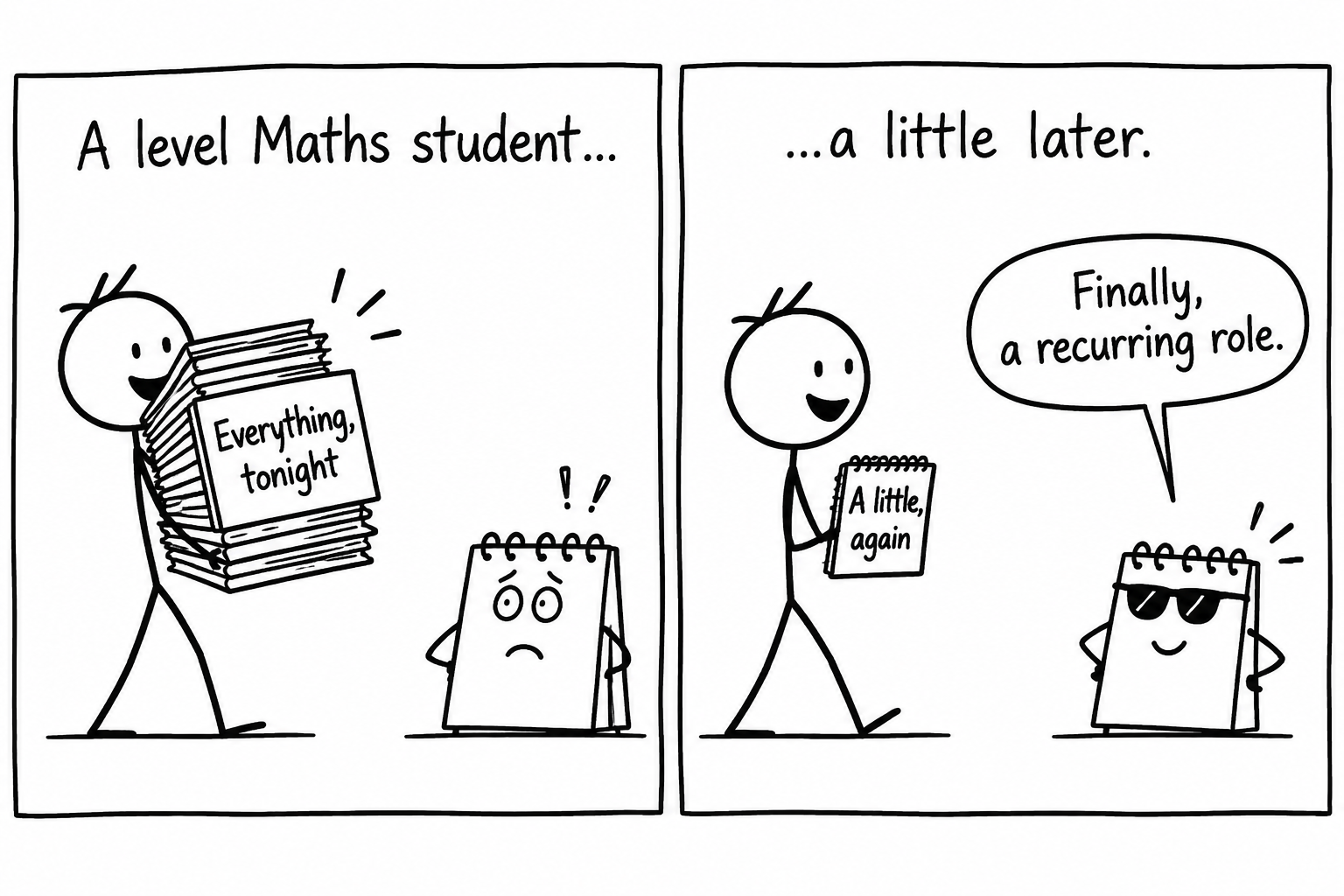 A student replaces one enormous revision session with smaller repeated sessions
How to use spaced repetition for A-Level Maths
Build a topic list from your specification
Avoid treating Pure Maths, Statistics and Mechanics as three enormous tasks. Break them into units such as differentiation, trigonometric identities, hypothesis testing, moments and kinematics.
Mark each topic:
- Red: you cannot begin a typical question unaided.
- Amber: you know the method but make errors or need prompts.
- Green: you can solve mixed exam questions accurately.
These labels must change when the evidence changes. A topic is not green because its notes look familiar. It is green because you can retrieve and apply the relevant ideas after a gap.
Use flexible review intervals
A simple starting schedule is to revisit a topic after approximately 111, 333, 777 and 141414 days. These are not scientifically perfect intervals. No single schedule is best for every student, topic or examination date.
Adjust the gap according to performance:
- If you could not start, review the explanation and return the next day.
- If the method was correct but accuracy was weak, return within a few days.
- If you solved unfamiliar questions accurately, extend the interval.
The schedule should respond to your answers rather than advancing automatically.
Retrieve by doing mathematics
Flashcards can help with formulae, conditions and definitions. You might use them to recall when a binomial model is appropriate or the assumptions behind a statistical test. But flashcards alone cannot establish whether you can select and execute a multi-stage method.
A spaced maths session might contain:
- A two-minute recall of key facts or method stages.
- Two routine questions completed without notes.
- One less familiar or mixed question.
- Immediate checking against worked solutions or a mark scheme.
- A brief record of the precise error.
Use MathsGenie A-Level resources to move from revision material into worksheets, practice questions and past papers. Video solutions can help when a correction alone does not explain why your approach failed.
Record errors precisely
“Bad at differentiation” is too broad to guide the next session. Write the smallest useful diagnosis instead:
- forgot to use the product rule;
- differentiated anx an xanx incorrectly;
- lost the constant when integrating;
- formed the right equation but made an algebraic error;
- used a calculator value before changing to radians.
Sam begins to see that several lost marks come from algebra inside calculus questions, not from calculus itself. The next review can now target the real weakness.
A sample week of spaced repetition revision
This sample assumes that differentiation is weak, trigonometry is developing and statistical distributions are relatively secure.
| Day | Main session | Spaced return |
|---|---|---|
| Monday | Learn or repair differentiation techniques | Attempt two questions without notes |
| Tuesday | Trigonometric equations | Reattempt Monday's hardest differentiation question |
| Wednesday | Statistical distributions | Complete a short mixed differentiation set |
| Thursday | Mechanics topic practice | Retrieve Tuesday's identities and solve one equation |
| Friday | Mixed Pure Maths questions | Correct errors from Wednesday and Thursday |
| Saturday | Timed exam section | Classify mistakes and schedule the next reviews |
| Sunday | Light review or rest | Brief recall only for topics due that day |
Each return is short. The purpose is not to complete an entire chapter four times. It is to test whether knowledge remains available after a delay.
Build this pattern around your own exam dates with the MathsGenie Revision Planner instead of maintaining every interval by hand.
When to add interleaving and past papers
Spacing decides when you return. Interleaving changes what you encounter together.
After practising differentiation in isolation, mix it with integration, coordinate geometry and trigonometry. Now you must identify the method from the structure of the question. That decision is part of A-Level Maths and is easily hidden when a worksheet announces the technique in its title.
Timed past papers belong later in the cycle, once you have repaired major topic gaps. Mark them honestly, using the official mark scheme where available, and convert every meaningful error into a future review. Predicted papers can provide additional exam-style practice, but they do not predict every question that will appear.
If you are returning to the qualification after an earlier result, the same diagnosis-first principle appears in the A-Level Maths resit revision plan.
Common spaced repetition mistakes
Rereading on a spaced schedule
Reopening the same notes every few days distributes exposure, but it does not adequately test retrieval. Close the notes before attempting the question.
Treating every topic equally
Equal intervals look tidy but waste time. Weak topics need earlier returns; secure topics can wait longer.
Reviewing answers without correcting them
A mark scheme tells you that an answer is wrong. Improvement requires identifying why it was wrong and then completing a fresh attempt.
Spacing before understanding
Retrieval cannot replace the initial teaching of an unfamiliar idea. If you do not understand a method, use a revision lesson or video solution first. Then begin spacing your independent attempts.
Ignoring full exam questions
Remembering a formula is not the same as recognising where it applies. Your later reviews should include unfamiliar, mixed and timed questions.
The honest limits of the technique
Spaced repetition will not compensate for missing lessons, unresolved misconceptions or too little question practice. It also creates a planning cost: several topics may become due on the same day, especially if every mistake is scheduled immediately.
Keep sessions realistic. Prioritise red topics, move secure material further apart and leave room for full papers. Near the examination, the gaps naturally shorten because there is less time available, but sleep and careful correction remain more valuable than an exhausted final-night marathon.
Turn the method into a schedule
Sam's real improvement is not a miraculous change in ability. It is a change from deciding what to revise each evening to following a repeatable cycle of retrieval, feedback and return. You now have that cycle, but exams have fixed dates and every week without a workable plan reduces the time available to revisit difficult topics.
Build your spaced repetition schedule in the MathsGenie Revision Planner.















