

How to Revise with a Part-Time Job
How to revise with a part-time job using a realistic weekly plan, focused study blocks and flexible routines for GCSE and A Level exams.

A Saturday shift can look harmless on a timetable. Then travelling takes an hour, you arrive home tired, and the revision you planned becomes another task moved to Sunday.
For a GCSE or A Level student, that pattern can create a worrying question: is it possible to work and prepare properly for exams?
The practical answer to how to revise with a part-time job is to plan around your fixed shifts, protect a small number of focused sessions and use active tasks rather than counting vague revision hours. You do not need to fill every free evening. You need a weekly routine that still works when work is busy and your energy is limited.
Imagine a student called Sam. Sam works one evening and most of Saturday. The first timetable treats those hours as an inconvenience. The better timetable treats them as facts. That small change makes the plan more honest and much easier to follow.
A simple revision and work checklist
Before building your schedule:
- enter school, college, work shifts and travel time first;
- identify the times when you usually have the most energy;
- choose specific topics rather than writing only “revise maths”;
- use short, active sessions on workdays;
- reserve longer exam practice for a day without a shift;
- include one catch-up block each week;
- protect sleep, meals and genuine rest;
- review the plan whenever your rota changes.
The aim is not a perfectly balanced week. Part-time rotas rarely produce one. The aim is a repeatable system.
Build the timetable around fixed commitments
Start with what cannot move: lessons, travel, shifts, meals and sleep. Revision fits around those commitments, not the other way round.
Suppose Sam works on Wednesday evening and Saturday. A realistic framework might look like this:
| Type of day | Suitable revision |
|---|---|
| School day without work | One or two focused topic sessions |
| School day with a shift | A short recall or mini-test session |
| Main workday | Rest, or a brief task before work if energy allows |
| Day without school or work | A longer practice session or past paper |
| Weekly catch-up period | Reschedule one missed priority task |
This is a framework, not a required number of hours. GCSE and A Level students have different subjects, journeys, rotas and responsibilities. A timetable copied from somebody else may look impressive while being impossible in your week.
For a more detailed structure, use the GCSE maths revision timetable guide alongside this job-specific approach. The important principle is the same: start with reality, then assign work you can complete.
Match each task to your energy
Time is only half of revision planning. Energy matters too.
After a demanding shift, beginning an unfamiliar A Level topic may be unrealistic. That does not make the evening useless. It means the task should be smaller. You might retrieve formulae from memory, complete a mini test or correct questions marked earlier.
Save demanding work for your stronger periods. This may include:
- learning an unfamiliar method;
- completing mixed practice questions;
- attempting a timed paper;
- analysing several mistakes from a mark scheme.
Use lower-energy periods for lighter but purposeful tasks:
- recalling definitions or formulae;
- watching a revision lesson linked to one weak skill;
- correcting a short set of questions;
- organising the next session;
- reviewing previously completed errors.
This distinction helps Sam avoid a common trap. The question stops being “Can I force myself through two hours tonight?” and becomes “What useful task fits the energy I actually have?”
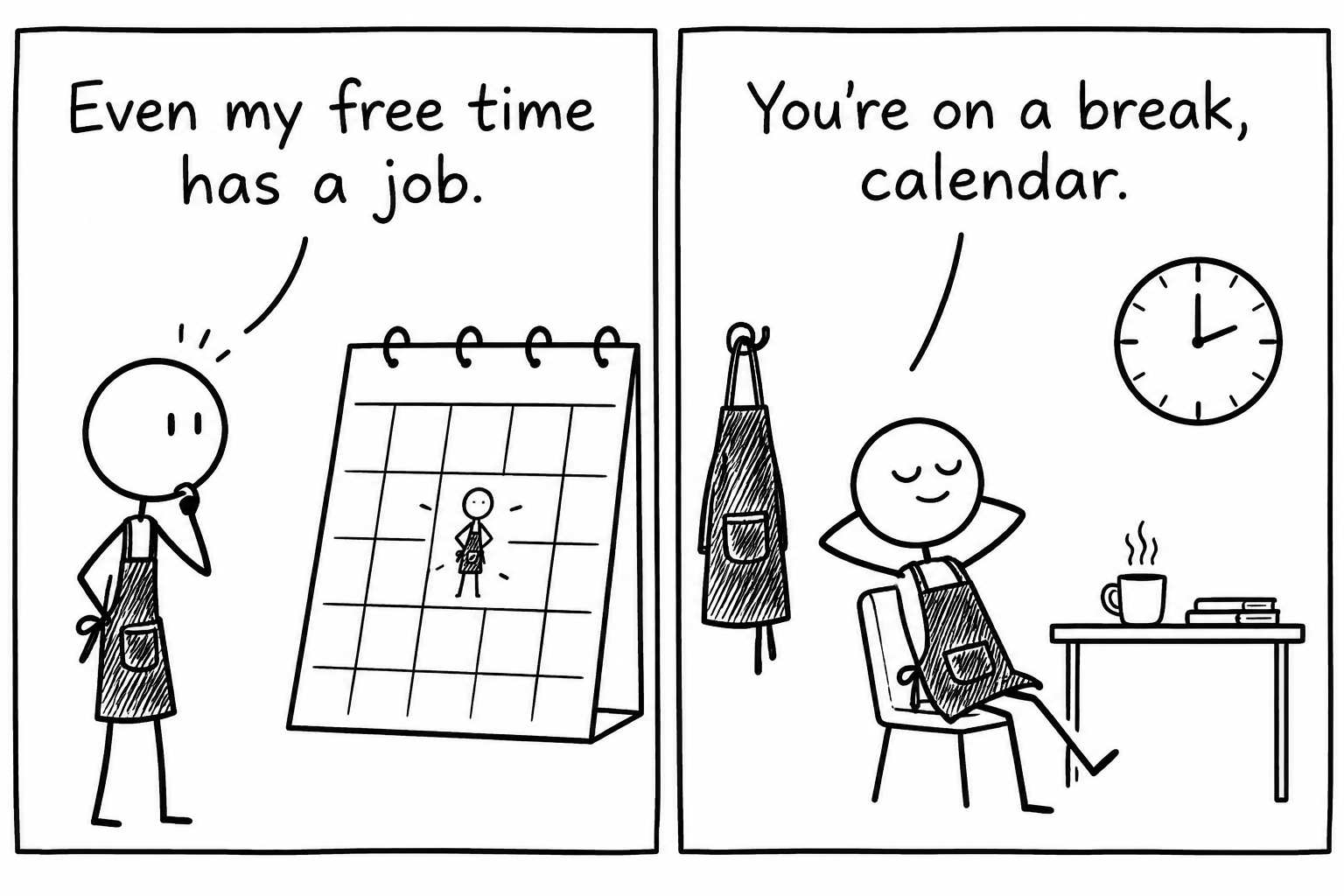 A student gives their crowded calendar a well-earned break
Use short blocks with precise outcomes
A short session can be valuable when its outcome is clear. “Do revision” has no finish line. “Complete ten questions on simultaneous equations and mark them” does.
A useful workday session has three parts:
- Recall: write down what you remember without notes.
- Practise: answer carefully selected questions.
- Check: use the mark scheme or video solution and record errors.
For maths, this might mean opening the relevant GCSE maths revision resources, reviewing one lesson and then completing its practice questions. An A Level student can follow the same cycle through the A Level maths revision materials.
The study technique matters because passive familiarity can be misleading. Reading a solution may make it feel obvious, but an exam asks you to produce the method yourself. Close the notes, attempt the question and then check. What you can retrieve and apply is more useful evidence than what you recognise on a page.
Once you have mapped fixed shifts, high-energy blocks and lighter workday tasks, the MathsGenie Revision Planner can turn that structure into a schedule without requiring you to keep redrawing it by hand.
Plan by priority, not guilt
Students balancing employment often respond to limited time by trying to cover everything equally. That can spread attention too thinly.
Instead, classify topics using three questions:
- Is this topic likely to appear within my specification?
- How secure am I when answering it without help?
- What did recent practice show?
Weak, important topics should receive the best available sessions. Secure topics still need revisiting, but usually through shorter checks. If a difficult algebra topic repeatedly causes lost marks, it deserves more attention than a topic you can already complete reliably.
Past papers help reveal these priorities. Use GCSE maths past papers when you are ready to combine topics, but do not simply record a total mark. Separate mistakes into missing knowledge, an incorrect method, misreading and avoidable arithmetic errors. Your next week should respond to that evidence.
Make the plan flexible enough to survive work
A rota can change. A shift may run late. You may be asked to cover for someone. A rigid timetable interprets every disruption as failure; a resilient one already knows what happens next.
Create these rules before you need them:
- If a short session is missed, move only its highest-priority task.
- Do not double the next day automatically.
- Use the weekly catch-up block before sacrificing sleep.
- If several tasks are missed, reduce the plan rather than endlessly moving them.
- Rebuild the next week around the confirmed rota.
This is especially important near exams. Every week without a workable plan loses useful preparation time, but panic does not create more hours. Clear priorities do.
Parents can help by discussing the rota calmly and protecting agreed revision periods. It is usually more useful to ask, “Which task matters most this week?” than to focus only on the total number of hours completed.
Common mistakes when combining revision and a job
Treating every free hour as available
Travel, food, sleep and recovery are real needs. Ignoring them produces an attractive timetable that quickly collapses.
Scheduling the hardest topic after every shift
Ambition is useful, but timing matters. Put demanding topics into your strongest periods and use workday evenings for shorter retrieval and checking.
Measuring effort only in hours
A long session spent highlighting can achieve less than a short set of questions followed by careful marking. Measure completed outcomes and corrected errors as well as time.
Using work as the explanation for every missed task
Employment does reduce available time, but a plan should distinguish genuine constraints from avoidable distractions. Keep the judgement neutral: notice what happened, then adjust the next block.
Removing all rest before reducing revision
Rest is not unused revision time. A tired student may take longer, make more errors and retain less. When the week becomes overloaded, remove low-priority tasks before cutting essential sleep.
Build a schedule that fits your shifts
Sam’s improvement does not come from finding hidden hours. It comes from stopping the weekly argument with an unrealistic timetable. The remaining challenge is turning sensible priorities into a schedule you can continue following as shifts and exams approach.
You have seen how the plan works: enter fixed commitments, match tasks to your energy and keep a catch-up block. Now build your shift-friendly schedule in the MathsGenie Revision Planner.















