How to Revise Between Exams in May and June
How to revise between exams in May and June: prioritise upcoming papers, use focused practice, protect sleep and build a realistic schedule for GCSEs and A Levels.
Imagine coming home after a difficult morning paper. Your phone is full of answer comparisons, tomorrow’s subject is waiting, and next week’s exams suddenly feel closer.
If you are wondering how to revise between exams in May and June, use a rolling plan: recover briefly, prioritise the next exam, keep later subjects ticking over, and practise recalling and applying knowledge. Update your priorities after each paper rather than rebuilding your timetable.
The aim is to reach each remaining exam prepared, with enough energy to think clearly.
Your between-exams checklist
Before choosing today’s revision, check:
- Which exams come next, including the exact component?
- What time remains after school, travel, meals and sleep?
- Which weaknesses could you realistically improve?
- What small task will keep a later subject familiar?
- When will you stop for the evening?
MathsGenie’s GCSE revision timetable guide covers building a sustainable routine. Here, the focus is adapting it once exams have started.
Close the finished paper before opening the next
Comparing answers might help you decompress briefly. An afternoon spent estimating lost marks leaves less attention for tomorrow.
Give yourself a transition: eat, drink, walk or sit away from your desk. Then check your next task. You do not need to restart revision immediately.
Record one useful reminder from the paper, such as checking units. Avoid turning uncertain memories into a predicted grade. If illness or a serious problem affected the exam, tell your school promptly so they can advise you.
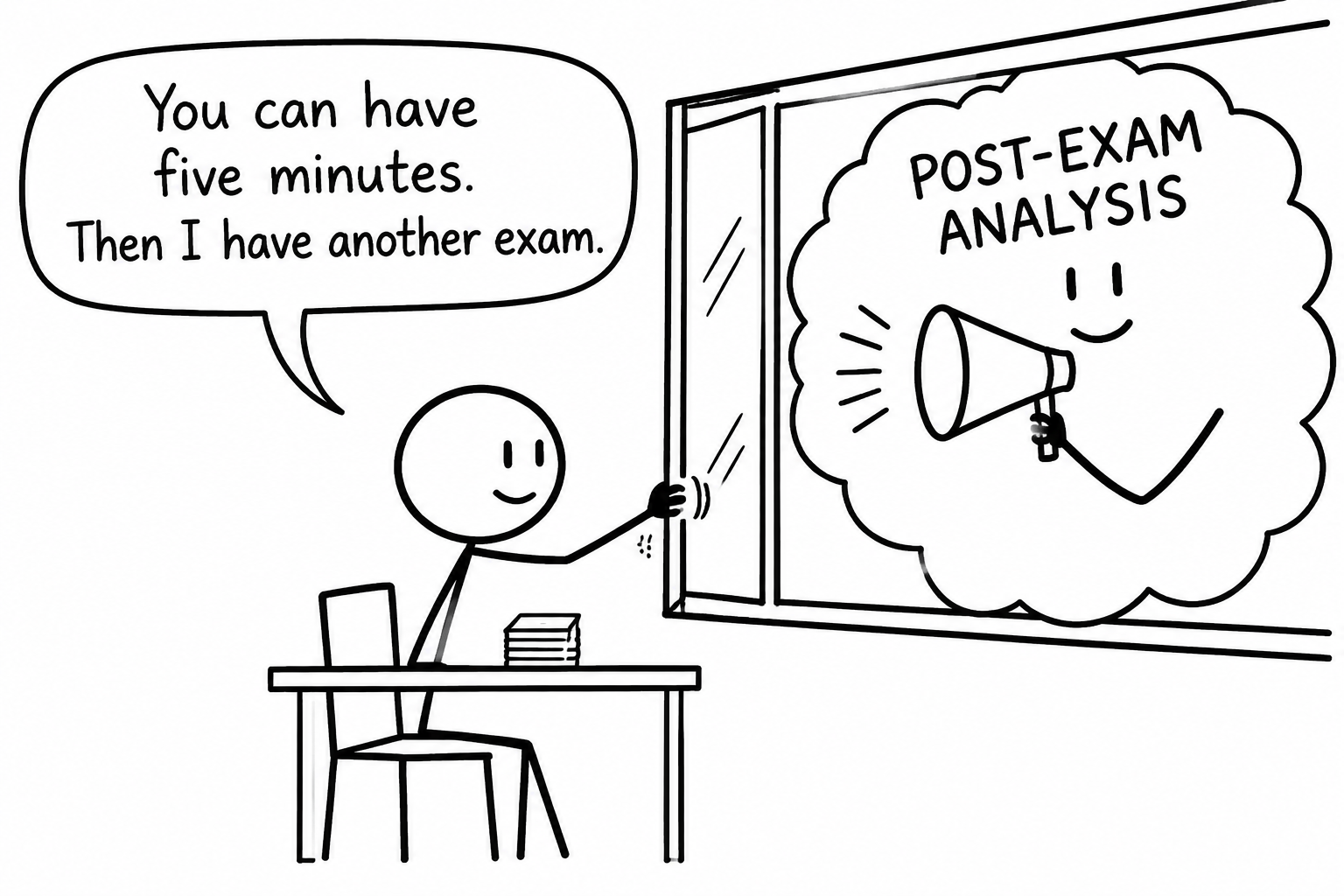 Stick-figure student setting a boundary with a noisy cloud labelled post-exam analysis
Plan the next few days in detail
Keep all remaining exams visible, but give the nearest days the most detail. Start with fixed commitments: exams, lessons, travel and school revision sessions. Protect meals, breaks and bedtime, then allocate usable gaps to specific tasks.
Write “attempt and mark probability questions” rather than “maths revision”. A task with a clear finish is easier to begin and evaluate.
Give each remaining subject a place
Use three priorities:
- Next exam: your main focus, especially weaknesses you can realistically improve.
- Following exam: a smaller preparation slot so it does not become tomorrow’s emergency.
- Later exams: brief recall or practice to keep material familiar.
If biology is tomorrow, maths follows shortly afterwards and history is next week, biology gets your freshest slot. Maths gets focused questions; history gets a short recall check.
Remove completed components and redistribute their slots. Check what each remaining paper assesses against your specification and teacher guidance. The Revision Planner can help organise those exams and available sessions.
Match revision to the gap available
The time between papers changes what is sensible. These are starting points, not compulsory targets.
| Gap before the next exam | Useful approach |
|---|---|
| Another exam the same day | Recover, eat and review a familiar checklist if helpful. Avoid starting a large new topic. |
| An exam tomorrow | Prioritise recall, common errors and selected questions. Allow time for marking and sleep. |
| A few clear days | Diagnose weaknesses, repair them, then revisit them through mixed practice. |
| A longer gap | Spread practice across several days while maintaining other subjects. |
After a tiring exam day, make the plan lighter. For broader workload decisions, the guide to GCSE revision hours explores how to balance revision time. Begin with the work needed and energy available.
Use practice that reveals what you know
Reading feels reassuring because material looks familiar. The exam asks you to retrieve and use it independently.
Use a simple cycle:
- Attempt a question, explanation or essay plan without notes.
- Check against a mark scheme or reliable course material.
- Identify the gap: knowledge, method, interpretation or timing.
- Review what is needed to repair it.
- Retry independently, then revisit later if time allows.
MathsGenie’s free GCSE maths resources provide revision materials and exam-board routes. Choose your board and foundation or higher tier before selecting questions.
Use the A Level maths revision resources for relevant practice in pure maths, statistics or mechanics, according to your specification and remaining components.
When a method needs explanation, use revision lessons or video solutions. Afterwards, close the solution and attempt a fresh question to check your understanding.
Choose practice you have time to review
A full past paper helps with timing, stamina and choosing methods, but also needs marking time. Starting late can leave a score without an opportunity to learn.
For shorter sessions, target a weakness or use GCSE maths mini tests where appropriate. Mark the work and retry the skill.
Past papers and mark schemes help you practise your qualification’s demands. Predicted papers offer additional practice, but cannot guarantee questions. Keep revising specification content even if it appeared earlier or is absent from a prediction.
Common mistakes during May and June
Revising only tomorrow’s subject. Reserve a small slot for the following exam.
Rebuilding the timetable after every setback. Move unfinished work according to urgency and value.
Skipping marking. Include review time within each practice session so repeated errors become visible.
Borrowing time from sleep. Set a stopping time and prepare your equipment before winding down. Avoid all-night cramming.
Treating exhaustion as laziness. Take a break when concentration collapses. Seek support from a trusted adult or school if distress persists.
How parents can help
Ask what practical help would be useful: a meal, quiet room, transport or requested quiz. Agree a check-in instead of repeatedly asking whether revision has started. After a difficult paper, listen before offering solutions.
Give the next session a clear purpose
You cannot change a finished paper, but you can choose a useful next task. Combine MathsGenie’s free practice resources with the Revision Planner to give each remaining exam a place and each session a purpose.