How to Plan Revision Around Mocks | MathsGenie
Learn how to plan revision around mocks: prioritise weak topics, balance subjects and organise manageable sessions with a clear plan for students and parents.
Picture a student opening their mock timetable after school. Three exams are close together, homework is still arriving, and every subject seems equally urgent. Their parent suggests making a plan. The student wonders where to begin.
The practical answer to how to plan revision around mocks is to work backwards from each paper, prioritise weaknesses within the assessed content, and book manageable sessions that include practice, marking and a later retry. Keep some time free for delays. Once mocks begin, adjust the plan after each paper without abandoning the subjects still ahead.
You need a plan that makes tomorrow’s revision clear, even when today has been tiring.
Get the mock dates and scope onto one page
Before choosing revision sessions, gather the information that determines what deserves your time:
- The date and subject of each mock paper.
- The topics your teachers say will be assessed.
- Your exam board and, for GCSE maths, foundation or higher tier.
- School, homework, activities and other fixed commitments.
- Recent tests or marked work showing where you need help.
Ask your teacher about anything uncertain. Schools decide their mock arrangements, so the content may differ from a complete final examination series.
For the broader weekly structure, use the GCSE revision timetable guide. This article focuses on the extra decisions mocks create: competing deadlines, limited preparation time and what happens between papers.
How to plan revision around mocks without overloading yourself
Prioritise using evidence
The student in our opening scenario might start with their favourite subject because it feels comfortable. That makes beginning easier, but it can leave the biggest gaps untouched.
For each subject, identify topics you can answer independently, topics where you make occasional mistakes, and topics where you cannot yet start. Use recent questions to judge this. Recognising a page of notes can feel reassuring without showing whether you can retrieve the knowledge.
Give extra attention to weaknesses that appear in an early mock or underpin several other topics. Keep brief checks for stronger areas so they stay accessible. For A Level students, this also means checking that an earlier skill is secure before allocating a whole session to a more demanding application.
Plan backwards in stages
Use the time you actually have. The following structure works whether your preparation window is several weeks or much shorter, although a short window means choosing fewer priorities.
| Stage | Main task | Evidence to keep |
|---|---|---|
| Earlier preparation | Repair important gaps using explanations and focused questions | Questions you can now answer independently |
| Middle preparation | Mix topics and revisit earlier weaknesses | Marked attempts and recurring errors |
| Final days before a paper | Practise relevant timed questions and check remaining uncertainties | A short list of reminders |
| During mocks | Prepare for the next papers and make brief adjustments | The next session’s clear task |
Put the earliest exams into your calendar first, then protect sessions for later subjects. Otherwise, the first paper can absorb all your attention.
Build your mock schedule in the Revision Planner to put these priorities around the days and minutes you have available.
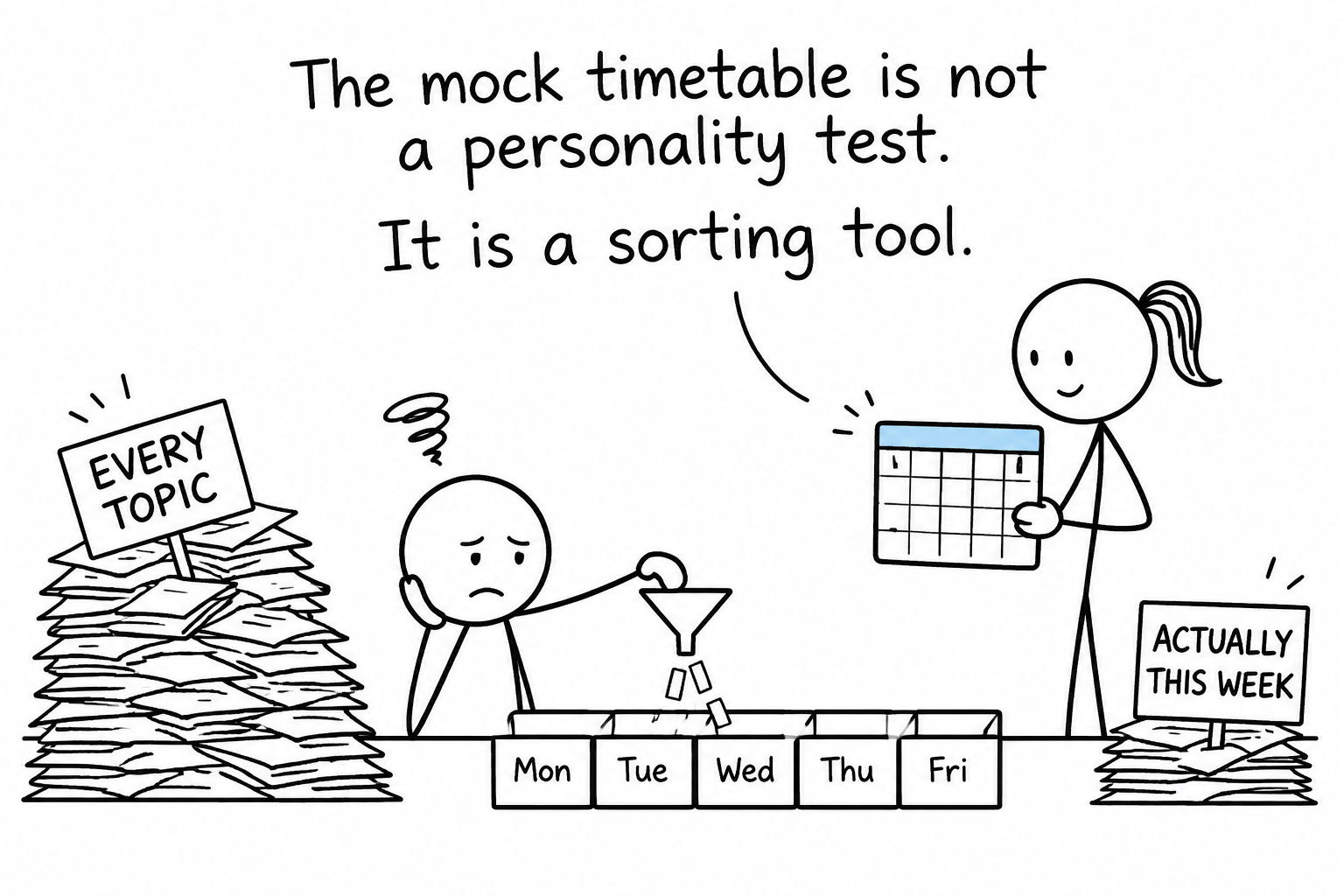 Stick-figure student and parent sorting an overwhelming pile of topics into a manageable weekly calendar
Make every session produce something useful
“Revise maths” leaves too many decisions until you are already tired. A more useful entry names the topic, resource and finish point: attempt a question set, mark it, then record the errors to revisit.
A reliable study technique is to attempt work from memory before checking your notes. If you cannot begin, use a short explanation, close it and try again independently. Return to the topic on another day. Retrieval practice and spaced practice help make your revision more durable than repeatedly rereading the same material.
MathsGenie’s GCSE maths revision resources provide questions and papers for checking understanding. Students preparing for sixth-form mocks can use the A Level maths resources to find materials for their course and exam board.
Match the resource to the problem. Revision lessons can clarify an unfamiliar method; practice questions test whether you can use it. Mark schemes and video solutions help you investigate mistakes after a genuine attempt. A full paper becomes more useful when you have time to mark it and act on the result.
For allocating those sessions across a week, the maths revision timetable guide covers the wider routine. Keep your mock plan focused on the next assessed topics.
Adjust the plan during mock week
After a difficult paper, it is tempting to spend the evening reconstructing every answer. Record any useful learning briefly, then return to the exams still ahead. A prolonged discussion about a finished paper can consume the preparation time for tomorrow’s.
On a day with several exams, make the evening workload lighter. Choose a small amount of targeted recall or question practice, prepare your equipment and preserve your normal bedtime.
If you miss a session, use a spare slot or move the most valuable task forward. Avoid doubling the next evening automatically. The guide to GCSE revision hours explores workload in more detail; around mocks, the immediate question is what you can complete attentively alongside school and recovery.
Common mistakes students and parents can avoid
Giving every subject identical time. Equal-looking boxes can hide unequal needs. Balance exam dates, current understanding and the amount of assessed content.
Scheduling practice without marking. Leave enough time to identify why an answer went wrong and attempt it again later.
Rewriting the whole timetable after one bad day. Keep the structure and change the next few tasks. Constant redesign can become another way to postpone revision.
Treating predicted papers as a forecast. Use them as additional practice where appropriate. Your teacher’s stated mock coverage should guide your preparation.
Parents can help by asking, “What will you finish in this session?” and helping protect a quiet space. When results arrive, look together for specific next steps rather than judging the plan by a grade alone.
Build a schedule you can follow through mocks
Our hypothetical student now has a smaller job each evening: a named task, a finish point and space to adjust when school gets busy. You have the same structure; the remaining step is putting it into your own calendar. Build your schedule around your mock dates and available time in the Revision Planner.