

How to Get Grade 8 in GCSE Astronomy
How to get grade 8 GCSE Astronomy: improve recall, maths, observation and exam technique with a focused revision plan designed to secure stronger marks.
A student can know why stars evolve, recognise the phases of the Moon and explain redshift, yet still lose marks through weak calculations, vague evaluations or forgotten units. That is what makes GCSE Astronomy demanding: knowledge matters, but knowledge alone is not enough.
The short answer to how to get grade 8 GCSE Astronomy is to revise for application rather than recognition. Learn the specification precisely, strengthen the maths behind astronomical ideas, practise interpreting unfamiliar data and turn every past-paper mistake into a specific action. Grade 888 performance comes from making these habits routine.
Your grade 8 checklist
Focus your revision around six priorities:
- cover every specification statement rather than revising only favourite topics;
- retrieve facts from memory before checking notes;
- become fluent with formulae, units, graphs and standard form;
- practise applying familiar ideas in unfamiliar contexts;
- understand how to design, analyse and evaluate observations;
- complete timed questions, mark them carefully and revisit mistakes.
This is not a promise of a particular boundary. Grade boundaries are set for each examination series, so there is no permanent mark that guarantees a grade 888. Your aim should be to build enough accuracy and flexibility to perform strongly across both papers.
Understand what the GCSE Astronomy papers demand
The current Pearson Edexcel GCSE Astronomy qualification, specification 1AS01\mathrm{AS}01AS0, is untiered. Every student takes the same two externally examined papers:
- Paper 111: Naked-eye Astronomy, covering Topics 111 to 888;
- Paper 222: Telescopic Astronomy, covering Topics 999 to 161616.
Each paper lasts 111 hour 454545 minutes, carries 100100100 marks and contributes 50%50\%50% of the qualification. Questions can include multiple choice, short responses, calculations, graphs and extended open responses. A calculator and the relevant formulae and data sheet are provided.
The assessment objectives reveal why passive revision has a ceiling. AO1, knowledge and understanding, accounts for 40%40\%40%. AO2, applying that knowledge, also accounts for 40%40\%40%. AO3, analysing and evaluating information, observations and methods, contributes 20%20\%20%.
In other words, remembering a definition is only the beginning. A grade 888 candidate must use it.
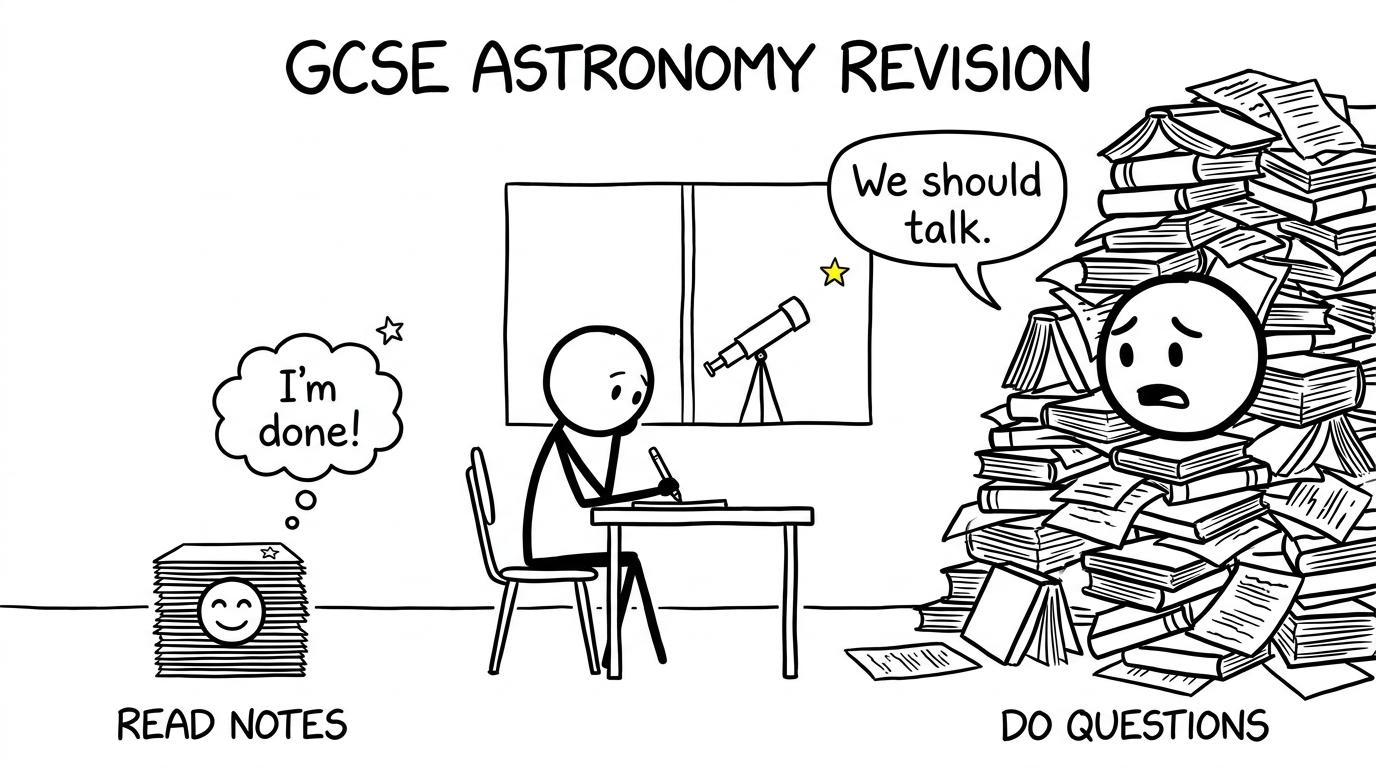 A student discovers that question practice is larger than the notes pile
Replace rereading with active recall
Rereading feels productive because the page becomes familiar. Unfortunately, familiarity can disguise weak recall. The exam removes the page.
Turn each specification statement into a question. Instead of reading about stellar evolution again, close the book and reconstruct the possible pathways for stars of different initial masses. Instead of highlighting telescope notes, compare refracting and reflecting telescopes from memory, including their limitations.
A strong topic session has three stages:
Retrieve
Write or say everything you can remember without support. Use blank diagrams, flashcards or short verbal explanations. This exposes gaps while there is still time to repair them.
Check
Compare your response with the specification, trusted notes and the wording used in mark schemes. Correct missing scientific vocabulary, but do not copy whole pages.
Apply
Answer questions that force you to select the relevant idea. This is the stage most likely to develop AO2 and AO3 performance.
Space your retrieval across several days. A topic successfully recalled once is not necessarily secure; returning to it after a delay tells you whether it has entered long-term memory.
Make mathematical skills dependable
At least 20%20\%20% of the marks across the written assessments reward mathematical skills. Astronomy places those skills inside scientific contexts, where a calculation may involve unfamiliar units or very large distances.
Your core list should include:
- standard form and powers of 101010;
- ratios, percentages and proportional reasoning;
- inverse-square relationships;
- rearranging and substituting into formulae;
- logarithms to base 101010;
- unit conversions involving astronomical units, light-years, parsecs and megaparsecs;
- graph plotting, gradients, interpolation and interpretation;
- significant figures and sensible rounding;
- geometry and trigonometry.
The formula sheet reduces memorisation, but it does not choose the equation, rearrange it or interpret the answer for you. You should be comfortable recognising structures such as Kepler’s third law,
T2r3=constant,\frac{T^2}{r^3}=\text{constant},r3T2=constant,the telescope magnification relationship,
magnification=fofe,\text{magnification}=\frac{f_o}{f_e},magnification=fefo,and the distance modulus formula,
M=m+5−5log10(d).M=m+5-5\log_{10}(d).M=m+5−5log10(d).Build fluency through MathsGenie’s free lessons and questions on standard form, direct and inverse proportion and SOHCAHTOA trigonometry. Although these pages teach GCSE Maths, the underlying skills transfer directly to astronomical calculations.
Keep units beside values throughout your working. Show substitutions before using your calculator, retain unrounded values until the final line and check whether the result is physically plausible.
Treat observational skills as examinable knowledge
Students must undertake two astronomical observational activities: one unaided and one aided. Their value reaches beyond completing the course requirement. Knowledge and application of observational work account for at least 15%15\%15% of the written examination marks.
Learn observation as a cycle:
- Design: identify the purpose, location, timing, equipment, variables and safety considerations.
- Observe: record measurements and relevant conditions accurately.
- Analyse: process the evidence, identify patterns and draw a supported conclusion.
- Evaluate: discuss limitations, reliability and realistic improvements.
Generic evaluation phrases rarely earn strong marks. “Repeat the observation” is incomplete unless you explain how repetitions help, such as reducing the influence of random variation or allowing a mean to be calculated. An improvement must address a named weakness in the method or data.
Create an observation bank containing common difficulties: cloud cover, light pollution, poor angular resolution, limited observation time, atmospheric turbulence and uncertainty in estimating positions or brightness. For each one, practise linking the limitation to its effect on the evidence and then to a practical improvement.
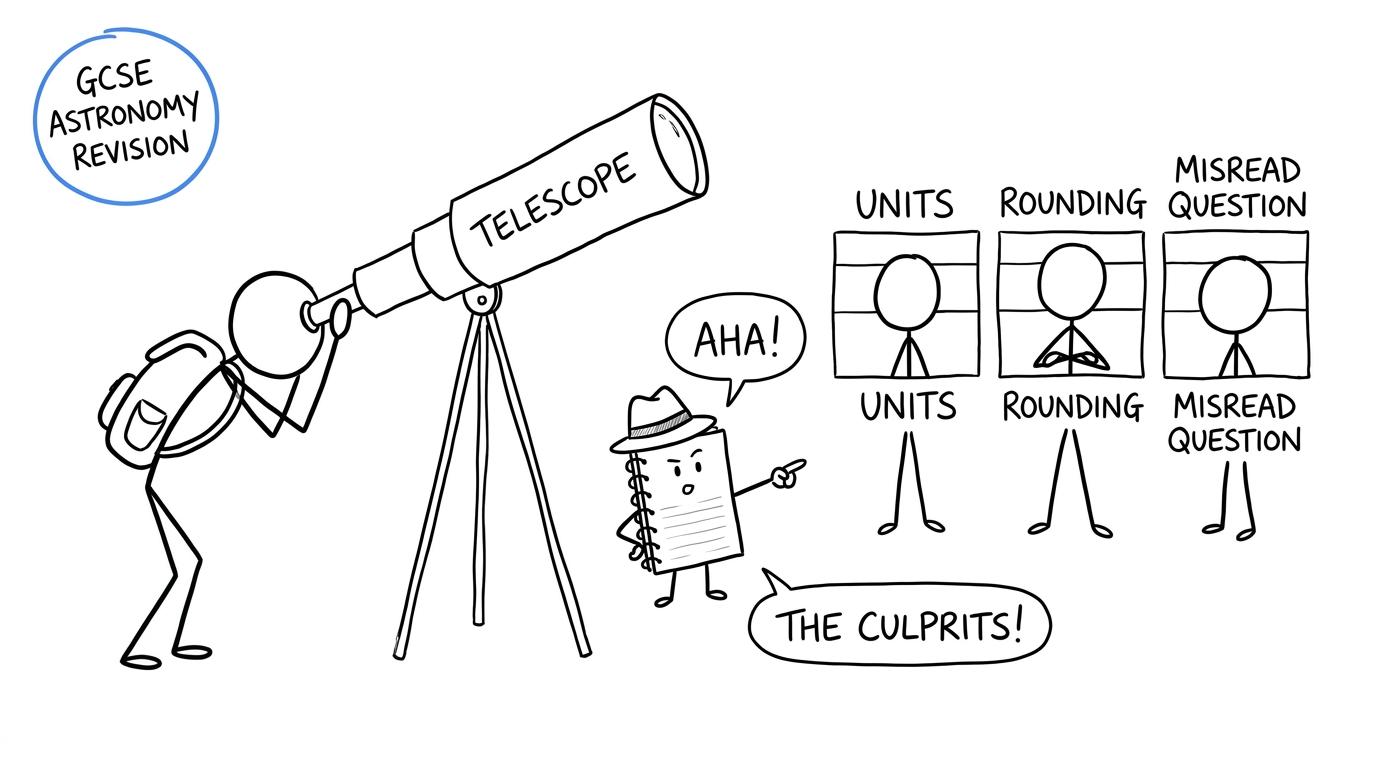 An error log investigates units, rounding and misread questions
Use an error log that changes what you do
A score tells you what happened. An error log tells you what to do next.
After every question set, classify each lost mark:
- knowledge: a fact, process or definition was missing;
- application: you knew the idea but did not connect it to the context;
- mathematics: the equation, rearrangement, unit or calculator work failed;
- data handling: a graph, table or conclusion was misinterpreted;
- communication: the response lacked a comparison, explanation or judgement;
- timing: the question was rushed or left unfinished.
Then write one precise repair. “Revise cosmology” is too broad. “Distinguish cosmological redshift from Doppler shift, then answer three comparison questions” creates an action.
Reattempt the question without notes after a short delay. MathsGenie’s guide to using GCSE past papers properly explains the same mark, diagnose, repair and retest cycle for maths papers. The habit transfers well to Astronomy, even though you must obtain Astronomy papers from your school or the official awarding body.
Practise explanations as chains of reasoning
Extended answers are not won by writing everything you remember. They are won by selecting connected ideas.
Build responses around a clear chain:
- make a relevant scientific statement;
- explain why it is true;
- connect it to the evidence or context in the question;
- evaluate limitations if the command word requires it;
- finish with a justified conclusion.
Pay attention to command words. “State” needs a concise fact. “Explain” requires linked reasoning. “Compare” needs both sides of the comparison. “Evaluate” requires strengths, limitations and a reasoned judgement.
When interpreting data, quote relevant values where appropriate and describe what the evidence shows before explaining why. MathsGenie’s scatter graphs revision can reinforce correlation, anomalous results and cautious conclusions.
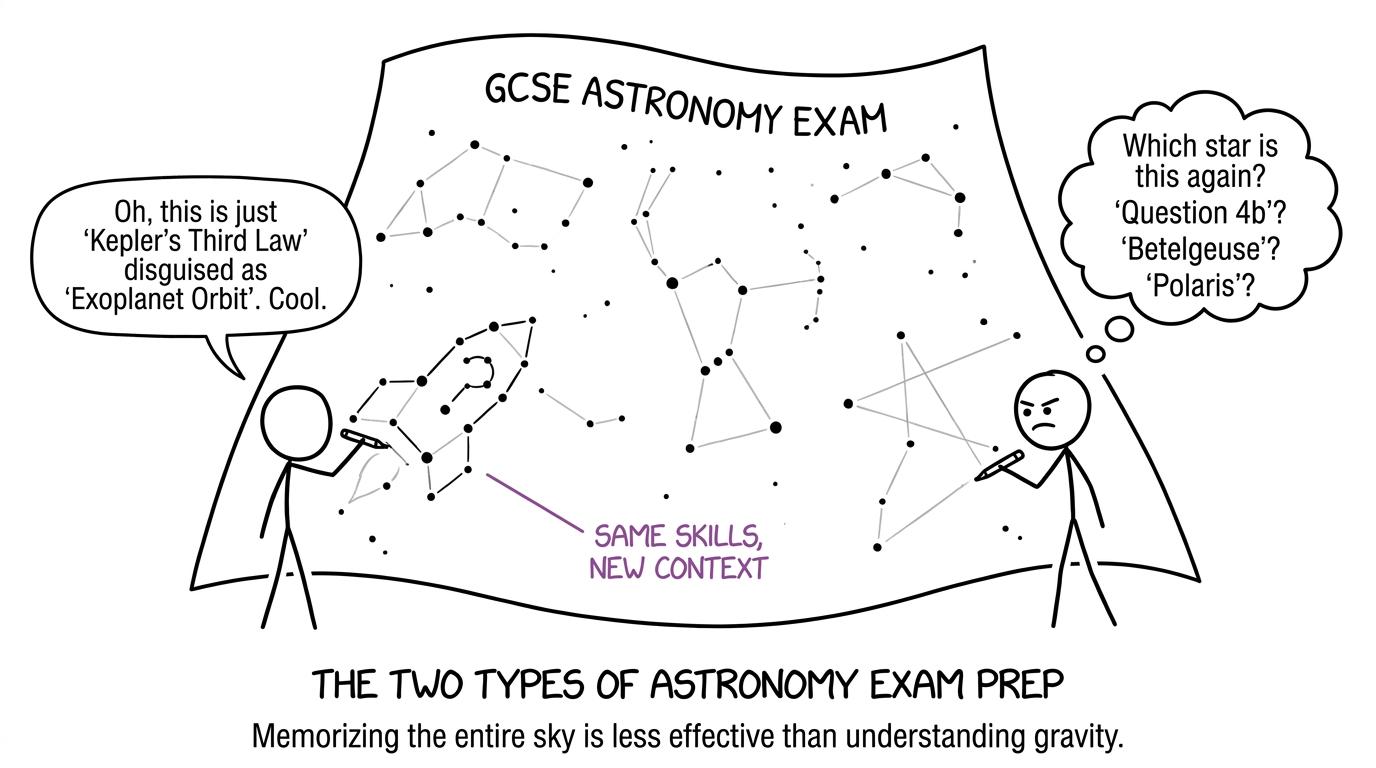 One student memorises stars while another connects them into transferable skills
Build a weekly grade 8 revision routine
A sustainable week is better than an heroic weekend followed by silence. Try this structure:
- two sessions retrieving and applying Paper 111 content;
- two sessions retrieving and applying Paper 222 content;
- one mathematical-skills session;
- one observation or data-analysis session;
- one timed mixed set followed by marking and repairs.
Keep sessions narrow. A useful block might contain 101010 minutes of retrieval, 252525 minutes of exam questions and 151515 minutes of marking and correction. Adapt the timing to your concentration and available weeks.
As exams approach, move from topic sets to timed sections and then complete papers. The principles in MathsGenie’s GCSE past-paper timing guide can help you phase this transition. If time is short, use the one-week GCSE revision plan as a framework, replacing the maths topics with your Astronomy priorities.
Do not use predicted topics to abandon parts of the specification. Fresh GCSE predicted papers are useful for maths practice and exam stamina, but prediction is not a substitute for coverage.
Common mistakes that hold students below grade 8
Revising only the dramatic topics
Black holes and cosmology are memorable. Coordinate systems, time, telescope calculations and observational procedures may feel less exciting, but omitted topics still cost marks. Audit all 161616 specification topics.
Memorising formulae without practising decisions
The examination supplies formulae and data, but you must select, rearrange and apply them. Practise identifying the required relationship before reaching for the calculator.
Giving vague evaluations
Name the limitation, state its effect on the result and propose a feasible improvement. Precision matters more than a long list of generic phrases.
Rounding too early
Keep full calculator values during intermediate steps. Round only the final answer to the requested or appropriate accuracy.
Confusing description with explanation
A description reports a pattern. An explanation gives the scientific reason for it. Check that every “because” is followed by a valid causal link.
Completing papers without repairing errors
Another paper may reproduce the same weaknesses. Mark schemes, correction and delayed reattempts are where practice becomes progress.
Turn curiosity into dependable marks
Astronomy begins with enormous questions, but a grade 888 is built from small, repeatable actions: one accurately rearranged formula, one sharper evaluation, one corrected misconception and one timed response completed calmly.
Use MathsGenie as your free maths support system. Strengthen the calculations behind Astronomy with revision lessons, practice questions, mini tests and video solutions; use mark schemes to understand where credit is earned; and build stamina with past papers and predicted papers. Add those resources to a realistic revision planner, keep your error log close and make your next session answer a specific weakness.










