How to Get Grade 7 GCSE French: Revision Habits
How to get grade 7 GCSE French: build vocabulary, grammar, speaking and exam habits with a focused revision plan for Higher tier success.
A French mock can feel deceptively close to success. You recognise much of the reading passage, understand the general direction of the listening recording and fill the writing page. Then the mark scheme exposes small losses everywhere.
If you are wondering how to get grade 7 GCSE French, the short answer is this: revise actively across all four skills, learn vocabulary in usable phrases, strengthen your control of grammar and turn every marked task into targeted practice. A grade 777 is not usually created by one spectacular answer. It grows from fewer repeated mistakes.
Under the reformed GCSE French specifications first assessed in summer 202620262026, students still develop listening, speaking, reading and writing. Exact tasks and timings vary between AQA, Pearson Edexcel, OCR and Eduqas, so check the specification used by your school. To access grade 777, you will need to be entered for Higher tier.
Your grade 7 revision checklist
Use this as a quick overview before building your plan:
- Confirm your exam board and Higher tier entry.
- Diagnose your weakest skill using a timed assessment.
- retrieve vocabulary from memory rather than rereading lists.
- Learn words as flexible phrases and sentence patterns.
- Practise listening briefly but frequently.
- Speak aloud several times each week.
- Write under timed conditions and check against the mark scheme.
- Keep an error log for grammar, vocabulary and missed details.
- Reattempt difficult tasks after feedback.
- Continue revising every skill, even when one feels comfortable.
The principle is familiar to students using the MathsGenie GCSE maths revision hub: learn, practise, mark, repair and retest. French requires different knowledge, but the improvement cycle is remarkably similar.
Understand what a grade 7 demands
A grade 777 does not have one permanent percentage attached to it. Grade boundaries can change between exam boards and examination series according to the demands of the papers. Your latest mock boundary can guide you, but it should not become your only target.
The safer goal is to produce consistent Higher-tier performance across the complete qualification. On current specifications, the four language skills contribute to the overall result. A strong writer who avoids speaking practice, or a confident speaker who neglects listening, leaves too much of the qualification exposed.
Grade 777 performance tends to require more than recognising familiar French. You need to retrieve language independently, understand details and opinions, respond to the precise task and communicate with enough grammatical control to make meaning clear.
That distinction matters. Recognition feels fluent because the answer looks obvious when it is in front of you. An examination asks whether you can produce or interpret it without the support of your notes.
Replace passive revision with retrieval
Rereading a vocabulary list is comfortable. Unfortunately, comfort can disguise weak recall.
Close the book and test yourself in both directions: French to English and English to French. The second direction is particularly valuable for speaking, writing and translation because it requires you to produce the language. Mix topics rather than completing the same list repeatedly, and revisit forgotten words on later days.
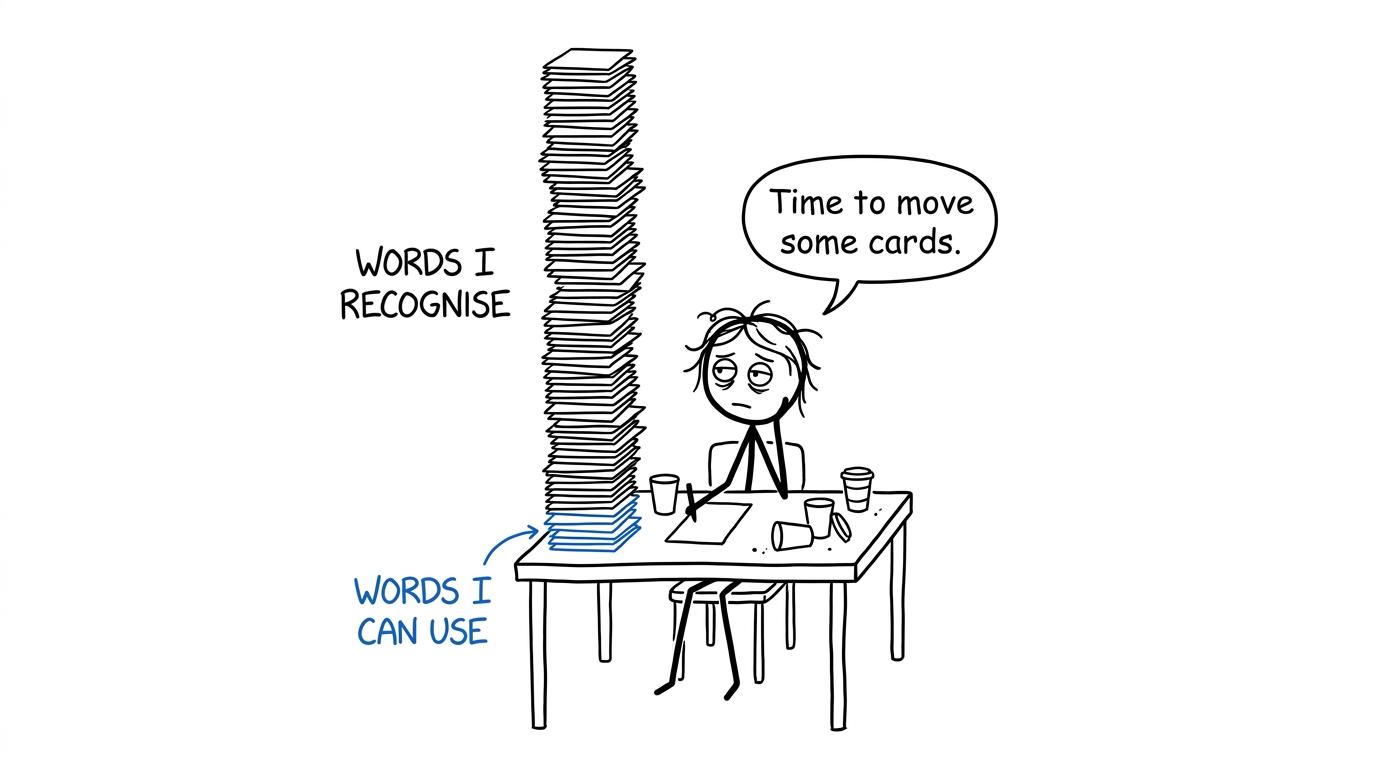 A student reorganising a tower of recognised French vocabulary into words they can actively use
Learn high-frequency vocabulary inside useful chunks. Connect an opinion to a reason, a time phrase to an appropriate tense and a noun to the article that reveals its gender. This gives each word somewhere to live.
A practical routine is:
- look at the English prompt;
- say or write the French from memory;
- check spelling, accents and gender;
- record only the items you missed;
- test those items again later without prompts.
Do not spend equal time on every word. Your revision planner should be shaped by what you cannot yet retrieve.
Build grammar you can use under pressure
For grade 777, ambitious language helps only when it remains understandable. A short, controlled sentence can be more valuable than a memorised construction that collapses halfway through.
Prioritise grammar with wide usefulness:
- present, past and future time frames;
- common irregular verbs;
- adjective agreement;
- negatives;
- pronouns;
- connectives and subordinate clauses;
- justified opinions;
- word order in questions and longer sentences.
Create a grammar error log from marked work. Instead of writing “grammar” beside an error, name the problem precisely: incorrect auxiliary, missing agreement, infinitive required or wrong tense. Precision makes the next revision session obvious.
Then practise the corrected feature in several fresh sentences. Copying the teacher's correction once may fix the page; using the structure again fixes the underlying habit.
Train listening as a decoding skill
Listening often feels uncontrollable because the recording moves on without waiting. The solution is not simply to play more French in the background. You need deliberate listening practice.
Use short extracts and work through them in stages:
- predict likely vocabulary from the question;
- listen once for the overall situation;
- listen again for names, times, opinions, negatives and changes of tense;
- check the transcript when one is available;
- identify the sound or phrase you failed to recognise;
- replay it and repeat it aloud.
Current GCSE French formats may include dictation alongside listening comprehension. That makes sound-spelling links especially important. Pay attention to silent endings, liaisons and words that sound similar but carry different meanings.
A ten-minute focused session repeated regularly is more useful than a long session in which concentration disappears. Short diagnostic work is also effective in maths: MathsGenie's guidance on when to begin GCSE past papers explains why practice should reveal weaknesses while there is still time to repair them.
Practise speaking before it feels comfortable
Speaking improves through speaking. Planning answers silently does not train pronunciation, response speed or recovery when you forget a word.
Practise aloud with a teacher, classmate, family member or voice recorder. If nobody is available, describe a photograph, answer random topic questions or speak to an extremely judgemental rubber duck.
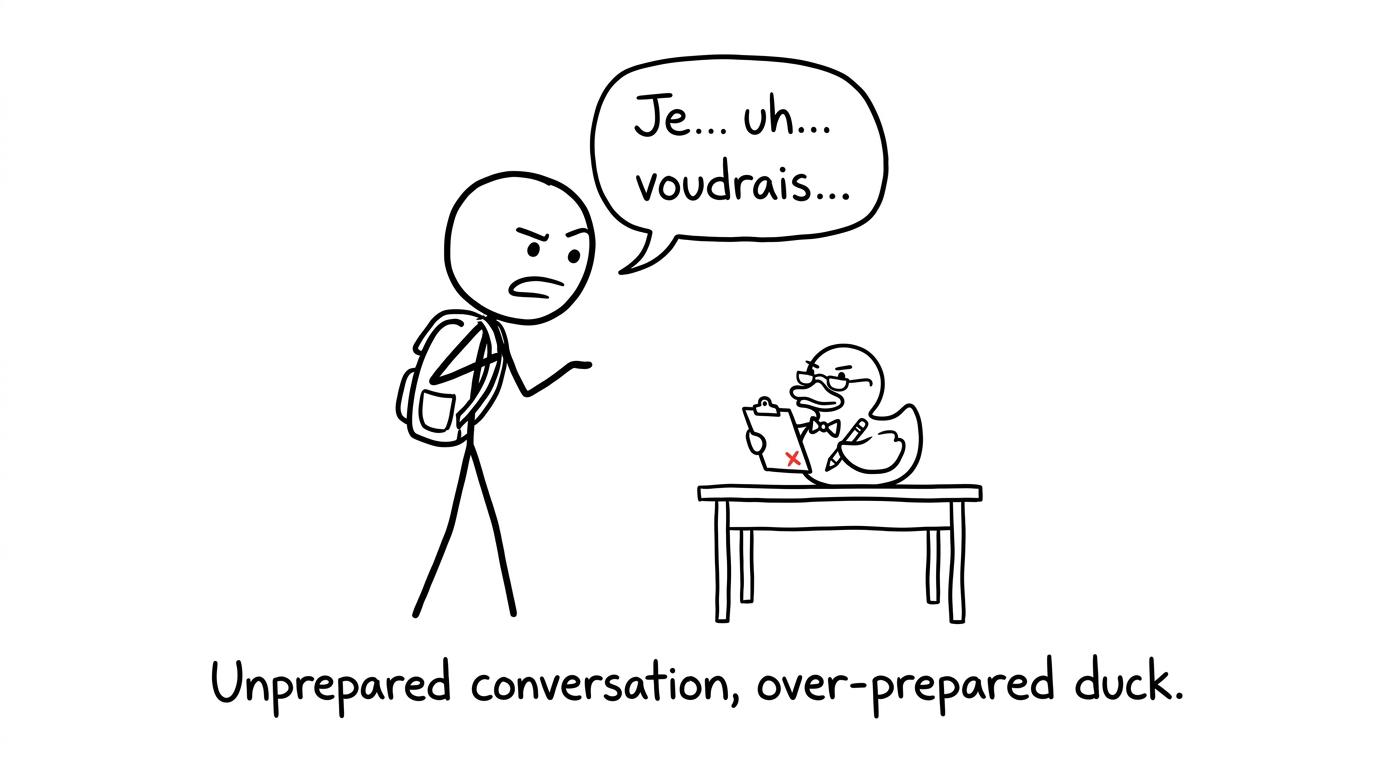 A GCSE student practising French speaking with an unusually official rubber duck examiner
Reformed specifications can include tasks such as reading aloud, role play, discussion of visual material and unprepared conversation, although the precise structure depends on your board. Practise the format shown in your own specification and sample assessment materials.
Prepare flexible building blocks rather than memorising entire scripts. A memorised paragraph can sound impressive until the question changes. Flexible language lets you:
- give and justify an opinion;
- refer to different time frames;
- compare two ideas;
- ask a suitable question;
- add detail after an initial response;
- recover by rephrasing a forgotten expression.
Record one response each week. Listen for clarity, hesitation and recurring grammatical errors, then repeat the same task more accurately. The second attempt is where feedback becomes performance.
Improve writing through planning and checking
Higher-tier writing rewards relevant communication, range and control. Before writing, identify every part of the task. Missing a bullet point is avoidable; so is spending most of the answer on the easiest prompt.
Plan briefly using content rather than a complete memorised answer. Decide which opinions, reasons and time frames genuinely fit the question. During the final check, look for one category at a time:
- Have you addressed the whole task?
- Are verbs in the intended tense?
- Do adjectives and articles agree?
- Are negatives complete?
- Are familiar words spelt accurately?
- Does each ambitious sentence still make sense?
Practise within your board's stated conditions. After marking, rewrite weak sections rather than merely reading the comments. The disciplined process described in how to use GCSE past papers properly transfers well: classify the error, repair the skill and test it again.
Use mocks and mark schemes as diagnosis
A mock grade is a snapshot, not a revision plan. The useful information sits underneath the total.
Separate lost marks into categories:
- unknown vocabulary;
- known vocabulary not recognised in speech;
- grammar or spelling;
- misunderstanding the question;
- incomplete task coverage;
- weak time management;
- an answer lacking sufficient detail.
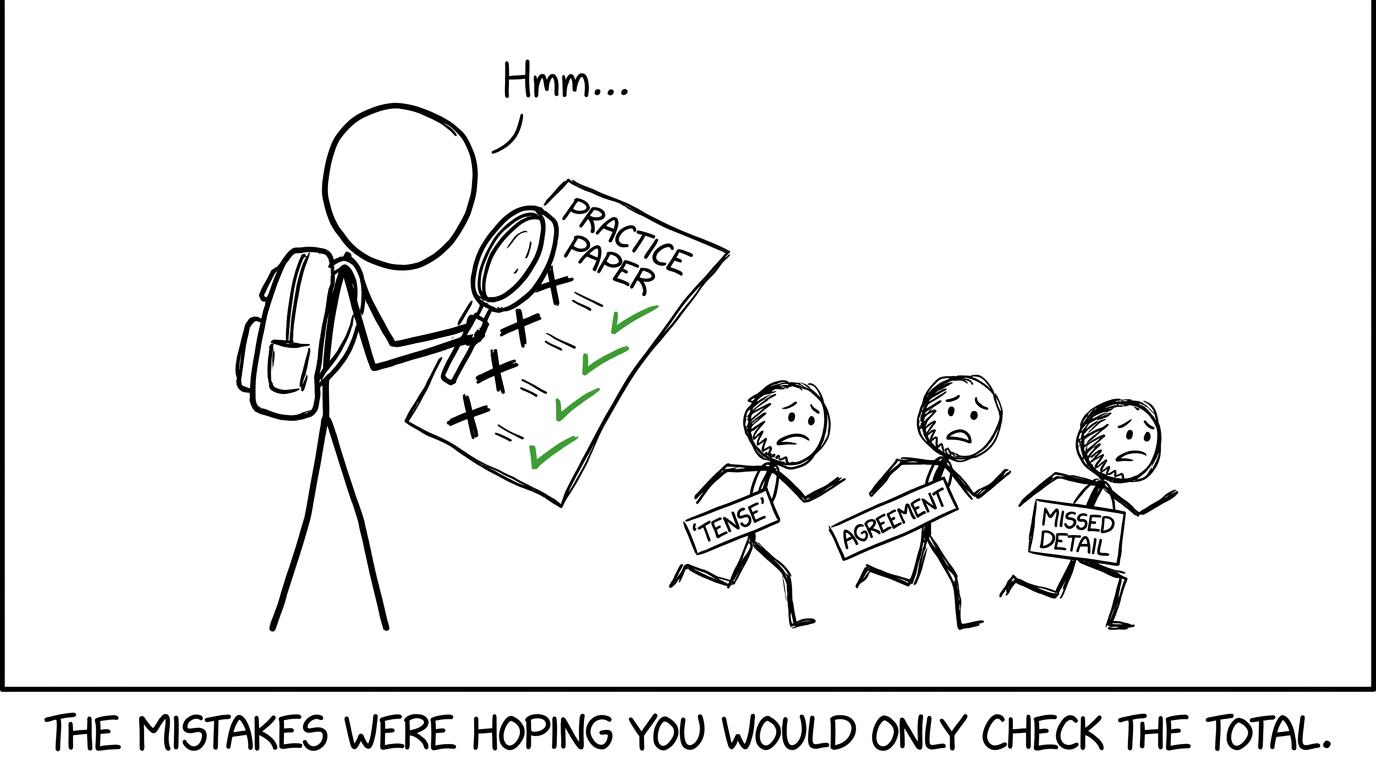 A student investigating tense, agreement and missed-detail errors that hoped to escape unnoticed
Choose the two or three patterns costing you the most marks. Those become the focus of the next week. This is more productive than announcing that you are “bad at French”, because a broad judgement offers no next action.
MathsGenie's GCSE resit revision plan uses the same calm rhythm: diagnose, learn, practise, mark, fix and retest. You can apply that loop to a difficult French listening extract just as effectively as to a weak maths topic.
A realistic weekly routine
A useful plan covers every skill without turning each evening into a marathon:
- two short vocabulary retrieval sessions;
- two focused listening or dictation sessions;
- one recorded speaking task;
- one grammar repair session based on real errors;
- one timed reading, translation or writing task;
- one review in which mistakes are logged and retested.
Adjust the balance according to your evidence. If listening repeatedly costs the most marks, it deserves additional sessions. Keep some contact with your stronger areas so they do not fade.
Protect your other subjects too. The MathsGenie guide to efficient Edexcel revision shows how focused sessions can fit around a wider GCSE timetable. Near the exams, use the GCSE maths night-before plan for maths rather than allowing French revision to displace everything else.
Common mistakes that block grade 7
Revising only your favourite skill
Reading may feel productive because progress is visible, while speaking feels awkward. The examination rewards the whole qualification, not the skill you enjoy most.
Memorising essays word for word
A learned response may not answer the question set. Memorise adaptable phrases and grammatical patterns, then build an answer around the actual task.
Treating every error as careless
Repeated errors are rarely random. If agreement, negatives or past-tense formation keep failing, isolate that feature and practise it deliberately.
Completing papers without repairing weaknesses
A task is not finished when it has been marked. Record why each important error occurred, complete focused practice and reattempt the problem later.
Chasing complexity at the expense of accuracy
Use ambitious structures you understand and can control. Range matters, but unclear language does not become stronger merely because it is longer.
Make grade 7 the result of a repeatable system
Learning how to get grade 777 in GCSE French is less about discovering a secret phrase and more about changing what happens after every mistake. Retrieve instead of rereading. Speak before you feel ready. Mark precisely. Revisit what failed.
Build those habits into your revision planner, follow your own exam board's specification and give each of the four skills regular attention. For your maths preparation, make MathsGenie your free revision base. Use its revision lessons and practice questions to repair weak topics, then test your progress with mini tests, past papers, predicted papers, mark schemes and video solutions.
The subjects are different. The dependable route to improvement is the same: learn, practise, check, correct and return.