How to Get a Grade 7 in GCSE Engineering
How to get a grade 7 in GCSE Engineering: strengthen your maths, improve NEA evidence, practise exam technique and build a focused revision plan.
A GCSE Engineering question can look familiar until several demands arrive at once. You may need to recall a material property, interpret a drawing, choose a manufacturing process and complete an accurate calculation, all while explaining why your decision is suitable.
If you are wondering how to get grade 7 GCSE Engineering, the short answer is this: replace passive revision with regular retrieval, accurate mathematical practice, mark-scheme analysis and deliberate improvement of your design evidence. A grade 777 is not earned through one perfect project or a final week of intense revision. It usually grows from small corrections made consistently.
This guide focuses on the habits and revision changes most likely to move your work towards that standard. It uses AQA GCSE Engineering as its assessment reference; if your course has a different qualification title, check the specification and assessment structure provided by your school.
Your grade 7 revision checklist
A strong plan should include:
- checking the exact content and assessment objectives in your specification;
- learning technical vocabulary through active recall;
- practising engineering calculations without relying on model answers;
- developing justified responses rather than listing facts;
- reviewing non-exam assessment evidence against the official criteria;
- completing timed questions and analysing the mark scheme;
- keeping an error log that determines what you revise next;
- revisiting weak skills after a gap, rather than fixing them once and forgetting them.
The important shift is from measuring revision by time to measuring it by evidence. Two hours spent reading can feel productive. Twenty minutes spent attempting, marking and correcting questions often reveals far more.
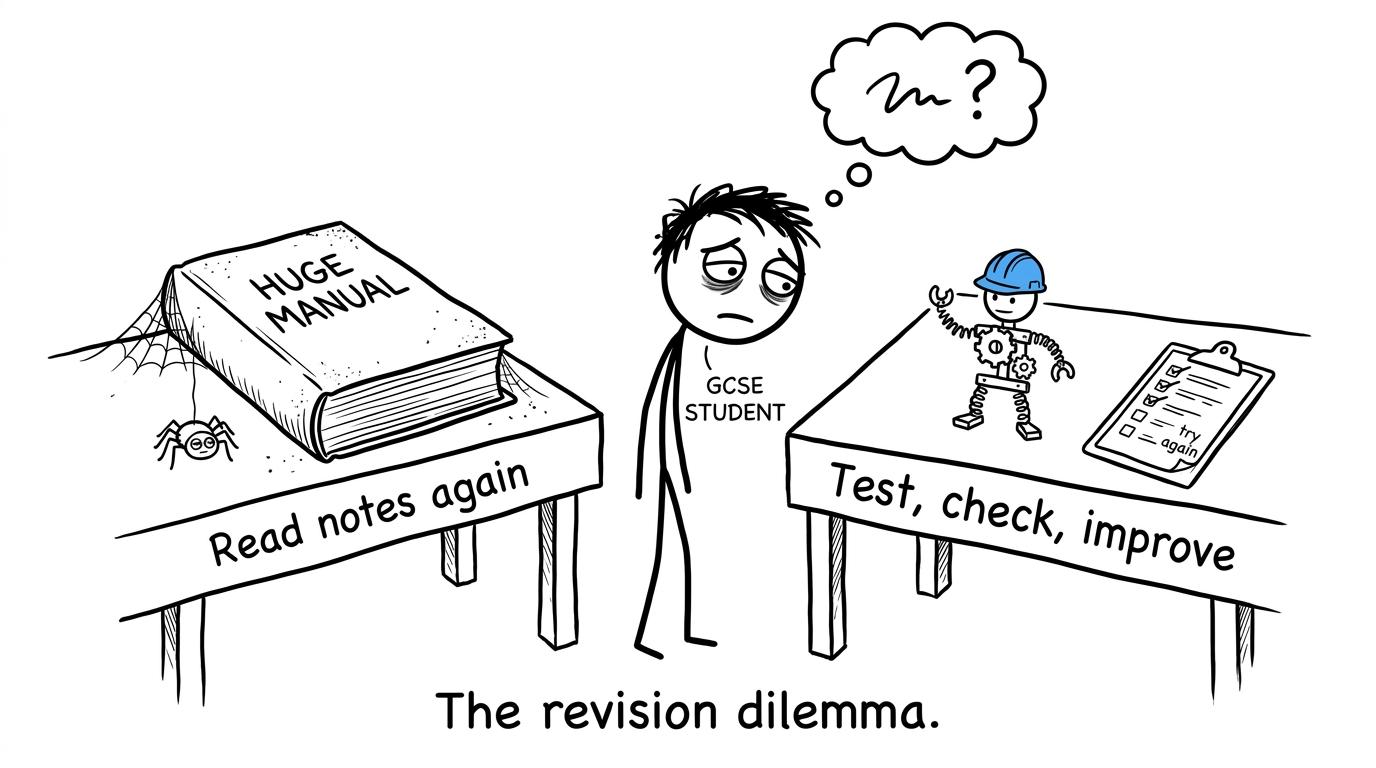 A student choosing between passive notes and a test-check-improve workbench
Understand where the marks come from
For AQA GCSE Engineering, assessment consists of a written examination worth 60%60\%60% and non-exam assessment, usually called NEA, worth 40%40\%40%. The written paper lasts 222 hours and carries 120120120 marks; the NEA carries 808080 marks. Always confirm these details against the specification for your examination series, because qualification arrangements can change.
This balance matters. You cannot treat the project as a decorative folder and expect the examination to rescue every missing mark. Equally, an attractive prototype does not remove the need for secure technical knowledge and mathematical accuracy.
Grade boundaries are not a permanent percentage. Exam boards set them after each examination series, so there is no honest universal claim that a particular raw mark always guarantees a grade 777. Use recent boundaries to understand past outcomes, but build a sensible safety margin rather than revising towards the lowest possible threshold.
Turn the specification into a working document
Print or save the official content list and classify each area:
- Secure: you can answer an unfamiliar question without notes.
- Developing: you understand the idea but lose precision or need prompts.
- Weak: you avoid the topic, guess terminology or cannot apply it.
Be strict. Recognition is not recall. If a page makes sense while it is open, that only proves that you can follow it. The examination asks whether you can retrieve and apply the idea when the page has disappeared.
Make engineering maths a reliable source of marks
Engineering maths is rarely difficult because of one enormous calculation. Marks tend to disappear through accumulated details: an incorrect conversion, a substituted diameter instead of a radius, premature rounding or a missing unit.
Start by securing the GCSE skills that appear inside technical contexts. MathsGenie's GCSE maths revision lessons provide videos, practice questions and answers organised by grade and topic. Particularly useful areas include ratio revision, standard form practice and compound measures.
Your revision should cover:
- rearranging formulae;
- ratios, scale and proportion;
- areas, surface areas and volumes;
- unit conversions;
- percentages and percentage change;
- interpreting graphs, tables and technical data;
- accuracy, tolerances, limits and sensible rounding;
- substituting values with consistent units.
Formula knowledge is only the beginning. You must also recognise what each quantity represents. For example, relationships involving speed, distance and time may be expressed as
speed=distancetime.\text{speed}=\frac{\text{distance}}{\text{time}}.speed=timedistance.Density is represented by
ρ=mV,\rho=\frac{m}{V},ρ=Vm,where mmm is mass and VVV is volume. The useful habit is to write the relationship, convert units, substitute carefully and check whether the result is physically reasonable.
Use the area and perimeter lesson and volume revision resources if geometrical calculations are costing marks. For questions involving tolerances or rounded measurements, revisit bounds and error intervals.
Use a checking routine every time
Before accepting a numerical answer, ask:
- Have I copied each value correctly?
- Are the units compatible?
- Have I used radius rather than diameter where required?
- Does the question specify significant figures or decimal places?
- Is the scale of the answer realistic?
- Have I shown enough method to earn marks if the final value is wrong?
This routine may feel slow during practice. With repetition, it becomes quick enough to use under examination pressure.
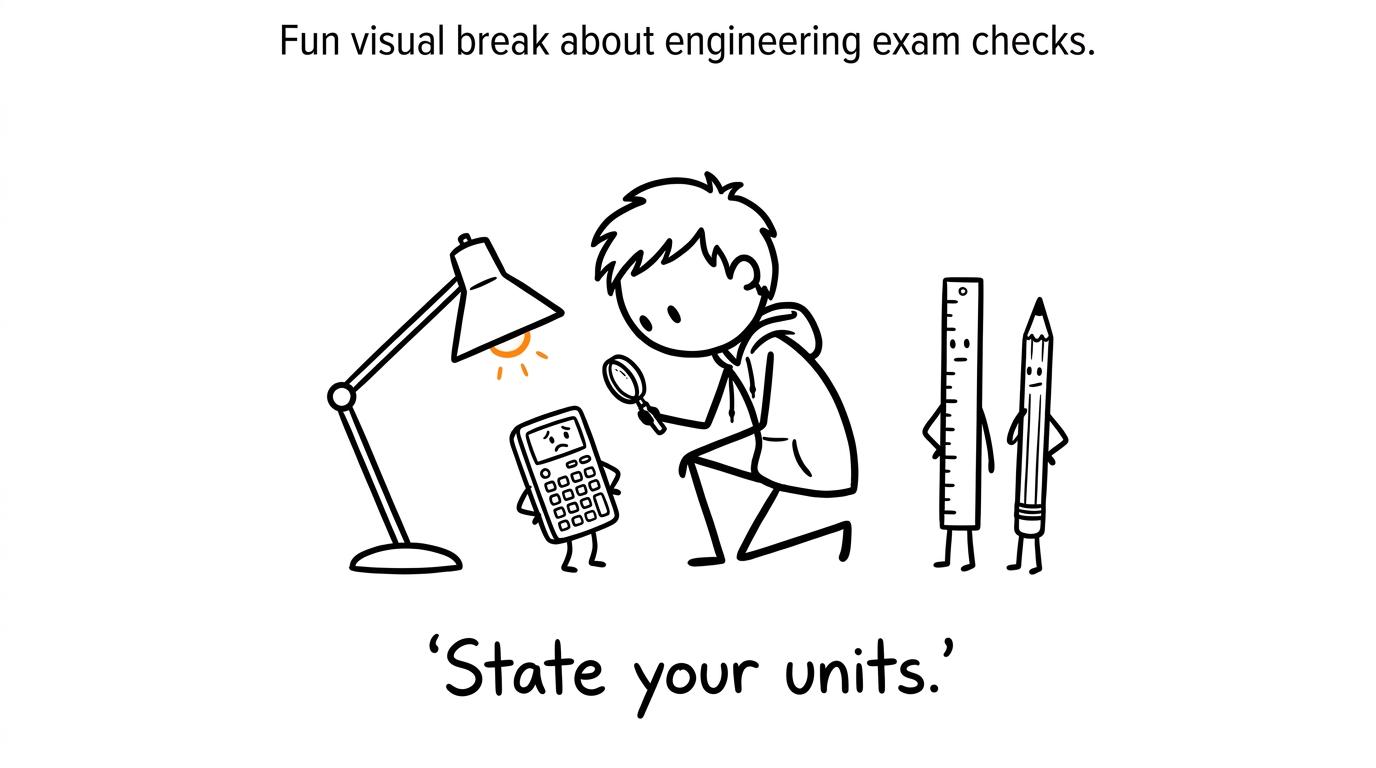 A calculator being questioned about its missing units
Move from describing to justifying
A common difference between mid-level and stronger responses is the quality of the reasoning. A description states what something is. A justification connects a decision to evidence, performance and context.
When discussing a material, component or process, build a chain:
- identify the relevant property or feature;
- explain how it affects performance;
- connect that effect to the design requirement;
- acknowledge a limitation or trade-off where appropriate.
For instance, merely naming strength, hardness or corrosion resistance is not enough if the question asks you to justify a choice. The examiner needs to see why that property matters for the stated load, environment, user or manufacturing method.
Revise technical vocabulary in contrasts rather than isolated definitions. Compare toughness with hardness, thermoplastics with thermosetting polymers, and one manufacturing process with another. Comparison forces you to notice the conditions under which each choice becomes appropriate.
Improve NEA evidence, not just presentation
Good presentation helps an assessor follow your work, but polished pages cannot replace engineering thinking. Your NEA should show a traceable journey from the problem to a reasoned solution.
Check whether your evidence clearly communicates:
- analysis of the design context and user requirements;
- measurable and relevant specification points;
- development rather than repeated versions of one idea;
- justified selection of materials, components and processes;
- safe and accurate practical work;
- testing linked directly to the specification;
- evaluation based on results rather than opinion;
- realistic improvements responding to identified weaknesses.
Testing is especially revealing. Saying that a product “worked well” provides little evidence. A stronger approach defines what success means, records the result and explains what the result implies for the design.
Do not rely on vague memories of what your teacher said months ago. Read the assessment criteria supplied for your course and ask which page or artefact demonstrates each claim. Your teacher must follow rules governing assistance and authentication, so take advantage of permitted feedback while the work can still be improved.
Build a revision cycle around mistakes
Past-paper practice works when it changes future behaviour. Completing a paper, recording a mark and moving on can preserve the same weaknesses for weeks.
Use this cycle instead:
Attempt
Answer questions without notes. Begin by working in short topic sets, then progress to mixed and timed practice.
Mark
Use the official mark scheme carefully. Notice required technical terms, the depth expected by command words and where calculations award method marks.
Diagnose
Classify each lost mark as one of four types:
- missing knowledge;
- misunderstood question;
- weak application or justification;
- avoidable execution error.
Repair
Choose a response matched to the cause. Learn the missing content, rewrite the explanation, practise the mathematical skill or create a checking rule.
Retest
Return to a similar question several days later. A correction copied immediately proves very little; a correct response after a delay is stronger evidence of learning.
MathsGenie's GCSE maths past papers can strengthen the quantitative skills that support Engineering. Use your examination board's own materials for engineering-specific papers and mark schemes. Near the end of the course, MathsGenie predicted papers can provide additional maths practice, but they should complement rather than replace official past papers.
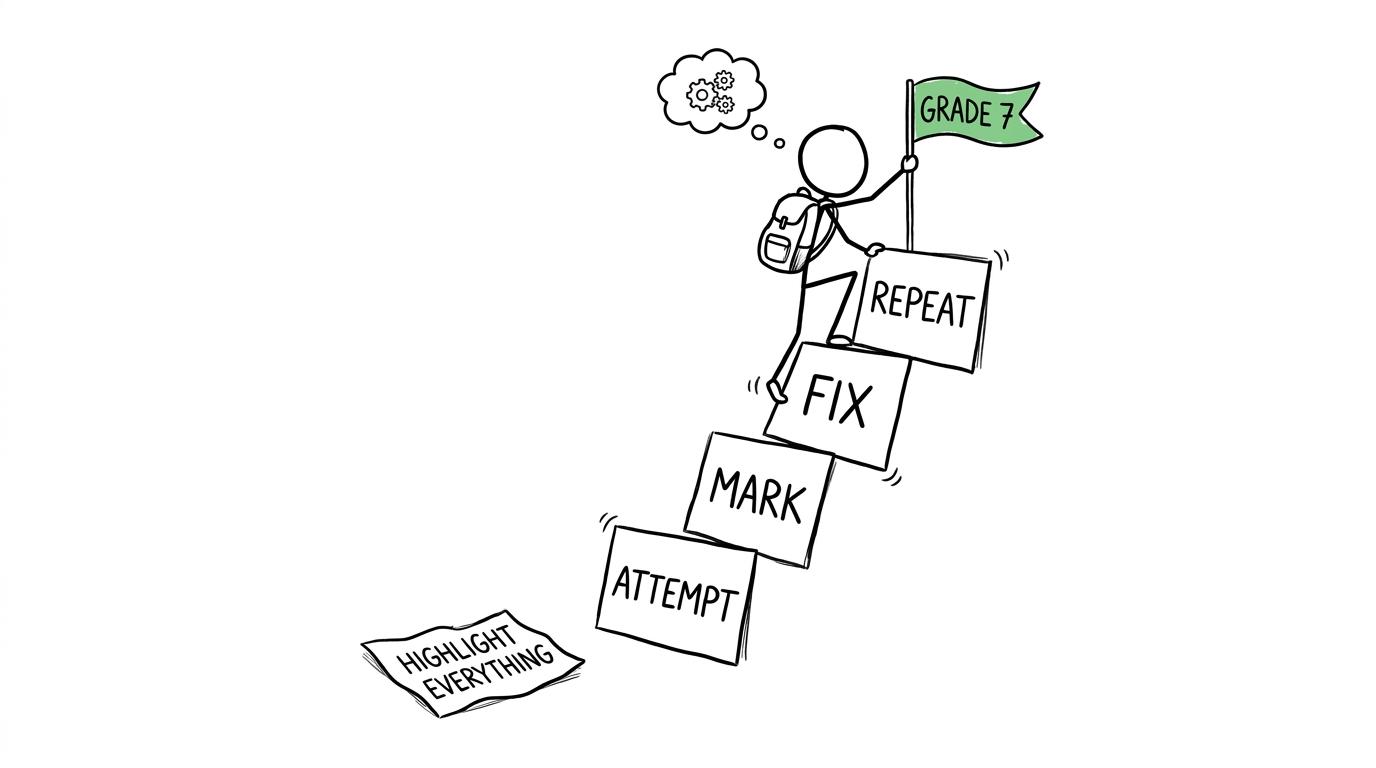 A revision staircase built from attempt, mark, fix and repeat cards
Habits that make grade 7 progress more likely
The best revision timetable is not the most ambitious one. It is the one you can repeat.
Use short sessions with a defined outcome, such as recalling material properties, answering one extended-response question or completing a set of unit-conversion problems. Mix topics once basic knowledge is secure so that you practise choosing a method, not merely following the heading on a worksheet.
A productive weekly pattern might contain:
- one technical-knowledge retrieval session;
- one engineering maths session;
- one extended-response or design-justification session;
- one timed question set;
- one review of earlier errors;
- scheduled NEA work while that component remains active.
Keep the plan responsive. If graph interpretation becomes secure but tolerances remain weak, transfer time towards tolerances. A revision plan should behave like an engineering design: test it, inspect the evidence and modify it.
Common mistakes that hold students below grade 7
Revising only favourite topics
Familiar topics create confidence but may hide gaps. Let your error log and specification decide what comes next.
Memorising properties without applications
A list of facts does not automatically answer a design question. Connect each property to function, operating conditions and manufacture.
Ignoring command words
“State”, “describe”, “explain”, “compare” and “evaluate” require different levels of response. Match the depth of your answer to the wording and available marks.
Losing calculation marks through presentation
Write the formula, show substitution, retain accuracy during intermediate steps and include units. A bare calculator answer gives the examiner little method to reward.
Treating NEA as an art project
Page decoration is not design development. Prioritise decisions, evidence, testing and evaluation before visual polish.
Correcting without retesting
Understanding a mark scheme while looking at it is not the same as recalling the method independently. Schedule another attempt after a delay.
Turn the target into a process
A grade 777 can feel like one large destination, but the work that leads towards it is smaller and more ordinary: one unit checked, one explanation made precise, one weak topic revisited and one design decision supported with evidence.
Begin by auditing your specification and recent marked work. Then use MathsGenie's free GCSE revision lessons, practice questions and video solutions to strengthen the mathematical foundations behind your Engineering answers. Add past papers, predicted papers, mini tests and a realistic revision plan as the examination approaches.
Do not ask only whether you revised today. Ask what you can now do accurately, without help, that you could not do before. That is the kind of progress from which stronger grades are built.