

How to Get a Grade 7 in GCSE Arabic
How to get grade 7 GCSE Arabic: strengthen vocabulary, balance all four papers and use past-paper feedback to turn daily practice into marks consistently.
A student can spend an hour copying vocabulary and still finish revision unsure whether anything has changed. The page looks busy. The brain feels tired. Yet none of that guarantees better listening, speaking, reading or writing.
If you are wondering how to get grade 7 GCSE Arabic, the short answer is this: enter Higher tier, build vocabulary through active recall, practise all four skills every week and use official past papers to identify exactly where marks are being lost. Grade 777 performance comes from balanced, accurate communication not from one impressive piece of memorised writing.
This matters particularly if Arabic is competing with maths and other GCSE subjects for your time. You do not necessarily need longer revision sessions. You need a repeatable system in which every task has a purpose.
Your grade 7 checklist
Use this checklist to keep your preparation focused:
- Confirm that you are entered for Higher tier, because Foundation tier does not award grade 777.
- Check the current Pearson Edexcel GCSE Arabic specification and assessment requirements with your teacher.
- Revise vocabulary by retrieving it from memory rather than repeatedly reading it.
- Practise listening, speaking, reading and writing every week.
- Learn vocabulary as part of useful phrases and grammatical patterns.
- Record errors by category, then revisit them.
- Complete timed tasks using official papers and mark schemes.
- Prepare flexible ideas rather than memorising one rigid answer.
- Protect time for your other subjects with a realistic revision timetable.
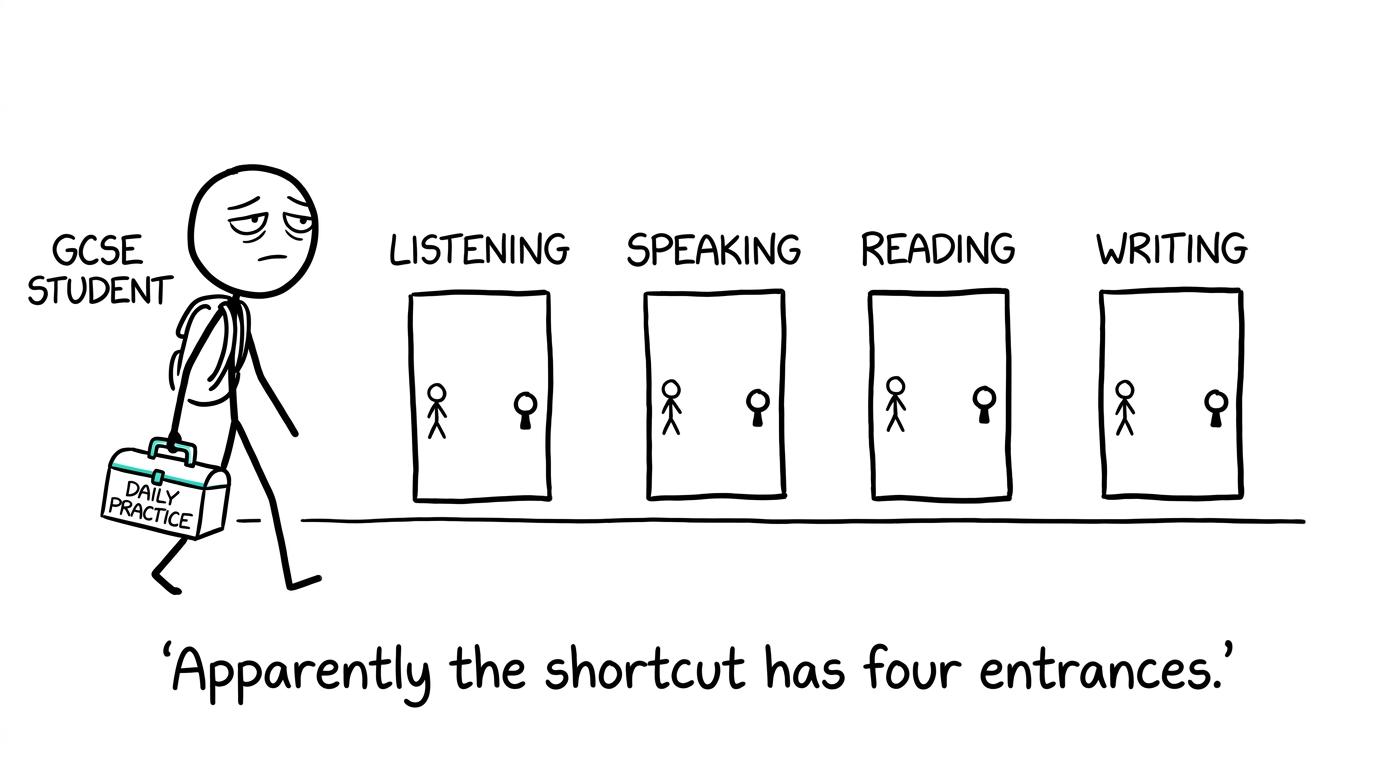 A student approaching the four entrances to GCSE Arabic with a daily-practice toolbox
Understand what a grade 7 must cover
The current Pearson Edexcel GCSE Arabic qualification is assessed through four papers: listening, speaking, reading and writing. Each contributes 25%25\%25% of the qualification, although the raw marks available are not identical. Students take the same tier across all four papers, and dictionaries are not permitted.
At Higher tier, the assessment includes:
- listening to standard spoken Arabic in different social and public settings;
- a role play, picture-based task and conversation in the speaking assessment;
- reading texts such as advertisements, emails, articles and literary material, followed by translation into English;
- extended responses and translation into Arabic in the writing paper.
The precise grade boundary is set after each examination series, so there is no permanent raw-mark target for grade 777. Previous boundaries can provide context, but they should not become a prediction. Your safer target is consistent performance across all four components with enough margin to absorb a difficult paper or an unfamiliar topic.
That changes the revision question. Instead of asking, “How many words do I know?”, ask, “Can I understand and use these words accurately when I am under pressure?”
Build vocabulary that you can actually retrieve
Vocabulary lists create a comforting illusion: every word looks familiar while it is on the page. Recognition, however, is not the same as recall.
A stronger routine begins with the English meaning or an image and asks you to produce the Arabic word without seeing it. Then reverse the direction. Say the word aloud, place it in a phrase and revisit it after a delay.
Organise vocabulary around the specification themes, which include identity and culture, local area and travel, school, future aspirations and work, and international or global issues. Within each theme, prioritise:
- common verbs in several time frames;
- opinions and reasons;
- connectives that develop an answer;
- time expressions;
- descriptive adjectives;
- question words;
- high-frequency nouns and topic-specific phrases.
Do not treat every word as equally urgent. Words that help you express several ideas deserve more attention than rare nouns with only one use.
A simple review cycle might revisit new material after one day, several days and again the following week. The exact spacing can change, but the principle should not: words must return after they have started to become difficult.
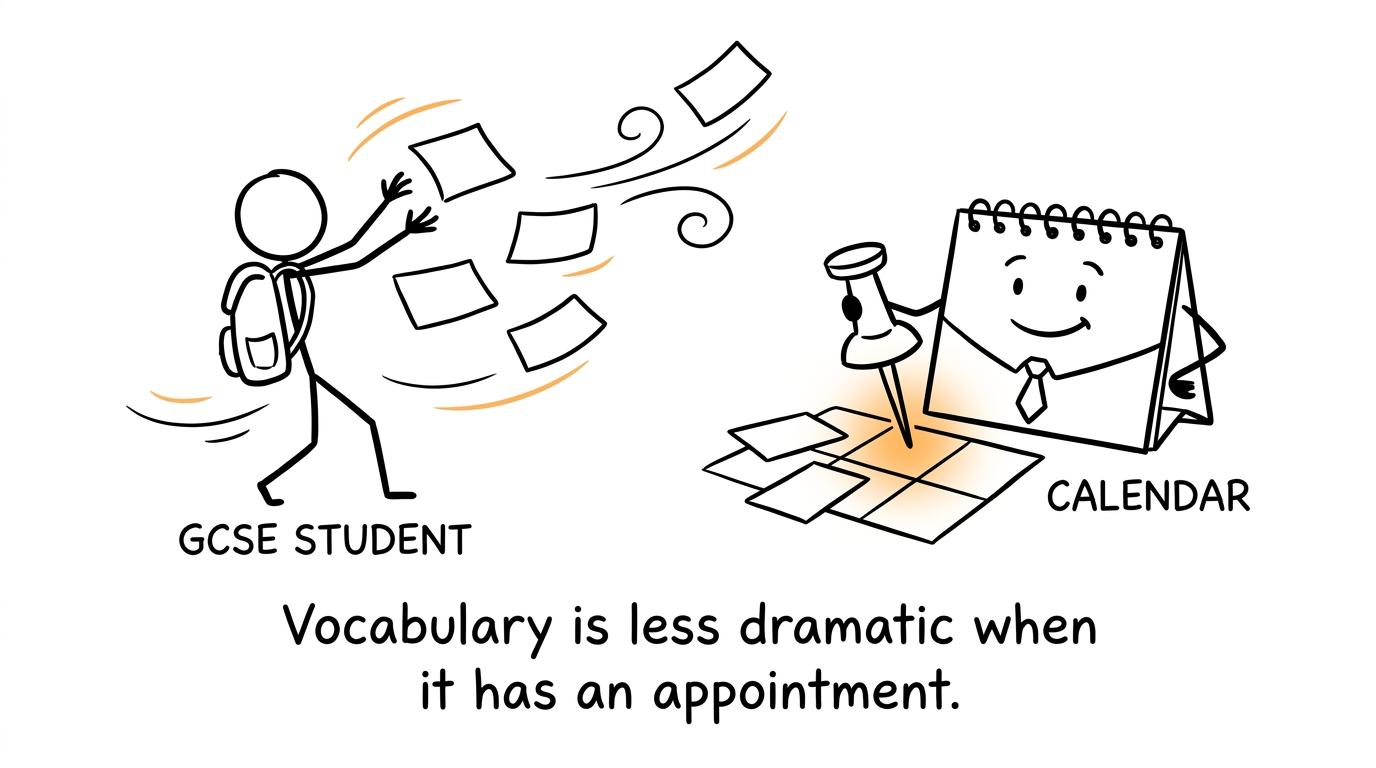 Vocabulary cards being calmly organised by a revision calendar
Turn grammar into reliable patterns
Grade 777 writing and speaking need range, but range without control can become expensive. A complicated sentence is not useful if agreement, tense or word order makes the meaning unclear.
Build a small bank of dependable structures that lets you:
- describe present routines;
- refer to past events;
- explain future plans;
- compare people, places or experiences;
- express and justify opinions;
- use negatives accurately;
- extend an idea with a reason or consequence.
Practise changing one part of a structure at a time. Swap the subject, time frame, opinion or topic while preserving the grammar. This makes the pattern flexible rather than memorised.
Keep a personal accuracy list too. If you repeatedly lose control of verb forms, gender agreement or spelling, that pattern deserves more attention than a completely new piece of ambitious language. Progress often comes from repairing the same small leak several times.
Practise each Arabic paper differently
The four skills support one another, but they are not improved by exactly the same activity.
Listening
Listening revision should move beyond playing audio and hoping to follow it. Before the recording begins, read the questions carefully and anticipate the type of information required. During the audio, listen for meaning, changes of opinion, negatives, time references and contrasts.
Afterwards, identify why an answer was missed. Was the vocabulary unknown? Did you recognise the word too slowly? Did a distractor appear before the correct information? That diagnosis determines the next task.
Short, repeated listening is often more useful than passively consuming a long recording. Use official audio where available so that speed, question style and exam demands become familiar.
Speaking
Speaking improves when production becomes routine. Record short answers and listen back for hesitation, unclear pronunciation and incomplete development. Practise responding to unpredictable follow-up questions rather than only rehearsing a prepared introduction.
For each specification theme, prepare flexible building blocks: an opinion, a reason, a past reference, a future intention and a comparison. They should be adaptable to different questions. Your teacher can also check whether pronunciation and grammatical choices communicate the meaning you intend.
Reading
Reading should train you to locate evidence, not merely translate every word. Look for names, dates, opinions, negatives and linking words. Use surrounding language to infer unfamiliar vocabulary, but make sure your final answer matches the language requested by the question.
Review wrong answers against the source text. Underline the exact phrase that supports the correct response. This turns marking into reading training rather than a score-checking exercise.
Writing
Plan briefly before writing. Check every bullet point in the task and decide where you will include developed opinions, different time frames and relevant detail. Leave time to inspect verb forms, agreement, spelling and whether every requirement has actually been answered.
It is better to write several controlled, connected sentences than to build one spectacular sentence that collapses under its own grammar. Accuracy and ambition should grow together.
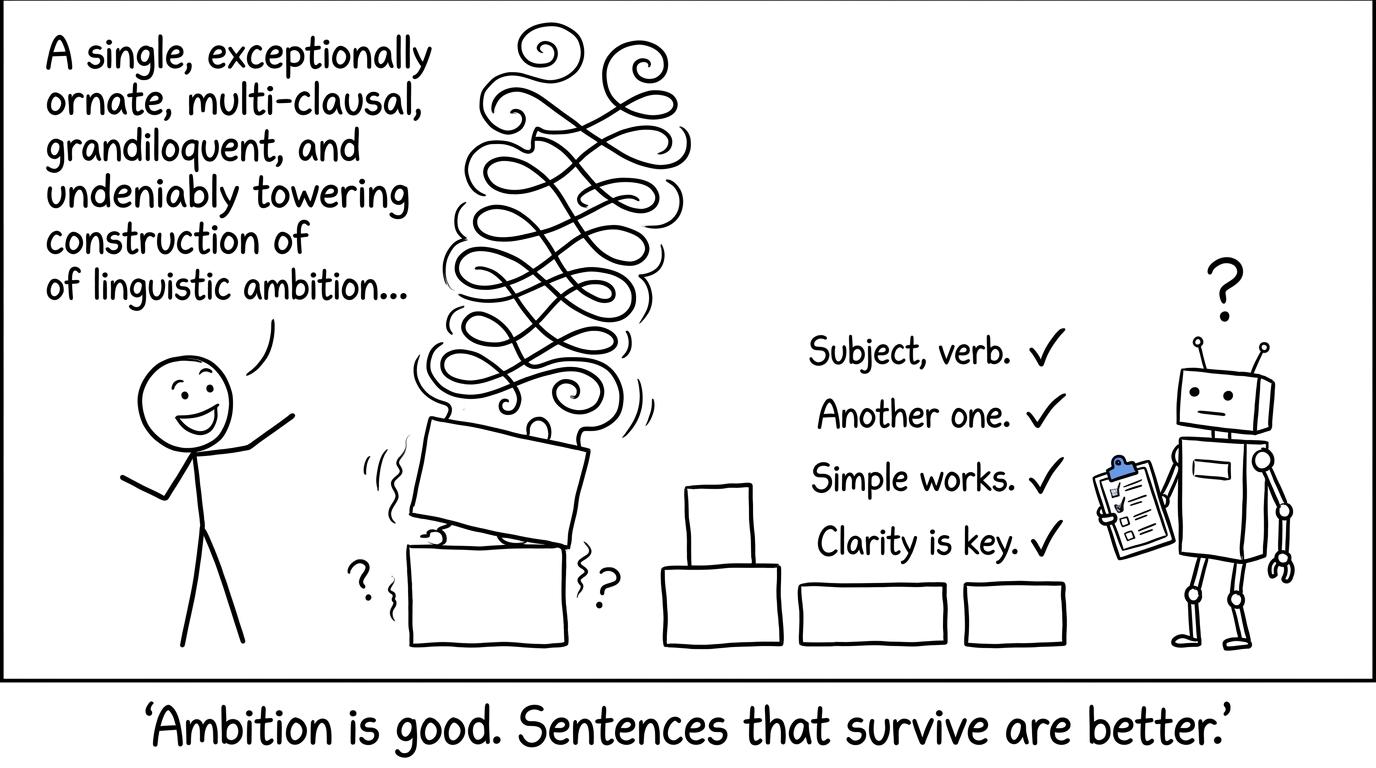 A giant fragile sentence competing with several sturdy sentences
Use a marks-leak log after every paper
Completing a paper is only the first half of past-paper revision. The second half is converting each lost mark into a specific action.
Create a log with four categories:
- Knowledge: the word or grammatical pattern was not known.
- Recognition: it was known but not recognised quickly enough.
- Technique: the instruction, bullet point or required response language was missed.
- Accuracy: the intended idea was understood, but the response contained avoidable errors.
Choose the two or three most frequent problems and repair those first. Then reattempt the relevant questions without notes. A paper has changed your grade only when its mistakes alter what you do next.
This is the same feedback habit explained in MathsGenie’s guide to using GCSE past papers properly. The subjects differ, but the useful loop remains stable: attempt, mark, diagnose, practise and retest.
Fit Arabic around maths and your other GCSEs
Revision plans often fail because they assume every evening will be calm and energetic. A better plan has a small minimum that survives ordinary school weeks.
For Arabic, that might mean brief vocabulary retrieval on most days, two focused skill sessions during the week and one longer timed task at the weekend. Rotate the four papers so that none quietly disappears from your routine.
MathsGenie’s one-month GCSE revision plan offers a useful model for balancing retrieval, focused practice and exam-style work. You can also use the advice on finding your weakest GCSE topics to make your revision decisions evidence-led.
When it is time for maths, keep the resources separate and precise. Use the Edexcel GCSE Maths revision hub, Edexcel GCSE Maths past papers and GCSE Maths mini tests rather than allowing Arabic revision to consume every available session. Near the maths exams, GCSE predicted papers can provide fresh timed practice after topic gaps have been addressed.
The purpose of a timetable is not to fill every square. It is to prevent one urgent subject from repeatedly stealing time from another.
Common mistakes that hold students below grade 7
Revising only the strongest skill
A confident speaker may avoid writing; a strong reader may neglect listening. Because each paper contributes 25%25\%25%, persistent weakness in one component can restrict the overall result.
Memorising answers word for word
A memorised response may not fit the actual question. Learn flexible structures and ideas, then practise adapting them to different prompts.
Copying vocabulary instead of recalling it
Neat notes measure handwriting, not retrieval. Close the book and test whether you can produce the language independently.
Ignoring the language of the instruction
Listening and reading papers contain sections with instructions and questions in different languages. Answer in the form and language requested rather than assuming every response follows the same rule.
Treating a mark scheme as the end
Marking reveals the problem; it does not repair it. Relearn the missing language and attempt the task again.
Chasing a historical grade boundary
Grade boundaries vary between examination series. Build a safety margin and focus on improving performance rather than aiming for last year’s minimum.
Make grade 7 the result of a system
A grade 777 in GCSE Arabic rarely comes from one dramatic final week. It is more often the result of modest habits repeated long enough to become reliable: vocabulary retrieved rather than reread, speaking practised aloud, errors logged honestly and all four papers kept in view.
Start with one official task. Mark it carefully. Identify the two biggest marks leaks and build your next week around fixing them.
Then protect the rest of your GCSE programme. MathsGenie gives you free GCSE maths revision, revision lessons, practice questions, mini tests, past papers, predicted papers, mark schemes and video solutions. Use those resources to make maths revision structured, leaving focused time and attention for the Arabic habits that can move you towards grade 777.










