How Stressful Is GCSE Arabic Compared to Other GCSEs?
How stressful is GCSE Arabic? Compare its workload, speaking pressure and language demands, then plan calmer revision alongside GCSE maths.
The hardest part of choosing or revising a GCSE is often not the content itself. It is uncertainty. You hear that one subject is "easy", another is "impossible", and soon you are judging your own timetable through somebody else's experience.
So, how stressful is GCSE Arabic? The short answer is that students' reports tend to place it in the moderate-to-high stress range, but with unusually large differences between learners. It can feel more demanding than a familiar content-based subject because it tests listening, speaking, reading and writing separately. However, a student who already reads and writes Modern Standard Arabic may find it less stressful than GCSE maths, science or another language.
There is no reliable national league table ranking GCSE subjects by stress. Student comments are useful for identifying patterns, not proving that Arabic has one fixed difficulty level. Your language background, teaching, confidence and available revision time matter far more than the subject's reputation.
GCSE Arabic stress at a glance
Before comparing subjects, use this quick checklist:
- Usually most stressful for: beginners, students with limited formal Arabic, and learners who avoid speaking practice.
- Often less stressful for: students who already read and write Modern Standard Arabic confidently.
- Common pressure points: the speaking assessment, vocabulary recall, reading speed, formal grammar and timed writing.
- Important complication: speaking an Arabic dialect at home does not automatically mean formal Arabic will feel easy.
- Best response: practise each language skill separately while protecting regular time for maths and other core subjects.
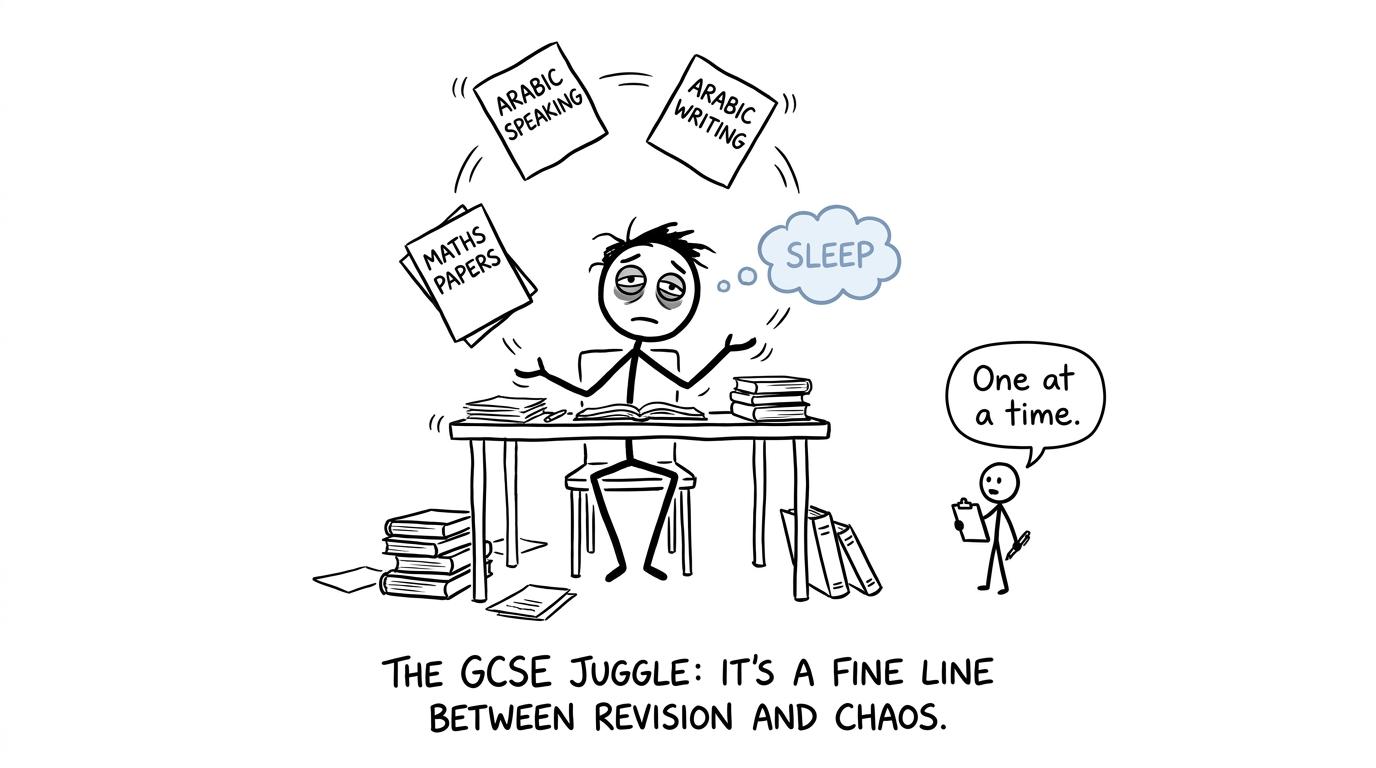 A GCSE student juggling Arabic, maths and sleep while a revision planner recommends one task at a time
Where does GCSE Arabic tend to rank for stress?
Based on recurring student reports, GCSE Arabic tends to sit above subjects that mainly reward factual recall, particularly for learners starting with little Arabic. It is often described as comparable in stress to other modern foreign languages, although the relationship between spoken dialects and Modern Standard Arabic creates an extra challenge.
Compared with GCSE maths, the stress is different rather than automatically greater. Maths usually builds towards several long written papers, where methods can be practised repeatedly. Arabic divides the qualification across four distinct skills, so a student may feel confident in reading but exposed in speaking. That unevenness can make the course feel less predictable.
A cautious comparison looks like this:
- Against other language GCSEs: broadly similar assessment pressure, with an additional formal-versus-dialect issue for some Arabic speakers.
- Against essay subjects: less extended English writing, but more rapid vocabulary retrieval and spontaneous communication.
- Against maths: fewer calculations, but more uncertainty about what you will hear or need to say in real time.
- Against practical subjects: less ongoing project work, but greater concentration of pressure around final assessments.
This is not an objective ranking. Student cohorts differ sharply. GCSE Arabic attracts many heritage speakers, so high grade outcomes cannot be treated as proof that the qualification is easy. Results reflect who entered, their prior knowledge and their preparation as well as paper difficulty.
Maths grade boundaries should be interpreted with the same care. A boundary tells you how marks translated into grades in one exam series; it does not measure how stressful students found the paper. MathsGenie's page on GCSE Arabic grade boundaries is useful for historical context, but boundaries should never become a substitute for learning the specification.
Why GCSE Arabic can feel stressful
Four different performances contribute to the result
The current Pearson Edexcel GCSE Arabic specification assesses listening, speaking, reading and writing. Each skill contributes 25%25\%25% of the qualification:
25%+25%+25%+25%=100%.25\% + 25\% + 25\% + 25\% = 100\%.25%+25%+25%+25%=100%.That balance is fair in one sense, but psychologically demanding in another. You cannot rely completely on one strength. Strong writing cannot erase every weakness in listening, and confident reading does not remove the speaking assessment.
At Foundation tier, the speaking assessment lasts approximately 777 to 999 minutes, with preparation time. At Higher tier, it lasts approximately 101010 to 121212 minutes. The tasks include a role play, questions based on a picture stimulus and a conversation. Current candidates are entered for one tier across all four papers, so tier decisions should be discussed carefully with the school.
Speaking creates a different kind of pressure
A written paper allows silence. A speaking assessment does not.
Students regularly report that the microphone, pauses and need to respond immediately make speaking feel especially intense. The assessment is conducted by a teacher and submitted for external marking, but knowing the teacher does not remove the sense of being recorded.
The encouraging part is that speaking anxiety is trainable. Rehearsing aloud, answering unfamiliar follow-up questions and recording short responses makes the assessment format ordinary. Silent vocabulary revision alone cannot create that familiarity.
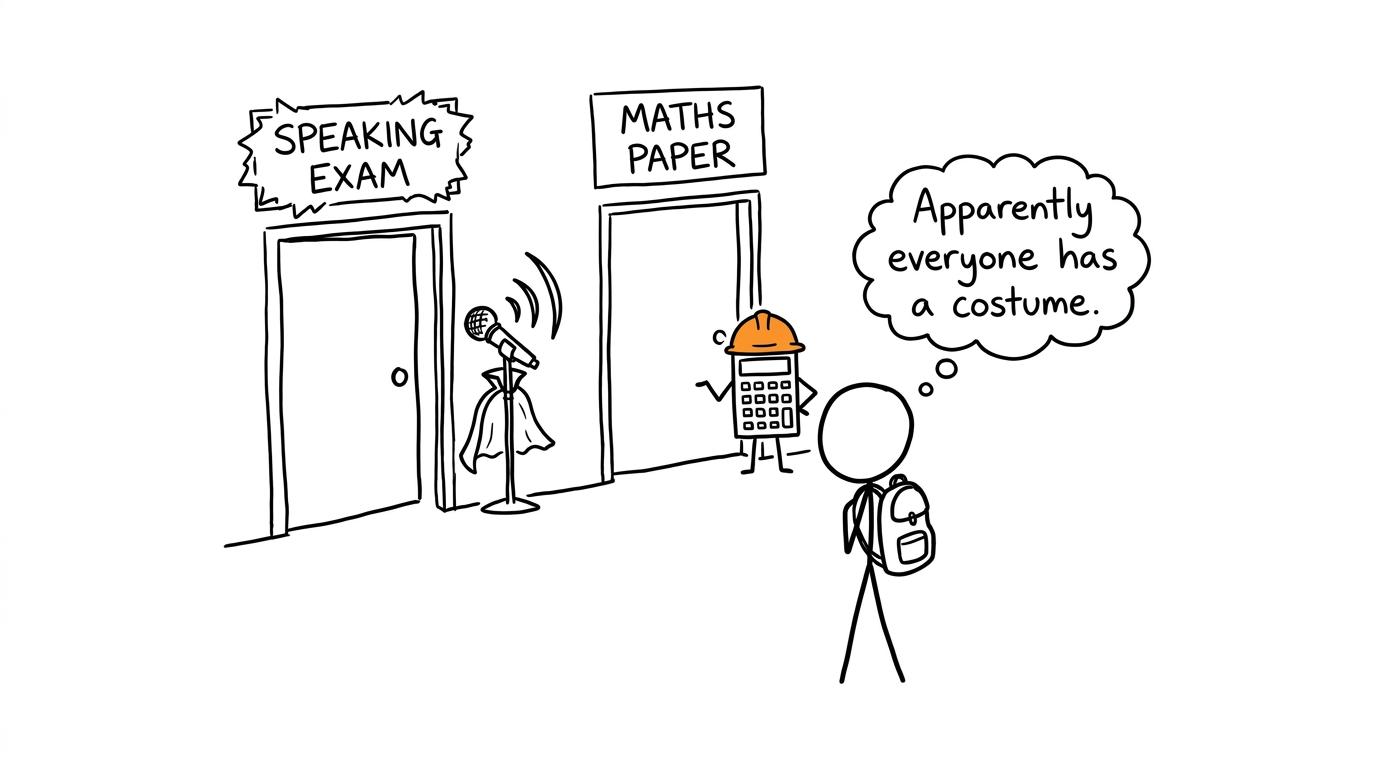 A microphone and calculator prepare for their different GCSE performances
Home Arabic and exam Arabic may not match
One of the strongest themes in research involving GCSE Arabic learners is the gap between everyday dialects and Modern Standard Arabic. A student may speak Arabic fluently with family yet have less experience of formal vocabulary, grammar, reading or extended writing.
This can produce a frustrating thought: "I speak Arabic, so why is this difficult?" The answer is not a lack of ability. The exam is testing a particular register and set of skills. Heritage knowledge is a real advantage, especially in comprehension and pronunciation, but it still needs to be converted into specification-level performance.
For a learner without an Arabic-speaking background, the script, unfamiliar vocabulary and grammatical structures can create a steeper starting point. Neither learner type should assume that classroom attendance alone is enough.
Reading and writing require breadth and speed
Student experiences vary over which paper feels hardest. Research has identified writing and vocabulary as major concerns, while recent informal student discussions also frequently mention demanding reading sections. These reports should be treated as experience rather than national statistics, but the pattern is useful: receptive fluency and productive accuracy both matter.
The writing paper requires communication in Arabic and includes translation into Arabic. Dictionaries are not permitted in the assessment. This means useful vocabulary must be retrievable under time pressure, not merely recognisable when looking through notes.
When GCSE Arabic may feel less stressful
Arabic may be one of your more manageable GCSEs if you can already:
- read Modern Standard Arabic without decoding every word slowly;
- write accurately across familiar topics;
- understand formal spoken Arabic rather than only a home dialect;
- respond aloud without memorising every sentence exactly;
- recognise how the mark scheme rewards communication, range and accuracy.
Motivation matters too. A subject connected to family, culture, faith or future plans may receive more voluntary practice. That does not change the assessment, but it changes how revision feels.
The decisive question is therefore not, "Is Arabic hard?" It is, "Which of the four assessed skills currently costs me the most effort?"
How to balance Arabic with GCSE maths revision
Stress grows when every subject is treated as one enormous task. A better plan gives each session a clear job.
For Arabic, rotate through listening, speaking, reading and writing rather than repeatedly choosing the skill you already enjoy. For maths, diagnose a topic gap, learn the method, answer questions, mark them and return to the same skill later.
A practical weekly pattern might include:
- short Arabic vocabulary retrieval on several days;
- one recorded speaking session;
- one timed reading or listening task;
- one planned writing response;
- focused maths topic sessions;
- a maths mini test or timed paper section at the weekend.
If school days are crowded, the twenty-minute GCSE maths revision routine offers a repeatable structure. Short sessions work best when they produce evidence: completed questions, marked answers or a recorded response.
Use Edexcel GCSE Maths mini tests when a complete paper would take too much energy. As exams approach, move towards Edexcel GCSE Maths past papers and use the mark schemes and solutions to identify where marks disappear.
The same principle applies across subjects: feedback makes revision specific. "Revise Arabic" is vague. "Practise Higher tier picture-stimulus follow-up questions" is actionable. "Do maths" is vague. "Complete and mark a ratio mini test" is actionable.
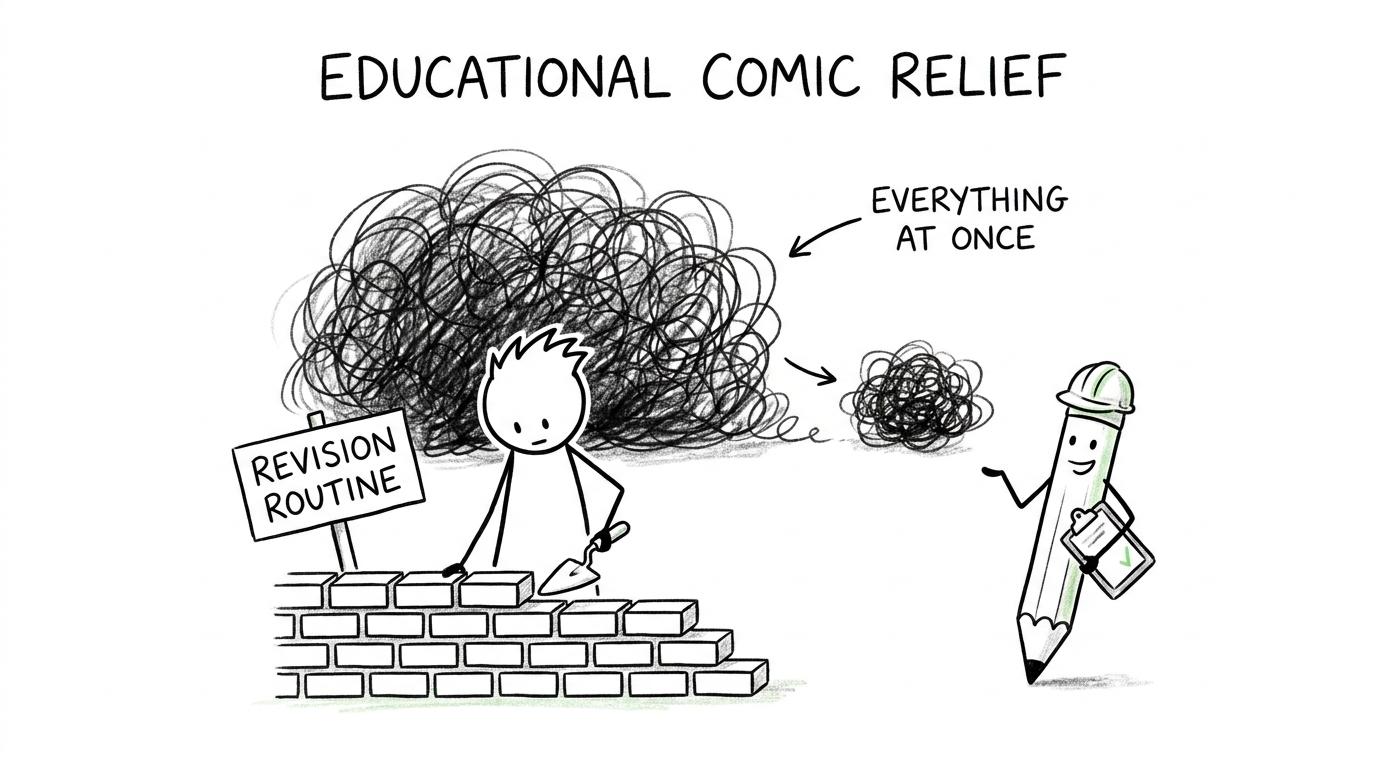 A student builds a revision routine while the everything-at-once cloud shrinks
A calmer revision strategy
Measure skills instead of feelings
After each Arabic task, record the main issue: vocabulary, comprehension, grammar, speed or confidence. In maths, use a similar error log based on lost marks. MathsGenie's guide to finding your weakest GCSE topics explains how to turn paper evidence into a focused revision list.
This matters because anxiety speaks broadly: "I am bad at Arabic." Evidence speaks narrowly: "I lose detail in longer listening extracts." Narrow problems can be practised.
Rehearse the format, not just the content
Knowing vocabulary is not identical to retrieving it during a conversation. Knowing a maths method is not identical to recognising it halfway through a mixed paper.
Use realistic conditions gradually. Begin with untimed practice, then timed sections, then complete assessments. For maths, predicted GCSE maths papers provide additional exam-style rehearsal after topic revision and official past papers. They should supplement past papers, not replace them.
Protect recovery time
More revision is not always better revision. Tired practice can create careless errors and make familiar work feel frightening. Set a stopping time, prepare equipment and avoid turning the evening before an assessment into an attempt to relearn the course. The GCSE maths night-before plan provides a calm checklist that can be adapted to your wider exam timetable.
Common mistakes when judging GCSE Arabic stress
Assuming fluent speech guarantees a top grade. Everyday dialect can help enormously, but formal reading, writing and grammar still require deliberate practice.
Treating high grade outcomes as proof of an easy GCSE. Entry patterns and prior language experience affect results, so subject percentages do not create a fair difficulty ranking.
Memorising scripts without practising unpredictable questions. Prepared language is useful, but the speaking assessment also requires interaction and recovery when a question changes.
Revising only vocabulary lists. Vocabulary supports every paper, yet students must also practise listening speed, reading inference, grammatical accuracy and timed communication.
Letting Arabic consume the whole revision timetable. A demanding optional subject should not quietly remove preparation time from maths, English or science. Plan by current weakness and upcoming assessment, not by whichever subject feels loudest.
Comparing your stress with somebody else's confidence. A heritage speaker, complete beginner and student with years of formal tuition are not starting from the same place.
The honest conclusion
So, how stressful is GCSE Arabic compared with other GCSEs? For many students it belongs in the moderate-to-high stress group, largely because four different skills are assessed and speaking creates immediate performance pressure. For confident readers and writers of Modern Standard Arabic, it may instead be one of the more manageable options.
The useful lesson is not that Arabic is easy or hard. It is that stress falls when the next task becomes obvious.
Identify your weakest Arabic skill, practise it in the actual assessment format and keep the session contained. Then do the same for maths. Start at MathsGenie for free revision lessons, practice questions, mini tests, past papers, predicted papers, mark schemes and video solutions. Build the plan one task at a time, because a calm routine is often more powerful than one heroic evening of revision.