How Many Students Take GCSE Biblical Hebrew?
How many students take GCSE Biblical Hebrew? Discover the latest entry figures, trends and what its small cohort means for GCSE grade boundaries each year.

A GCSE subject can feel enormous when it fills your timetable. Yet, nationally, some examination rooms would barely fill a school hall. If you are wondering how many students take GCSE Biblical Hebrew, the latest complete figure is remarkably small: Pearson’s final statistics show that 609609609 candidates sat the qualification in summer 202520252025.
That makes Biblical Hebrew one of the UK’s smallest GCSE subjects. Recent annual entries have generally remained between roughly 560560560 and 650650650. By comparison, there were 893,198893{,}198893,198 GCSE Mathematics entries across the UK in 202520252025.
The interesting question is not only how popular Biblical Hebrew is. It is what such a small cohort means for percentages, grade boundaries and the way GCSE results should be interpreted.
The short answer
Here is the essential picture:
- 609609609 candidates took Pearson Edexcel GCSE Biblical Hebrew in summer 202520252025.
- Recent entry totals were 579579579 in 202220222022, 643643643 in 202320232023 and 562562562 in 202420242024.
- The current qualification is Pearson Edexcel GCSE Biblical Hebrew, specification 1BH01\text{BH}01BH0.
- It is an untiered GCSE, so there are no separate foundation and higher papers.
- The qualification has two written components, each worth 100100100 marks and 50%50\%50% of the final result.
- A small entry does not mean that grades are distributed through a fixed quota.
- Grade boundaries are set after the papers have been marked, using evidence about assessment difficulty, candidate performance and the quality of work around key boundaries.
Summer 202620262026 results had not been published at the time of writing, so 202520252025 provides the latest complete entry figure.
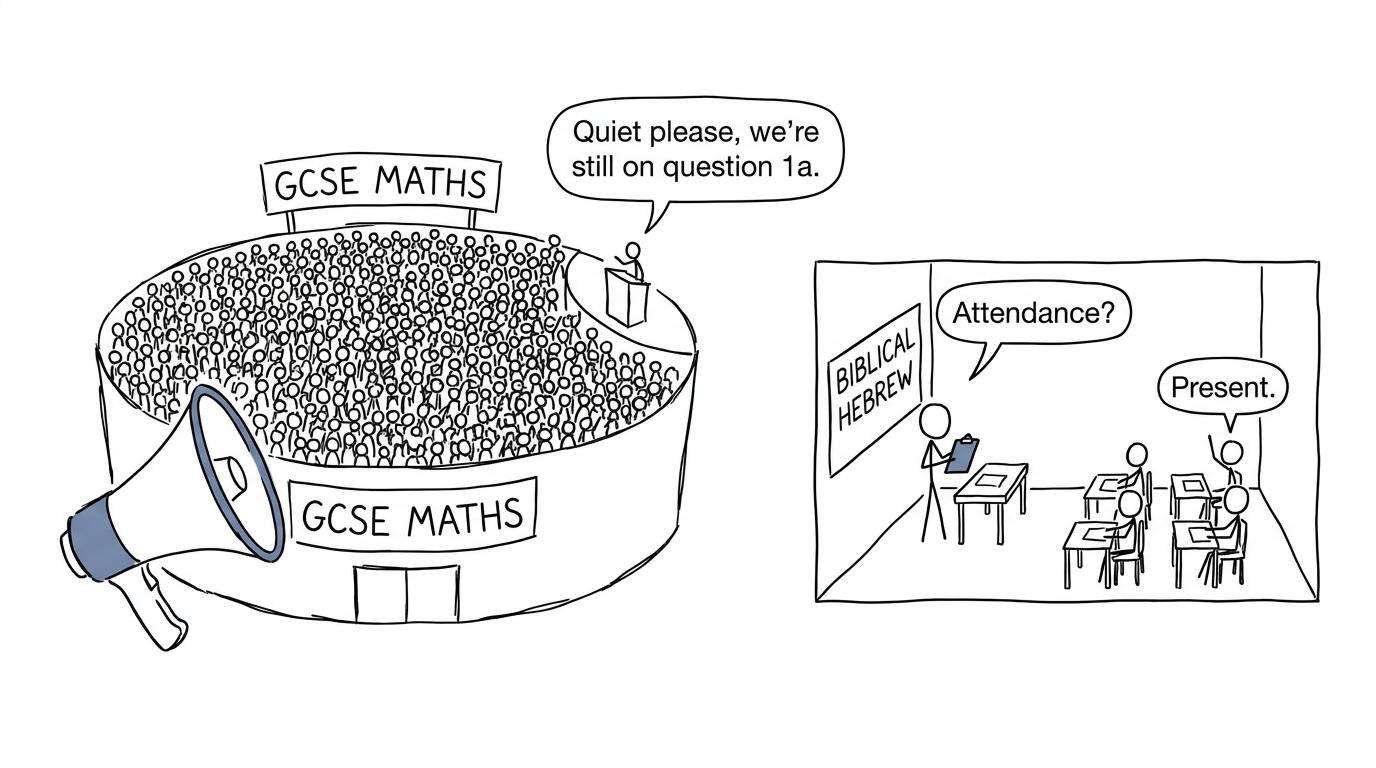 A packed GCSE Maths stadium beside a tiny Biblical Hebrew classroom
GCSE Biblical Hebrew entry numbers by year
The recent figures reveal a subject that is consistently small rather than one disappearing in a straight line.
| Examination year | GCSE Biblical Hebrew entries |
|---|---|
| 202220222022 | 579579579 |
| 202320232023 | 643643643 |
| 202420242024 | 562562562 |
| 202520252025 | 609609609 |
The highest total in this four-year period was 643643643 in 202320232023, while the lowest was 562562562 in 202420242024. That is a range of only 818181 candidates, although it represents a noticeable proportional movement because the starting numbers are so small.
A sensible summary is therefore that about 600600600 candidates take GCSE Biblical Hebrew in a typical recent year. It would be misleading to treat 609609609 as a permanent annual total. Entries can change as schools alter their options, cohort sizes vary and individual centres decide whether to enter candidates.
There is also a technical distinction worth noticing. Published results normally count qualification entries or candidates sitting the subject, not necessarily unique people across the entire GCSE system. A student taking Biblical Hebrew will usually be entered for several other GCSEs too.
How small is the subject compared with GCSE Maths?
The contrast with GCSE Maths is difficult to picture until the figures are placed beside each other. In 202520252025, there were 893,198893{,}198893,198 GCSE Mathematics entries across the UK, compared with 609609609 for Pearson Edexcel Biblical Hebrew.
The Biblical Hebrew cohort was approximately:
609893,198×100≈0.068%\frac{609}{893{,}198}\times 100\approx 0.068\%893,198609×100≈0.068%of the size of the GCSE Maths entry. Put another way, there were roughly 1,4671{,}4671,467 Mathematics entries for every Biblical Hebrew entry.
This does not make one qualification more important than the other. It illustrates why percentages from small subjects need care. In a cohort of 609609609, one candidate represents approximately:
1609×100≈0.16%\frac{1}{609}\times 100\approx 0.16\%6091×100≈0.16%A movement of only a few candidates can therefore change a published percentage visibly. In a subject with hundreds of thousands of entries, the same movement would disappear after rounding.
This is a useful statistics lesson for maths students. A percentage can look precise while resting on a small underlying frequency. Always ask for the denominator.
What does a small cohort mean for grading?
A common assumption is that GCSE grades are awarded by ranking candidates and giving only a predetermined proportion each grade. That is not an accurate description of GCSE awarding.
Exam boards set grade boundaries after scripts have been marked. They consider statistical evidence alongside the judgement of senior examiners, including how demanding the assessment proved to be, how the cohort performed and the standard of work around key boundary marks. Ofqual oversees the process used by awarding organisations.
For relatively small qualifications, statistical evidence is naturally less stable. The professional judgement of senior examiners consequently matters alongside the available data. The aim remains to maintain a comparable standard, not to force every subject into an identical grade distribution.
There is no fixed number of grade 999s
If more candidates produce work meeting the required standard, more can receive high grades. Candidates are not competing for a tiny, predetermined allocation of grade 999s.
In the final 202520252025 Pearson statistics:
- 117117117 of the 609609609 candidates achieved grade 999, or 19.2%19.2\%19.2%.
- 318318318 achieved grade 777 or above, or 52.2%52.2\%52.2%.
- 526526526 achieved grade 444 or above, or 86.4%86.4\%86.4%.
Those percentages are much higher than the outcomes seen in many large-entry GCSE subjects. They do not prove that Biblical Hebrew is easier. The candidates taking a specialist subject are not a random sample of all GCSE students. They may have particular language experience, specialist teaching or a strong reason for choosing the qualification. These are plausible selection effects, not evidence that the assessment standard is lower.
What the grade boundaries show
The Pearson Edexcel qualification is marked out of 200200200. In summer 202520252025, the overall boundaries included:
| Grade | Minimum mark in 202520252025 | Percentage of available marks |
|---|---|---|
| 999 | 149149149 | 74.5%74.5\%74.5% |
| 777 | 125125125 | 62.5%62.5\%62.5% |
| 444 | 919191 | 45.5%45.5\%45.5% |
You can see the complete set on MathsGenie’s GCSE Biblical Hebrew grade boundaries page.
Boundaries moved between 202420242024 and 202520252025. For example, the grade 999 boundary fell from 162162162 to 149149149, while the grade 777 boundary fell from 138138138 to 125125125. This does not mean standards were simply lowered. Boundaries can move because papers differ in difficulty and because awarding decisions are based on the evidence from that examination series.
The same principle applies to GCSE Maths. A previous boundary is useful context, but it is never a promise about the next series. Your safest target is not the exact minimum from one past year. It is consistent performance with room for variation.
 An examiner carefully moving a grade-boundary marker
How GCSE Biblical Hebrew is assessed
The current Pearson Edexcel specification contains two externally examined components:
- Component 111: Language: a two-hour paper worth 100100100 marks and 50%50\%50% of the qualification.
- Component 222: Literature: a two-hour paper worth 100100100 marks and 50%50\%50% of the qualification.
The final grade is based on the combined subject mark and reported on the GCSE scale from 999 to 111, with 999 the highest. Individual components contribute marks rather than separate certificate grades.
It is also important not to confuse Biblical Hebrew with Religious Studies, Modern Hebrew or an A Level qualification carrying a similar name. They have different specifications, assessments and entry statistics.
What maths students can learn from these figures
The story of a 609609609-candidate GCSE contains several habits that transfer directly to maths revision.
Look behind percentages
The percentage 19.2%19.2\%19.2% sounds precise, but it represents 117117117 candidates. Frequencies and sample sizes give percentages their meaning. This matters in probability, statistics and everyday claims based on data.
Do not mistake outcomes for difficulty
A high proportion of top grades does not, by itself, show that an examination is easy. The ability, preparation and experience of the candidates matter. Correlation is not an explanation.
Treat boundaries as evidence, not targets carved in stone
Previous boundaries help you understand the rough mark range associated with each grade. They cannot predict a future boundary exactly. For maths, begin with the GCSE Maths revision hub, choose your board and tier, and measure progress across several papers rather than against one historical figure.
MathsGenie’s Edexcel GCSE Maths past papers let you practise under timed conditions and check the official mark schemes. Nearer the exams, GCSE predicted papers can provide additional unseen practice, but they should complement rather than replace genuine past papers.
Common mistakes when interpreting the data
Calling 609609609 the number for every year. It is the final summer 202520252025 figure. Recent totals have moved above and below 600600600.
Assuming a small subject is automatically easy. Entry size tells you about popularity and availability, not assessment demand.
Reading a high grade-999 percentage as proof of generous grading. The cohort is highly selected, and its results cannot be compared fairly with a compulsory subject without considering who entered.
Believing grades are rationed. GCSE awarding does not simply reserve a fixed percentage of each grade for each subject.
Predicting future boundaries from one series. Boundaries are set after papers are marked and may rise or fall. The better revision strategy is explained in MathsGenie’s guide to using GCSE past papers properly.
Focusing only on the total mark. A paper score becomes useful when you identify where marks were lost. The weakest-topics revision guide shows how to turn errors into specific next steps.
A small subject with a useful lesson
So, how many students take GCSE Biblical Hebrew? The latest complete answer is 609609609 candidates in summer 202520252025, with recent annual entries usually sitting at around 600600600.
Its small size makes annual percentages more sensitive to a handful of candidates, but it does not create an easier grading system or a fixed quota of top grades. Boundaries still reflect evidence from the paper, candidate performance and examiner judgement. The lesson is quietly mathematical: context matters, denominators matter and one statistic rarely tells the whole story.
Bring that same discipline to your own revision. Use the MathsGenie GCSE revision timetable to plan regular sessions, learn through free revision lessons, practise topic questions, and then test yourself with mini tests, past papers and predicted papers. Mark every attempt carefully, use video solutions when a method is unclear, and turn each lost mark into a specific action. That is how data becomes progress.