How Many Students Take GCSE Arabic Each Year?
How many students take GCSE Arabic? About 5,300 sat it across the UK in 2025. Explore entry trends, grade outcomes and what the data really means.
A subject can feel rare inside one school and still fill thousands of exam desks across the country. That is exactly what happens with GCSE Arabic. Your school may have a full class, a handful of candidates or no course at all, making its national popularity difficult to judge.
So, how many students take GCSE Arabic each year? The latest published UK results show that 5,3255{,}3255,325 students sat GCSE Arabic in summer 202520252025. That was up from 5,2565{,}2565,256 in 202420242024 and 5,1715{,}1715,171 in 202320232023. The short answer is therefore around 5,0005{,}0005,000 to 5,3005{,}3005,300 candidates annually in recent exam series.
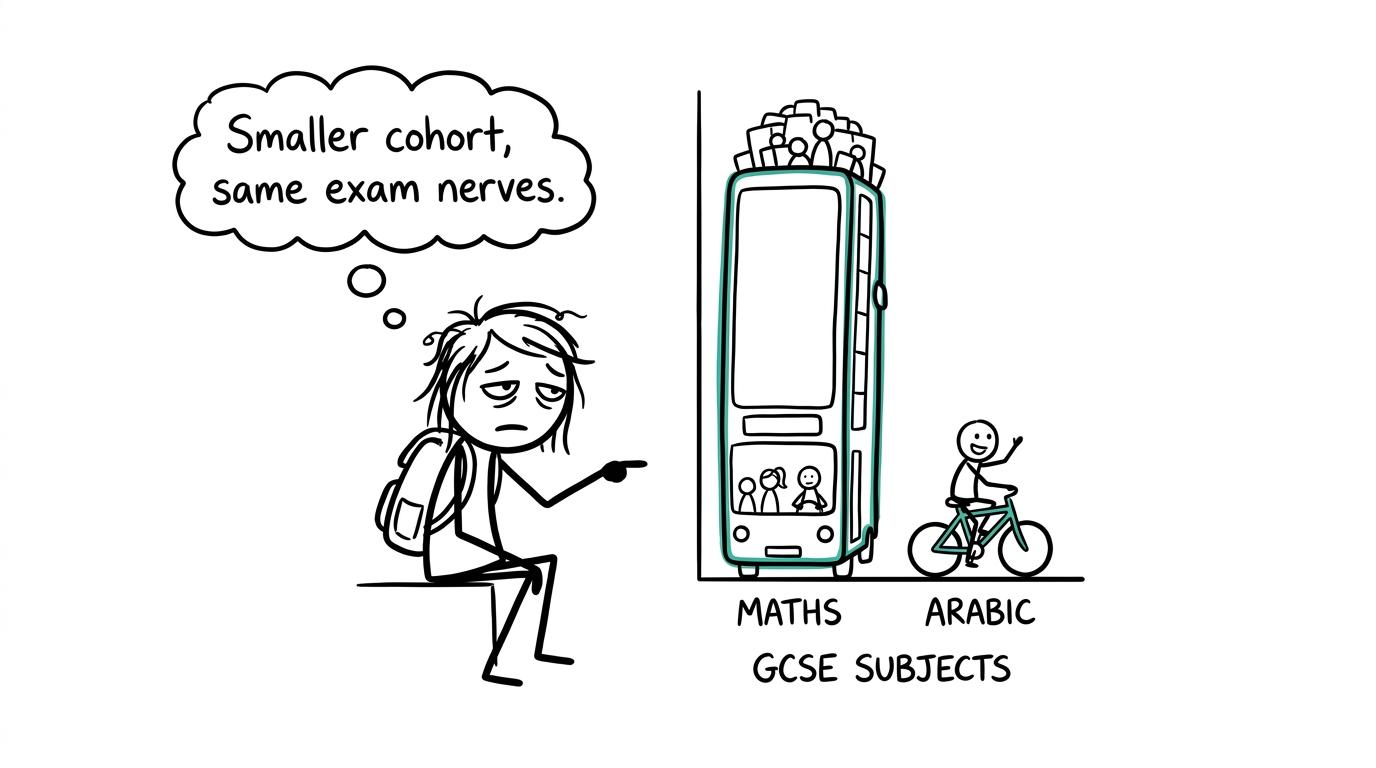
That makes Arabic a relatively small GCSE compared with mathematics, English or the largest modern languages. But it is not an obscure qualification. It has a stable national cohort, a complete grades 999 to 111 structure and formal Foundation and Higher tier assessments.
GCSE Arabic numbers at a glance
Here is the essential picture before we look more closely at what the figures mean:
- 5,3255{,}3255,325 students sat GCSE Arabic across the UK in summer 202520252025.
- The total was 5,2565{,}2565,256 in 202420242024 and 5,1715{,}1715,171 in 202320232023.
- Candidate numbers increased in both of the latest year-on-year comparisons.
- Arabic represented about 12.2%12.2\%12.2% of all UK entries grouped by JCQ as “Other Modern Languages” in 202520252025.
- In 202520252025, 58.5%58.5\%58.5% of candidates achieved grade 777 or above and 84.7%84.7\%84.7% achieved grade 444 or above.
- These strong outcomes do not prove that the examination is easier. The characteristics and prior experience of the candidate group matter enormously.
The figures come from the Joint Council for Qualifications, or JCQ, which publishes UK examination results. Pearson’s provisional GCSE grade statistics report the same 202520252025 candidate total for its Edexcel Arabic qualification.
 A GCSE student comparing a crowded maths bus with a cheerful Arabic bicycle
How GCSE Arabic participation has changed
The recent totals show gentle growth rather than a sudden surge.
| Summer exam series | Students who sat GCSE Arabic | Annual change |
|---|---|---|
| 202320232023 | 5,1715{,}1715,171 | Not shown |
| 202420242024 | 5,2565{,}2565,256 | +1.6%+1.6\%+1.6% |
| 202520252025 | 5,3255{,}3255,325 | +1.3%+1.3\%+1.3% |
Across the two years from 202320232023 to 202520252025, the cohort grew by 154154154 candidates, or approximately 3.0%3.0\%3.0%.
That is a useful distinction. Saying that GCSE Arabic is “growing” is accurate for this period, but it would be misleading to describe the growth as dramatic. The numbers suggest a subject with a fairly steady base of roughly five thousand candidates.
JCQ placed Arabic inside its Other Modern Languages category alongside subjects including Chinese, Italian, Polish, Portuguese, Russian, Turkish and Urdu. The complete category rose from 43,12143{,}12143,121 entries in 202420242024 to 43,67843{,}67843,678 in 202520252025. Arabic accounted for:
5,32543,678×100≈12.2%\frac{5{,}325}{43{,}678}\times 100\approx 12.2\%43,6785,325×100≈12.2%This calculation gives context without pretending that the category is one uniform group. Each language has its own availability, candidate population and pattern of school or private entry.
Students who want to become more confident with this kind of interpretation can revisit percentages in GCSE maths and explore the wider GCSE Maths revision hub.
Is GCSE Arabic a popular subject?
The fairest answer is that it is established but comparatively small.
Hundreds of thousands of students receive results in compulsory subjects such as mathematics and English. GCSE Arabic, at just over 5,0005{,}0005,000 candidates, operates on a different scale. It may also be unavailable as a timetabled option in many schools, so national demand and school-level availability are not the same thing.
Within the Other Modern Languages group, however, Arabic is significant. Its 202420242024 entry total was below Polish and Chinese but above each of the other individually listed languages in that JCQ table. It should not be treated as a qualification taken by only a few isolated candidates.
Availability can shape participation. Some students are taught during the normal school day, while others may prepare through supplementary education or enter through an examination centre. National totals alone do not reveal how candidates learnt the language, their home-language background or why they chose the qualification.
That limitation matters because statistics answer only the question they were designed to measure. A candidate total tells us how many results were recorded. It does not tell us how many schools actively taught the course or how many interested students could not access it.
What the results say about GCSE Arabic grading
The 202520252025 grade distribution is striking:
| Outcome in summer 202520252025 | Percentage of GCSE Arabic candidates |
|---|---|
| Grade 999 | 29.2%29.2\%29.2% |
| Grade 777 or above | 58.5%58.5\%58.5% |
| Grade 444 or above | 84.7%84.7\%84.7% |
| Grade 111 or above | 94.8%94.8\%94.8% |
A quick glance may tempt someone to conclude that Arabic is generously graded. That conclusion does not follow from the figures.
Subject grade distributions reflect the students who enter as well as the assessment itself. GCSE Arabic may include many candidates who already use Arabic at home, have attended supplementary classes or possess substantial language experience before beginning the GCSE course. It may also attract students and centres that believe they are well prepared for the assessment.
This is an example of selection effect. The group taking a subject is not a random sample of every GCSE student. A high proportion of top grades can therefore coexist with a demanding examination.
The same caution applies when comparing grades between any two subjects. Grade distributions show what happened within particular candidate groups; they do not provide a simple difficulty league table. If you enjoy analysing distributions, averages and grouped data, MathsGenie’s GCSE Statistics revision resources and averages revision lesson develop the same habit of reading numbers carefully.
How GCSE Arabic is assessed and graded
Pearson Edexcel GCSE Arabic assesses four language skills:
- listening;
- speaking;
- reading;
- writing.
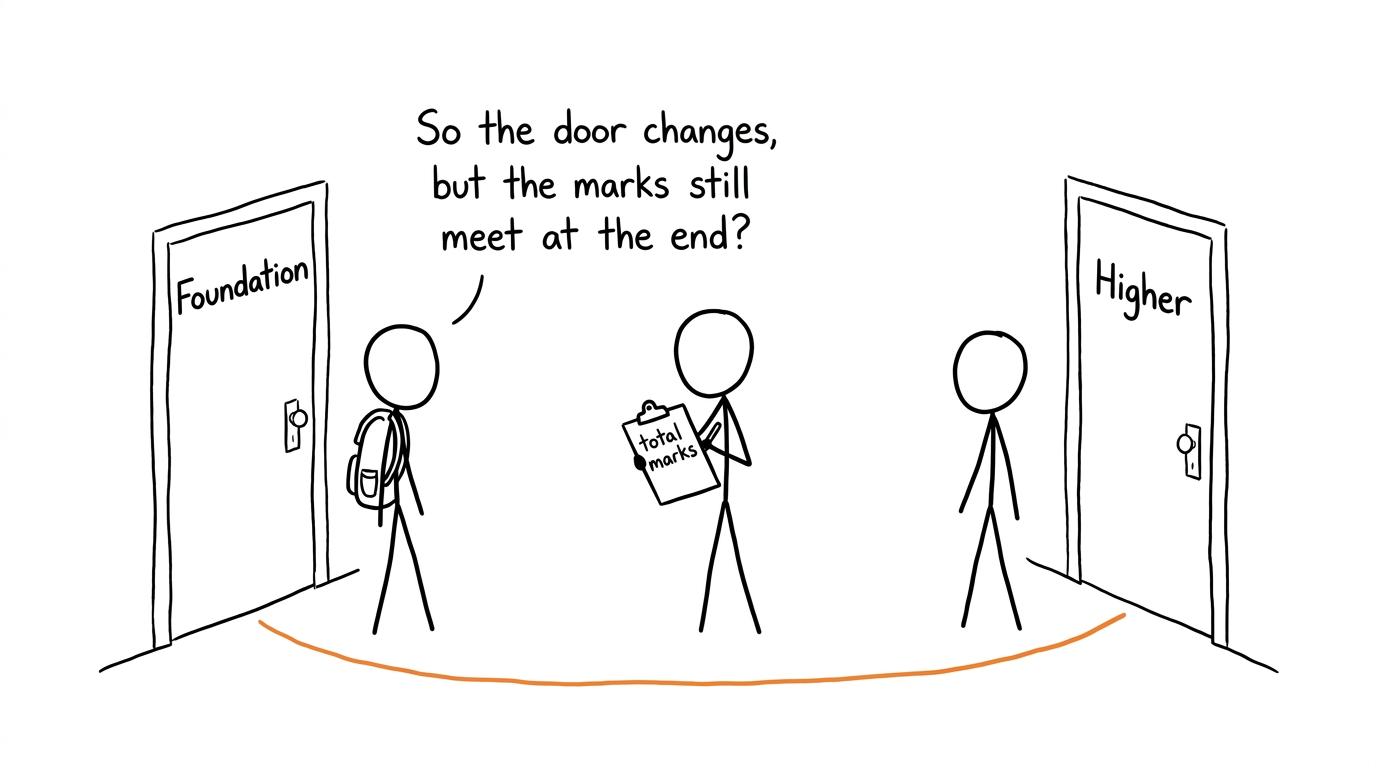
Each skill contributes 25%25\%25% of the qualification. Students must take all papers at the same tier, and the final grade is based on the total subject mark rather than separate grades for individual papers.
Foundation tier makes grades 111 to 555 available. Higher tier makes grades 444 to 999 available, with a possible grade 333 for a candidate who falls a limited number of marks below the grade 444 boundary. This resembles the broad logic of tiering in GCSE maths, although the papers and assessment structure are naturally different.
The published Edexcel boundaries for summer 202520252025 used a maximum total of 280280280 marks. Grade boundaries are minimum marks for a grade in that particular exam series. They are set after the assessments have been completed and marked, so they can vary between years when paper demand varies.
You can inspect the current and historical figures on MathsGenie’s Edexcel GCSE Arabic grade boundaries page.
 Students choosing Foundation and Higher doors while an examiner holds the total-marks clipboard
Does a smaller cohort change your chance of a high grade?
Not in the simple way students sometimes imagine.
There is no rule saying that only a fixed number of GCSE Arabic candidates may receive each grade. You are not trying to occupy one of a tiny number of grade 999 places. Your result depends on the quality of your assessed work and the grade boundaries applied to that examination series.
A smaller cohort can make annual percentages look more sensitive to changes in candidate composition. But the standard is not supposed to become easier merely because fewer students take the subject. Awarding organisations use statistical evidence and examiner judgement when setting boundaries, with Ofqual overseeing regulated qualifications in England.
The practical lesson is reassuring: another candidate’s fluency does not take marks away from you. Your attention belongs on the specification, the assessment objectives and the quality of your own responses.
What these statistics can teach maths students
Even if you are reading this while primarily preparing for GCSE maths, the Arabic figures offer a compact lesson in data handling.
A raw frequency answers “how many?”, while a percentage helps compare that frequency with a larger total. A time series reveals direction, but three years of modest growth do not justify a sweeping long-term forecast. A grade distribution describes outcomes, but it cannot identify the cause of those outcomes by itself.
Those habits transfer directly to GCSE maths questions involving tables, charts and written conclusions:
- identify the population and time period;
- distinguish entries from candidates who actually sat the examination;
- compare absolute and percentage changes;
- avoid inferring causation from an association;
- check whether grouped categories hide important differences.
The full GCSE Maths topics by board and tier guide can help you locate the statistics, percentages and ratio skills assessed by Edexcel, AQA, OCR and Eduqas.
Common mistakes when interpreting GCSE Arabic figures
Mixing up GCSE and A Level entries
The qualifications have separate cohorts. A Level Arabic numbers cannot be added to GCSE totals when answering how many students take the GCSE.
Confusing UK figures with England-only data
JCQ’s headline Arabic table covers the UK. Ofqual publications generally concern regulated qualifications in England. Always check the geographical coverage before comparing totals.
Treating entries and results as identical in every source
Provisional entry statistics count examination entries before results day. Results tables report candidates who sat or received results. Late changes, withdrawals and absences can create small differences.
Assuming high grades mean an easy paper
The grade distribution is influenced by who chooses and can access the subject. Prior language experience is a plausible factor, but the published totals do not reveal every candidate’s background.
Predicting the future from a short trend
The increase from 202320232023 to 202520252025 is real, but it is only a short period. It supports the conclusion that participation recently rose modestly, not that it will rise forever.
 A student balancing language revision and maths revision under the watch of a tiny calendar
Turn curiosity into a calmer revision plan
The most useful conclusion is simple: GCSE Arabic is a smaller national subject with a stable cohort of just over 5,0005{,}0005,000 recent candidates. Its high proportion of top grades should be interpreted through the composition of that cohort, not as proof that the qualification is easy or that grades are handed out differently.
Good revision works in much the same way as good data interpretation. Look closely. Separate evidence from assumption. Then act on what the evidence actually says.
For your maths preparation, begin with the MathsGenie GCSE Maths revision area, build a manageable plan using the GCSE maths revision timetable, and test your progress with Edexcel past papers and mark schemes. Nearer the examination, use Edexcel predicted papers alongside revision lessons, practice questions, mini tests and video solutions.
The aim is not to feel busy. It is to know what the numbers are telling you and what to do next.