

How Long to Revise for GCSE Bengali Per Week
How long revise GCSE Bengali per week? Build a realistic plan by months remaining, balance all four skills and protect enough time for GCSE maths.
Revision time has a strange habit: it feels abundant several months before an exam and almost weightless until the calendar suddenly becomes urgent. If you are asking how long revise GCSE Bengali per week, a realistic starting point is 222 to 333 hours when the exam is more than six months away, rising gradually to 444 to 666 focused hours in the final two months.
That time should be spread across the week, not saved for one exhausting session. Your exact plan depends on your current language ability, target grade, schoolwork and the time remaining. It must also leave room for subjects such as GCSE Maths, where regular practice matters just as much.
Your weekly GCSE Bengali revision checklist
A useful weekly plan should:
- cover listening, speaking, reading and writing;
- include vocabulary retrieval rather than passive rereading;
- revisit grammar and Bengali script regularly;
- contain at least one timed or exam-style task;
- spread revision over several shorter sessions;
- change as the exam gets closer;
- leave protected time for maths and your other GCSE subjects.
For the current Pearson Edexcel GCSE Bengali qualification, listening, speaking, reading and writing are assessed separately, with each skill contributing 25%25\%25% of the qualification. Check the specification and information supplied by your school for your examination year, tier and final arrangements.
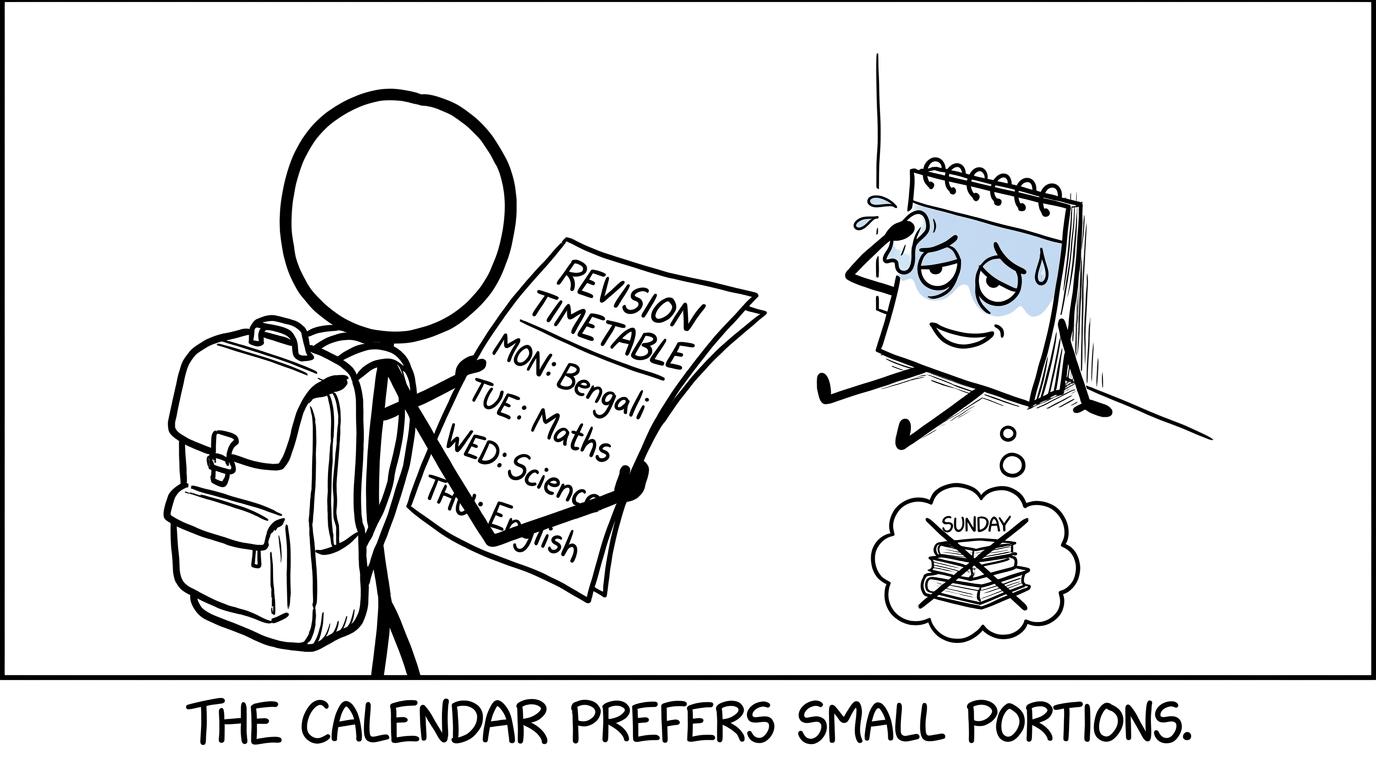 A revision calendar relieved to receive small portions of Bengali and maths practice
How many hours should you revise for GCSE Bengali?
There is no official number of compulsory revision hours. Exam boards set content and assessment requirements, not a universal home-revision timetable. The figures below are practical starting ranges rather than guarantees of a particular grade.
| Time before the exam | Suggested Bengali revision per week | Sensible session pattern |
|---|---|---|
| More than 666 months | 222 to 333 hours | 444 sessions of 303030 to 454545 minutes |
| 333 to 666 months | 333 to 444 hours | 444 or 555 sessions of 404040 to 505050 minutes |
| 111 to 222 months | 444 to 666 hours | 555 sessions plus one longer exam task |
| Final 222 weeks | 555 to 777 hours, if sustainable | Short daily recall plus targeted paper practice |
These ranges assume that you are attending lessons and completing normal homework. If you already speak Bengali confidently at home, you may need less time for everyday listening and speaking but more deliberate practice with formal vocabulary, accurate spelling, reading and exam-style writing. Familiarity with a language is valuable, but it is not identical to examination readiness.
A beginner or a student with substantial gaps may need to start near the upper end of each range. More time is not always the answer, however. A focused 303030-minute session with a clear outcome is usually more useful than two distracted hours beside an open textbook.
Adjust the plan to your starting point
The most honest timetable begins with evidence. Before choosing your weekly hours, complete a short task in each skill and review it against the relevant mark scheme or assessment criteria.
Ask yourself:
- Can I understand the main message and important details when listening?
- Can I answer spoken questions without relying on memorised fragments?
- Can I read unfamiliar passages and infer meaning from context?
- Can I write accurately across more than one time frame?
- Which recurring errors lose marks?
Sort the answers into three groups: secure, developing and weak. Your weakest assessed skill should receive the largest share of your Bengali revision time, but no skill should disappear completely.
If speaking is secure but writing is weak, for instance, a balanced plan does not require equal minutes every week. You could temporarily give writing 40%40\%40% of your time, reading 25%25\%25%, listening 20%20\%20% and speaking 15%15\%15%. Review that split after two or three weeks using fresh evidence.
Divide each week between the four language skills
Because all four skills matter, a useful three-hour week might contain separate blocks for listening, speaking, reading, writing, vocabulary and correction. This is a planning structure, not a rigid formula.
Listening and speaking
Listen to short, level-appropriate Bengali material and decide in advance what you are trying to identify: the overall message, opinions, reasons, time references or specific details. Replay selectively rather than allowing the recording to become background noise.
Speaking practice should involve producing language aloud. Rehearse likely themes, respond to unprepared prompts and record yourself where appropriate. Listen for hesitation, unclear pronunciation and grammatical patterns that need correction. Quietly reading an answer is not equivalent to speaking it under pressure.
Reading and vocabulary
Build vocabulary through retrieval. Cover the Bengali, recall it from the English meaning, then reverse the direction. Include vocabulary inside phrases and sentences so that you learn how words behave, not simply what they mean.
Reading practice should move beyond translating every word. Look first for topic, viewpoint, tense and key details. Then inspect unfamiliar vocabulary and grammar. This reflects the decisions you must make when time is limited.
Writing and grammar
Writing improves when it is followed by correction. Practise planning, sentence construction, spelling and accurate use of different time frames. After a task, create a short error list and rewrite only the sentences that need improvement.
Do not measure progress solely by the length of an answer. Accuracy, relevance, range and communication matter. Use the assessment guidance for your course rather than inventing your own idea of what a high-mark response should look like.
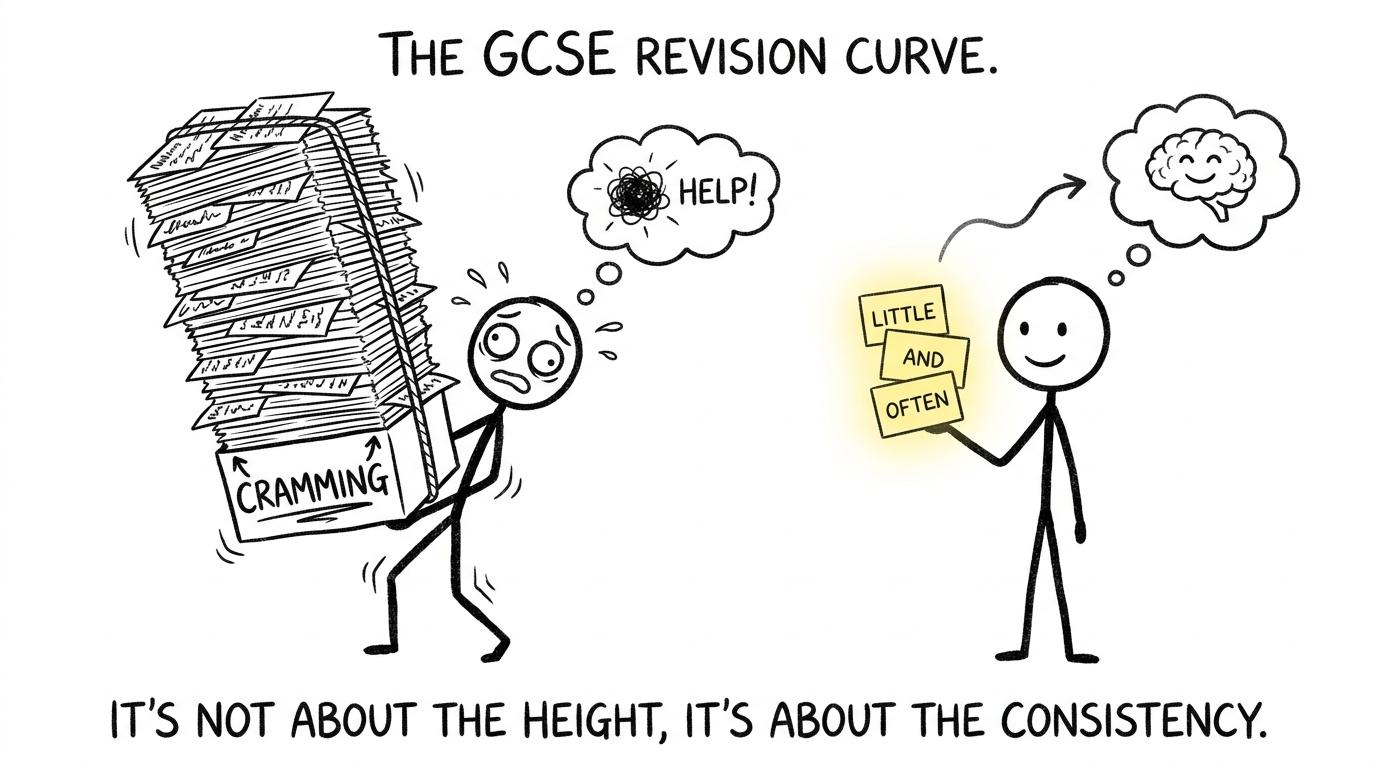 A student chooses little-and-often revision while another struggles beneath a tower labelled cramming
Revise little and often rather than cramming
A language depends on recall becoming increasingly available. That is difficult to build in a single weekly block. Four 404040-minute sessions generally create more opportunities to retrieve and revisit material than one uninterrupted session of similar total length.
Spacing does not mean completing a task once and forgetting it. Return to difficult words, structures and corrections after a delay. Retrieval should require some effort: test yourself before looking at the answer, then check and correct it promptly.
A simple rhythm is:
- early week: vocabulary and listening;
- middle of the week: reading and grammar;
- later in the week: speaking and writing;
- weekend: an exam-style task followed by corrections.
The purpose is not to create a beautiful timetable. It is to make the next useful action obvious.
Balance Bengali with GCSE Maths revision
Students do not revise one GCSE in isolation. If Bengali expands whenever an exam feels worrying, it can quietly consume the time meant for maths, science or English. Instead, give each subject protected weekly blocks based on need, proximity of the exam and recent performance.
For maths, begin with the free GCSE Maths revision lessons and identify topics where you cannot yet answer questions independently. MathsGenie organises material by grade and provides videos, practice questions and answers, making it easier to plan purposeful sessions rather than vaguely deciding to “do maths”.
Use GCSE Maths past papers when you need evidence across the whole course. A paper can reveal whether the real problem is algebra, geometry, number or time management. Near the examination period, GCSE Maths predicted papers can provide additional exam-style practice, but they should supplement specification-wide revision rather than replace it.
If a full paper feels premature, MathsGenie mini tests can create shorter checkpoints. You can also use the Maths revision planner to organise the remaining weeks.
Keep the methods distinct. Bengali requires frequent contact with vocabulary and all four language skills. Maths requires active problem solving, clear working and careful use of mark schemes. Both improve when you attempt something before consulting the solution.
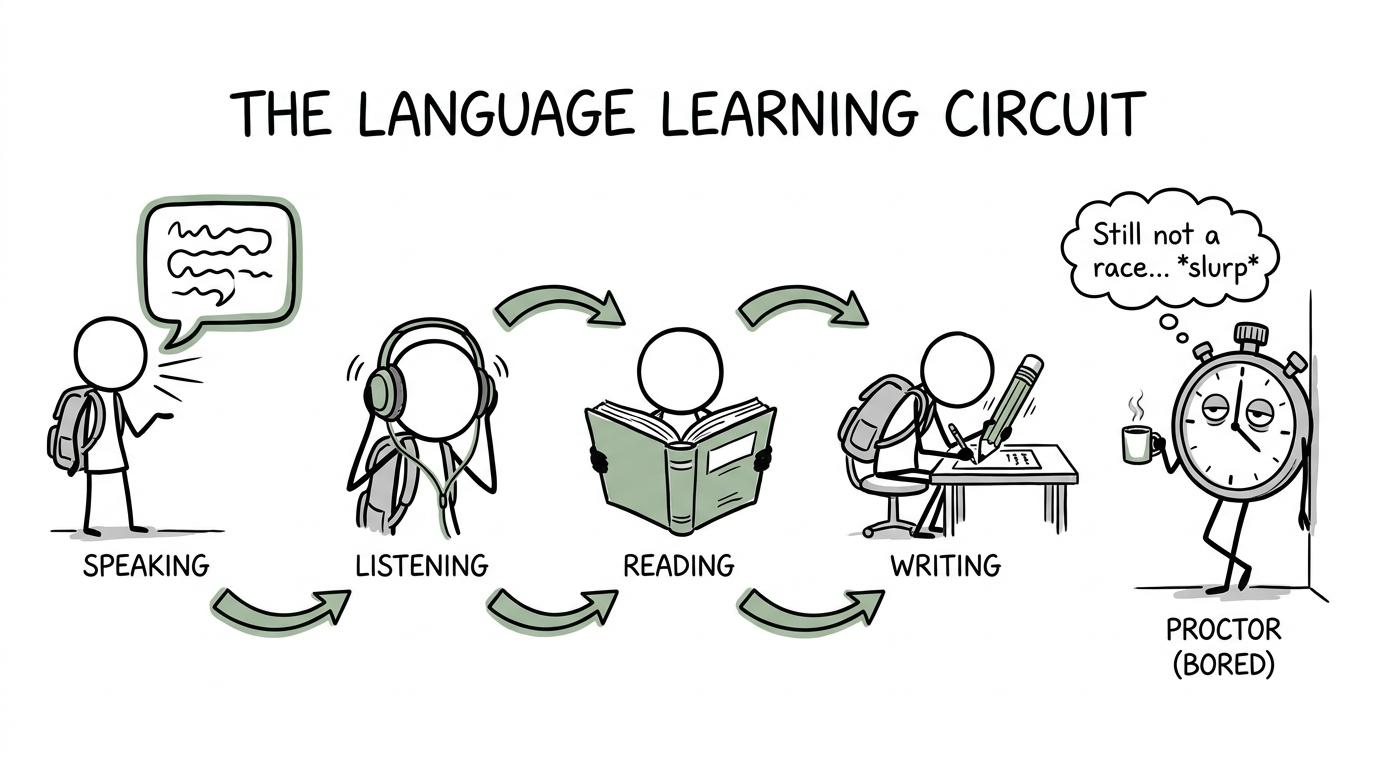 Four cheerful language-practice stations and a bored stopwatch enjoying tea
How to increase revision as the exam approaches
More revision should mean more specific practice, not simply longer days. Several months out, concentrate on building vocabulary, grammar and fluency. With three to six months remaining, introduce regular exam-style questions and timed sections. In the final two months, use complete tasks more frequently and track errors by category.
Increase weekly time only when you can explain what the extra sessions will achieve. “Revise Bengali for another hour” is vague. “Complete a timed reading section, mark it and review incorrect vocabulary” has a finish line.
Protect sleep, lessons and reasonable breaks. If a proposed 777-hour Bengali week repeatedly collapses, reduce it to a sustainable plan and make each session more focused. Consistency creates more value than an ambitious timetable that survives for three days.
Common GCSE Bengali revision mistakes
Giving every skill identical time
Equal weighting in the qualification does not mean your weaknesses are equal. Use assessment evidence to direct extra time while maintaining all four skills.
Counting exposure as revision
Hearing Bengali in daily life can support fluency, but exam preparation also requires deliberate reading, formal writing, accurate vocabulary and practice under assessment conditions.
Memorising without adapting
Prepared phrases can provide useful structures. Problems arise when an answer does not address the question or when memorised language cannot be adapted to a different tense, opinion or context.
Completing tasks without correcting them
A marked paper is not the end of revision. Record why each error occurred, correct it and revisit the underlying word or grammatical structure later.
The same principle applies to maths. Use the answers and video support attached to MathsGenie GCSE resources, but only after making a genuine attempt.
Increasing hours too quickly
Moving immediately from no routine to daily two-hour sessions is rarely sustainable. Add one or two short sessions, maintain them, then increase the total if the evidence shows that you need to.
Build a plan you can actually follow
So, how long should you revise for GCSE Bengali each week? Begin with 222 to 333 hours when you have more than six months, aim for 333 to 444 hours with three to six months remaining, and consider 444 to 666 focused hours during the final two months. Adjust those ranges using your starting level, target grade and performance across listening, speaking, reading and writing.
A good revision plan is not the one with the most coloured boxes. It is the one that repeatedly brings you back to the work that matters.
Place your Bengali sessions into the week, then protect your maths time with MathsGenie's free GCSE revision resources, past papers and mark schemes, predicted papers, practice questions, video solutions and mini tests. Start with one realistic week, review what worked, and let evidence shape the next.











