

Have I Revised Enough for GCSE English Literature?
Have I revised enough GCSE English Literature? Use a realistic check for recall, analysis, timed essays and weak areas before the final exam season.
There is a peculiar moment in revision when doing more stops feeling reassuring. You have reread the play, highlighted the novel and filled pages with quotations, yet the question remains: have I revised enough GCSE English Literature?
The honest answer does not come from counting hours or pages. You have revised enough when you can retrieve essential knowledge without notes, use it to answer unfamiliar questions, write effectively under time pressure and identify weaknesses from marked work. Readiness is evidence, not a feeling.
That distinction matters because anxiety can survive even excellent preparation. Instead of waiting to feel ready, use the checks below to establish what you can actually do.
The GCSE English Literature readiness checklist
You are approaching exam readiness when you can:
- explain the central characters, themes and developments in every set text;
- recall a flexible bank of short, accurate quotations;
- connect quotations to language, form or structure;
- build an argument that answers the precise question;
- integrate relevant context rather than adding a detached history paragraph;
- compare poems or texts where your paper requires it;
- analyse unseen material without relying on memorised interpretations;
- complete the required responses within your exam board's time limit;
- mark your work against the assessment objectives and act on the feedback;
- repeat this performance on more than one day.
Do not treat this as a demand for perfection. A forgotten word or difficult question does not mean your revision has failed. The useful question is whether your knowledge and method remain dependable when the text, wording and time pressure change.
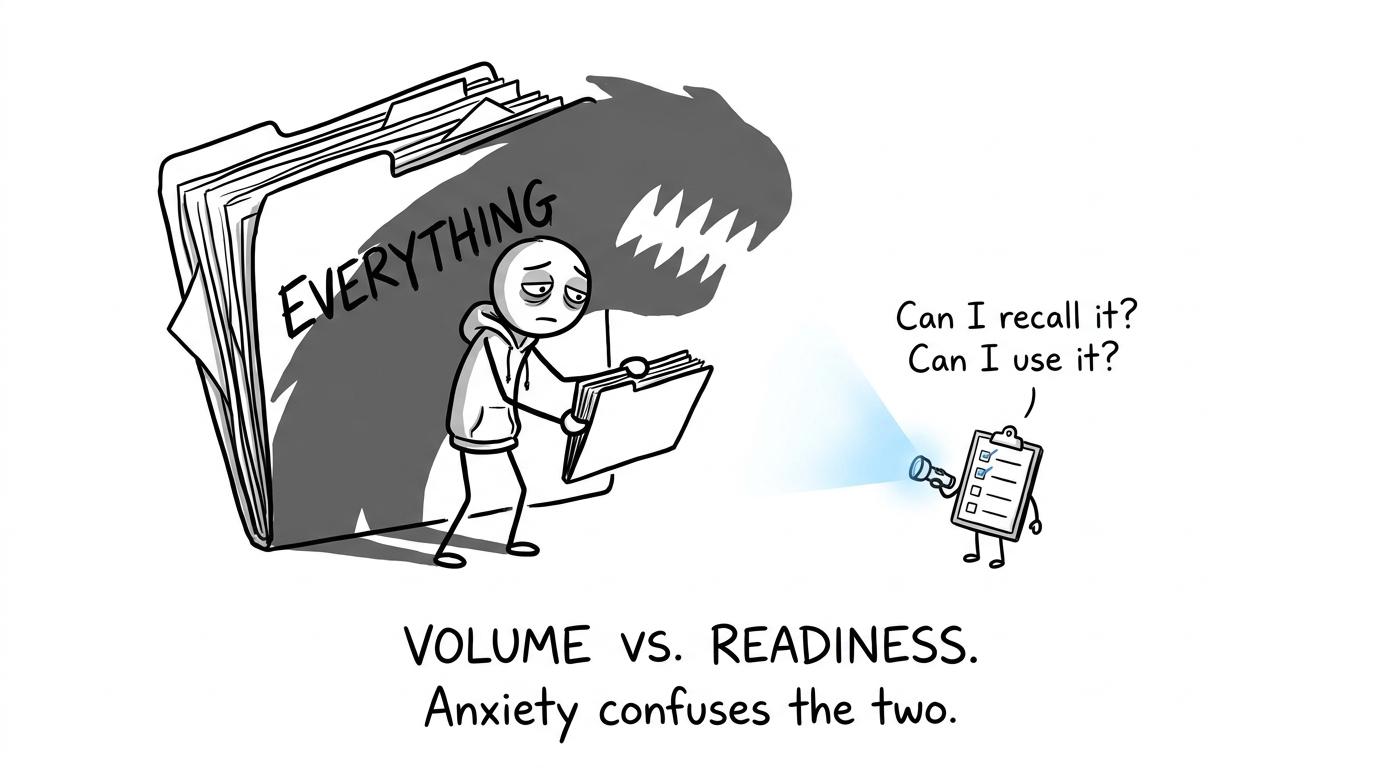 A student discovers that a small readiness checklist is more useful than an enormous revision folder
Measure outputs rather than revision hours
Two students can each revise for ten hours and finish in very different positions. One may spend the time copying attractive notes. The other may recall quotations, plan essays, complete timed paragraphs and correct weaknesses. The clock records equal effort, but the exam will not reward equal readiness.
A more realistic test uses five forms of evidence.
| Area | Evidence that revision is working |
|---|---|
| Coverage | You have checked every set text and required question type for your exam board. |
| Recall | You can retrieve useful knowledge without opening your notes first. |
| Application | You can adapt that knowledge to an unfamiliar question. |
| Performance | You can plan and write within realistic time limits. |
| Correction | Marked work shows that earlier weaknesses are becoming less frequent. |
This is similar to the evidence-led approach used in effective maths revision. The MathsGenie guide to finding your weakest GCSE topics explains why completed work reveals more than confidence alone. In English Literature, your evidence comes from essay plans, timed responses, quotation retrieval and teacher feedback rather than topic calculations.
Check that you have covered the correct course
GCSE English Literature is untiered, unlike foundation and higher tier GCSE Maths. However, Edexcel, AQA, OCR and Eduqas organise their papers differently. Text choices, section structures, timings and comparison tasks can vary.
Before judging your readiness, confirm:
- your exam board and specification;
- the texts your class has studied;
- the questions appearing on each paper;
- which sections require comparison;
- where spelling, punctuation and grammar are assessed;
- the time and marks available for each section.
Across the main specifications in England, the shared assessment objectives reward understanding and response, textual references, analysis of writers' methods, relevant context and accurate written expression. The balance and application of those objectives can differ between papers, so use your board's current specification, specimen materials and teacher guidance.
Coverage is therefore not “I have revised Macbeth”. It is closer to “I can respond to questions on its major characters and themes, support an interpretation with textual references, and analyse Shakespeare's choices”.
Maths students already recognise the value of checking the right board and paper. The GCSE Maths topics by exam board and tier guide applies the same principle: preparation becomes reliable only when it matches the assessment you will actually sit.
Test whether you can retrieve knowledge
Recognition can be deceptive. A quotation may look completely familiar when it is on a flashcard, but that does not mean you can retrieve it during an exam.
Close your notes and try to produce:
- a brief plot sequence for each text;
- several short quotations for each major character or theme;
- the speaker and significance of each quotation;
- relevant contextual ideas;
- links between anthology poems;
- a selection of language, form and structure methods.
Then check your accuracy. Incorrect retrieval should be corrected promptly so that mistakes are not repeatedly rehearsed.
Research on learning consistently supports retrieval practice and spacing over passive rereading alone. In practical terms, attempt recall first, check second and revisit the same material on later days. The MathsGenie guide to stopping forgotten content uses this same learn, retrieve, correct and revisit rhythm for maths.
You do not need to memorise an enormous quotation bank. A smaller collection of short, accurate and flexible references is often more useful than long passages that you cannot analyse or adapt. Your teacher can help you judge an appropriate bank for your texts and target grade.
Test whether knowledge survives a new question
Knowing the material is necessary, but literature exams ask you to make choices. You must decide which evidence answers the question and how it supports your interpretation.
Take an unfamiliar question and spend a short, fixed period producing a plan without notes. Your plan should contain:
- a clear overall argument;
- distinct ideas that answer the wording of the question;
- suitable textual references;
- analysis of the writer's methods;
- relevant contextual connections where assessed;
- comparison points where required.
If every plan uses the same paragraphs regardless of the question, your revision is still too rigid. Memorised essays can create the illusion of security, but a changed character, theme or viewpoint can expose the problem immediately.
The goal is flexible command. You should be able to move the same quotation into different arguments when the interpretation genuinely fits.
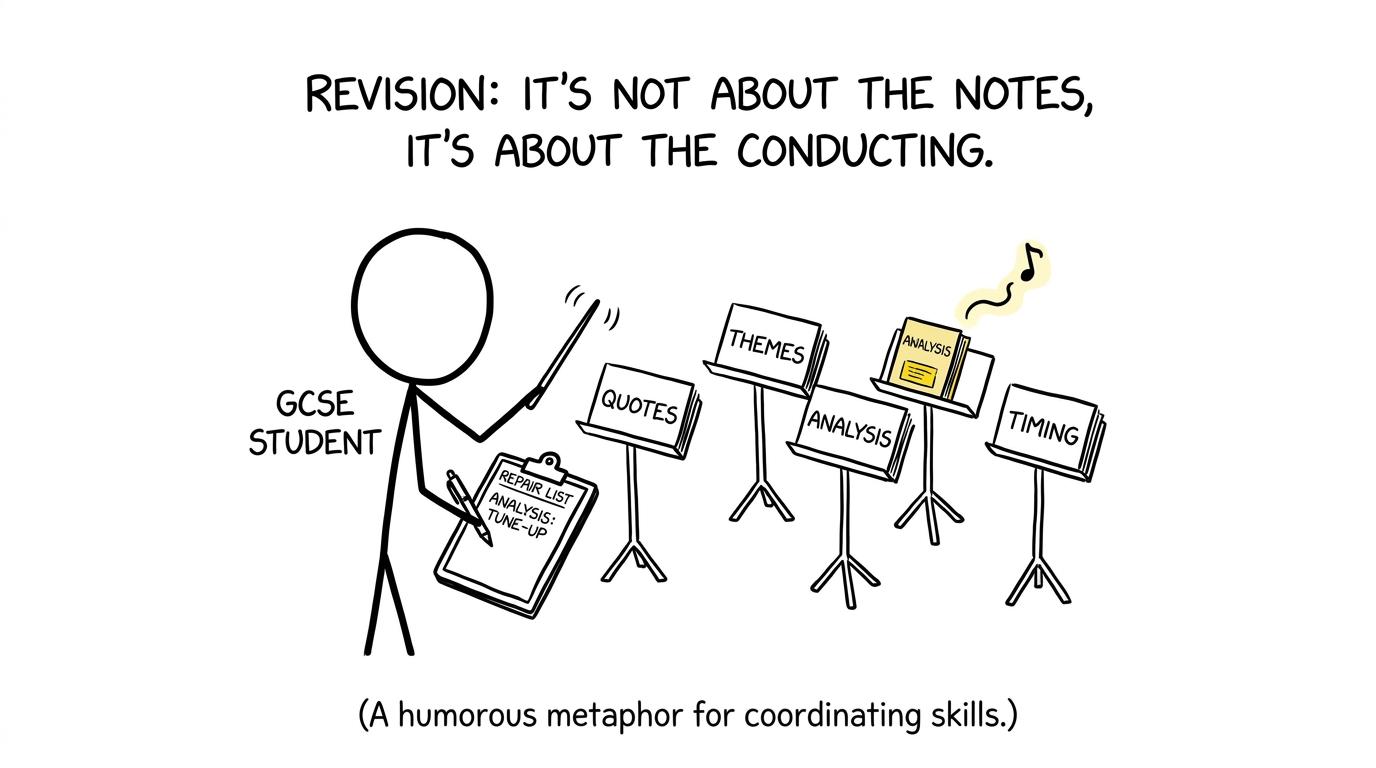 A student conducts an orchestra of quotations, themes, analysis and timing
Use timed writing as the final reality check
Essay plans test selection. Timed responses test selection, development, stamina and control together.
Complete at least some work under conditions resembling the examination:
- use an unseen question;
- remove notes and model answers;
- follow the time available for that section;
- write by hand if that is how you will sit the exam;
- continue without pausing to research a better interpretation.
Mark the response using your exam board's assessment materials and, where possible, ask your teacher for focused feedback. Do not reduce literature marking to a crude quotation count. Look for the qualities the assessment objectives reward: a developed response, well-selected evidence, analysis, relevant context and clear expression.
One timed answer is only a snapshot. A stronger sign of readiness is producing competent work twice, with several days between attempts and with different questions. This is a practical benchmark, not an official grade guarantee.
Past-paper practice works similarly in maths. MathsGenie's guide to using GCSE past papers properly emphasises the cycle of attempting, marking, repairing and retesting. A completed paper is not the end of revision; the useful part is what you change afterwards.
Build a simple red, amber and green dashboard
Rate each text and question type using evidence rather than mood.
| Status | What it means | Your next action |
|---|---|---|
| Red | You cannot recall core material or construct a relevant plan. | Relearn the smallest missing area, then retrieve it without notes. |
| Amber | You can answer, but evidence, analysis or timing is inconsistent. | Complete targeted plans or paragraphs and obtain feedback. |
| Green | You can produce a relevant, timed response more than once. | Maintain it through short, spaced retrieval. |
Your revision is broadly sufficient when there are no serious red areas, the important question types are mostly green, and your amber areas have specific repair tasks. Green does not mean “never revise this again”. It means maintenance rather than rebuilding.
This approach also protects your maths preparation. English Literature can expand to fill every free evening because there is always another interpretation to read. A dashboard gives you a stopping rule, allowing you to return to free GCSE Maths revision without wondering whether you should have read one more chapter summary.
Common mistakes when judging whether you have revised enough
Mistaking familiarity for recall
Rereading notes feels smooth because the material is in front of you. Test yourself with the page closed before deciding that you know it.
Counting quotations instead of building arguments
A long quotation list does not automatically produce a strong response. Know what each reference suggests, which methods you can analyse and which questions it could support.
Revising favourite texts repeatedly
Comfort can distort your timetable. Use your dashboard to give more attention to the text or question type producing the weakest evidence.
Avoiding timed work until the final week
Timing is a skill, not an administrative detail. Build gradually from plans to paragraphs, sections and complete papers rather than discovering the problem in the examination.
Treating one good essay as proof
A familiar title or recently revised theme may produce an unusually strong result. Repeat the test later with a different question.
Making revision all-or-nothing
You do not need another complete reread every time you find a weakness. Repair the precise gap, check it and move on. MathsGenie's revision guide for students who struggle to get started shows how small attempt-and-correct loops can make revision manageable across subjects.
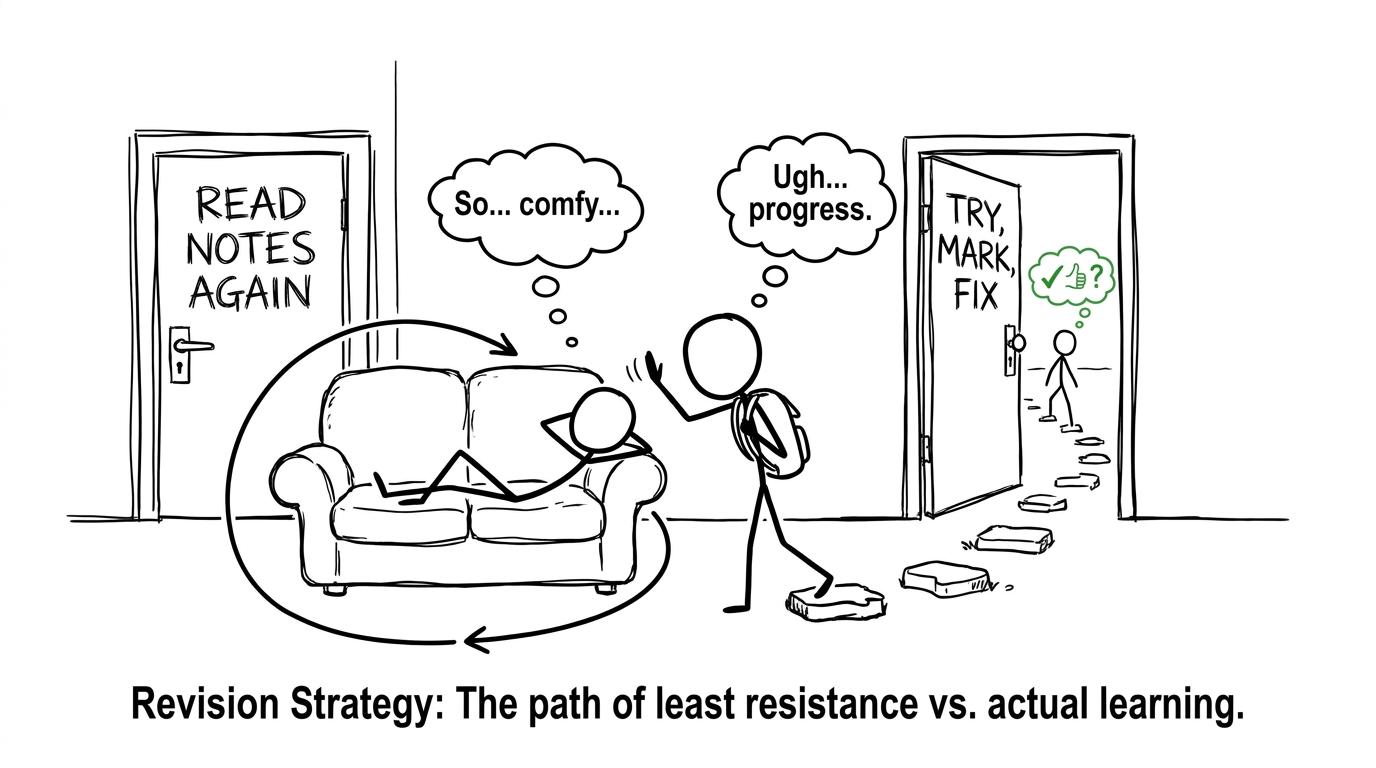 A student leaves the comfortable rereading loop for the try, mark and fix path
Stop when the evidence says maintenance is enough
You may never experience a dramatic moment of feeling completely prepared. That is normal. Literature contains ambiguity, and no revision plan can predict every question.
A better stopping rule is this: you have covered the specification, can retrieve central knowledge, can adapt it to unfamiliar tasks, can write within the time and have evidence that recurring weaknesses are improving. At that point, more anxious rereading is unlikely to be your best use of time. Maintain the knowledge with short retrieval sessions, protect your sleep and balance the rest of your subjects.
For maths, turn the same principle into marks with the Edexcel GCSE Maths revision hub, or choose your board through the main GCSE area. MathsGenie brings together free revision lessons, practice questions, mini tests, past papers, predicted papers, mark schemes and video solutions. Start with evidence, repair one weakness and retest it. That is how revision becomes something you can trust.










