Hate GCSE Physics? How to Revise When It Won't Click
Hate GCSE Physics? How to revise using short routines, targeted questions, mark schemes and core maths skills that make difficult topics manageable.
Some subjects feel difficult because you have not practised them enough. Others feel difficult because every page seems to create three new questions. GCSE Physics can fall into the second category.
If you are searching hate GCSE Physics how to revise, the useful answer is not to wait until you suddenly enjoy the subject. Make revision smaller, more active and easier to start. Choose one narrow topic, attempt a few questions, check the mark scheme and fix one specific gap. Motivation often arrives after you begin seeing progress, not before.
You do not need to fall in love with Physics. You need a routine that still works on the days when you would rather revise almost anything else.
Your quick GCSE Physics revision checklist
When Physics is not clicking, use this basic plan:
- Confirm your exam board and specification.
- Choose one small topic rather than an entire paper.
- Revise for a short, defined block.
- Attempt questions without looking at your notes first.
- Mark your answers immediately.
- Record why each mark was lost.
- Practise any underlying maths skill separately.
- Return to the same topic after a gap.
- Use past-paper sections once individual topics feel more secure.
That is enough structure to begin. A plan does not have to be impressive to be effective.
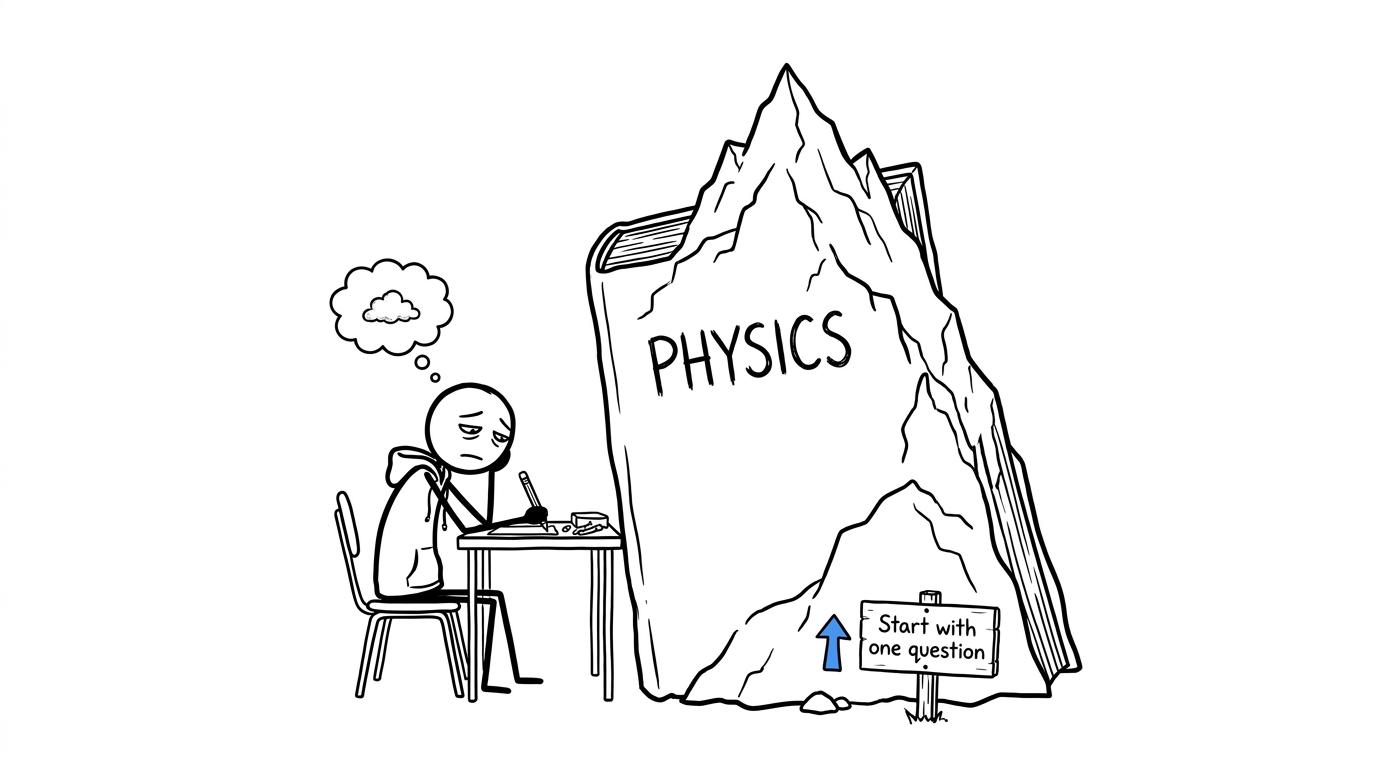 A student treating a Physics book as a mountain and starting with one question
Stop asking yourself to revise all of Physics
“Revise Physics” is not a task. It is a large, unclear instruction covering forces, energy, electricity, waves, particles, magnetism, space physics and required practical work. Your brain has no obvious first move, so avoidance becomes understandable.
Replace it with something that has a visible finish line:
- review circuit symbols and answer five questions;
- practise identifying energy stores and transfers;
- mark one page of forces questions;
- learn the variables and units used in wave equations;
- review one required practical and its sources of error.
The smaller instruction is not an easier version of revision. It is revision. Once the first action is clear, the emotional weight of the whole subject becomes less relevant.
If you do not know where to begin, use the method in How to Find Your Weakest Topics in Physics. A short diagnostic section can reveal whether the real problem is Physics knowledge, maths technique or exam wording.
Build a routine that does not depend on motivation
Motivation is unreliable because it responds to mood, tiredness and how difficult you expect a task to feel. A repeatable routine removes some of those decisions.
Try a session with four parts:
Start with a tiny retrieval task
Close your notes and write down what you remember about one topic. This might include definitions, units, diagrams, variables or stages in a required practical.
Retrieval practice means actively trying to recall previously learnt material. Educational research supports its usefulness, particularly when the task provides an appropriate level of challenge and is followed by feedback. The feedback matters because recalling an incorrect idea without correcting it can reinforce a misconception.
Fill only the gaps you exposed
Now open a concise revision guide or watch a relevant video solution. Do not restart the whole topic automatically. Look for the exact explanation you were missing.
Students following AQA can use the AQA GCSE Physics revision resources, while the Edexcel GCSE Physics revision guides are organised around the Pearson Edexcel specification. If you take OCR or Eduqas, check your own specification before choosing topics because content and paper organisation can differ.
Answer questions without support
Notes can make a topic feel familiar, but familiarity is not the same as being able to produce an answer. Attempt several questions with the guide closed. Include both calculations and written explanations where appropriate.
Mark, fix and schedule a return
Compare your response with the mark scheme. Write one short correction for each lost mark, then revisit the topic after a gap. Spacing revision across separate sessions gives you a more honest test of what remains available from memory than repeating the same material continuously in one sitting.
Make the maths your route into GCSE Physics
If you are preparing for GCSE maths exams, Physics calculations may be the most approachable part of the subject. The context changes, but the mathematical moves are familiar:
- substitute values into a formula;
- rearrange an equation;
- convert units;
- use standard form;
- calculate a gradient;
- interpret a graph;
- work with ratios and proportional relationships;
- round to an appropriate degree of accuracy.
For example, Physics equations may involve structures such as:
v=stv = \frac{s}{t}v=tsor
ρ=mV.\rho = \frac{m}{V}.ρ=Vm.You are not being asked to discover a new branch of mathematics. You are being asked to identify quantities, choose a relationship and apply methods you may already know from GCSE maths.
When a calculation goes wrong, label the cause precisely:
- selection error: you chose the wrong equation;
- algebra error: you rearranged it incorrectly;
- unit error: you substituted incompatible units;
- calculator error: you entered or interpreted the values incorrectly;
- rounding error: you rounded too early or ignored the instruction.
That label tells you what to practise. “I am bad at Physics” does not.
The AQA gravity revision guide shows how quantities, symbols and units are connected within one topic. For broader support with the mathematical layer, use MathsGenie's free GCSE maths revision resources to strengthen algebra, graphs, standard form and unit conversion.
Use the equation sheet properly
Under current assessment arrangements, students receive the relevant Physics equation sheet in GCSE Physics and Combined Science examinations. You should still check the current document supplied by your exam board for your exam series.
An equation sheet removes some memorisation, but it does not remove the need to understand:
- what each symbol represents;
- which quantities are given;
- which quantity must be calculated;
- what units are required;
- whether the equation needs rearranging;
- whether values must be converted first.
Revise with the same equation sheet you expect to use in the examination. Learn where equations appear and practise selecting them from the wording of a question. The sheet is a tool, not an automatic answer.
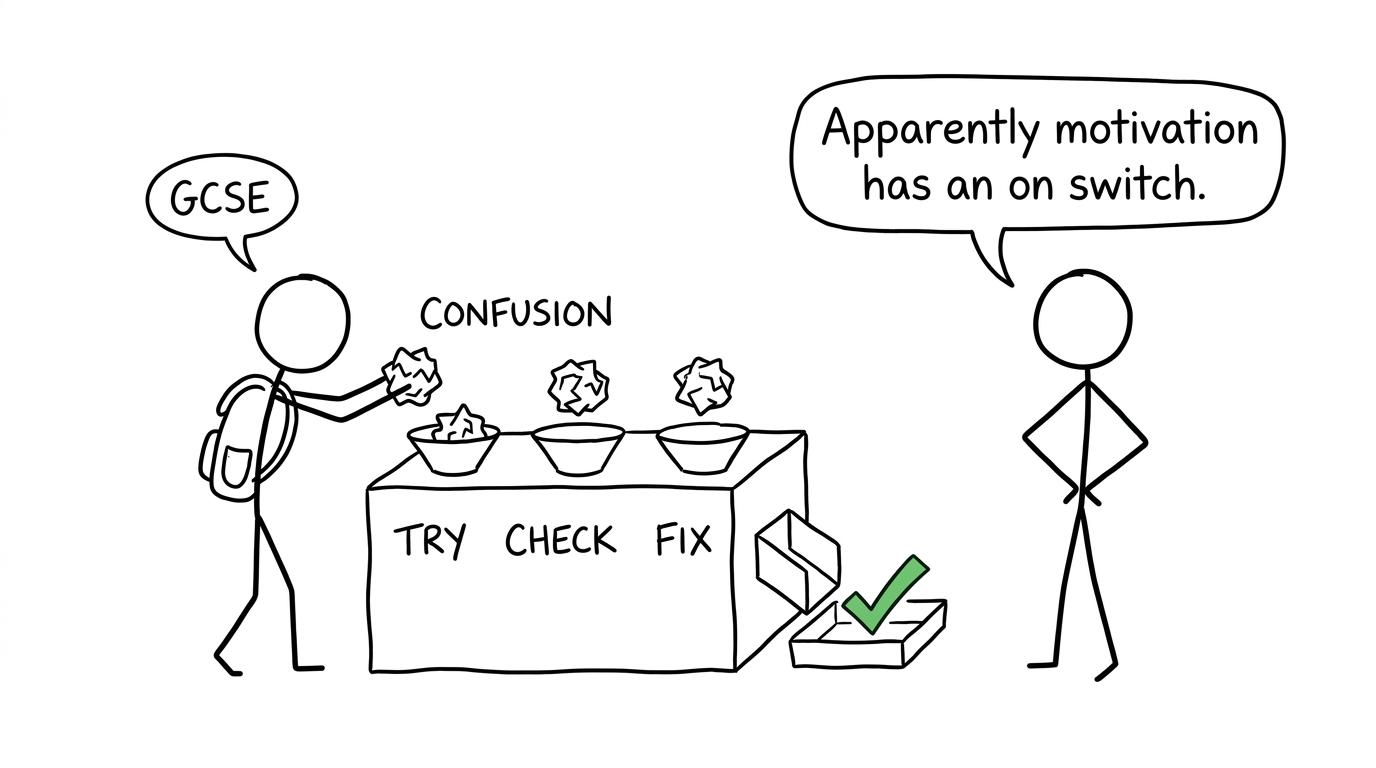 A revision machine turning attempts, checks and fixes into progress
Separate difficult content from difficult exam language
Sometimes you understand the Physics but still lose marks because the question requires a particular comparison, explanation or conclusion.
Command words matter. “State” usually calls for a concise fact. “Calculate” requires a numerical method and answer. “Explain” asks you to connect ideas, often through cause and effect. “Evaluate” may require evidence, limitations and a supported judgement.
Use mark schemes to notice what a complete response contains. Do not memorise isolated sentences without understanding them. Instead, identify the structure:
- what changed;
- what physical principle applies;
- how one quantity affects another;
- what conclusion follows.
Required practical questions deserve the same treatment. Know the variables, apparatus, measurements, controls, safety considerations and ways reliability or accuracy could be improved. Simply rereading the practical is weaker preparation than closing the guide and reconstructing the method yourself.
Use past papers without making them overwhelming
A full Physics paper can feel punishing when confidence is low. Begin with sections rather than complete papers.
A useful progression is:
- topic questions with notes available for checking;
- topic questions completed independently;
- mixed questions from several topics;
- a timed section of a past paper;
- a complete paper under exam conditions.
After marking, sort mistakes into knowledge, maths and exam technique. Then choose the next revision task from the evidence. This turns a disappointing mark into a set of instructions.
The guide to GCSE Physics revision without wasting time explains this attempt, mark, fix and reattempt cycle in more detail. It is more useful than repeatedly copying notes because every session produces feedback you can act upon.
Create a minimum session for bad days
There will be evenings when concentration is poor. Decide in advance what counts as your minimum session. It might be:
- one short retrieval quiz;
- three exam questions;
- one marked correction;
- one required practical summary;
- one maths skill followed by one Physics calculation.
The minimum should be small enough to start but substantial enough to produce evidence of learning. You may continue once you have begun, but continuation is optional. The purpose is to protect consistency.
A missed long session often creates guilt. A completed short session creates momentum. Over several weeks, repeated contact with the subject also makes each return less unfamiliar.
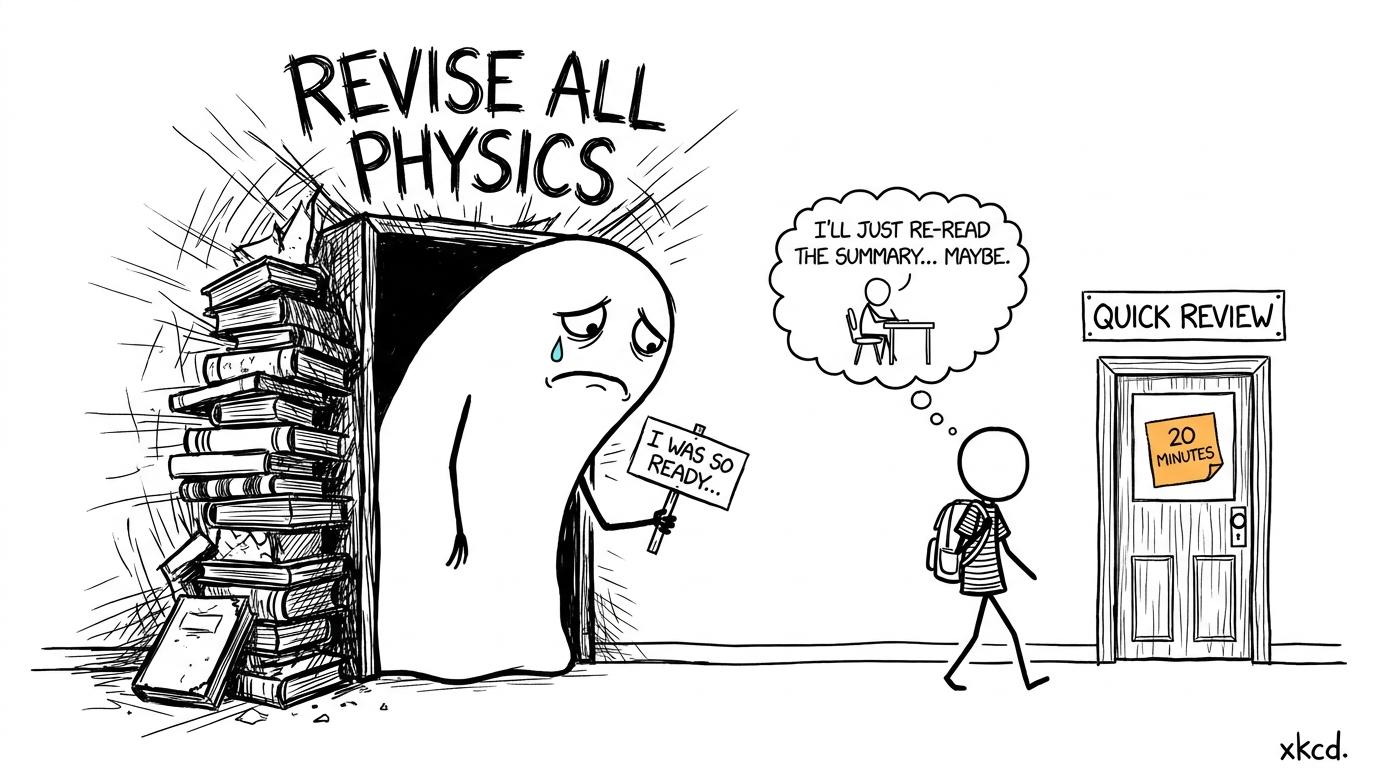 A student choosing a manageable revision door instead of revising everything
Common mistakes when revising a subject you hate
Waiting to feel motivated
If revision begins only when you feel enthusiastic, difficult topics will keep being postponed. Choose a time, place and first task before the session begins.
Making beautiful notes without testing yourself
Notes can organise ideas, but copying is not proof that you can recall or apply them. Follow note-making with closed-book questions.
Revising your favourite topics repeatedly
Familiar work feels productive because it is comfortable. Use question results to choose topics rather than mood.
Ignoring written questions
Calculations are only part of GCSE Physics. Practise definitions, practical methods, explanations, comparisons and evaluations as well.
Treating every wrong answer as the same problem
A missing unit needs a different fix from a misunderstood concept. Diagnose the error before choosing another task.
Doing full papers too early
Past papers are valuable, but a full paper may give poor-quality feedback if several topics have not yet been learnt. Build topic confidence first, then increase the amount of mixed and timed practice.
You do not have to like Physics to improve at it
Disliking a subject can make every mistake feel like confirmation that you should avoid it. A better interpretation is simpler: the mistake has identified the next thing to fix.
Begin with one topic and one short set of questions. Mark it carefully. Strengthen the maths underneath any calculation errors, then return to the Physics question. As the examination approaches, move from topic practice to mixed questions, past papers and predicted papers.
MathsGenie gives you a free place to run that process through revision lessons, practice questions, mini tests, mark schemes, video solutions and past papers. Start small today. You do not need a dramatic burst of motivation but only a clear first question and the willingness to check what happens next.