Hate GCSE Art and Design? How to Revise and Cope
Hate GCSE Art and Design? How to revise with short practical sessions, assessment-objective checklists and a realistic plan alongside GCSE maths.
There is a particular kind of dread that comes from opening an unfinished sketchbook. Every blank space seems to ask why you did not start earlier. Every polished page online makes your own work feel worse. If you hate GCSE Art and Design, how to revise may feel like the wrong question altogether.
Here is the useful answer: stop waiting to enjoy the subject. Make each session short, specific and connected to the assessment objectives. You do not need a sudden wave of artistic inspiration. You need a manageable next action: one annotation, one experiment, one photograph or one refined idea.
That matters particularly when art coursework is competing with GCSE maths. Your goal is not to let one difficult subject consume all the time and energy needed for the others.
Your practical survival checklist
When Art and Design is not clicking, use this checklist:
- Find out exactly what evidence is missing from your portfolio or externally set assignment.
- Sort the missing work under the four assessment objectives.
- Ask your teacher which task would improve your submission most.
- Work in short sessions with a visible finish line.
- Record experiments and decisions instead of trying to make every page beautiful.
- Protect time for maths and your other GCSE subjects.
- Stop at a planned time rather than working until you resent the subject even more.
This is less exciting than “find your passion”. It is also much more useful.
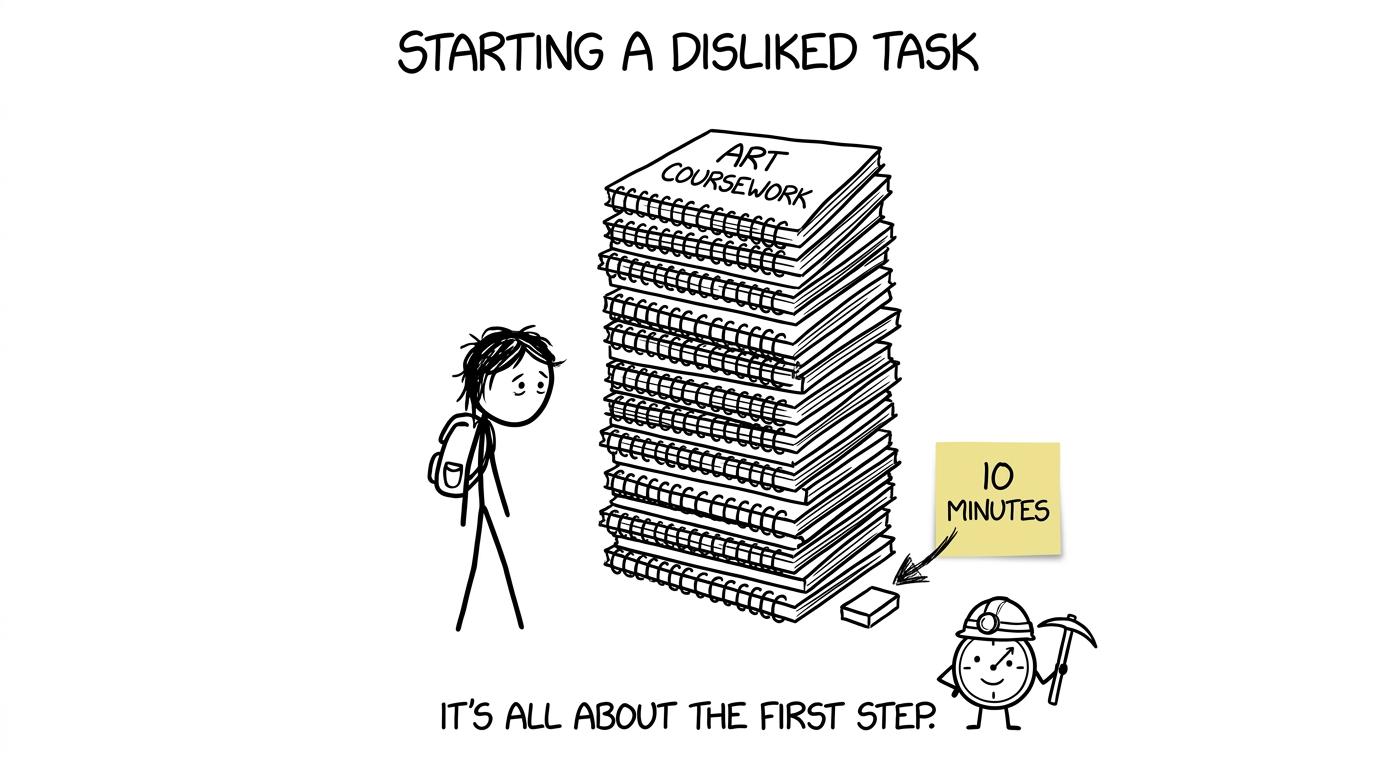 A student tackles an art coursework mountain using one tiny ten-minute task
Understand what GCSE Art and Design actually rewards
GCSE Art and Design is not usually revised like a written knowledge exam. Under the current AQA, Pearson Edexcel, OCR and Eduqas specifications, assessment is based on a portfolio and an externally set task or assignment. Across these boards, the portfolio contributes 60%60\%60% and the externally set component contributes 40%40\%40%. The externally set component includes 101010 hours of supervised work, although the preparation and administrative arrangements vary by board and centre.
Your teacher should be the final source for deadlines, permitted materials and what can be completed outside supervised time.
The four assessment objectives are common across the exam boards and are equally weighted overall:
| Assessment objective | What your work needs to show | A useful next action |
|---|---|---|
| AO1 | Development of ideas through investigation and critical understanding of sources | Analyse a relevant artist and explain how the research affects your idea |
| AO2 | Refinement through experimenting with media, materials, techniques and processes | Compare two trials and decide what to retain or change |
| AO3 | Recording of ideas, observations and insights as work progresses | Add drawings, photographs or annotations that document your decisions |
| AO4 | A personal, meaningful response that realises your intentions | Connect your development clearly to a resolved outcome |
Each objective contributes 25%25\%25% overall. This is good news if you dislike the idea that art marks depend only on producing a spectacular final piece. The journey matters too: investigating, trying, recording, refining and explaining.
Do not guess which objective is weakest. Show your work to your teacher and ask a narrow question: “Which assessment objective needs the clearest additional evidence?” A precise answer turns a vague burden into a task.
Replace motivation with a smaller starting point
Motivation is unreliable because feelings often change after action, not before it. Waiting until you feel creative can therefore keep you waiting indefinitely.
Set a minimum so small that beginning feels almost unreasonable to refuse. For example:
- annotate one experiment;
- photograph one piece of development work;
- produce three thumbnail ideas;
- compare two materials;
- organise one group of pages;
- write a short explanation of one decision.
A timer can help, but the task matters more than the duration. “Do art for 303030 minutes” still leaves you deciding what to do. “Photograph and annotate my ink experiment” gives the session an endpoint.
This approach reflects established guidance on self-regulated learning: plan the task, monitor what is happening and evaluate the result. At the end, leave a note naming the next physical action. Tomorrow’s session then begins with less friction.
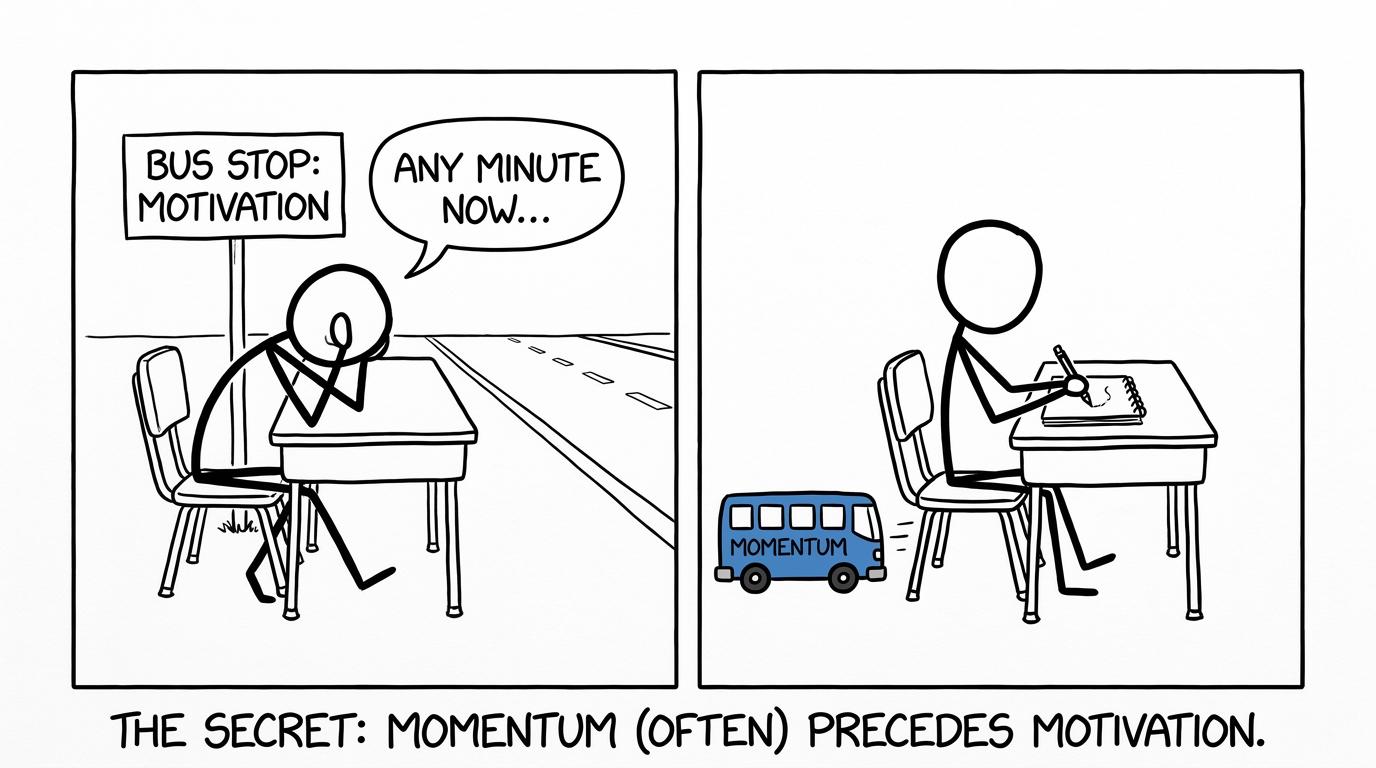 One student waits for motivation while another starts and finds momentum
Revise art by producing evidence, not decorating pages
When students feel behind, it is tempting to spend an evening improving titles, borders or backgrounds. Presentation can support clarity, but decoration is not a substitute for assessment evidence.
Before starting any task, finish this sentence:
This will provide evidence for AO___ because...
If you cannot complete it, ask whether the task is genuinely useful.
Make artist research change your work
Artist research should not become copied biography. Select relevant visual features, techniques, ideas or contexts. Then explain what you noticed, what you tested and how the source influenced your direction.
The important movement is from “this artist uses colour” to “I tested a restricted palette because it could strengthen the mood I want, but I changed the contrast after reviewing the first trial”. The second statement shows investigation, experimentation and reflection.
Acknowledge sources that are not your own. Your school can explain its required format and how to handle photographs, online images and other reference material.
Treat unsuccessful experiments as usable evidence
An experiment that fails can still show AO2 and AO3 when it is documented honestly. Record:
- what you intended;
- what material or process you used;
- what succeeded;
- what did not communicate the intended effect;
- what you will alter next.
Failure without reflection is unfinished work. Failure followed by a reasoned decision is development.
Make the final outcome easier to begin
If the final piece feels enormous, separate planning from production. Confirm the composition, materials, scale, sequence and practical risks before the supervised period. Your preparatory work should make the final response feel like the next stage of an established process, not a last-minute invention.
Always follow your board and teacher’s rules about when preparation must stop and what may enter the supervised sessions.
Build an art plan that does not damage maths revision
The hidden danger is not only disliking art. It is allowing unfinished coursework to expand into every available evening.
Create fixed art blocks and give each one a defined output. Then schedule maths separately. The MathsGenie GCSE maths revision hub lets you select your exam board and work at the appropriate foundation or higher tier, so you do not lose time searching for relevant material.
A balanced week might contain:
- two short art sessions for annotations, research or experiments;
- one longer practical art block when materials and concentration are available;
- several focused maths sessions built around weak topics;
- one maths mini test or timed paper section;
- protected rest and sleep.
If your timetable currently exists only in your head, use the structure in the GCSE maths revision timetable guide. The principle transfers well: choose realistic blocks, identify the output and leave catch-up space.
On busy days, the GCSE 202020-minute maths revision routine can keep maths moving without pretending you have endless time. An Edexcel GCSE maths mini test is another short, measurable option.
The point is not to create a perfect timetable. It is to stop art from becoming an unbounded task.
Use support before resentment becomes paralysis
Tell your teacher what is blocking you, but be specific. “I hate art” is honest, yet difficult to act on. Try:
- “I cannot tell which pages are missing AO2 evidence.”
- “I spend too long deciding what to make.”
- “I do not understand how my artist research should influence my response.”
- “I am worried I cannot complete this by the deadline.”
Ask your teacher to identify the highest-priority task and what “complete enough” looks like. If access to equipment, materials, printing or space is the problem, say so directly.
If exam pressure is affecting your sleep, appetite, mood or everyday life, speak to a parent, carer, teacher, pastoral lead or GP. NHS guidance recommends seeking support when anxiety or low mood is severe, persistent or interfering with daily life. Revision strategies help with workload; they are not a replacement for appropriate wellbeing support.
Common mistakes when revising GCSE Art and Design
Waiting for inspiration
Inspiration is useful but optional. Begin with observation, research or a material test. Momentum often follows a concrete action.
Trying to repair the entire sketchbook at once
“Finish art” is not a task. Break the work into evidence you can complete and show your teacher.
Making everything look polished
A polished page cannot compensate for missing investigation, experimentation, recording or personal development. Clarity comes before decoration.
Hiding unsuccessful work
Do not assume every experiment must look impressive. Select useful trials and explain how they changed your decisions.
Copying artist information without making connections
Biographical facts alone do not demonstrate how a source informed your work. Analyse relevant choices and show their impact.
Sacrificing every other subject
One urgent deadline can justify temporary adjustment, but permanently abandoning maths creates another crisis. Keep a minimum routine using AQA GCSE maths past papers, OCR GCSE maths past papers or Edexcel GCSE maths past papers, depending on your board.
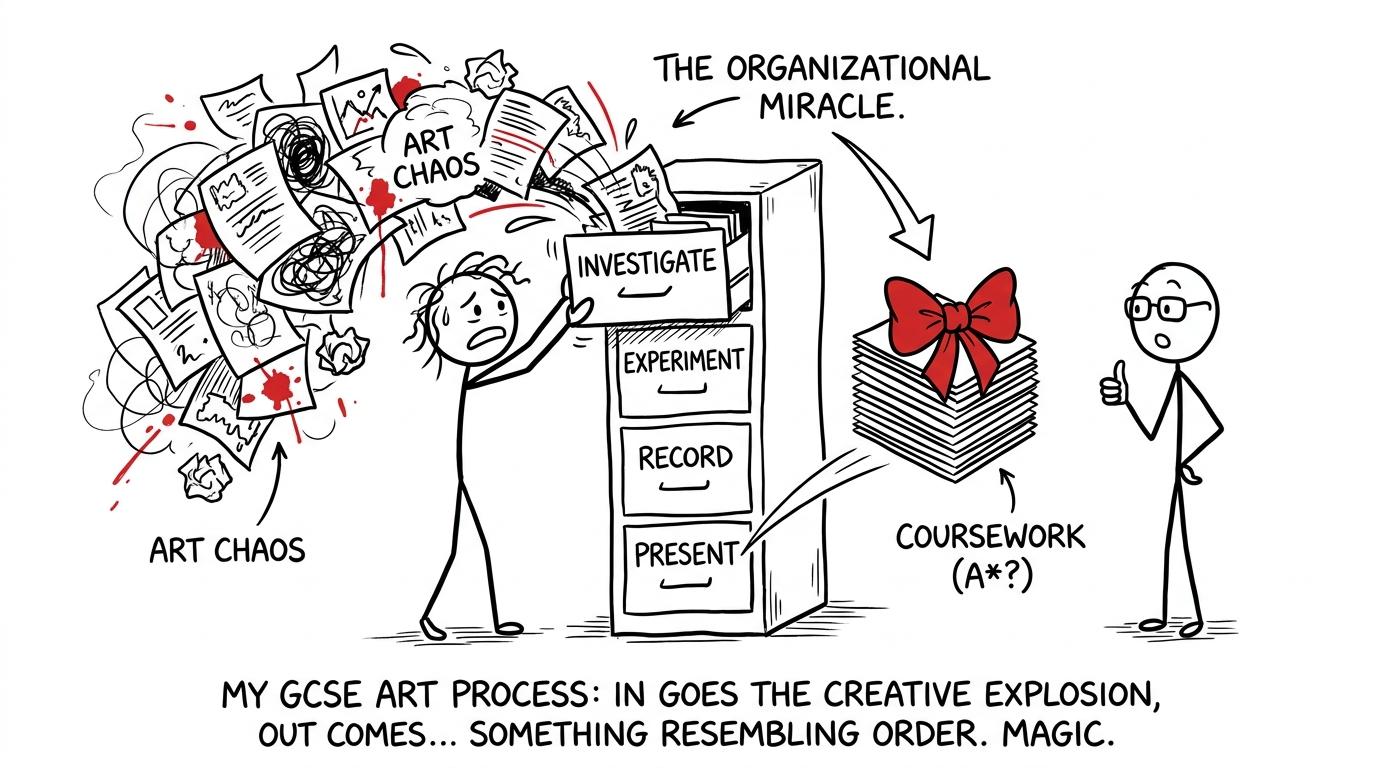 Chaotic art pages become organised through four assessment-objective drawers
You do not have to love the subject to finish it well
Disliking GCSE Art and Design does not make you lazy or incapable. It may mean that open-ended decisions, workload, perfectionism or the practical process do not suit you. The solution is not to force enthusiasm. It is to reduce ambiguity.
Identify the weakest assessment objective. Choose one piece of evidence. Set a short work period. Record the next action before stopping. Then return to the rest of your GCSE plan.
MathsGenie can keep the maths side of that plan calm and organised. Start with the free GCSE revision hub, use revision lessons and practice questions to repair weak topics, then build confidence through mini tests, past papers, mark schemes and video solutions. Near the exams, add GCSE predicted papers for fresh practice, while remembering that predicted papers are practice tools, not guarantees of exact exam content.
You do not need to solve the whole term tonight. Open the sketchbook, complete one useful action, and let that be enough to start.