Hate GCSE Arabic? How to Revise When Motivation Fails
Hate GCSE Arabic? How to revise with a realistic, low-motivation plan using short sessions, active recall, exam practice and manageable daily goals.
Some subjects feel difficult. Others feel personal. You open the book, recognise how much you have forgotten, and close it before revision has properly begun.
If your search was “hate gcse arabic how to revise”, the practical answer is this: stop waiting to enjoy the subject. Make each session short, specific and active. Revise one language skill at a time, test yourself without notes, correct mistakes immediately and return to them after a gap.
You do not need a dramatic change of attitude. You need a routine that still works when motivation is low, while leaving enough time for GCSE maths and your other exams.
Your low-motivation revision checklist
Use this as the minimum plan:
- Confirm your specification, tier and assessment format with your teacher.
- Split revision into listening, speaking, reading and writing.
- Choose one small task before starting a session.
- Work for ten to twenty-five focused minutes.
- Recall vocabulary without looking at your notes.
- Mark or check every task and record specific errors.
- Revisit difficult material across several days.
- Practise the actual question formats before the examination.
- Protect time for maths and your other GCSE subjects.
The key word is small. “Revise Arabic” feels endless. “Recall ten school-topic words and say five sentences aloud” has a finish line.
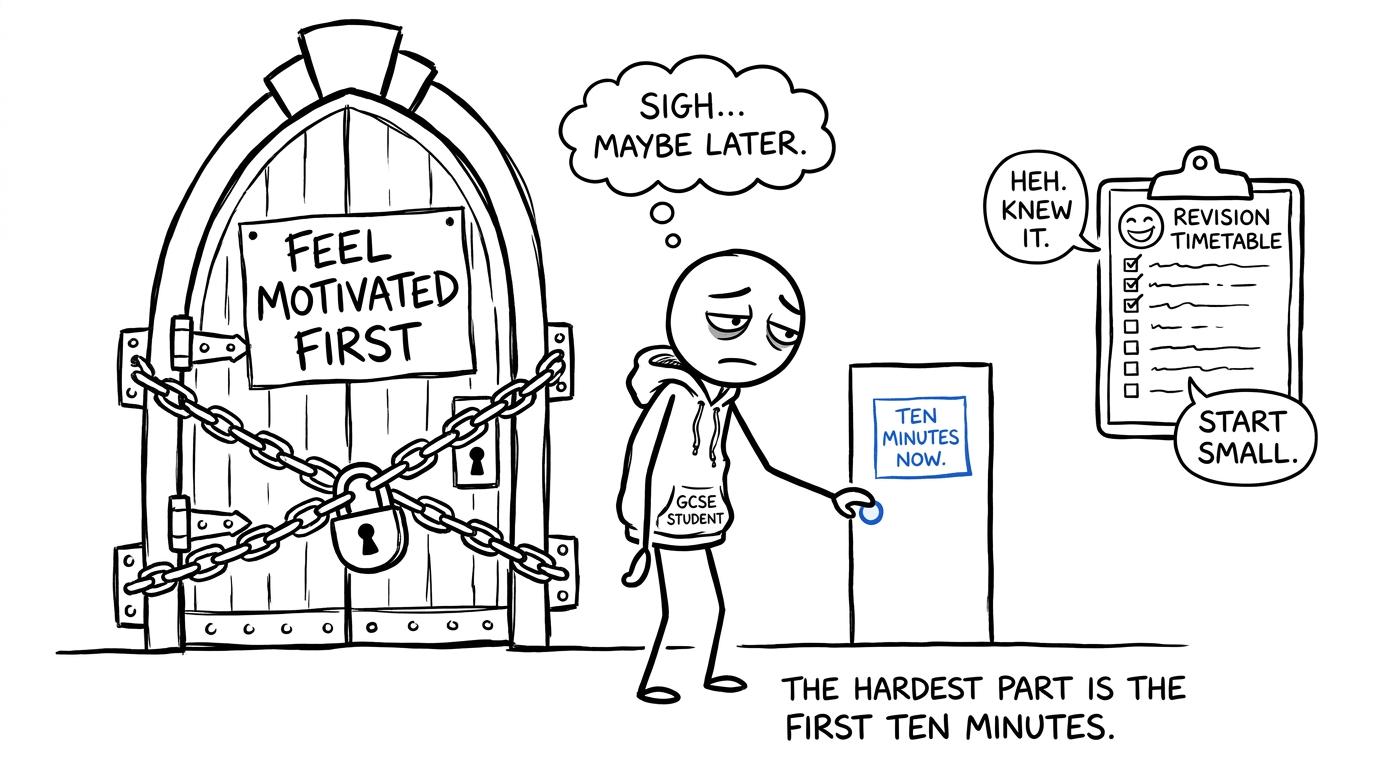 A student choosing the small door marked ten minutes now instead of waiting to feel motivated
Why hating a subject makes revision harder
Dislike creates avoidance. Avoidance creates gaps. Those gaps make the next lesson or practice paper feel worse, which gives you another reason to avoid it.
The cycle is powerful because it appears logical: I am bad at this, so today’s revision will be miserable. Yet the conclusion does not follow. A subject can feel uncomfortable and still be trainable.
Do not set “liking Arabic” as the condition for beginning. Set a smaller standard: complete the next defined action. Motivation often arrives after progress becomes visible, but your plan should not depend on it arriving at all.
This principle also applies to maths. The MathsGenie guide to finding your weakest GCSE topics treats mistakes as evidence rather than a judgement. Arabic revision becomes less emotional when you do the same: identify the exact skill that failed, practise it and test it again.
Know what GCSE Arabic actually assesses
As of the current Pearson Edexcel GCSE Arabic specification, the qualification assesses four skills: listening, speaking, reading and writing. Each contributes 25%25\%25% of the qualification. Students take either Foundation or Higher tier across all four papers rather than mixing tiers.
The course covers five broad themes:
- identity and culture
- local area, holiday and travel
- school
- future aspirations, study and work
- the international and global dimension
Listening and reading include questions in both English and Arabic, while reading also includes translation into English. Writing includes translation into Arabic, and speaking assesses a role play, a picture-based task and conversation. Dictionaries are not permitted in the assessments, including the speaking preparation period.
That structure matters because “I hate Arabic” is too broad to solve. You may dislike listening because speech feels too fast, while your reading is reasonably secure. Or you may know vocabulary but struggle to produce accurate sentences under pressure.
Check the current specification and arrangements with your school. Do not assume that the paper format, tier or speaking requirements are the same as another language qualification.
Build a plan that survives bad days
A useful revision plan has a normal version and a minimum version.
On a normal day, complete a twenty-five-minute session. On a difficult day, do ten minutes. The minimum session should be too small to negotiate with:
- recall five words from memory
- listen to one short extract
- answer one speaking prompt aloud
- translate two short sentences
- correct one previous writing task
This is not permission to avoid serious practice forever. It is a way to preserve continuity. A chain of modest sessions gives you more useful contact with the language than one exhausting evening followed by a week of avoidance.
If you are balancing Arabic with maths, map both subjects before the week begins. The GCSE maths revision timetable guide shows how to prioritise weak areas and revisit them rather than simply revising favourite topics. Use the same timetable principle for Arabic, but keep separate tasks for each of its four skills.
Give every session one visible outcome
Avoid vague goals such as “go over vocabulary”. Choose an outcome you can check:
- recall and spell twelve words about school
- record answers to three conversation questions
- complete and mark one reading section
- plan one response using more than one time frame
- review every error from yesterday’s listening task
A completed task gives you feedback. Time spent staring at a page does not.
Revise actively instead of making revision look tidy
Re-reading vocabulary can feel productive because every word looks familiar. Recognition, however, is not the same as being able to retrieve the word in an examination.
Educational research supports retrieval practice: attempting to remember information strengthens access to it and reveals what is missing. Effective retrieval should involve genuine recall, delayed repetition and feedback. That makes the following cycle more useful than repeated highlighting:
- Look briefly at the material.
- Cover it.
- Recall, write or say what you remember.
- Check the answer.
- Correct errors clearly.
- Test the same material on another day.
Flashcards can help, but only if you answer before turning the card over. Include both directions: English to Arabic for production, and Arabic to English for recognition. Add short phrases and sentence patterns rather than collecting isolated nouns indefinitely.
The same active approach is central to the MathsGenie one-month GCSE revision plan: diagnose, practise, mark and revisit. The content changes between Arabic and maths, but the learning loop remains useful.
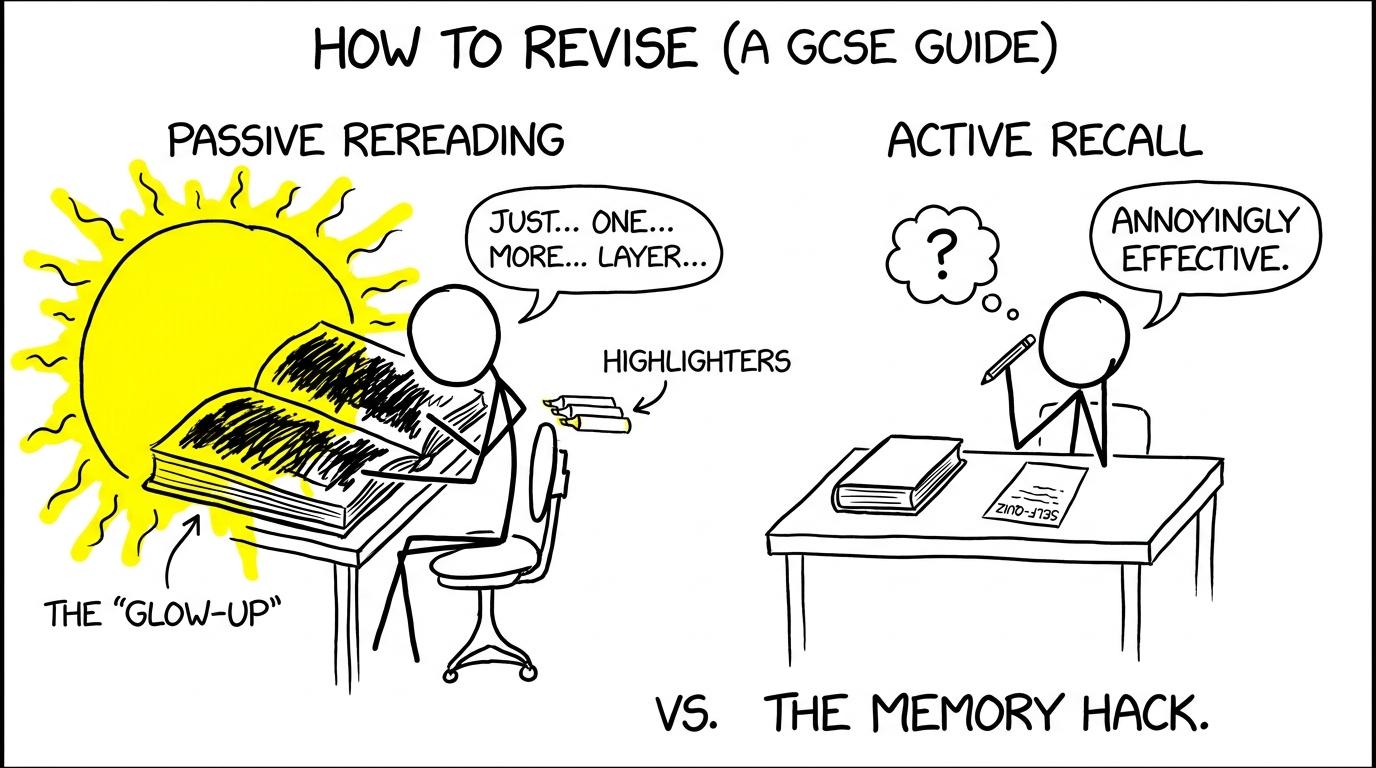 A student highlighting endlessly beside another student using active recall
Match your method to each Arabic skill
Listening
Do not restart an extract every time you miss a word. Listen once for the overall topic, then again for details such as opinions, time references, negatives and changes of direction.
After checking your answers, identify why each mistake happened. Did you not know the word? Did you confuse two sounds? Did you miss a negative? Your next task should repair that cause rather than replaying the entire recording without a purpose.
Speaking
Speaking improves through speaking. Silent rehearsal does not recreate the pressure of producing language aloud.
Record short answers on your phone, listen back and note one improvement. Build flexible sentence structures for giving an opinion, explaining a reason, referring to another time and asking a question. Avoid memorising one enormous script so rigidly that an unfamiliar prompt makes it unusable.
Reading
Read the question before the passage so you know what information matters. Train yourself to notice question words, connectives, negatives, opinions and references to past or future events.
When checking a response, underline the evidence in the text. This stops reading practice becoming guesswork and helps you distinguish an unfamiliar word from a misunderstood sentence.
Writing
Practise producing short, accurate sections before attempting long answers. Use a checklist based on the task and your teacher’s feedback: have you addressed every bullet point, communicated clearly, used appropriate time frames and checked common spelling or grammar errors?
Corrections matter more than copying out a polished answer. Rewrite the sentence that failed, then produce a different sentence using the corrected structure.
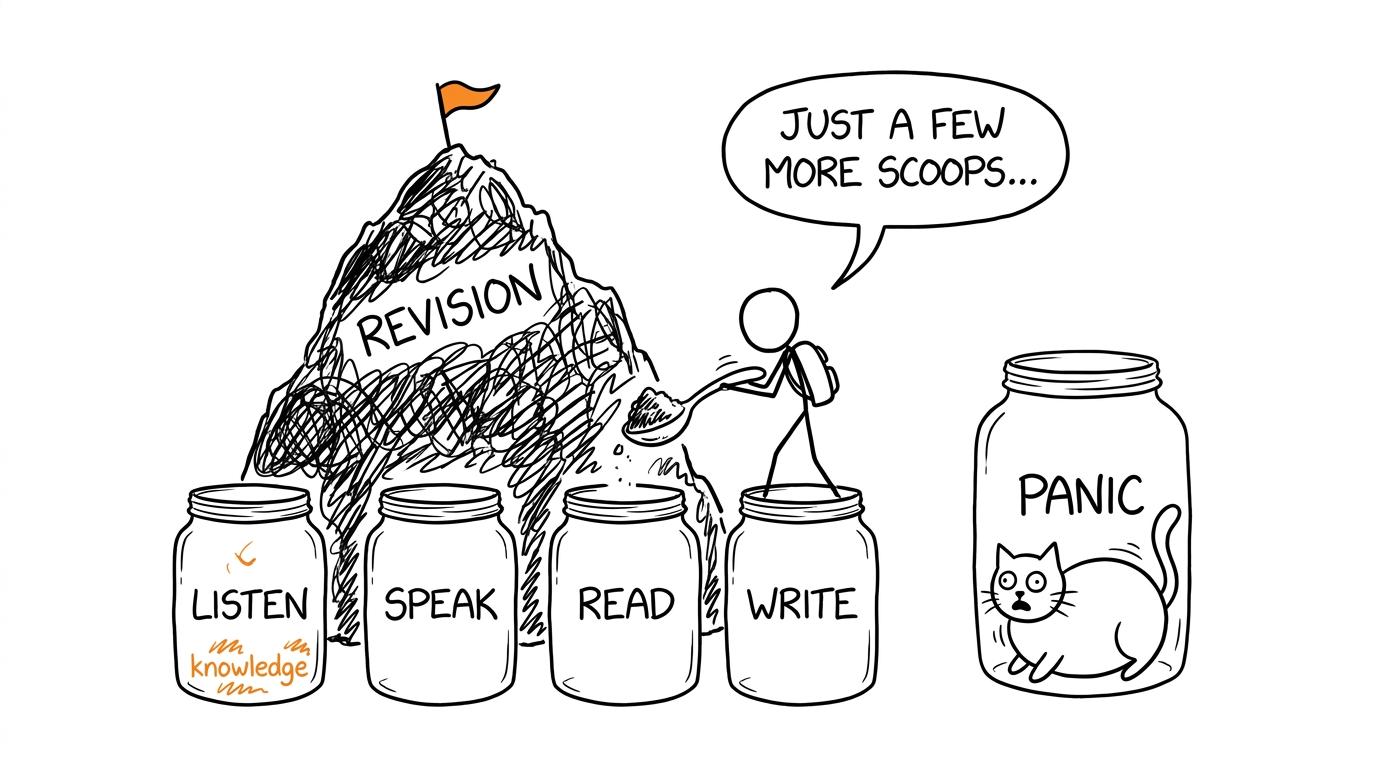 A student dividing a giant revision mountain into listening, speaking, reading and writing jars
Use past papers without turning them into punishment
A full paper completed too early can confirm everything you already fear. Begin with one section or one task. Mark it carefully and convert every lost mark into an action:
- unknown vocabulary becomes a recall set
- missed listening detail becomes a focused replay task
- weak speaking becomes a recorded response
- inaccurate writing becomes a correction and rewrite
Later, build towards timed sections and full papers. Keep a simple error log containing the skill, theme, mistake and next action. Revisit mistakes after a delay rather than merely reading the correct answer once.
Maths students can mirror this process through the GCSE maths revision hub, which brings together board-specific revision for Edexcel, AQA, OCR and Eduqas, as well as other boards. Short Edexcel GCSE maths mini tests are useful when a full paper feels too large, while AQA GCSE maths past papers help build realistic timing and mark-scheme habits.
Common mistakes when revising a subject you hate
Waiting for the right mood
The right mood is unreliable. Decide the task and start time in advance so beginning requires less thought.
Revising only vocabulary
Vocabulary matters, but GCSE Arabic assesses understanding and communication across four skills. Words must eventually appear in listening, speaking, reading and writing practice.
Choosing tasks that feel safe
Copying familiar words can create comfort without exposing gaps. Spend more time retrieving, answering and correcting than decorating notes.
Ignoring feedback
A completed paper is not automatically useful. Improvement happens when you identify why marks were lost and change the next revision task.
Cramming one skill for hours
Long, massed sessions can become tiring and passive. Shorter sessions spread across the week give you repeated opportunities to retrieve and use the language.
Letting Arabic consume the whole timetable
Panic about one subject can damage preparation for everything else. Give Arabic regular, bounded sessions, then move on. If maths also needs attention, use MathsGenie GCSE predicted papers alongside topic lessons and past papers rather than revising randomly.
You do not have to love it to improve
There is a quiet advantage in accepting that GCSE Arabic may never become your favourite subject: you can stop spending energy trying to manufacture enthusiasm. Your goal is simpler. Make the work small enough to start, active enough to reveal weaknesses and regular enough to build familiarity.
Choose one task now. Ten minutes. One skill. Then record what needs to happen next.
For the maths side of your GCSE timetable, make MathsGenie your free revision base. Use revision lessons and practice questions to repair weak topics, mini tests to check recall, and past papers or predicted papers to develop exam technique. Mark with the provided mark schemes, use video solutions when a method is unclear, and let each mistake choose your next session.