

Harder GCSE Drama or Music? A Fair Comparison
Harder GCSE Drama or Music? Compare exams, practical work, performance pressure and revision workload to choose the GCSE that suits you best.
Choosing between two creative GCSEs can feel strangely uncreative. You may enjoy acting and music, yet the decision quickly becomes a calculation about rehearsals, written work, performances and the time left for maths revision.
So, is it harder GCSE Drama or Music? For most students, GCSE Music is harder if they lack confidence in performing, composing or recognising musical features by ear. GCSE Drama can be harder if they dislike extended writing, group rehearsals, learning performance material or being assessed live. Neither subject is universally easier. The better choice is the one whose demands match your existing skills and the way you prefer to work.
This comparison looks at the real workload behind both subjects, not the idea that creative GCSEs are easy options.
The quick comparison
Before examining each course, use this checklist:
- Choose Drama if you enjoy interpreting texts, developing ideas with other people, performing or designing, and explaining theatrical decisions in writing.
- Choose Music if you already sing, play an instrument or use music technology confidently, and enjoy composing and listening analytically.
- Expect a written examination in both subjects. Practical talent alone is not enough.
- Expect non-exam assessment in both subjects. Work accumulates across the course rather than appearing only in the final examination period.
- Check your school’s exam board and specification. Edexcel, AQA, OCR and Eduqas organise components differently.
- Consider timetable pressure. Rehearsals, practice and controlled assessment can compete with preparation for maths, English and science.
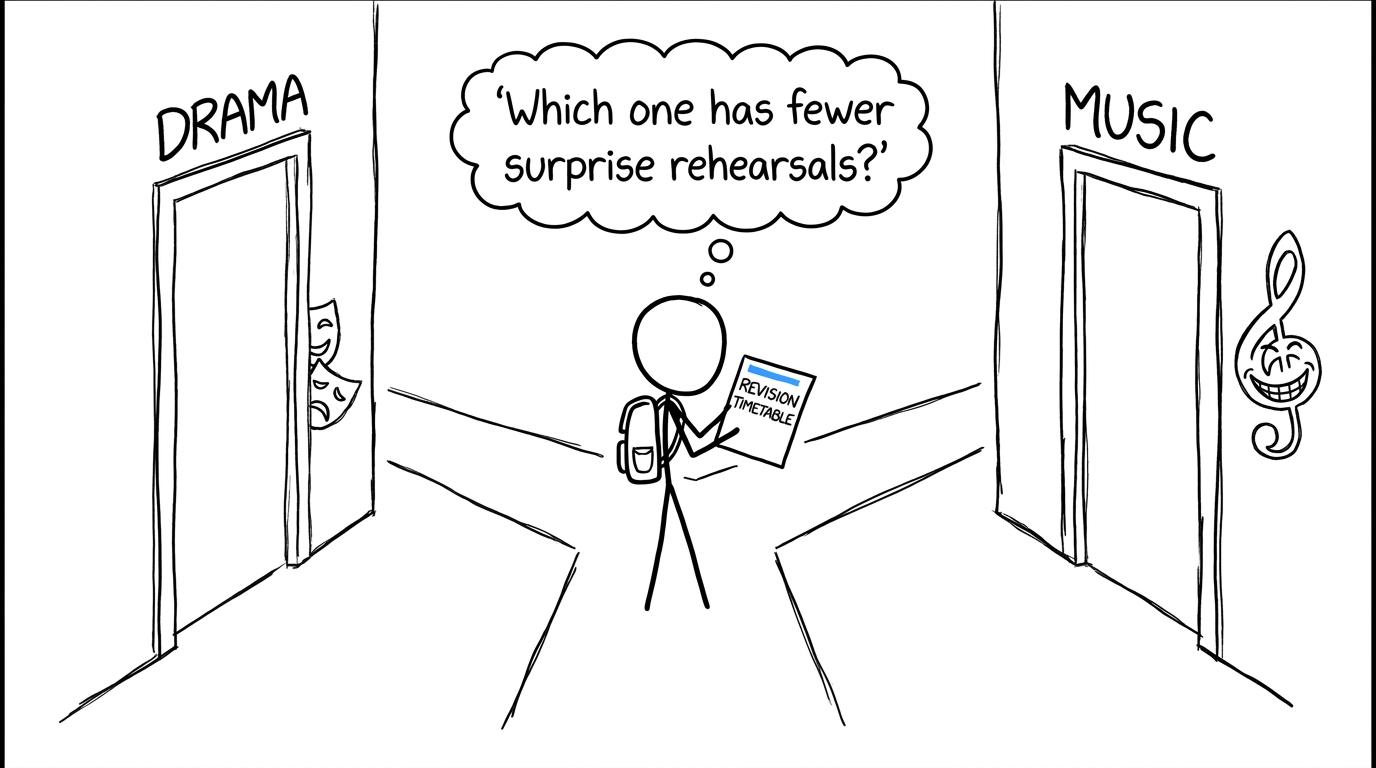 A student choosing between GCSE Drama and GCSE Music while holding a revision timetable
What GCSE Drama actually involves
GCSE Drama is not simply acting in lessons. Across current specifications, the subject combines creating drama, performing or realising design ideas, studying performance texts, analysing live theatre and completing a written examination.
National assessment requirements allocate 40%40\%40% of GCSE Drama marks to examination assessment and 60%60\%60% to non-exam assessment. The precise arrangement varies by board. For example, AQA currently divides the qualification between a written examination, devising work and performances from a text. Edexcel, OCR and Eduqas use their own component structures, so students should read the specification used by their school.
The practical workload
Drama involves sustained rehearsal. A devised piece has to move from an initial stimulus to a coherent performance, while scripted work requires interpretation, blocking and refinement. Depending on the route offered by the school, some students may be assessed as designers rather than performers.
Group work is central. That can make Drama rewarding, but it also creates a type of difficulty that is hard to measure on a revision timetable. Your preparation may depend partly on everyone attending, remembering decisions and responding constructively to feedback.
Rehearsal time is not automatically productive time. Repeating a scene without a clear purpose feels busy but may not improve the performance. Strong groups identify one feature to refine, such as pace, vocal delivery, movement, spacing or audience impact, and then evaluate whether the change worked.
The written workload
Drama requires more writing than some students expect. You may need to document how ideas developed, justify artistic decisions, evaluate your own contribution and analyse a live production. In the written paper, precise theatrical vocabulary must be connected to meaning and audience response.
Students who are confident performers can therefore find the analytical side demanding. Remembering what happened in a production is only the beginning; high-quality responses explain how particular performance or design choices created an effect.
What GCSE Music actually involves
GCSE Music brings together three broad disciplines: performing, composing and appraising. Across the national assessment objectives, performing contributes 30%30\%30%, composing contributes 30%30\%30%, and musical knowledge and appraisal together contribute 40%40\%40%.
On several current specifications, including AQA and OCR, students complete solo and ensemble performance work, create compositions and sit a listening or appraising examination. Exact timings, set works, areas of study and submission rules depend on the board.
The performance workload
Music often rewards skills built over a long period. If you already practise an instrument or singing regularly, performance preparation may fit naturally into your week. If your technical control is still developing, the same component can require substantial independent practice.
This does not mean that only advanced musicians can take the subject. It means that you should ask an honest question: can you currently perform complete pieces with reasonable fluency, expression and control, and are you willing to practise consistently?
Unlike a homework task that can be completed in one evening, instrumental or vocal fluency grows through repeated, focused sessions. Missing several weeks and attempting to recover immediately before recording is unlikely to be comfortable.
Composing and appraising
Composition is creative, but it is not unstructured. Students must develop musical ideas with technical control and coherence. That means making purposeful decisions about features such as melody, rhythm, harmony, texture, structure, instrumentation and dynamics.
The appraising examination brings another challenge: some questions are based on music you hear during the paper. Students must identify features accurately, apply musical vocabulary and sometimes make critical judgements. Revising facts without regular listening practice leaves a gap between knowing a term and recognising it by ear.
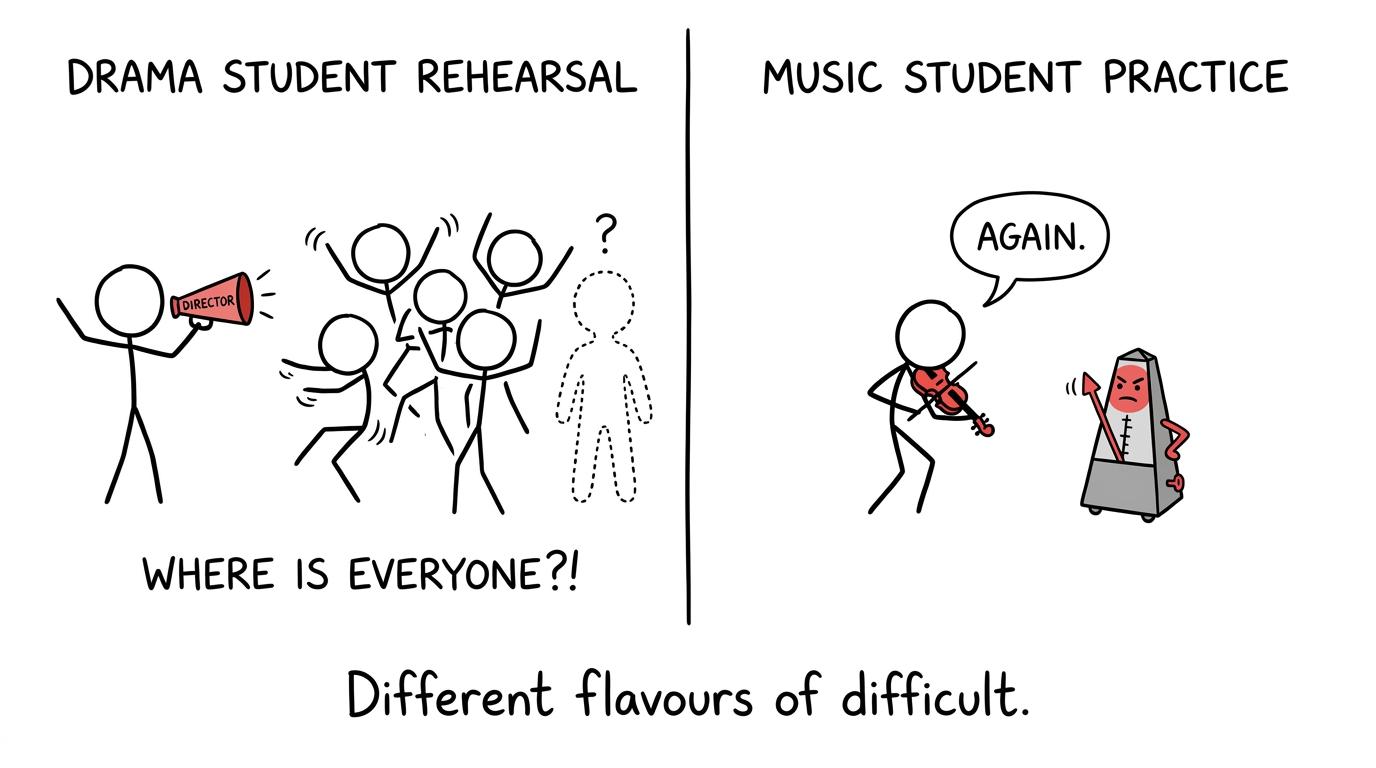 Drama and Music students facing different kinds of practice difficulty
Which subject has the heavier workload?
The total workload can be substantial in either subject, but its shape is different.
| Workload factor | GCSE Drama | GCSE Music |
|---|---|---|
| Regular preparation | Group and individual rehearsals | Instrumental, vocal or technology practice |
| Creative assessment | Devising original theatre | Developing compositions |
| Written demands | Set-text analysis, live theatre evaluation and reflective evidence | Musical vocabulary, contextual knowledge and appraising responses |
| Dependence on others | Often high during group performance | Present in ensemble work, but much practice is independent |
| Deadline pressure | Portfolios, rehearsals and assessed performances | Recordings, compositions and final submissions |
| Main performance risk | A live scene depends on memory, interaction and timing | Technical accuracy and musical control must be sustained |
Drama can consume more visible time after school because groups need to rehearse together. Music may consume more invisible time because regular individual practice is expected. One appears on the calendar; the other quietly fills the spaces between lessons.
A useful way to think about difficulty is:
perceived difficulty≈skill gap+independent hours+deadline concentration+pressure mismatch\text{perceived difficulty} \approx \text{skill gap} + \text{independent hours} + \text{deadline concentration} + \text{pressure mismatch}perceived difficulty≈skill gap+independent hours+deadline concentration+pressure mismatchThis is not a grade formula. It is a decision-making tool. A subject feels harder when its main demands sit far from your present skills or working habits.
Which GCSE is harder to get a good grade in?
There is no responsible universal answer. Grade boundaries vary between exam boards and examination series, while your result depends on the full combination of assessed components. Choosing a subject because someone calls it easy is risky.
GCSE Music may be the harder route when:
- you are beginning an instrument or singing from a low-confidence starting point;
- you dislike independent practice;
- composing feels directionless even after feedback;
- identifying musical features by ear is difficult;
- performance recording creates significant pressure.
GCSE Drama may be the harder route when:
- you dislike relying on a group;
- you struggle to retain lines, cues or detailed staging decisions;
- extended analytical writing is a weakness;
- you find evaluating your own creative process uncomfortable;
- live performance pressure affects your communication.
The best predictor is not which subject sounds more enjoyable on a good day. It is which subject you would still be prepared to practise on an ordinary Wednesday when maths homework is due and motivation is limited.
How the choice affects GCSE maths revision
Creative subjects and maths demand different kinds of attention. That can be helpful: a rehearsal may provide a change from algebra. The problem begins when practical deadlines arrive together and maths is repeatedly postponed because it has no immediate group waiting for you.
Start with the GCSE Maths Revision hub and identify your exam board and tier. Then protect short, repeatable sessions rather than hoping for an empty weekend.
A balanced week might include:
- several brief instrument-practice or line-learning sessions;
- one longer rehearsal or composition block;
- three focused maths topic sessions;
- one GCSE Maths mini test;
- time to mark mistakes and plan the next session.
The twenty-minute maths revision routine is particularly useful on rehearsal days. When you have more time, use Edexcel GCSE Maths past papers or select the correct board through the main revision hub.
Past papers only help when you review them properly. The guide to using GCSE past papers explains how to mark, diagnose and retest rather than simply collecting scores. Nearer the examinations, Edexcel predicted papers can provide fresh practice alongside official papers.
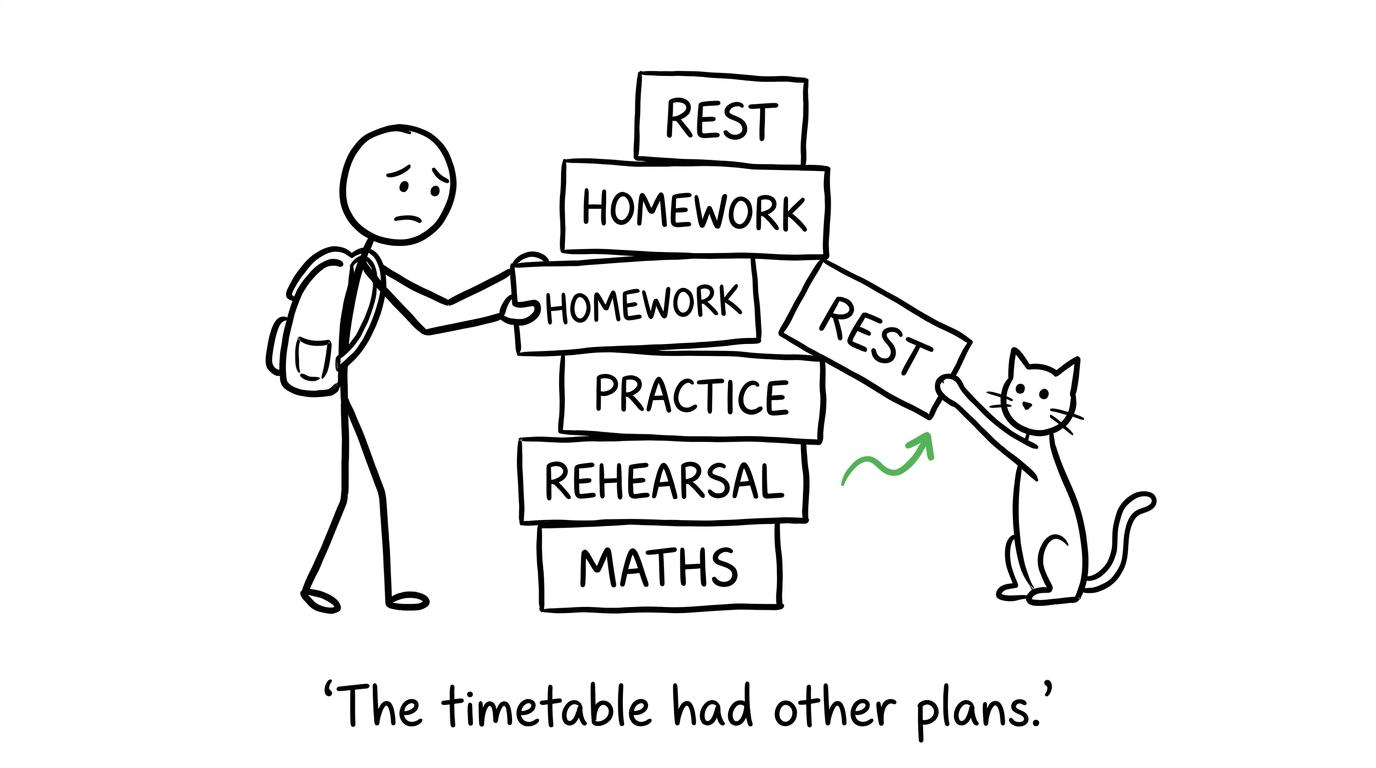 A GCSE student trying to balance maths, rehearsals, practice and rest
How to make the decision fairly
Check the exact course offered
Ask which exam board your school uses, which set texts or areas of study are taught, and how the timetable handles rehearsals and performance recordings. A subject title tells you less than the actual specification and teaching arrangements.
Compare your current starting points
Do not compare your enthusiasm for Drama with your examination anxiety about Music, or vice versa. Compare like with like:
- current performance confidence;
- willingness to practise independently;
- ability to analyse in writing;
- response to feedback;
- comfort with group responsibility;
- interest in the course content, not just the subject name.
Speak to the teachers
Teachers can explain the expected standard, available instruments or technology, design options in Drama, rehearsal arrangements and likely independent workload. They can also tell you whether your idea of each course matches what is actually taught.
Protect your wider GCSE timetable
If you are already behind in core subjects, choosing a practical GCSE does not automatically make revision easier. Use a realistic weekly plan. MathsGenie’s catch-up revision guide can help you turn weak topics into manageable sessions rather than allowing them to accumulate.
Common mistakes when choosing between Drama and Music
Assuming creative subjects involve little revision. Both include examined knowledge and sustained practical preparation.
Choosing Music only because you enjoy listening to songs. GCSE Music assesses performance, composition and analytical listening, not musical taste alone.
Choosing Drama only because you enjoy acting games. The course also demands textual understanding, reflection, evaluation and disciplined rehearsal.
Ignoring independent practice. Classroom time is rarely enough to polish every performance, composition or written response.
Looking only at the final written examination. In both subjects, a large proportion of marks comes from non-exam assessment completed over time.
Following friends. Friendship can make a class enjoyable, but it cannot replace technical practice, analytical writing or personal interest.
Sacrificing every maths session near a practical deadline. Use short sessions and mini tests to keep methods active. If you need a broader structure, the one-month GCSE maths revision plan provides a manageable rhythm.
The final verdict
If you have little musical experience, GCSE Music will often present the steeper initial climb because performance, composition and aural recognition all need sustained development. If you dislike analytical writing, collaboration or live interpretation, GCSE Drama may feel harder.
The fairest answer is that Music tends to be more technically dependent on prior or rapidly developing musicianship, while Drama places heavier demands on collaboration, theatrical interpretation and reflective writing. Both require far more than talent in the final performance.
Choose the difficulty you are willing to practise. Then protect the rest of your timetable. Use MathsGenie for free revision lessons, practice questions, mini tests, mark schemes and video solutions, before moving into past papers and predicted papers. A creative GCSE should broaden your week, not quietly remove the consistent maths revision that turns uncertainty into marks.











