

Harder GCSE: Biblical Hebrew or Modern Hebrew?
Harder GCSE Biblical Hebrew or Modern Hebrew? Compare assessment, workload and revision demands to choose the course that best fits your skills and experience.
Choosing between two subjects with “Hebrew” in the title can make the difference look smaller than it is. Yet the real question (is harder GCSE Biblical Hebrew or Modern Hebrew) has no universal answer. GCSE Biblical Hebrew is usually harder for students who dislike detailed grammar, unseen translation and literary analysis. GCSE Modern Hebrew is often harder for students who find listening, spontaneous speaking and extended writing under pressure difficult.
The fairest answer is that Biblical Hebrew has greater depth in a narrower range of skills, while Modern Hebrew spreads the workload across four distinct language skills. Your existing Hebrew, teaching support and preferred way of learning will matter more than the subject name.
The comparison at a glance
Use this checklist before looking at the detail:
- Choose Biblical Hebrew cautiously if unfamiliar texts, grammatical analysis and set literature are weak areas.
- Choose Modern Hebrew cautiously if speaking or listening makes you anxious, because together they contribute 50%50\%50% of the qualification.
- Consider your background: regular experience of spoken Modern Hebrew can substantially change the comparison.
- Check available teaching: a well-supported course is usually more manageable than a theoretically easier subject taught with limited contact time.
- Think about your full GCSE timetable: workload matters alongside maths, English and your other options.
| Feature | GCSE Biblical Hebrew | GCSE Modern Hebrew |
|---|---|---|
| Current example specification | Pearson Edexcel | AQA |
| Main emphasis | Ancient language and literature | Practical communication |
| Assessment structure | Two externally examined written components | Listening, speaking, reading and writing |
| Skill weighting | Language 50%50\%50%; literature 50%50\%50% | Each of four skills worth 25%25\%25% |
| Tiers | Untiered | Foundation and Higher |
| Oral assessment | None | Yes |
| Listening assessment | None | Yes |
| Literature study | Central to the course | Only limited adapted literary material within reading |
| Likely revision pattern | Grammar, translation and close set-text study | Frequent practice across four skills |
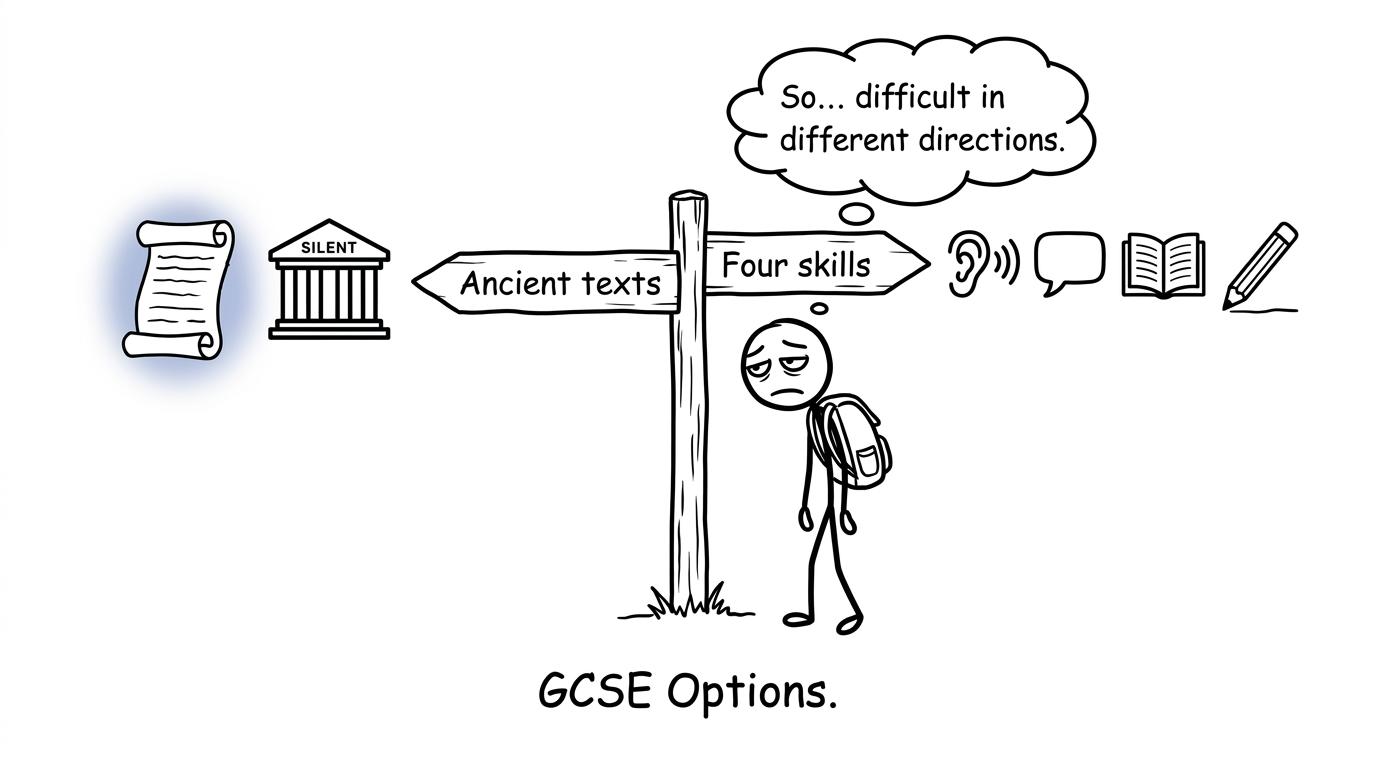 A student discovers that the two Hebrew GCSEs are difficult in different directions
Why GCSE Biblical Hebrew can feel harder
Biblical Hebrew is classified as an ancient language GCSE. It is not primarily a test of everyday conversation. The course asks students to understand how the language works, translate unfamiliar material and engage closely with prescribed literature.
Under the current Pearson Edexcel structure, the qualification has two written components. The language component is worth 50%50\%50% and includes comprehension and translation from unseen Biblical Hebrew. Students also meet either grammatical analysis or translation of short English sentences into pointed Biblical Hebrew, depending on the option followed.
The literature component provides the other 50%50\%50%. Students study prescribed selections in the original language, translate extracts and respond to their content, style, ideas, values and context. Ofqual’s ancient-language requirements specify substantial original-language study; for Biblical Hebrew, the compulsory literature component includes at least 757575 verses.
The difficult parts of Biblical Hebrew
Morphology carries a heavy load. Students must recognise how roots, verb forms, person, gender, number and other grammatical features affect meaning. Knowing the general sense of a passage may not be enough when a question asks for precise understanding.
Unseen translation tests flexible knowledge. Memorising a familiar passage cannot fully prepare you for language presented in a new context. Vocabulary recall, grammar and careful English expression have to work together.
Pointing adds another layer. Biblical texts and assessment tasks may require attention to vocalisation. Students accustomed mainly to unpointed Modern Hebrew can still need deliberate practice here.
Literature is more than translation. Half of the GCSE concerns set texts, including informed responses to content and literary features. A student who enjoys language but dislikes evidence-based analytical writing may underestimate this part.
The advantage is focus. There is no speaking examination and no audio that disappears after it is played. Students who prefer quiet, methodical analysis may find Biblical Hebrew demanding but predictable.
Why GCSE Modern Hebrew can feel harder
AQA GCSE Modern Hebrew follows the familiar modern foreign language pattern. It assesses listening, speaking, reading and writing, with each skill worth 25%25\%25%. Students study themes covering identity and culture, wider local and global interests, and current and future study and employment.
Foundation Tier covers grades 111-555, while Higher Tier covers grades 444-999. All four assessments must be taken at the same tier and in the same exam series.
Listening and speaking change the challenge
Modern Hebrew requires students to understand recorded speech and communicate aloud. The speaking assessment includes a role-play, photo card and general conversation. It lasts seven to nine minutes at Foundation Tier and ten to twelve minutes at Higher Tier, in addition to preparation time.
This is not necessarily harder than translating an ancient passage, but it is less controllable. A forgotten word in writing gives you time to reconsider. During conversation, you must respond, repair the sentence or express the idea differently.
Listening creates similar pressure. Students need to recognise details, opinions and time frames at the pace of the recording. Familiar vocabulary may sound less familiar when spoken quickly or embedded in a longer sentence.
Reading and writing add two further revision streams. Higher Tier writing includes structured and open-ended communication as well as translation from English into Modern Hebrew. Accuracy matters, but so do range, relevance and the ability to express and justify ideas.
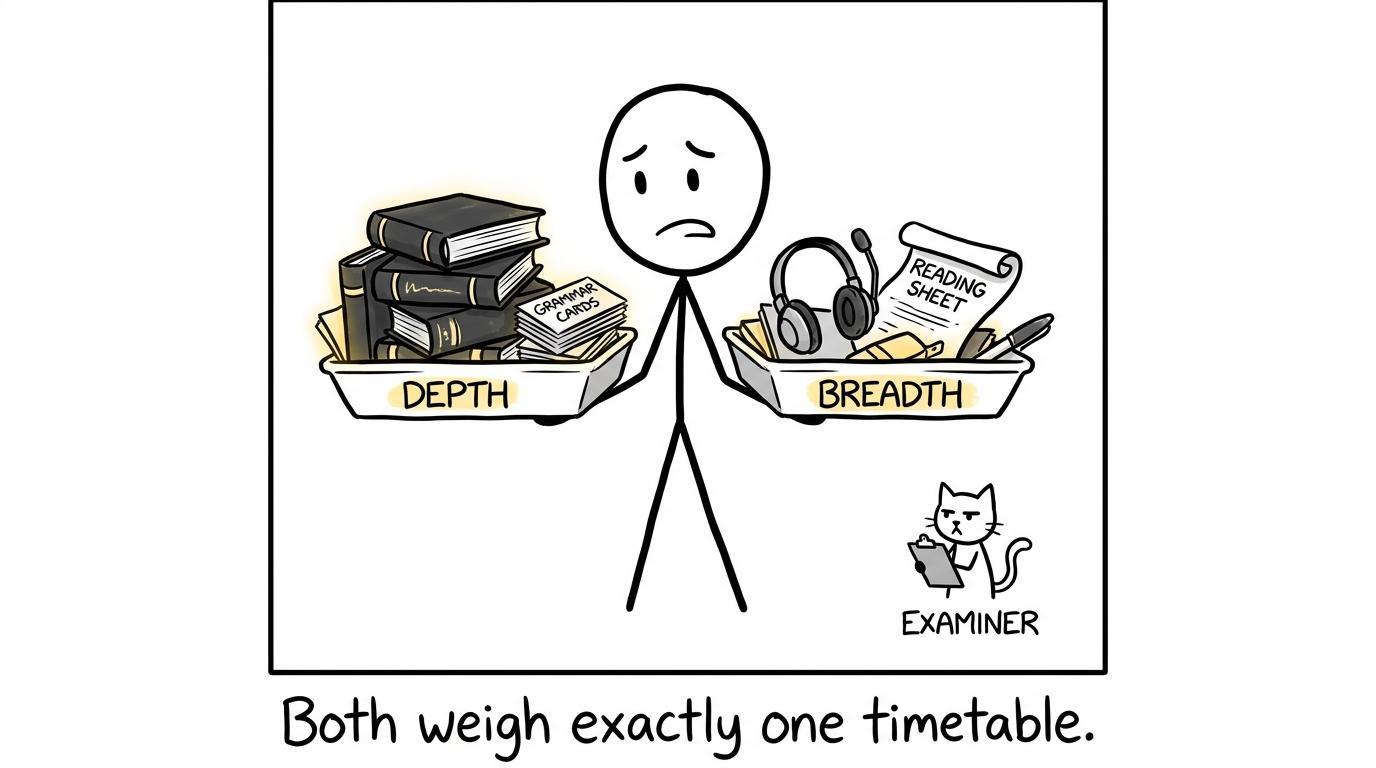 Two revision trays show the depth and breadth of the competing workloads
Which GCSE has the greater workload?
The answer depends on what counts as workload for you.
Biblical Hebrew tends to create a concentrated workload. You may spend long sessions learning grammatical patterns, revisiting vocabulary, annotating prescribed texts and practising accurate translation. Set-text knowledge must be maintained across the course rather than left until the final weeks.
Modern Hebrew creates a distributed workload. Listening improves through repeated exposure; speaking needs regular rehearsal; vocabulary supports both reading and writing; grammar must become usable rather than merely recognisable. It is difficult to compress all of that into a last-minute revision block.
A useful distinction is this:
- Biblical Hebrew often demands more depth per passage.
- Modern Hebrew demands readiness across more modes of communication.
Neither workload should be judged only by the number of papers. Four shorter skill areas are not automatically easier than two substantial written components, and two written examinations are not automatically easier because no speaking test is involved.
Your starting point may decide which is harder
A student who regularly hears and speaks Modern Hebrew may find its listening and speaking demands relatively natural. That does not remove the need to learn exam vocabulary, formal writing and accurate grammar, but it can provide a major head start.
Conversely, experience reading biblical texts can make Biblical Hebrew vocabulary, pointing and structures more familiar. Modern Hebrew fluency alone does not guarantee easy access to the ancient language. The languages are connected, but differences in vocabulary, usage, grammar and register mean that competence does not transfer perfectly in either direction.
Teaching quality is equally important. Ask practical questions before choosing:
- How many taught lessons will you receive?
- Is the course taught in school or mainly independently?
- Does the teacher regularly prepare students for that specification?
- Will you receive speaking practice for Modern Hebrew?
- Are all Biblical Hebrew set texts taught and revised systematically?
- Can you access current past papers and mark schemes?
A supported difficult course is often a wiser choice than an “easier” course for which you must assemble everything alone.
Balancing Hebrew with GCSE maths revision
Language revision expands to fill the time available. Maths can do the same. The solution is not to decide which subject deserves every evening, but to give each a repeatable job.
Start from the GCSE maths revision hub and separate learning from testing. On one day, use a revision lesson and topic questions. On another, test the skill under time pressure. This prevents maths from becoming a vague intention beside a demanding language course.
A balanced weekly pattern might include:
- two short Hebrew vocabulary or grammar sessions;
- one listening or speaking session for Modern Hebrew, or one set-text session for Biblical Hebrew;
- two focused maths topic sessions;
- one timed assessment block followed by careful marking.
If the calendar feels crowded, the GCSE maths revision timetable guide helps turn weak topics into specific sessions. Students closer to the exams can use the one-month GCSE maths revision plan rather than attempting every topic at once.
Revision order matters too. Maths Genie’s guide to the best order for learning GCSE maths topics builds from number fluency into algebra, geometry, statistics and Higher Tier content. That structure leaves more mental energy for Hebrew because you are not deciding what to revise every evening.
How to make a fair personal decision
Do not ask only, “Which subject has the harder specification?” Ask which assessment produces the larger gap between your current ability and exam readiness.
Try one current sample or past assessment from each course under realistic conditions. You are not trying to predict a grade from one attempt. Notice where the resistance appears:
- Can you decode an unseen Biblical Hebrew passage without relying on memory?
- Can you explain details from prescribed literature precisely?
- Can you follow Modern Hebrew audio without seeing a transcript?
- Can you sustain spoken answers beyond a memorised sentence?
- Can you write accurately within the available time?
Then consider the cost of closing each gap. Improving spontaneous speech requires repeated live practice. Improving ancient-language translation requires sustained grammar and vocabulary work. The better choice is usually the course whose practice you can access consistently and are willing to repeat.
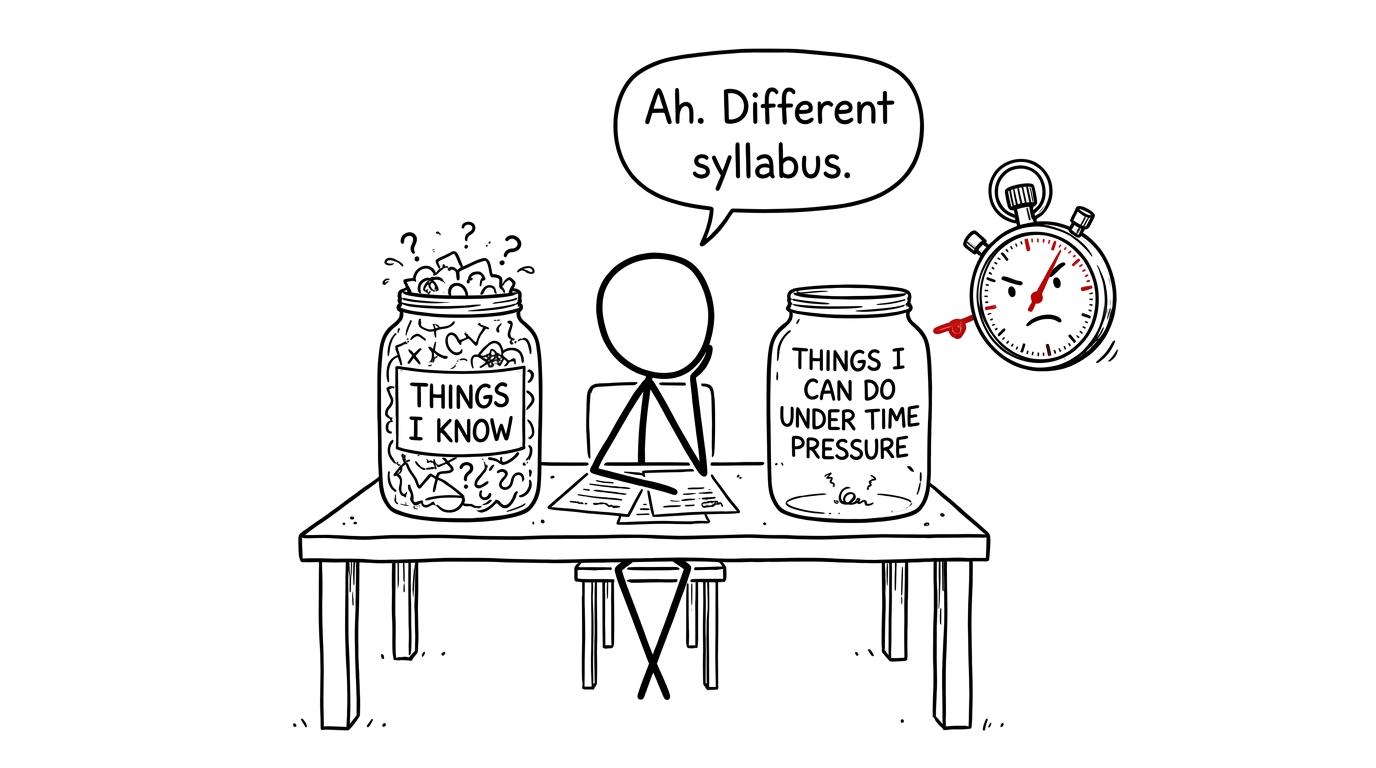 A stopwatch reveals the difference between knowing material and performing under pressure
Common mistakes when comparing the two GCSEs
Assuming Modern Hebrew is automatically easier
“Modern” does not mean simple. Listening and spontaneous speaking can be demanding even for students who read the language confidently.
Treating Biblical Hebrew as a memory test
Set-text familiarity helps, but unseen language, grammar and evidence-based literary responses require transferable understanding.
Ignoring tier decisions
Modern Hebrew has Foundation and Higher tiers; Biblical Hebrew is untiered. Comparing a Foundation Modern Hebrew task with the full Biblical Hebrew qualification does not produce a fair conclusion.
Overestimating transfer between the languages
Shared roots and vocabulary can help, but ancient and modern forms are not interchangeable. Each specification deserves separate preparation.
Choosing without checking school support
A subject’s practical difficulty changes when speaking partners, specialist teaching or reliable feedback are unavailable.
Letting the choice damage maths preparation
A demanding option needs a timetable, not the abandonment of another core subject. Use the guide on when to start GCSE past papers to phase maths practice sensibly. If you are struggling to move beyond a pass, follow the focused advice for GCSE maths revision at the pass-grade boundary.
The final verdict
GCSE Biblical Hebrew is likely to feel harder if you struggle with detailed grammar, pointed text, unseen translation or literary analysis. GCSE Modern Hebrew is likely to feel harder if listening, spontaneous speaking and extended communication are your weaker areas.
For many beginners, Modern Hebrew has the broader ongoing workload because four skills must develop together. Biblical Hebrew may present the steeper intellectual challenge per text because language knowledge and close literary study carry equal weight. Neither description proves that one GCSE is universally harder.
Choose using evidence: inspect the specification, try assessment material, assess your existing language experience and confirm what teaching is available. Then protect the rest of your timetable.
For maths, let MathsGenie’s free GCSE resources remove the planning burden. Use revision lessons and practice questions to repair weak topics, mini tests to check recall, and past papers, predicted papers, mark schemes and video solutions to turn knowledge into exam marks. The subject choice may be complicated. Your next revision step does not need to be.










