Growth and Decay Exam Questions: GCSE Guide
Growth and decay exam questions explained through three GCSE examples, with multipliers, method marks, common mistakes and targeted practice.

Growth and decay exam questions often look like long word problems, but nearly all of them test the same decision: which multiplier should you use, and how many times should you apply it?
Growth means multiplying by a number greater than 111. Decay means multiplying by a number between 000 and 111. Once you can translate a percentage into the correct multiplier, the rest becomes much more predictable.
Imagine a student called Sam opening a GCSE paper. The first question asks about a population, the second about depreciation, and the third hides the original amount. They look different. Underneath, however, they are variations of one idea.
The growth and decay method
Before following Sam through the questions, learn this short checklist:
- Identify the starting amount.
- Decide whether the quantity is growing or decaying.
- Convert the percentage into a multiplier.
- Count the number of time periods.
- Use a power for repeated changes.
- Keep the full calculator value until the final step.
- Round and label the answer as instructed.
For growth of r%r\%r%, the multiplier is:
1+r1001+\frac{r}{100}1+100rFor decay of r%r\%r%, the multiplier is:
1−r1001-\frac{r}{100}1−100rThe general model is:
final amount=initial amount×(multiplier)number of periods\text{final amount}=\text{initial amount}\times(\text{multiplier})^{\text{number of periods}}final amount=initial amount×(multiplier)number of periodsThe power matters because the percentage change is repeated. Each new percentage is calculated from the latest amount, not from the original amount.
You can develop this method with the Repeated Percentage Change lesson, which provides questions and answers you can work through on screen or print.
Question one: straightforward compound growth
Sam's first question says:
A town has a population of 24,00024{,}00024,000. The population increases by 3%3\%3% each year. Work out the population after 444 years.
The word “increases” signals growth. A growth rate of 3%3\%3% gives the multiplier:
1+3100=1.031+\frac{3}{100}=1.031+1003=1.03The multiplier is applied once per year for 444 years:
24,000×1.03424{,}000\times1.03^424,000×1.034Using a calculator:
24,000×1.034=27,012.2114424{,}000\times1.03^4=27{,}012.2114424,000×1.034=27,012.21144A population should be given as a whole number, so:
27,012\boxed{27{,}012}27,012Where the method marks come from
A typical mark scheme may reward the correct multiplier and the correct repeated calculation, even if the final answer contains an arithmetic or rounding error. Exact allocation varies by paper and exam board, but Sam should make the method visible by writing:
24,000×1.03424{,}000\times1.03^424,000×1.034Typing everything into a calculator without recording the calculation hides useful evidence from the examiner.
After learning this setup, use the Repeated Percentage Change exam booklet to practise recognising growth multipliers without relying on prompts.
Question two: depreciation with careful rounding
The next growth and decay GCSE exam question is less comfortable:
A car is worth £18,500£18{,}500£18,500. Its value decreases by 14%14\%14% each year. Calculate its value after 555 years. Give your answer to the nearest pound.
Sam initially wants to multiply by 0.140.140.14. But 0.140.140.14 represents the proportion lost, not the proportion remaining.
If the car loses 14%14\%14%, it retains:
100%−14%=86%100\%-14\%=86\%100%−14%=86%Therefore, the decay multiplier is:
86100=0.86\frac{86}{100}=0.8610086=0.86The complete calculation is:
18,500×0.86518{,}500\times0.86^518,500×0.865Keeping the calculator value unrounded gives:
18,500×0.865=8,695.29268818{,}500\times0.86^5=8{,}695.29268818,500×0.865=8,695.292688To the nearest pound, the value is:
£8,695\boxed{£8{,}695}£8,695Why repeated subtraction is risky
Sam could calculate 86%86\%86% of the value five separate times. That can work, but it creates more opportunities to round too early or mistype a value. The power form is shorter and communicates the repeated process clearly.
This is a reliable structure for depreciation, falling populations and other repeated decreases:
new value=original value×(1−r100)n\text{new value}=\text{original value}\times\left(1-\frac{r}{100}\right)^nnew value=original value×(1−100r)nYou now have the complete setup method, so use Maths Genie's Lessons and Question Bank to move from guided examples to independent growth and decay exam questions.
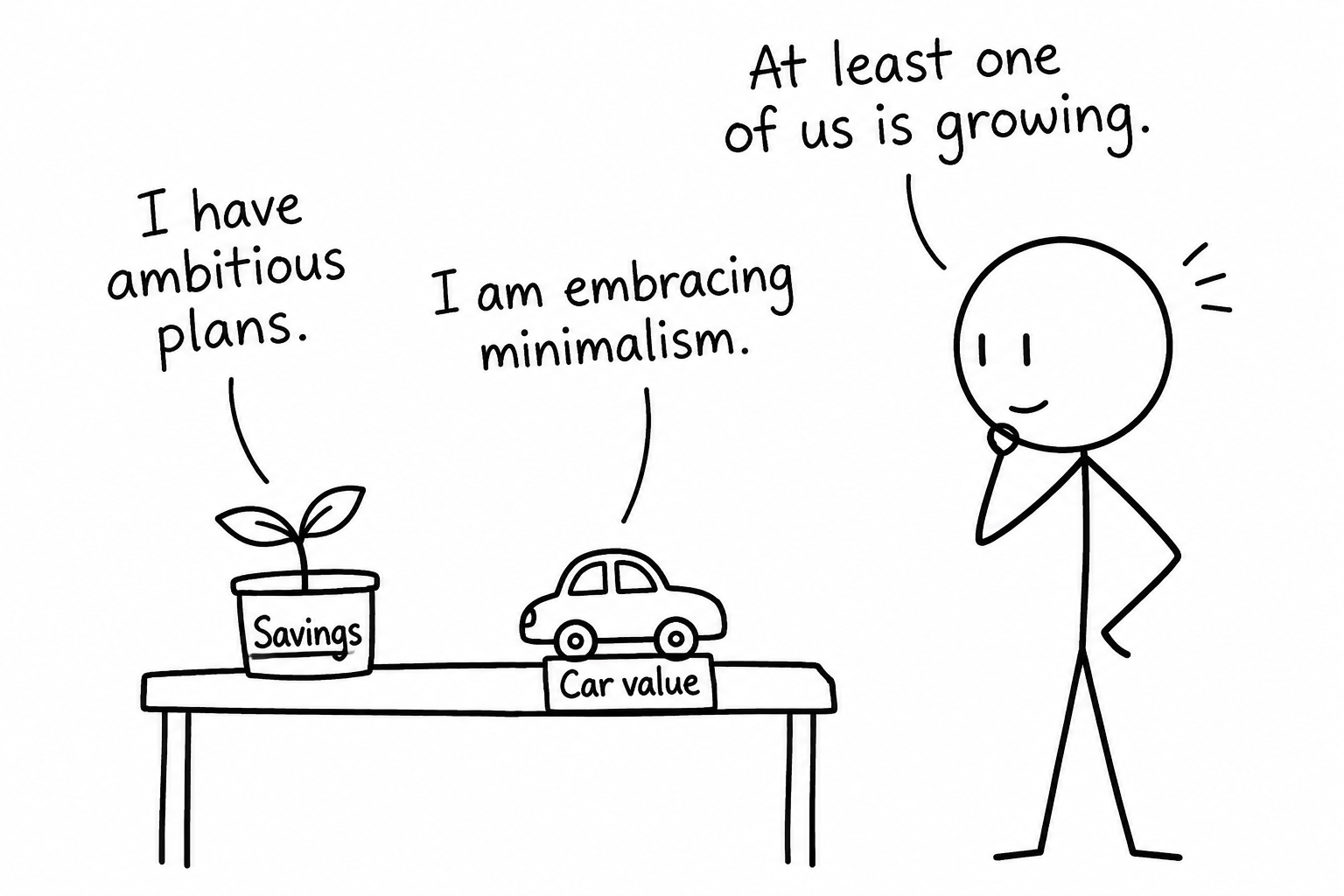 A stick-figure student watches savings grow while a car value embraces minimalism
Question three: finding the original amount
The final question reverses the usual direction:
After decreasing by 8%8\%8% each year for 333 years, a machine is worth £9,737.36£9{,}737.36£9,737.36. Work out its original value.
Sam knows the decay multiplier is:
1−8100=0.921-\frac{8}{100}=0.921−1008=0.92The familiar relationship still applies:
final value=original value×0.923\text{final value}=\text{original value}\times0.92^3final value=original value×0.923This time, the final value is known. Let the original value be xxx:
9,737.36=x×0.9239{,}737.36=x\times0.92^39,737.36=x×0.923To undo multiplication by 0.9230.92^30.923, divide by it:
x=9,737.360.923x=\frac{9{,}737.36}{0.92^3}x=0.9239,737.36Therefore:
x=12,500x=12{,}500x=12,500The original value was:
£12,500\boxed{£12{,}500}£12,500Where the method marks come from
This question is harder because Sam must work backwards. Useful written evidence includes:
- identifying 0.920.920.92 as the decay multiplier;
- using 0.9230.92^30.923 for three annual changes;
- dividing the final value by the combined multiplier.
A common wrong method is to increase £9,737.36£9{,}737.36£9,737.36 by 8%8\%8% three times. Percentage change is not reversed by applying the opposite percentage. Multiplication by 0.920.920.92 is reversed by division by 0.920.920.92.
How to approach growth and decay past paper questions
Questions may describe savings, bacteria, populations, prices or depreciation. Do not let the setting choose the method for you. Look instead for three pieces of information:
| Information | What it tells you |
|---|---|
| Starting or final amount | Which value is known |
| Percentage rate | The multiplier |
| Time period | The required power |
Underline whether the rate is monthly, quarterly or yearly. The power counts the number of matching periods, not simply the number appearing in the question.
For example, 333 years of monthly change contains 363636 monthly periods:
3×12=363\times12=363×12=36When working through growth and decay past paper questions, show the multiplier calculation before using your calculator. This takes little time and makes your reasoning easier to check.
Common mistakes in growth and decay questions
Using the percentage as the decay multiplier
A decrease of 12%12\%12% uses 0.880.880.88, not 0.120.120.12:
1−0.12=0.881-0.12=0.881−0.12=0.88Multiplying the percentage by the number of years
Repeated percentage change is compound. A 5%5\%5% annual increase for 444 years is not generally a single 20%20\%20% increase. Use:
1.0541.05^41.054Using simple interest
Adding the same amount every year models simple interest. Compound growth calculates each increase from the latest balance.
Counting the periods incorrectly
Read the wording carefully. “After 555 years” normally means five applications of an annual multiplier. A table showing values at named dates may require more careful counting.
Rounding during the calculation
Store the full calculator value and round once at the end. Early rounding can change the final answer, particularly over many periods.
Forgetting units
Money needs a pound sign and appropriate rounding. Populations usually require whole numbers. Measurements may need stated units or a requested degree of accuracy.
Turn the method into exam marks
Sam's progress did not come from memorising three separate answers. It came from recognising one structure: starting value, multiplier and number of periods. The remaining gap is practising that decision until it feels routine under exam conditions.
Start with the Maths Genie Repeated Percentage Change lesson and questions, then use the Lessons and Question Bank to practise growth, depreciation and reverse growth problems for yourself.