Your Resit Exam Day Checklist
Your resit exam day checklist covers what to pack, when to arrive and how to handle a GCSE maths resit calmly, from breakfast to the final check.
A resit morning has its own atmosphere. You already know what a GCSE exam feels like, but this time you may be travelling from college, fitting revision around a course or apprenticeship, and sitting beside people whose routes through maths have been very different.
That experience can help. Your resit exam day checklist is simple: confirm the time and venue, pack approved equipment, arrive early, follow the invigilator's instructions and use the full exam time. Check every local detail with your college or exam centre because its arrival arrangements are the ones you must follow.
This guide is written for post-16 students preparing for a GCSE maths resit, including a November resit. It is not about pretending nerves disappear. It is about removing avoidable decisions so that your attention is available for the paper.
Your resit exam day checklist at a glance
The evening before
- Check the date, start time, venue and required arrival time on your official timetable or centre message.
- Confirm which paper you are sitting and whether it is calculator or non-calculator.
- Pack the equipment listed by your exam centre.
- Choose your clothes and plan your journey.
- Set an alarm, plus a backup if possible.
- Stop intensive revision at a sensible time and prioritise rest.
Before leaving
- Eat something familiar and drink some water.
- Take any identification or candidate information requested by your centre.
- Check for travel disruption.
- Leave enough time to report to the correct room without rushing.
Before entering the room
- Switch off your phone and store it exactly as your centre instructs.
- Remove any watch and follow the centre's storage arrangements.
- Check your pockets for notes, electronic devices and other unauthorised items.
- Listen carefully to the invigilator, even if you have heard the instructions before.
Exam regulations can be updated, and centres may have different practical arrangements. Treat your current exam-centre instructions and the latest official candidate notice provided by your centre as authoritative.
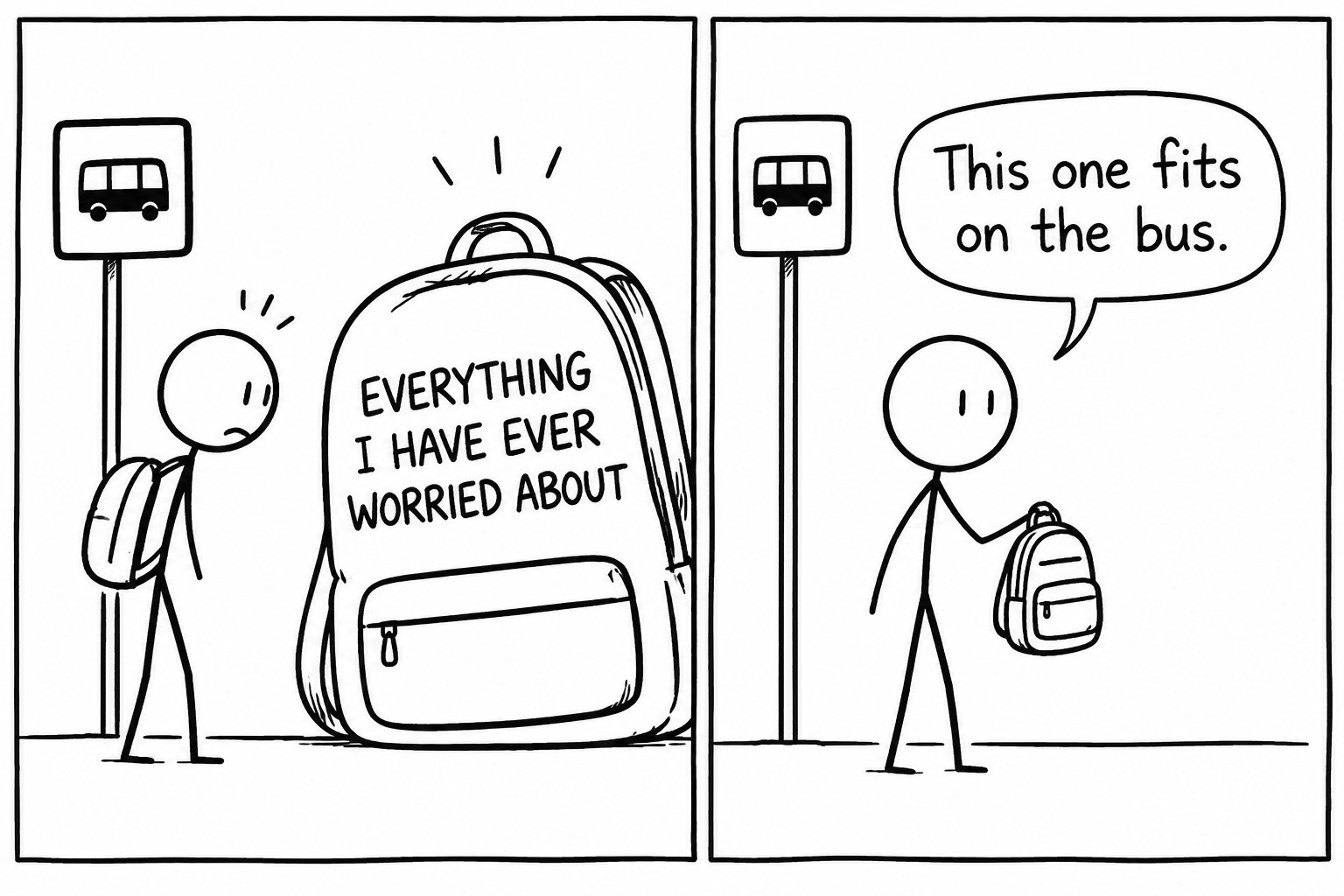 A post-16 student chooses a manageable exam-day backpack instead of carrying every worry
Pack the night before your GCSE maths resit
A rushed morning makes small uncertainties feel important. Packing the previous evening turns them into completed tasks.
Bring at least two black pens, pencils, an eraser, a ruler and the geometrical instruments required by your centre. For a calculator paper, take a familiar calculator that meets the relevant exam rules. Check that it works, has sufficient power and is in the mode you normally use. Remove its lid or case if instructed.
Do not rely on borrowing equipment. Your centre may be able to help, but arriving prepared protects your concentration.
Water is commonly permitted only in a clear bottle with its label removed, but confirm this with your centre. The same principle applies to tissues, medication and any other item you need in the room: ask beforehand rather than guessing on the morning.
If you have approved access arrangements, such as extra time, supervised rest breaks or a separate room, check where you must report. These arrangements should already have been agreed through the centre; exam day is not the moment to assume that everybody knows where you are going.
Check the details of your November resit
GCSE English language and maths are normally available in the November examination series for eligible post-16 candidates, but exact dates and entry details vary by year and awarding organisation. Do not use an old screenshot, a friend's timetable or a remembered date from another exam board.
Use the timetable issued by your college or exam centre. Check:
- your awarding organisation, such as Edexcel, AQA, OCR or Eduqas;
- your tier, foundation or higher;
- the paper number;
- the date and session;
- the venue and room;
- your candidate details;
- the centre's required arrival time.
If anything looks wrong, contact the exams office before exam day. A quick question in advance is far easier to solve than confusion outside an exam room.
Plan the journey as part of the exam
Suppose your bus usually arrives ten minutes before registration. On an ordinary college day, that may be acceptable. On an exam day, one cancellation turns a routine journey into a crisis.
Build in a sensible margin and identify a backup route. Save the exams office number, but do not assume that calling makes lateness harmless. If disruption occurs, contact the centre immediately and follow its instructions. Do not exchange information about the paper with anyone.
Arriving early is not about performing confidence. It creates quiet time to find the room, use the toilet and let your breathing settle.
Use the reading time you create for yourself
Once the exam begins, read the information on the front of the paper and follow the invigilator's instructions. Check that you have the correct paper. Write the candidate details requested, then look carefully at each question before starting.
For every question, ask three things:
- What information have I been given?
- What is the question asking me to find?
- What working will make my method visible?
Show your working. A correct method can earn marks even when arithmetic goes wrong, depending on the mark scheme. Include units where required and use an appropriate degree of accuracy. Keep exact values during intermediate steps when possible, then round only as instructed.
If you become stuck, record any useful method or relevant calculation, leave space and return later. One difficult question does not predict the rest of the paper.
Manage time without watching every minute
The clock is useful when it guides you and distracting when it judges you. Make occasional checks rather than looking up after every line.
Move on when a question is consuming too much time. Securing accessible marks elsewhere is usually better than spending a long stretch trying to force one solution. Return with the remaining time and a fresher view.
Before the end, check that you have:
- attempted every question you reasonably can;
- shown working rather than leaving unexplained answers;
- answered the actual question;
- included units where needed;
- checked calculator entries and negative signs;
- completed any answers on additional paper correctly.
Common resit exam day mistakes
Revising new material at the door
Last-minute learning can crowd your short-term attention. Use brief prompts if they settle you, but avoid trying to rebuild an entire topic while waiting to enter.
Bringing a phone or watch into the room incorrectly
Do not decide for yourself that an item is harmless because it is switched off. Follow the centre's storage instructions precisely. Check pockets before you enter.
Using an unfamiliar calculator
A borrowed calculator may place familiar functions in unfamiliar menus. Practise with the calculator you intend to take and make sure it complies with the current rules communicated by your centre.
Leaving answers without working
Mental calculation can feel faster, but invisible methods cannot be credited. Set out enough working for the examiner to follow your approach.
Discussing the paper too soon
Other candidates may sit related papers at different times. Follow all instructions about when you may discuss exam content. After leaving, avoid turning one uncertain answer into a judgement about the whole result.
Make the final practice paper count
The best rehearsal is not another evening of random questions. It is a paper shaped around the topics that still cost you marks.
Use MathsGenie's revision resources to revisit weak areas, then complete practice under timed conditions. Mark it honestly. Sort each lost mark into one of three groups: knowledge, method or exam technique. That distinction tells you what to do next.
If the issue is knowledge, return to the relevant revision lesson and practice questions. If it is method, compare your working with video solutions and mark schemes. If it is exam technique, practise identifying command words, showing steps and checking answers.
For your final focused rehearsal, build a targeted practice paper in MathsGenie's Mock Exam Builder. Choose the topics that matter, complete the paper without notes, and use the result to guide a short final review.
A resit is not a repeat of the same moment. You now know more about the exam, your habits and the places where marks disappear. Pack carefully, arrive with time to spare and let the paper show what your preparation has built.