Resitting GCSE Maths for University Entry
Resitting GCSE maths for university entry? Check course rules, plan your November resit and target the grade you need with focused practice.
A GCSE Maths result can feel surprisingly powerful. One number may appear to stand between you and a university course, even when your Level Three work shows what you can really do.
The practical answer is reassuring: resitting GCSE Maths for university entry is possible, and many universities accept resits. But acceptance is not universal across every institution or course. Your first task is to confirm the exact GCSE Maths grade required, whether resits are accepted and when the result must be available.
After that, the problem becomes more manageable. You are not returning to Year Eleven or starting maths from nothing. You are a post-16 student preparing for a specific qualification requirement, with evidence from your previous papers showing where the marks can be recovered.
Your resit checklist
Before planning revision, establish the facts:
- Check the GCSE Maths requirement on the page for your exact university course.
- Ask admissions whether a resit is accepted if the published guidance is unclear.
- Confirm whether you need grade 444, 555, 666 or another specified grade.
- Find out whether your school, college or another approved centre will enter you.
- Confirm the exam board, tier, entry deadline and examination series.
- Record your resit correctly on your UCAS application.
- Use your previous paper or a diagnostic mock to identify weak topics.
- Build revision around targeted questions, timed papers and mark-scheme review.
Requirements can differ between courses at the same university. A general institutional statement should not replace checking the individual course page.
Start with the university requirement
Consider a hypothetical post-16 student called Maya. She achieved grade 333 in GCSE Maths and is now progressing well in her Level Three course. A university course she is considering asks for grade 444 in Maths.
Maya does not begin by downloading every worksheet she can find. She begins with admissions information.
That matters because grade 444 is a common minimum numeracy requirement, but it is not a universal university entry rule. Some courses ask for grade 555 or 666, particularly where the degree contains more substantial mathematical or scientific content. Other courses may accept an alternative qualification. Certain competitive programmes may also apply particular policies to resits.
If the wording is uncertain, contact the university admissions team and ask specific questions:
- Is a GCSE Maths resit accepted for this course?
- What minimum grade is required?
- Must the result be achieved before applying, or can it form part of a conditional offer?
- Is the relevant alternative qualification accepted?
- Does the number of attempts affect consideration?
Keep the reply. A clear written answer is more useful than relying on what happened to another applicant several years ago.
How the November resit works
GCSE Mathematics is available in the November examination series for candidates who were aged at least 161616 on 313131 August of that year. This age rule is confirmed in Ofqual's official student guidance.
A November resit can be helpful because it provides an earlier opportunity than waiting for the following summer. However, it is not an easier version of GCSE Maths. You normally sit the complete set of papers required by the specification, and the same mathematical content and assessment objectives apply.
You must be entered through an examination centre. This may be your school or college, or an approved centre that accepts private candidates. Entry deadlines, internal college decisions and possible fees vary, so speak to your examinations officer early. A centre's internal deadline may be earlier than the awarding body's final deadline.
Your college will also consider whether November is a suitable entry point. Under current post-16 funding rules in England, students on relevant programmes who have not achieved grade 444 or above generally continue with approved maths provision. Full-time students holding grade 333 are normally expected to work towards GCSE Maths. Your individual programme and entry arrangements should still be confirmed with your college.
For an overview of the examination window, read the November GCSE resits guide.
Foundation or higher tier?
Tier choice should follow the grade you need, not pride or habit.
Foundation tier awards grades 1-51\text{-}51-5, while higher tier awards grades 4-94\text{-}94-9, subject to the awarding body's grading rules. If your university requires grade 444 or 555, foundation may provide the most appropriate route for some students. If you need grade 666 or above, higher tier is necessary.
Higher is not automatically better. It contains more demanding content and gives a student targeting grade 444 less access to straightforward marks. Equally, foundation cannot award a grade above 555. Discuss the decision with a teacher who can consider your required grade, previous scripts and current performance.
You should also revise for the exam board used by your centre. Although Edexcel, AQA and OCR GCSE Maths specifications share substantial content, their paper styles and administrative arrangements are not identical. The GCSE Maths topic guide by board and tier can help you organise the correct material.
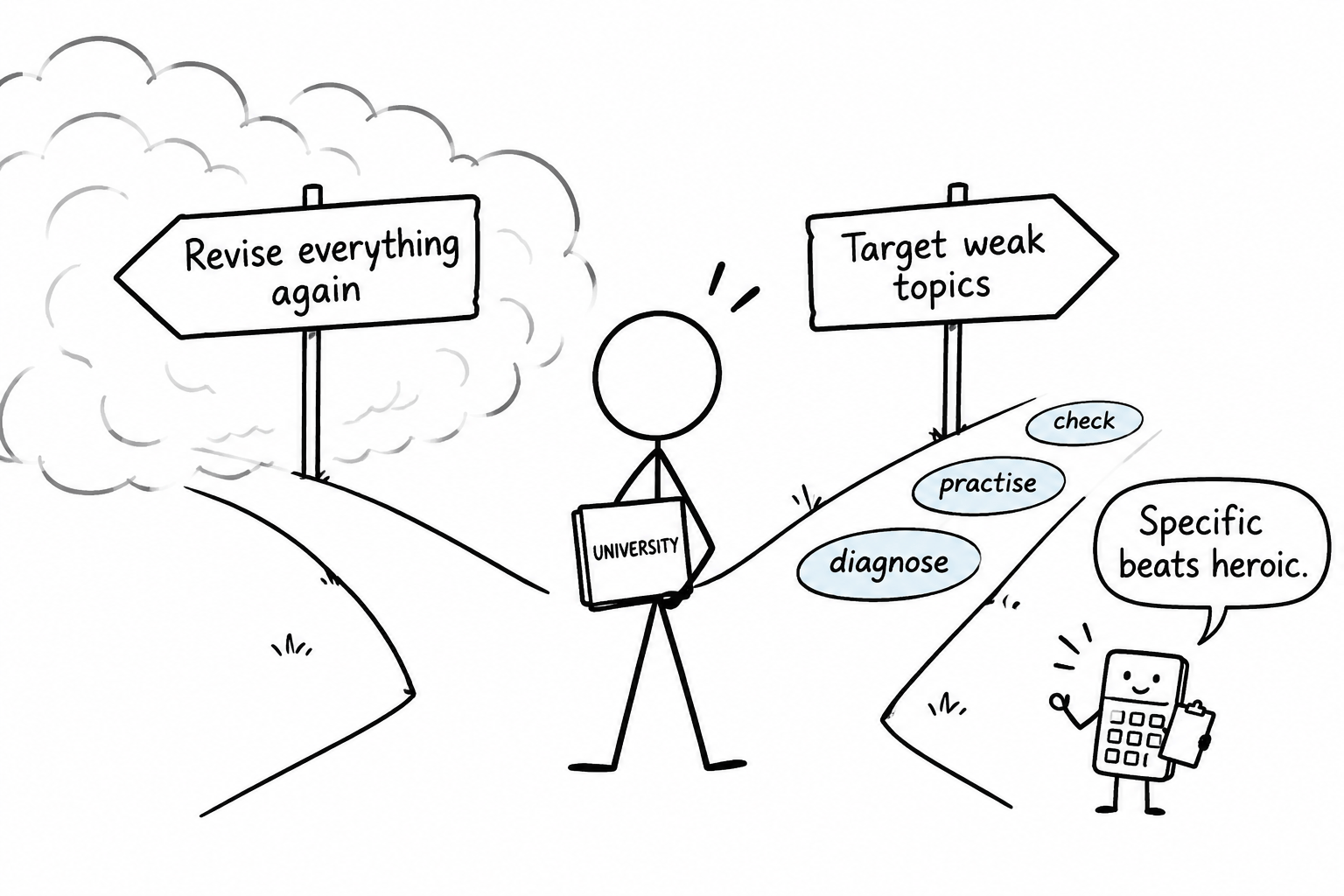 A post-16 student choosing targeted revision instead of disappearing into a fog of every maths topic
Tell UCAS about the resit accurately
UCAS asks applicants to include their GCSE qualifications. If you are retaking GCSE Maths, the achieved qualification and the new pending attempt must be entered accurately according to the current UCAS application guidance.
Your school or college can help with the details and any predicted grade. Do not replace or conceal the original result. Universities need an accurate academic record, and a pending resit allows them to consider the new result when making a decision.
Depending on the university and timing, the required GCSE grade may become part of a conditional offer. If your resit result arrives after you submit your application, follow the instructions from UCAS and the university about reporting it. Never assume that the result will update in every system without action.
Build revision from evidence, not anxiety
Maya's first instinct might be to revise everything equally. That feels responsible, but it often wastes the limited time available around college work, employment or caring responsibilities.
A better plan begins with a full diagnostic paper under realistic conditions. Use the correct tier and exam board, then mark it carefully. The GCSE past papers collection provides papers organised by exam board, while the main GCSE Maths revision hub brings together lessons, topic practice and tests.
Sort lost marks into three groups:
- Knowledge gaps: you did not know the method.
- Application gaps: you knew the skill but could not recognise it in context.
- Exam gaps: timing, calculator use, incomplete working or misreading cost marks.
This distinction changes what you do next. A knowledge gap needs a revision lesson and practice questions. An application gap needs mixed exam-style problems. An exam gap needs timed work followed by honest mark-scheme analysis.
For short sessions, GCSE Maths mini tests help you check one area at a time. Longer 45-minute GCSE Maths tests can develop concentration before you move to full papers. These particular test collections are for Edexcel, so students following another board should use board-appropriate papers and resources.
A useful weekly rhythm is simple:
- repair two weak topics;
- complete mixed questions without notes;
- sit one timed section or paper;
- mark it and record why each mark was lost;
- revisit errors several days later.
The MathsGenie revision planner can turn those tasks into a day-by-day schedule. This is particularly useful for resit students whose maths preparation must fit around another course rather than dominate the entire week.
Common mistakes when preparing for a GCSE Maths resit
Assuming every university wants grade 444
Some courses require a higher grade, and policies can change. Check the course requirements for your proposed year of entry.
Treating November as the automatic choice
November offers an earlier opportunity, but it may not provide enough preparation time for every student. A secure summer result can be better than a rushed November attempt. Discuss readiness and application timing with your college.
Revising only comfortable topics
Repeating familiar percentages or basic algebra may feel productive. Your diagnostic evidence should decide where time goes, especially when several extra marks could come from one repairable topic.
Completing papers without studying the errors
A score tells you where you are. The mark scheme, written solutions and corrections tell you how to move. Record the topic and cause of every lost mark rather than merely writing down a total.
Choosing higher tier without considering the required grade
The correct tier is the one that gives you the most suitable route to the grade required by your course.
Turn the requirement into a plan
A resit result matters, but it does not erase the progress you have made since Year Eleven. The useful question is not whether you are naturally good at maths. It is which marks are currently missing, why they are missing and what practice will recover them.
Confirm the university rule. Arrange your entry. Diagnose your gaps. Then use MathsGenie's free revision lessons, practice questions, mini tests, past papers, mark schemes and video solutions to work on the evidence in front of you.
When you know the topics that need attention, use the MathsGenie Mock Exam Builder to build a targeted practice paper. Sit it under timed conditions, mark it carefully and let the result choose your next revision session.