Mixed-Topic Practice for GCSE Maths Resit Students
Mixed-topic practice for resit students: build a focused GCSE maths routine, repair weak areas and prepare confidently for the November resit series.
A post-16 maths resit sits beside college, an apprenticeship, work and travel. That is why mixed-topic practice for resit students needs to be focused. The aim is to recognise topics, choose methods without prompts and earn more marks from skills you partly know.
Topic worksheets help you learn a method. Mixed practice tests whether you can identify when to use it. A useful revision cycle is:
- diagnose gaps with mixed questions
- repair one or two weak topics
- return to mixed practice
- mark each attempt carefully
- revisit mistakes a few days later
You do not need to restart the entire course. Begin by finding the marks that keep slipping away.
Why mixed-topic practice matters
Imagine completing a percentage worksheet confidently, then struggling with a price reduction in a mock paper. The calculation may be familiar, but recognising it without the topic heading adds another challenge.
GCSE papers move between number, algebra, ratio, geometry, probability and statistics. Mixed questions develop three connected skills: recognising what is being tested, selecting a method and carrying it out accurately.
Focused topic work still matters. Move between learning a method and meeting it among unrelated questions. MathsGenie's GCSE maths revision hub provides a starting point for lessons, practice questions and exam preparation.
A practical mixed-practice routine
Start with evidence
The topics that feel frightening are not always those costing the most marks. Complete a short mixed test or part of a past paper, then classify your mistakes:
- Knowledge gap: you did not know the method.
- Recognition gap: you knew the method but did not spot it.
- Accuracy gap: your approach was sound, but calculation, notation or checking failed.
A knowledge gap needs a lesson and focused questions. A recognition gap needs practice choosing methods. An accuracy gap needs clearer working and deliberate checking.
If a full paper feels too demanding after college, try GCSE maths mini tests, or divide a paper between sessions. Save some complete papers for timed practice later.
Repair narrowly
Choose one or two weaknesses. Watch the relevant lesson, complete practice questions and check your work against the solutions.
“Revise algebra” is too broad. “Practise solving linear equations with brackets” gives you something specific to finish and assess.
Build your schedule around your actual commitments. Three manageable sessions are more useful than an ambitious plan you cannot maintain. The GCSE maths revision timetable guide can help you organise available time.
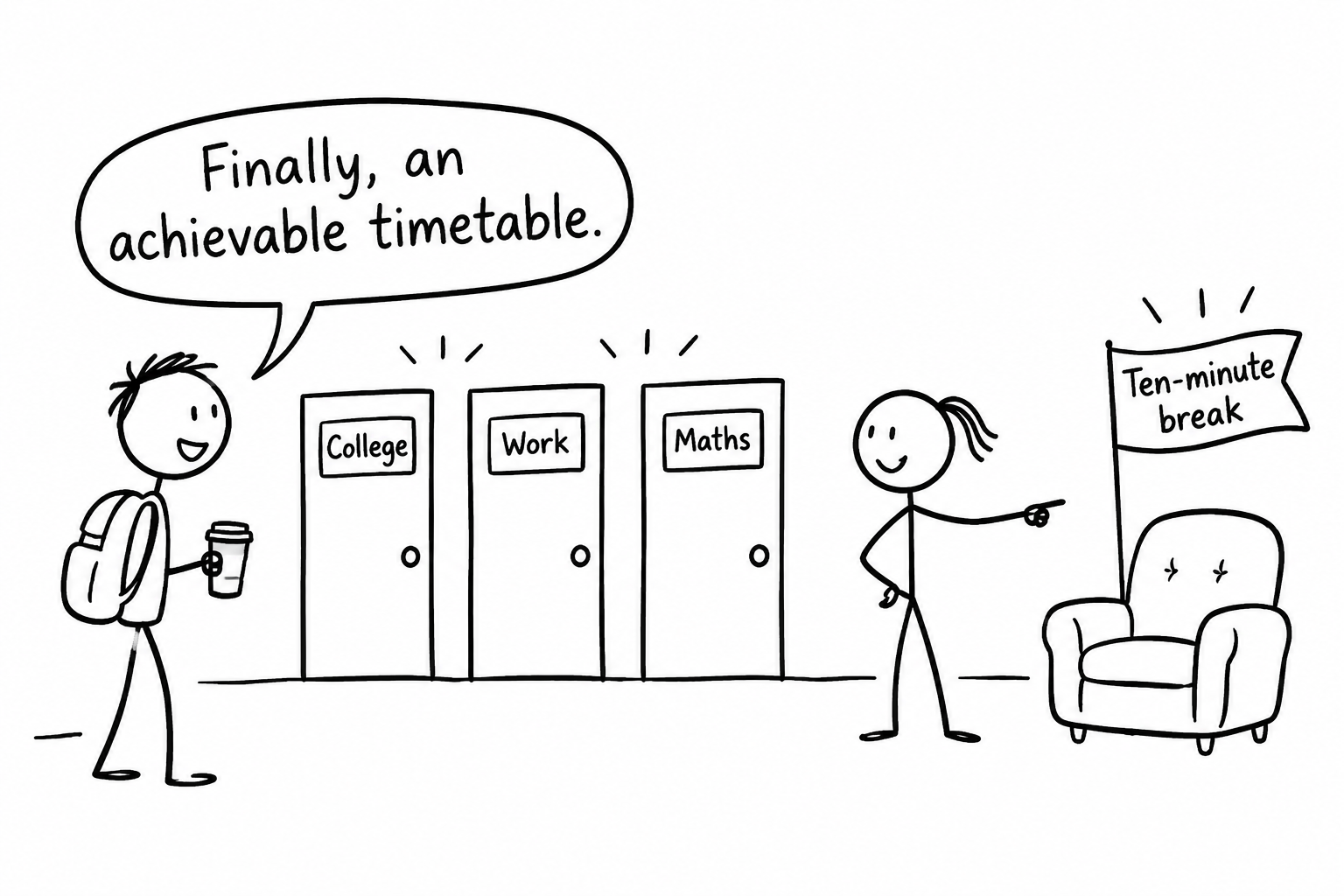 A post-16 student finds that a ten-minute break is the most achievable part of a crowded timetable
Return to mixed questions
Include a repaired topic in your next mixed set. This reveals whether you recognise the method without a worksheet title giving it away.
A weekly pattern could include a short assessment, two repair sessions and another mixed set, followed by reviewing previous mistakes. Adjust the workload to your timetable while keeping that sequence.
The MathsGenie Mock Exam Builder can help you create targeted practice from past-paper questions. Include secure topics alongside weaker areas so that you still practise switching between methods.
Prepare for your actual resit
GCSE mathematics is available in the November series to students aged 161616 or over on 313131 August of that year. Confirm eligibility, entry arrangements, exam board, tier and dates with your school, college or examination centre.
Trust your statement of entry and centre timetable. Another exam board's timetable may not apply to you.
Preparation for November often involves a shorter period than summer revision. Prioritise weaknesses identified in marked work, while continuing to sample the wider specification.
Predicted papers provide fresh practice, but cannot promise what will appear. Edexcel students can use the GCSE maths predicted papers alongside past papers and their accompanying solutions.
If you are aiming to move from grade 333 to grade 444, the focused GCSE resit plan offers further guidance. At any target grade, look for accessible questions that you cannot yet answer reliably.
Make marking part of revision
A mark scheme does more than provide a score. It helps you understand which steps earn marks and what working to show.
After each set, record the skill tested, why marks were lost, the missing step and when you will attempt a similar question again. Keep this brief enough to maintain.
Copying a solution does not demonstrate understanding. Close it and attempt the question again from a blank page. Revisit the skill several days later, preferably through a different question.
If methods repeatedly disappear between sessions, read how to stop forgetting GCSE maths content. Spaced review and recalling methods independently help make revision more durable.
Common mistakes to avoid
Completing papers without repairing gaps
Repeated papers can expose the same weaknesses without resolving them. Turn each marked attempt into a short repair list, then complete the relevant lessons and questions.
Choosing only comfortable topics
Familiar work feels productive. Let marked answers guide your priorities, while retaining some secure questions to practise accuracy and build fluency.
Opening solutions too early
Allow time to identify the topic, organise the information and attempt a first step. Afterwards, use the solution to understand precisely where your reasoning stopped.
Neglecting non-calculator practice
Include calculator and non-calculator questions. Secure arithmetic, fractions, proportional reasoning and algebraic manipulation remain essential.
Treating one score as a verdict
Look across several attempts. Better method selection, clearer working and fewer unanswered questions can reveal progress before the total mark changes substantially.
Make your next session count
A resit means revisiting familiar material alongside new responsibilities. Give each session a clear purpose: identify a gap, repair it or check that the learning has lasted.
Use MathsGenie's free lessons, practice questions, mini tests, past papers, mark schemes and video solutions to support that cycle. Start with a short mixed set today, mark it carefully and let the evidence choose your next revision task.