

Group vs 1:1 Tutoring GCSE Biology: Which Is Better?
Group vs 1:1 tutoring GCSE Biology: compare feedback, cost, confidence and revision needs, then choose the support that fits how you learn best.
A tutoring session can look productive from the outside while achieving very little inside a student’s head. Notes are copied. Questions are answered. An hour passes. Yet the real test is whether the student can explain the idea or apply it alone two days later.
That is why the answer to group vs 1:1 tutoring GCSE Biology is not simply that one format is better. One-to-one tuition usually offers more personalised diagnosis and feedback. Small-group tuition is often more affordable and can strengthen understanding through discussion. The better choice is the one that matches the student’s gaps, confidence, budget and willingness to participate.
This guide explains the practical differences, including what each format feels like, which students tend to benefit and how to judge whether tutoring is actually working.
The quick decision checklist
Choose one-to-one tutoring when a student:
- has specific or substantial gaps in biological knowledge
- needs explanations delivered at a carefully controlled pace
- struggles to ask questions in front of other people
- needs close support with exam technique or mathematical skills
- has additional learning needs requiring tailored instruction
- is working towards a demanding improvement over limited time
Choose small-group tutoring when a student:
- learns well by hearing other students’ questions
- benefits from discussion, comparison and shared problem-solving
- has reasonably similar needs to the rest of the group
- needs a structured weekly routine rather than constant individual attention
- is comfortable contributing without being repeatedly prompted
- needs a more cost-effective form of regular support
Neither list is a verdict. A confident student can still need individual help, while a quiet student may flourish in the right group. The format matters, but the quality and targeting of the teaching matter more.
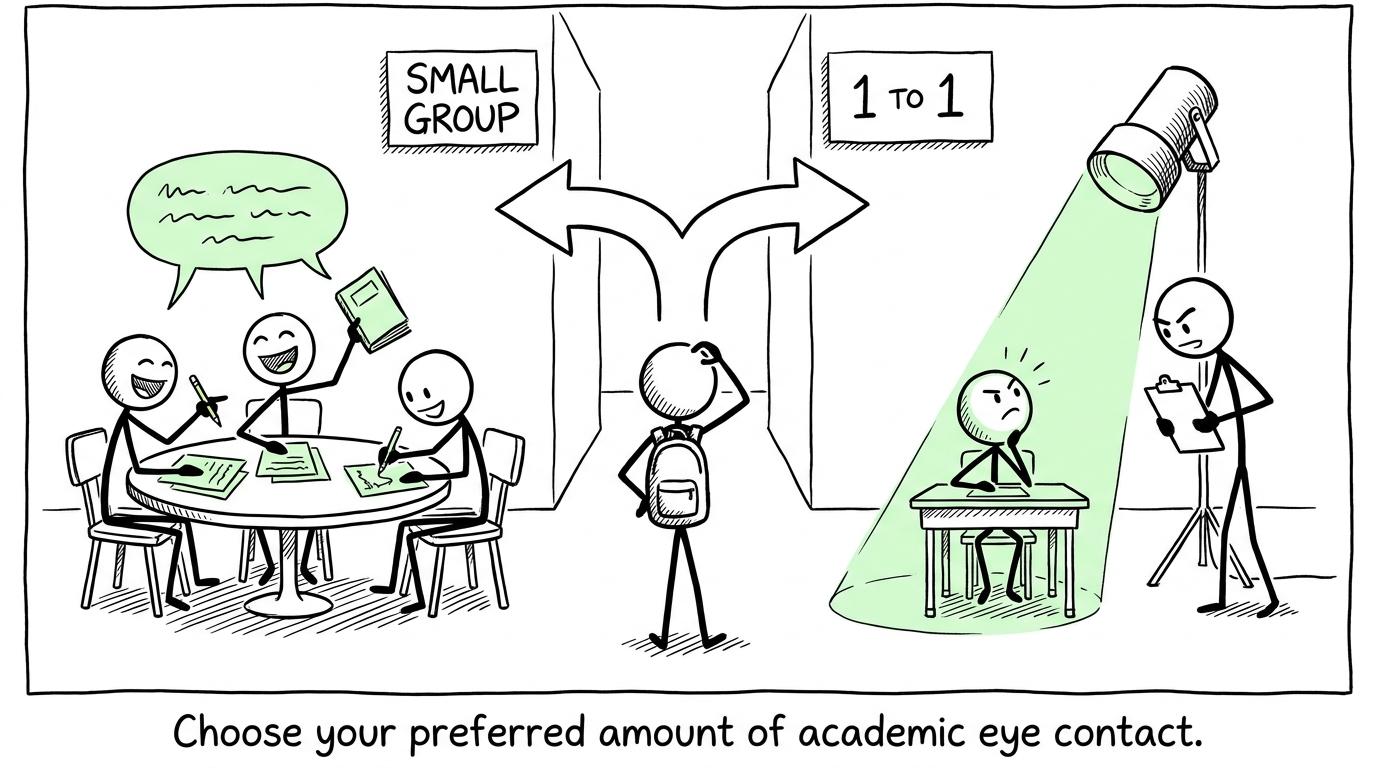 A student choosing between small-group and one-to-one tutoring
What the tutoring evidence really says
The Education Endowment Foundation defines small-group tuition as one tutor working with approximately 222 to 555 pupils. Its Teaching and Learning Toolkit reports positive average effects for both formats: around five additional months of progress for one-to-one tuition and four for small-group tuition over an academic year.
Those figures require care. They are averages across different subjects, age groups and programmes. They do not prove that every GCSE Biology student will gain five months from individual lessons, nor do they represent a direct Biology-only contest between the two formats. The EEF also reports mixed results from comparisons: sometimes one-to-one tuition performs better, while groups of two or three can be equally or more effective in other settings.
The more dependable lesson is less dramatic. Tutoring works best when it is:
- targeted at diagnosed needs
- connected to normal classroom teaching
- delivered regularly and consistently
- supported by appropriate assessment
- adjusted when progress stalls
A well-matched group with a skilled tutor can outperform vague one-to-one lessons. Individual attention is valuable, but only when that attention is directed towards the right problem.
The real differences between group and one-to-one tutoring
Personalisation and pace
In a one-to-one session, the tutor can stop as soon as confusion appears. If the student understands cell division but cannot interpret enzyme graphs, the lesson can move directly towards graph work. There is no need to wait for a group or follow its average pace.
That precision is particularly useful when misunderstandings sit underneath apparently simple mistakes. A student might know the definition of magnification but keep losing marks because they cannot convert units. The visible problem is Biology; the underlying problem is mathematical fluency.
Group tutoring cannot usually respond with the same precision. The tutor must balance several students’ needs, so part of each session may cover material an individual already understands. Good grouping limits this problem by placing students with similar attainment, specifications and goals together.
Questions and feedback
One-to-one tuition gives every question immediate space. The tutor can inspect reasoning, ask follow-up questions and notice when an answer was guessed rather than understood.
Groups distribute that attention. However, another student’s question can expose a gap you did not know you had. Explaining an idea to a peer can also reveal whether you genuinely understand it. Retrieval becomes social rather than silent.
The risk is hiding. In a passive group, one confident pupil may answer first while everybody else nods. A strong group tutor prevents this by asking each student to retrieve, explain and attempt questions independently before discussion begins.
Confidence and pressure
Some students find one-to-one lessons reassuring. Others find the undivided attention intense. There is nowhere to disappear while thinking, and every uncertain answer feels visible.
A group can reduce that pressure by making mistakes feel ordinary. It can also create comparison. If the pace is too quick or the atmosphere is competitive, a student may become quieter rather than more confident.
The useful question is not, “Are you shy?” It is, “In which setting are you most likely to attempt an answer before you are certain?” Learning requires that small act of intellectual risk.
Cost and access
Small-group tuition generally divides the tutor’s time and cost across several students, making regular sessions more accessible. One-to-one tuition normally costs more because the whole session is reserved for one learner.
Do not compare hourly prices alone. Compare what the student receives: group size, lesson frequency, marking, homework feedback, tutor qualifications, resources and whether sessions match the correct exam board. A cheaper group that does not address the student’s needs can be poor value. An expensive individual lesson without a plan can be equally wasteful.
Why GCSE Biology needs targeted support
GCSE Biology is not only a test of remembering facts. AQA, Edexcel, OCR and Eduqas specifications require students to apply knowledge, interpret unfamiliar information, analyse practical methods and communicate conclusions. Exact paper structures and topic organisation vary, so tutoring should follow the student’s own specification rather than a generic list.
Mathematical skills also matter. Current GCSE science assessment requirements allocate at least 10%10\%10% of Biology marks to maths at the appropriate level. Biology specifications include skills such as:
- ratios, fractions and percentages
- standard form and orders of magnitude
- arithmetic means and significant figures
- probability in genetic contexts
- interpreting tables, charts and scatter diagrams
- plotting graphs and finding gradients
- solving simple equations
- calculating area, surface area and volume where relevant
This is where MathsGenie can complement Biology tutoring. Students can strengthen GCSE percentages, graphs, ratio, standard form and algebra through the free GCSE Maths revision hub. The scientific context changes, but the underlying mathematical habits remain useful.
A tutor should therefore diagnose mistakes by type. Was the mark lost because the biological concept was unknown, the command word was misread, the calculation failed or the answer lacked sufficient scientific detail? Different causes need different repairs.
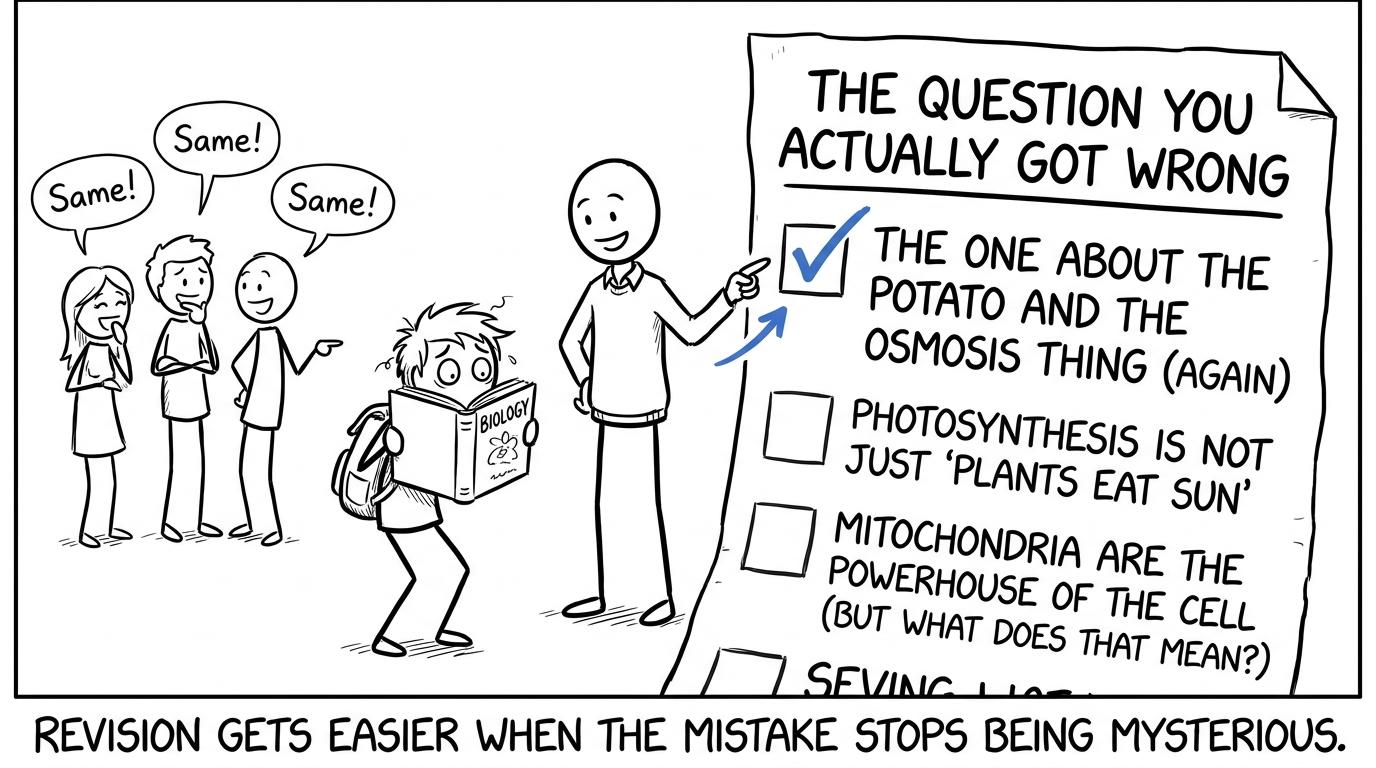 A tutor and students making an exam mistake less mysterious
Which format suits which GCSE student?
The student with scattered knowledge gaps
One-to-one tuition is often the stronger starting point. A tutor can diagnose exactly what is missing and build a sequence around it. This is useful when weaknesses cross several areas, such as cell biology, homeostasis, required practicals and data handling.
The same diagnostic mindset works in maths. MathsGenie’s guide to finding your weakest GCSE topics explains how to turn lost marks into specific revision priorities rather than revising everything equally.
The student who understands lessons but lacks exam confidence
A small group may work well. Shared questioning can show that difficult application questions challenge other students too. Timed tasks and discussion can make examination language more familiar without placing one student under constant scrutiny.
However, the group must include individual written work. Biology grades are awarded for what each student can produce independently, not for what the group can collectively say.
The student aiming for the highest grades
Either format can succeed. One-to-one tuition offers precision for subtle weaknesses such as evaluating methods, linking topics and constructing extended responses. A carefully selected higher-attaining group can offer valuable challenge because students encounter alternative reasoning and questions.
Tutor expertise becomes decisive here. The tutor should understand the relevant board, higher-tier demand and the distinction between knowing content and applying it in unfamiliar contexts.
The student with weak mathematical foundations
Individual support can help when several basic skills need rebuilding at different speeds. A well-matched group can be effective when students share the same weakness and every learner must complete the calculations.
Use the GCSE maths topics by board and tier to identify the relevant foundations. Topic lessons should be followed by independent questions, marking and a later retest. Reading a method is not the same as being able to use it.
The student who struggles to revise consistently
A regular group can create useful accountability. Students know others will attend and that tasks will be checked. One-to-one tutoring provides even closer accountability, but it can accidentally create dependence if the student waits for the tutor before doing any work.
Whichever format you choose, tutoring should sit inside a wider plan. A structured one-month GCSE revision plan can help students balance learning, retrieval, topic practice and timed papers.
How to test a tutoring option before committing
Treat the first few sessions as evidence, not a promise. Before starting, identify a small number of measurable goals. These could include interpreting biological graphs, recalling required practical methods or improving responses to particular command words.
Then check whether the tutor:
- identifies prior knowledge before teaching
- knows the student’s exam board and tier
- makes the student answer questions independently
- corrects misconceptions rather than simply giving answers
- sets purposeful work between sessions
- reviews errors and revisits them later
- communicates what has improved and what remains weak
Progress should appear in fresh questions, not just repeated ones. For mathematical weaknesses, students can use Edexcel GCSE Maths past papers or the relevant board resources to test whether methods survive under exam conditions. MathsGenie also explains when to start GCSE past papers so that paper practice begins early enough to shape revision.
Common mistakes when choosing Biology tutoring
Assuming one-to-one automatically means better
Individual attention cannot compensate for weak explanations, poor diagnosis or lessons disconnected from the specification. Ask what the tutor will do with the extra attention.
Choosing a group because friends attend
A familiar face may make the first session easier, but similar friendships do not guarantee similar learning needs. The group should be matched by level, goals and content requirements.
Ignoring the group size
A class marketed as group tutoring may be much larger than the small groups considered in most tutoring research. Ask how many students normally attend and how individual work is checked.
Revising content without testing application
Knowing a definition is useful, but GCSE Biology also demands application, analysis and evaluation. Effective tuition should include unfamiliar data, practical contexts and exam-style questions.
Letting tutoring replace independent revision
Tutoring is additional support, not a substitute for retrieval, practice and correction. The student must eventually work without hints. That independence is the point.
The better choice is the one that changes the next answer
One-to-one tutoring is usually best for precise diagnosis, individual pacing and students with complex or substantial gaps. Small-group tutoring is often best for affordability, discussion, shared accountability and students whose needs are well matched. Neither wins automatically.
Choose the tutor and structure before choosing the label. Agree clear goals, monitor independent performance and change approach if the same mistakes continue.
For the mathematical skills inside Biology, including percentages, graphs, ratio, standard form and equations, make MathsGenie your free revision base. Start with the GCSE Maths revision resources, use revision lessons and practice questions to repair weak methods, then check progress with mini tests, past papers, predicted papers, mark schemes and video solutions. Good support should not make a student permanently need more support. It should steadily make them capable of doing more alone.











