Grade 6 GCSE English Language: Enough for Sixth Form?
Grade 6 GCSE English Language sixth form entry is often enough, but course rules vary. Check what it means for A Level Maths and other choices.
There is a particular kind of worry that arrives when you read a sixth form prospectus. You have a respectable predicted grade, but the admissions page contains several different thresholds, conditions and subject-specific rules. Suddenly, “good enough” feels surprisingly difficult to define.
When you compare a grade 6 GCSE English Language result with sixth form entry requirements, the short answer is encouraging: a grade 6 is enough for many sixth forms, colleges and Level 3 courses. It is comfortably above the grade 4 threshold used for the post-16 English funding condition in England. However, it does not guarantee entry everywhere. Your overall GCSE profile, chosen subjects and the provider’s own admissions policy still matter.
The important question is not simply whether a grade 6 is good. It is whether it meets every condition attached to the course you actually want.
The quick grade 6 sixth form checklist
Before worrying or changing your plans, check these five things:
- The sixth form or college’s general entry requirements
- The subject-specific requirement for each A Level or Level 3 course
- Whether it asks specifically for English Language, or accepts English Literature
- The required number of GCSEs at grades 4, 5, 6 or above
- Any additional conditions in your offer, including GCSE Maths requirements
A grade 6 often clears the English threshold. The more likely obstacle for a prospective A Level Maths student is the required GCSE Maths grade, which may be higher.
If you want a wider explanation of how English results affect applications, read MathsGenie’s guide to GCSE English Language grades and sixth form entry.
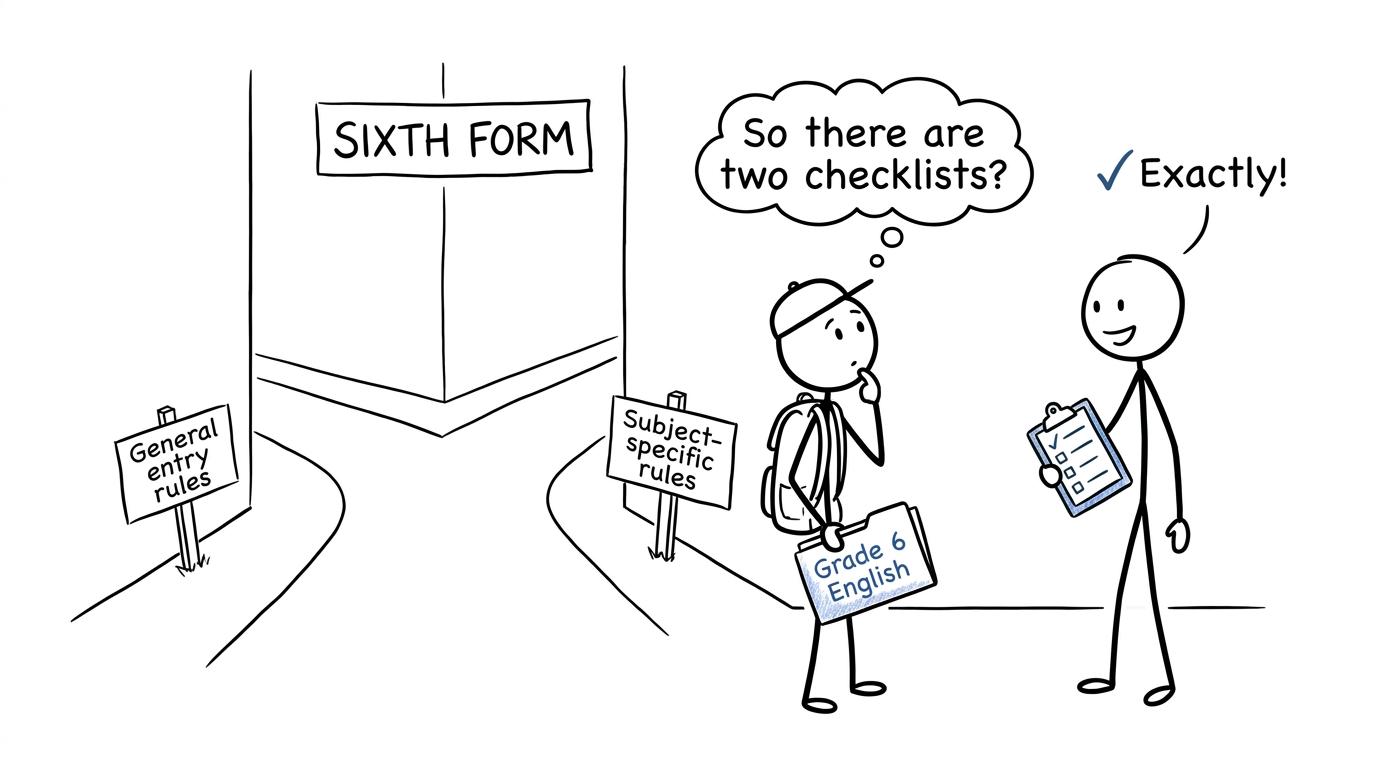 A student discovers that sixth form entry has two separate checklists
Is a grade 6 in GCSE English Language good?
Yes. Within England’s 9-1 grading system, a grade 4 is treated as a standard pass and a grade 5 as a strong pass. A grade 6 therefore represents a solid result above both benchmarks.
It demonstrates that you can read demanding material, organise written responses and communicate ideas with reasonable control. Those skills matter beyond English lessons. A Level subjects increasingly ask you to interpret unfamiliar information, justify conclusions and write with precision.
For sixth form entry, though, “good” and “accepted” are not identical. Admissions decisions are based on published criteria rather than a general judgement about the quality of one result.
Current sixth form policies illustrate the variation. Some providers set their general English threshold at grade 4 or 5. Others require grade 6 in English Language, particularly for selective programmes or combinations involving essay-heavy subjects. Highly selective sixth forms may expect grade 7 or a stronger overall GCSE profile.
That is why nobody can honestly promise that one grade will unlock every provider. There is no single national GCSE English Language entry requirement covering all sixth forms and colleges.
General entry rules and course entry rules are different
Most applications involve two separate tests.
The general sixth form requirement
This decides whether you are eligible for the provider’s overall programme. A typical policy might ask for a certain number of GCSEs at grades 4, 5 or 6 and above, including English and Maths.
A grade 6 in English Language will meet the English part of many such policies. But you must still satisfy the required number and pattern of other grades. One strong English result cannot compensate automatically for every other condition.
The subject-specific requirement
Each course may then impose its own threshold. This is where students sometimes get caught out.
A sixth form might accept grade 5 English for general admission while requiring grade 6 English for Psychology, Economics, History or English Literature. Requirements differ because providers make their own judgement about the preparation needed for each course.
Always open the individual course page. Do not stop after reading the headline admissions requirement.
Is grade 6 enough for A Level Maths?
Usually, your English grade will not be the deciding factor for A Level Maths. Providers commonly place greater emphasis on your GCSE Maths result.
Published requirements vary. Some sixth forms accept grade 6 in GCSE Maths, while many ask for grade 7. More selective providers may set higher thresholds, particularly for Further Maths. Their minimum English requirement may be grade 4, 5 or occasionally 6.
So a grade 6 in GCSE English Language may be perfectly adequate while your Maths grade determines whether you can take the course.
Check three separate conditions:
- The provider’s overall sixth form requirement
- Its minimum GCSE English Language grade
- Its minimum GCSE Maths grade for A Level Maths or Further Maths
If A Level Maths is your aim, use the GCSE Maths revision hub to choose your exam board and target the topics that are still costing you marks. The GCSE Maths topics by exam board and tier guide can also help you distinguish Foundation and Higher content across Edexcel, AQA, OCR and Eduqas.
When might a grade 6 not be enough?
A grade 6 may fall short in a small number of important situations.
You are applying to a selective sixth form
Selective providers can require grade 7 or above in English and Maths, a high average across several GCSEs, or a set number of grades in the 7-9 range. Meeting one subject threshold does not necessarily meet the overall academic standard.
Your chosen course has a higher English requirement
English-based and essay-heavy courses sometimes ask for particular results in English Language, English Literature or both. Psychology, Economics and other subjects may also use English requirements because students must interpret evidence and construct extended arguments.
Your offer is based on an overall grade profile
Some schools calculate an average or total from your best GCSE results. A grade 6 contributes positively, but the final decision depends on the complete set.
The course is oversubscribed
Meeting minimum requirements can make you eligible without guaranteeing a place. An admissions policy may contain separate oversubscription criteria, so read the policy rather than assuming the minimum is an automatic offer.
Will you need to resit English Language with a grade 6?
Normally, no.
Under the Department for Education’s condition of funding in England, eligible post-16 students who have not achieved grade 4 or above in GCSE English and/or Maths must continue working towards an approved qualification in the subject they still need. A grade 6 is safely above that threshold.
This funding rule should not be confused with a sixth form’s admissions policy. Grade 4 may satisfy the national post-16 English condition while a particular provider or course still asks for grade 5, 6 or 7.
In other words, avoiding a compulsory English resit does not automatically mean qualifying for every A Level programme.
How to check whether your result is enough
Do not rely on what a friend needed last year. Requirements can differ between providers and admissions cycles.
Read the current prospectus
Look for the prospectus or admissions policy for the year you intend to start. Check both the general requirements and every course in your proposed combination.
Write the conditions down in one place. This turns a vague worry into a factual comparison.
Check the wording carefully
“English” might mean:
- GCSE English Language specifically
- Either English Language or English Literature
- Both qualifications at a stated grade
- One grade for general entry and another for a particular subject
Those distinctions can change the answer.
Contact the admissions team
If the wording is unclear, ask the sixth form directly. Give them your predicted or achieved grades and the precise subjects you want to take. Admissions staff can explain their own policy more reliably than an online discussion or an older prospectus.
Keep a sensible alternative
A backup choice is not a prediction of failure. It is simply good planning. Consider another provider or course combination whose requirements fit your likely results, while continuing to work towards your preferred option.
What maths students should focus on now
Once you know that your English grade is likely to clear the relevant threshold, return your attention to the grades you can still influence.
For an aspiring A Level Maths student, that means building fluency rather than collecting revision resources. Start with a diagnostic such as the GCSE Maths self-assessment sheet, then repair the weakest topics through revision lessons and focused practice questions.
Use GCSE Maths mini tests for short checks. When your topic knowledge is steadier, move to GCSE past papers with mark schemes. Nearer the exams, GCSE predicted papers can provide extra unseen practice, but they should complement rather than replace real past papers.
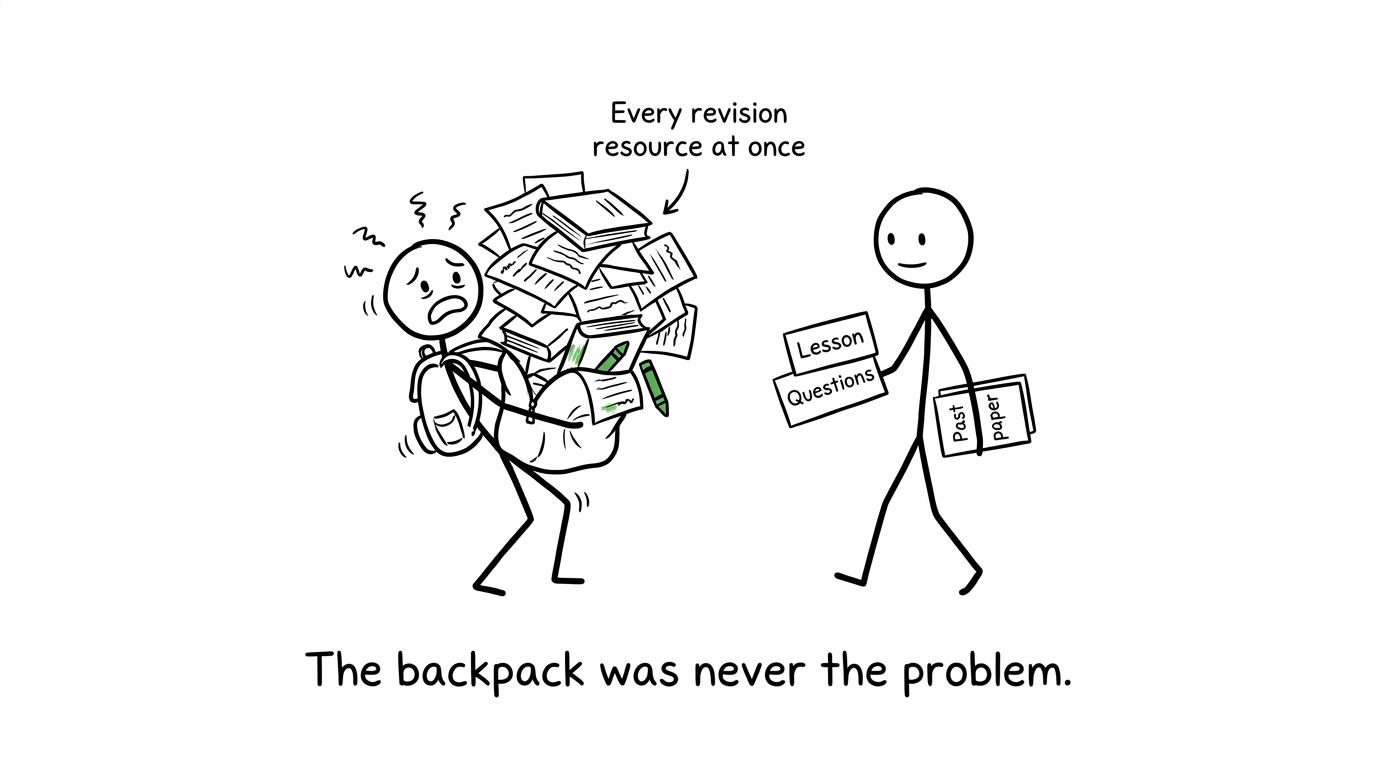 One student carries every resource while another follows a simple revision sequence
The useful sequence is simple:
- Learn or revisit one method
- Complete practice questions without copying
- Mark them and identify the exact error
- Reattempt the skill after a gap
- Test it later in a timed paper
If planning feels harder than the maths itself, follow the one-month GCSE Maths revision plan. Students already looking beyond Year 11 can also see how the standard rises through the Edexcel A Level Maths past papers.
Common mistakes when judging sixth form entry
Assuming every sixth form uses the same threshold
They do not. Compare the current policies of the institutions you are genuinely considering.
Checking general entry but not individual courses
Being admitted to the sixth form does not necessarily mean being admitted to every subject. Read each course requirement separately.
Looking only at English
For A Level Maths, GCSE Maths is normally the more demanding subject-specific condition. Your overall GCSE profile may matter too.
Treating predicted grades as confirmed entry
Offers based on predicted grades are usually conditional. Your achieved results and the exact offer wording matter on results day.
Assuming a minimum grade guarantees a place
Minimum requirements establish eligibility. Availability, oversubscription rules and additional admissions conditions may still affect the outcome.
A grade 6 is usually a strong position
For most students asking whether a grade 6 GCSE English Language sixth form application is good enough, the answer is yes: it will meet the English requirement for many providers and courses. It also means that, in England, you would not normally be required to continue English under the post-16 funding condition.
But the most useful answer is more precise. Check the current provider, the complete course combination and every subject-specific threshold. If you want to study A Level Maths, pay particular attention to the GCSE Maths requirement.
Then return to what you can control. Use MathsGenie’s free revision lessons to understand weak topics, practice questions and mini tests to build accuracy, and past papers, predicted papers, mark schemes and video solutions to prepare for exam conditions. A sixth form requirement is a line on a page. Your revision routine is how you put yourself on the right side of it.