Grade 5 GCSE Arabic Sixth Form Entry Guide
Grade 5 GCSE Arabic sixth form entry explained. Check course requirements, protect your maths grade and choose the right route into post-16 education.
A results sheet can turn years of learning into a row of small numbers. The temptation is to stare at one of them and treat it as a verdict.
If you are wondering whether a grade 5 GCSE Arabic sixth form result is good enough, the short answer is: often yes, but not automatically for every sixth form or course. A grade 5 is a strong pass in England. However, admission normally depends on your complete set of GCSE results, the sixth form's general entry rules and the requirements for each subject you want to take.
Your Arabic grade may help you satisfy an overall GCSE requirement. If you want to study A Level Arabic, though, some providers accept grade 5 while others ask for grade 6 or assess applicants individually. For A Level Maths, sciences, economics and other numerate subjects, your GCSE Maths grade is usually more important than your Arabic result.
Your sixth form entry checklist
Before deciding whether your grade is enough, check these five things:
- the sixth form's general entry requirements
- whether GCSE Arabic counts among the qualifications used for admission
- the subject-specific grades for your chosen courses
- the required GCSE Maths and English grades
- whether the course you want is actually available
Read the current prospectus or admissions policy rather than relying on an older screenshot or another student's offer. Requirements vary between institutions and can change between entry years.
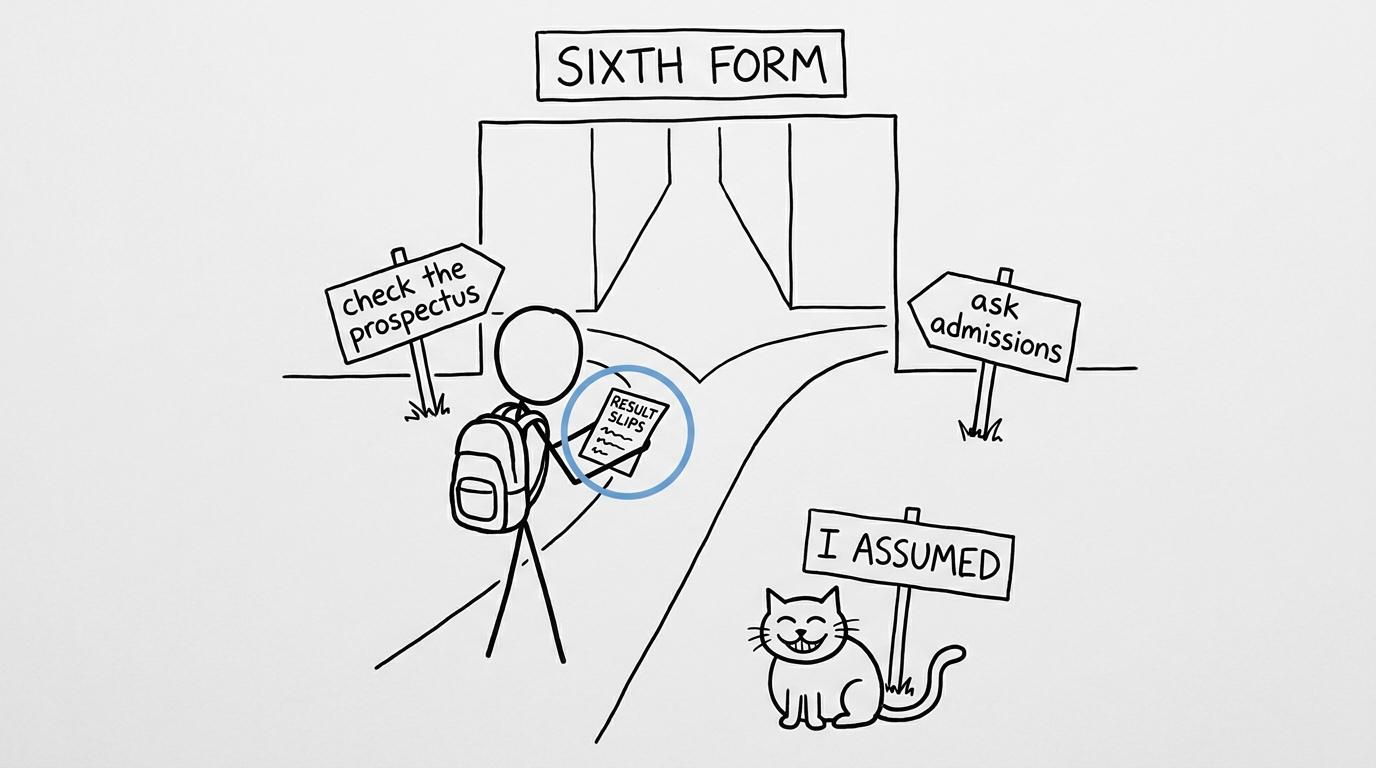 A student choosing between checking a sixth-form prospectus and making an assumption
Is grade 5 in GCSE Arabic a good result?
Yes. Under England's GCSE grades 9-1 system, grade 5 is commonly described as a strong pass, while grade 4 is the standard pass threshold. A grade 5 therefore represents a secure Level 2 result.
For Pearson Edexcel GCSE Arabic, the final qualification is graded from 9 to 1. Foundation tier makes grades 1 to 5 available, while Higher tier principally makes grades 4 to 9 available, with a limited grade 3 safety outcome close to the lower boundary. A grade 5 has the same value on your certificate whichever tier produced it.
What the result does not provide is universal sixth form admission. There is no single national rule saying that every applicant with grade 5 Arabic must be accepted. Schools and colleges publish their own academic criteria within their admissions arrangements.
That distinction matters. A GCSE grade tells you how you performed in a subject. An admissions policy tells you what a particular provider requires next.
Is it enough for the course you actually want?
Think of sixth form entry as a set of gates rather than one large gate. You normally need to pass through each relevant layer.
| Entry layer | What to check |
|---|---|
| General admission | The required number and pattern of GCSE grades |
| English and maths | Any minimum grades required in these core subjects |
| Chosen A Levels | Separate requirements for each course |
| Qualification rules | Whether GCSE Arabic is included in the provider's GCSE count |
| Course availability | Whether Arabic or your preferred subject combination is offered |
If you want to study A Level Arabic
A grade 5 may be enough at some providers. Current published requirements demonstrate that at least some sixth forms set grade 5 in GCSE Arabic as their subject requirement. Others apply a general rule asking for grade 6 in any subject continued to A Level, or may use an interview or language assessment.
Availability can be the bigger issue. A sixth form cannot admit you to A Level Arabic if it does not offer the course, even if your GCSE grade is excellent. Search its course list and ask whether Arabic is taught on site, through a partner institution or not at all.
Also check which qualification you completed. GCSE Arabic and International GCSE Arabic are not necessarily treated identically in every admissions calculation. If Arabic was taken outside your school, independently or as a community language, ask admissions to confirm in writing whether it counts towards the general GCSE total. Some providers exclude independently entered community-language qualifications from particular calculations, while others accept them.
If you want to study A Level Maths
Your grade 5 in Arabic is unlikely to be the deciding subject grade. The crucial result will normally be GCSE Maths.
Published sixth form requirements vary. Some providers ask for grade 6 in GCSE Maths for A Level Maths, while others require grade 7. Further Maths commonly has a still higher threshold, such as grade 7 or grade 8, depending on the institution. You must check your chosen provider rather than assume that meeting its general admission standard also qualifies you for Maths.
If Maths is part of your plan, begin with the GCSE Maths revision hub. It brings together board-specific revision for Edexcel, AQA, OCR and Eduqas, with lessons and questions organised around the skills assessed in the exam.
If you want sciences, economics or computing
These subjects may carry their own maths conditions. A provider can accept grade 5 Arabic as one of your general GCSE results but still ask for a higher grade in Maths, science or computing for a particular A Level.
This is why the question is not simply, “Is grade 5 good?” It is, “Does my complete grade profile satisfy every condition attached to my proposed programme?”
Make a separate row for each intended subject and copy the exact requirement from the current prospectus. If the wording is unclear, contact admissions before making a decision.
Why GCSE Maths may matter more for sixth form
Arabic demonstrates language knowledge, communication and sustained preparation. Yet GCSE Maths is explicitly named in many post-16 entry policies and is frequently used as a subject-specific requirement.
A student could have a strong collection of GCSEs, including grade 5 Arabic, but still miss an A Level Maths condition because their Maths grade is below the stated threshold. The reverse is also possible: Arabic might not be relevant to the chosen A Levels, but it may still contribute to the required total of GCSE passes.
Start by identifying the maths grade your course needs. Then use the GCSE revision timetable guide to turn that target into weekly actions. A target becomes useful only when it changes what you practise.
How to protect your sixth form choices before results day
The most useful strategy is to keep more than one door open.
Compare several providers
Build a shortlist containing your preferred sixth form and at least one realistic alternative. Compare general entry grades, subject requirements, available combinations and any rules concerning independently taken qualifications.
Do not compare names or reputations alone. Compare the courses you would actually be allowed to study.
Ask precise admissions questions
Instead of asking, “Is grade 5 Arabic good enough?”, give admissions the information needed for a definite response:
- Is GCSE Arabic included in the GCSE total for general entry?
- Is grade 5 sufficient to continue Arabic at A Level?
- What GCSE Maths grade is required for my chosen subjects?
- Are independently entered or community-language GCSEs accepted?
- What happens if I miss one subject requirement by one grade?
Keep the reply. A written answer is more reliable than a remembered conversation between students.
Strengthen the grades that control your options
If Maths is the fragile part of your application, diagnose it rather than simply “doing more revision”. Use a paper matching your board and tier, mark it carefully, and list the topics responsible for lost marks.
The AQA GCSE Maths past papers and Edexcel GCSE Maths mini tests are useful starting points for full-paper and short-form practice. Whichever board you take, use the correct specification and tier.
A reliable revision cycle is:
- learn or revisit one weak method
- complete targeted practice questions
- mark the work immediately
- record the precise error
- retest the skill later without notes
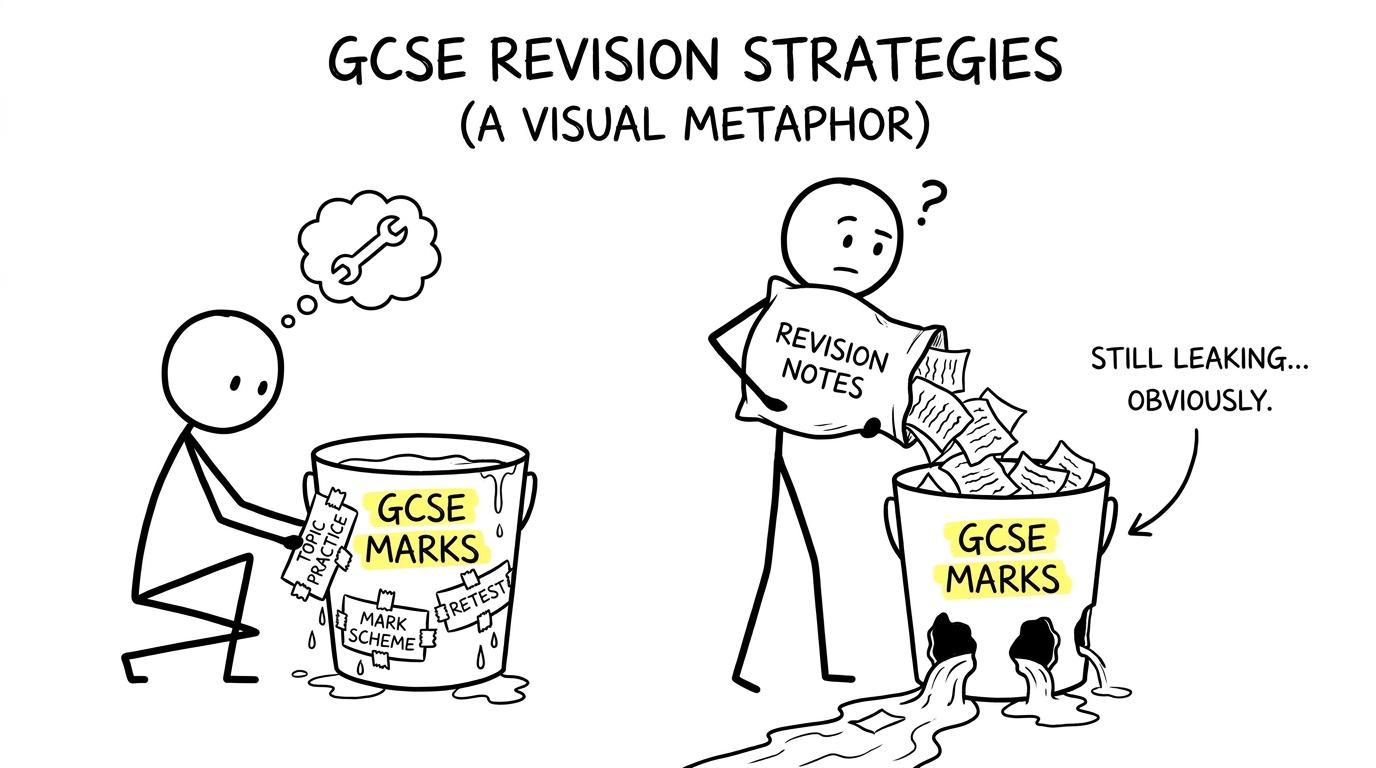 A student repairing lost GCSE marks with topic practice, mark schemes and retesting
Turning a grade target into better maths revision
Grade boundaries are set after exams and can vary between series, so revising towards a guessed raw mark is less dependable than building secure performance across the specification.
Begin with topics where you lose repeatable marks. A forgotten method needs a revision lesson. An accuracy problem needs slower checking and short practice. A timing problem needs staged timed work.
Once topic gaps are smaller, move to papers. MathsGenie's guide to using GCSE past papers properly explains the essential rhythm: complete, mark, fix and retest. A paper measures performance; the review afterwards improves it.
Nearer the exams, GCSE predicted papers can provide fresh exam-style practice. They should support specification coverage and official past-paper work, not replace them. For Edexcel students, the dedicated Edexcel GCSE Maths predicted papers include mark schemes and worked support.
If A Level Maths is your intended destination, remember that entry is only the first step. Strong algebra, graphs, ratio, trigonometry and numerical fluency make the transition less abrupt. Improving GCSE Maths is not merely an admissions exercise; it builds the foundation you will use in Year 12.
Common mistakes when judging sixth form eligibility
Treating grade 5 as a universal entry ticket
Grade 5 is a strong pass, but each provider decides its general and subject-specific criteria. Always check the current admissions document.
Looking only at the Arabic requirement
Your chosen programme may depend more heavily on English, Maths, science or another related GCSE. Check every course separately.
Assuming Arabic will definitely count
Some institutions have particular rules for community languages, independently entered qualifications or subjects not taught at the applicant's school. Ask explicitly rather than guessing.
Confusing GCSE Arabic with International GCSE Arabic
The names are similar, but they are distinct qualifications. Give admissions the exact title and awarding organisation shown on your entry or certificate.
Revising maths without using mark schemes
Completing questions feels productive, but uncorrected errors become habits. Mark schemes and video solutions reveal which method earned marks and where your reasoning changed direction.
Having no alternative plan
A backup route is not an admission of failure. It is sensible planning. Consider another sixth form, a different subject combination or an appropriate vocational Level 3 route if your first programme has higher requirements.
The grade matters, but the rule matters more
A grade 5 in GCSE Arabic is a respectable strong pass and may be enough to contribute towards sixth form entry. It can also satisfy the Arabic requirement at some providers. But it is only enough for your course when your full GCSE profile meets both the institution's general conditions and every subject-specific condition.
Check the prospectus, confirm whether Arabic counts, and pay close attention to the Maths grade attached to numerate A Levels. Then act on the part you can still improve.
Use MathsGenie as your free revision base: begin with revision lessons and practice questions, test yourself with mini tests, and progress to past papers and predicted papers. Mark every attempt with the mark scheme, use video solutions when a method is unclear, and let each mistake choose the next task. That is how an uncertain target becomes a practical route into sixth form.