

GCSE: Why Can’t I Understand Algebra?
GCSE algebra feels confusing until you learn the few patterns it’s built from. Clear methods, worked examples, mistakes to avoid and links to practise.
Algebra rarely feels hard in a single moment. It feels hard slowly.
One lesson you’re fine, then a bracket appears, then a fraction, then the question says “hence”, and suddenly it’s like you’ve missed a chapter that everyone else read. If you’re revising for GCSE maths (or building towards A Level), that fog can be worrying because algebra turns up everywhere: equations, graphs, sequences, ratio, even geometry. The good news is that algebra isn’t a mysterious language. It’s a small set of rules used again and again, usually in slightly different outfits.
This post explains why algebra can feel impossible, and how to make it feel predictable. Along the way, you’ll see worked methods you can practise, plus the most common mistakes that cost marks.
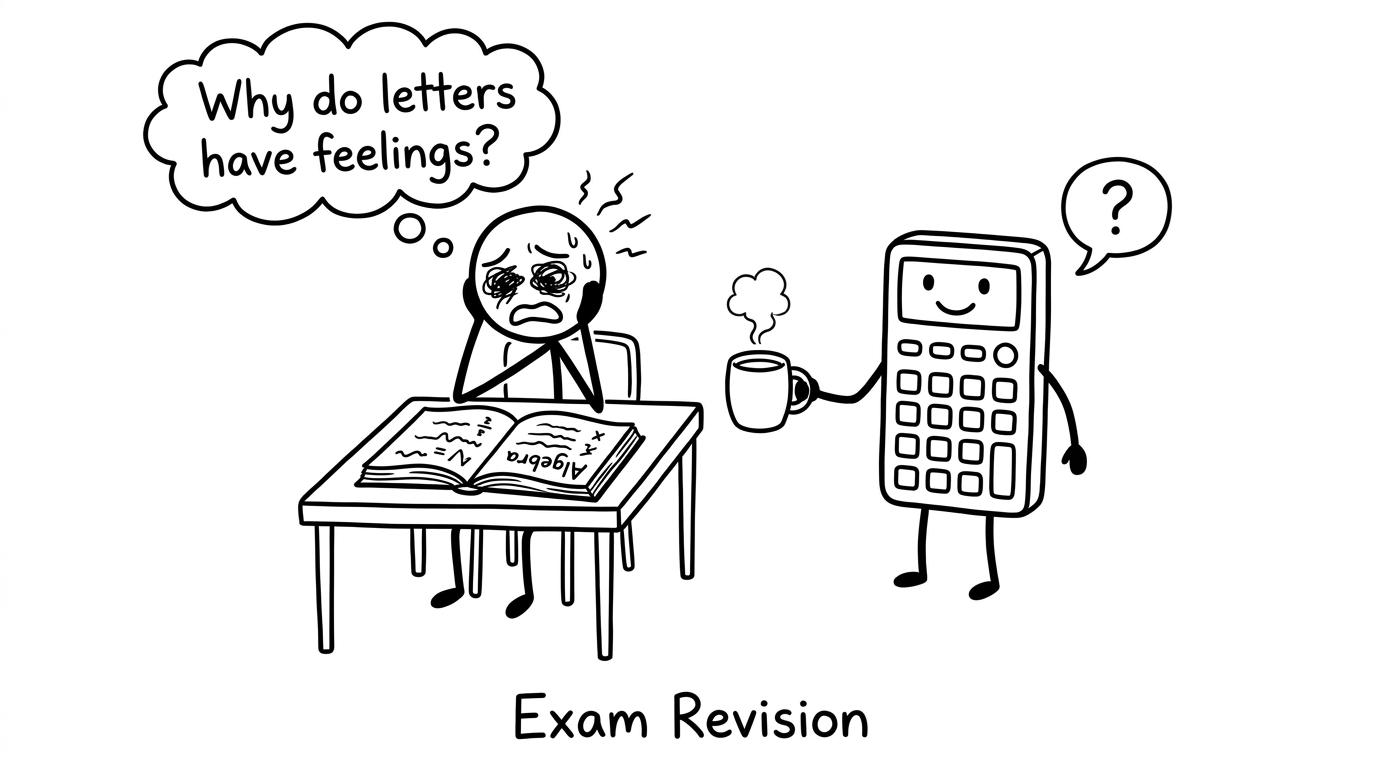 A stressed student vs algebra with tea
A quick checklist for understanding algebra at GCSE
If algebra feels confusing, it’s usually one (or more) of these:
- You’re treating letters like “special numbers” rather than placeholders.
- You’re not fully confident with negative numbers and multiplication facts.
- You’re mixing up the four core moves: simplify, expand, factorise, solve.
- You’re trying to memorise lots of different question types instead of a few patterns.
- You practise, but you don’t check against a mark scheme, so the same small errors repeat.
A very practical place to start is one focused topic at a time, with solutions:
Why algebra feels different (even if it’s just arithmetic in disguise)
Arithmetic rewards speed. Algebra rewards restraint.
In arithmetic, you see 7+37 + 37+3 and your brain reaches for an answer. In algebra, you see 7+x7 + x7+x and there is no single answer, because xxx can change. That’s the whole point: algebra is arithmetic that works for every value.
Here’s the shift that helps most GCSE students:
- A number is a finished value.
- A letter is an unfinished value, a placeholder.
So the goal in algebra questions isn’t always “get a number”. Often it’s “write something more useful”: simpler, rearranged, or in a form you can solve.
The four moves that run almost every GCSE algebra question
When students say “I can’t do algebra”, they usually mean “I can’t tell what move the question wants”. At GCSE (across Edexcel, AQA, OCR, Eduqas), most algebra marks come from four moves.
Simplify (collect like terms)
Like terms match exactly in letter and power. So 3x3x3x and 5x5x5x are like terms. But 3x3x3x and 3x23x^23x2 are not.
Worked example: simplify
Simplify 4x−3+2x+7−x4x - 3 + 2x + 7 - x4x−3+2x+7−x.
Combine like terms:
- xxx terms: 4x+2x−x=5x4x + 2x - x = 5x4x+2x−x=5x
- constants: −3+7=4-3 + 7 = 4−3+7=4
So the simplified expression is:
5x+4 5x + 4 5x+4If you want a tight set of practice questions with answers, use Simplifying Algebra.
Expand (remove brackets)
Expanding is just multiplication shared out.
Worked example: expand and simplify
Expand and simplify 3(2x−5)+2(x+4)3(2x - 5) + 2(x + 4)3(2x−5)+2(x+4).
Expand each bracket:
3(2x−5)=6x−15 3(2x - 5) = 6x - 15 3(2x−5)=6x−15 2(x+4)=2x+8 2(x + 4) = 2x + 8 2(x+4)=2x+8Add them:
6x−15+2x+8=8x−7 6x - 15 + 2x + 8 = 8x - 7 6x−15+2x+8=8x−7Final answer:
8x−7 8x - 7 8x−7For quick, exam-style practice, Maths Genie has a whole worksheet and examples:
Factorise (put into brackets)
Factorising is reversing an expansion. The simplest form at GCSE is taking out the highest common factor.
Worked example: factorise
Factorise 12x+1812x + 1812x+18.
The highest common factor of 121212 and 181818 is 666. Take out 666:
12x+18=6(2x+3) 12x + 18 = 6(2x + 3) 12x+18=6(2x+3)Quick check by expanding back:
6(2x+3)=12x+18 6(2x + 3) = 12x + 18 6(2x+3)=12x+18That “expand to check” habit is one of the best mark-protectors in GCSE algebra.
Solve (find a value that makes the equation true)
Solving means you have an equals sign, and you’re trying to isolate the letter.
Worked example: solve an equation with brackets
Solve 4(2x−3)=204(2x - 3) = 204(2x−3)=20.
Expand:
8x−12=20 8x - 12 = 20 8x−12=20Add 121212 to both sides:
8x=32 8x = 32 8x=32Divide by 888:
x=4 x = 4 x=4If you want this style of question in proper GCSE format (marks, spacing, exam feel), use GCSE (1-9) Expanding and Factorising worksheet (PDF).
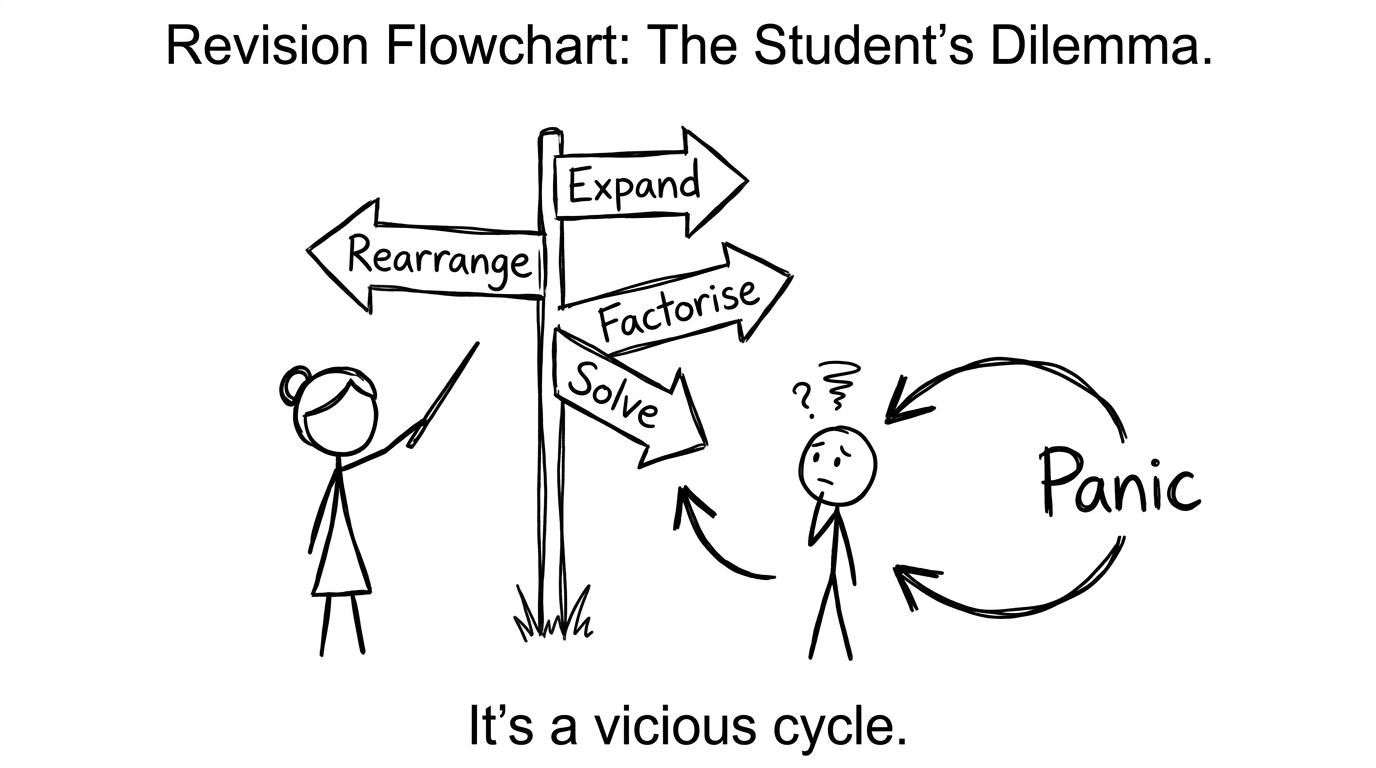 A revision flowchart where “panic” loops back
The real reason you “don’t understand” algebra: it’s usually a missing mini-skill
Algebra is rarely the first domino. Something smaller is.
Here are the usual culprits:
Negatives and subtraction are leaking marks
A lot of GCSE algebra errors are actually arithmetic errors.
For example, simplifying 5−(2x−3)5 - (2x - 3)5−(2x−3) requires care:
5−(2x−3)=5−2x+3=8−2x 5 - (2x - 3) = 5 - 2x + 3 = 8 - 2x 5−(2x−3)=5−2x+3=8−2xThe bracket changes the signs. If that feels unreliable, practise expanding with negatives until it becomes automatic.
You’re not comfortable with “doing the same to both sides”
Solving equations is a discipline: whatever you do on one side, you do on the other.
If you ever find yourself doing random steps because you’re “trying stuff”, pause and ask:
- Am I adding/subtracting the same thing to both sides?
- Am I multiplying/dividing both sides by the same non-zero number?
That’s it. The magic is repetition.
You’re not seeing algebra as a story
In exams, algebra questions often tell a story: “the perimeter is…”, “the sequence is…”, “the cost is…”. The algebra is just a way of keeping track.
A good training habit is to underline what is variable (becomes a letter) and what is fixed (stays a number). That reduces the panic.
A Level students: the same four moves, just with more layers
If you’re bridging from GCSE to A Level, the emotional experience is similar: you meet expressions that look bigger and feel less forgiving. But A Level algebra is still built from simplifying, expanding, factorising, and solving.
For example, simplifying algebraic fractions depends on factorising:
Worked example: simplify an algebraic fraction
Simplify x2−9x+3\dfrac{x^2 - 9}{x + 3}x+3x2−9.
Factorise the numerator using difference of squares:
x2−9=(x−3)(x+3) x^2 - 9 = (x - 3)(x + 3) x2−9=(x−3)(x+3)So:
x2−9x+3=(x−3)(x+3)x+3=x−3 \frac{x^2 - 9}{x + 3} = \frac{(x - 3)(x + 3)}{x + 3} = x - 3 x+3x2−9=x+3(x−3)(x+3)=x−3with the restriction x≠−3x \neq -3x=−3.
If you’re doing A Level content, Maths Genie’s algebra resources are a useful anchor:
How to practise algebra for GCSE without wasting time
The quiet secret of doing well in GCSE maths is that you don’t need more hours. You need cleaner feedback loops.
Use exam questions, then mark like an examiner
When you mark your work properly, patterns show up fast: you always drop a minus, or you expand correctly but simplify wrongly.
Maths Genie makes that loop easier because you can practise and then check:
Mix topic practise with full-paper stamina
Algebra is a high-frequency topic, but it appears in mixed form on papers. The best combo is:
- short topic drills (to fix errors)
- then full papers (to build recognition under time pressure)
For different boards, these are useful starting points:
Common mistakes that stop algebra clicking
These are the mistakes that make students feel like algebra is “random”, because the answer changes dramatically.
Treating xxx like a unit
You can’t simplify 2x+32x + 32x+3 to 5x5x5x. The 333 is not an xxx.
Forgetting the bracket affects every term
A classic:
−(x−4)≠−x−4 -(x - 4) \neq -x - 4 −(x−4)=−x−4Correct is:
−(x−4)=−x+4 -(x - 4) = -x + 4 −(x−4)=−x+4Cancelling terms instead of factors
You can cancel common factors, not terms being added.
Wrong idea:
x+3x≠3 \frac{x + 3}{x} \neq 3 xx+3=3But if it’s factorised:
3xx=3(x≠0) \frac{3x}{x} = 3 \quad (x \neq 0) x3x=3(x=0)Dropping a solution in equations with squares
If x2=9x^2 = 9x2=9, then:
x=3 or x=−3 x = 3 \text{ or } x = -3 x=3 or x=−3At GCSE higher tier, missing the negative solution is a very common way to lose marks.
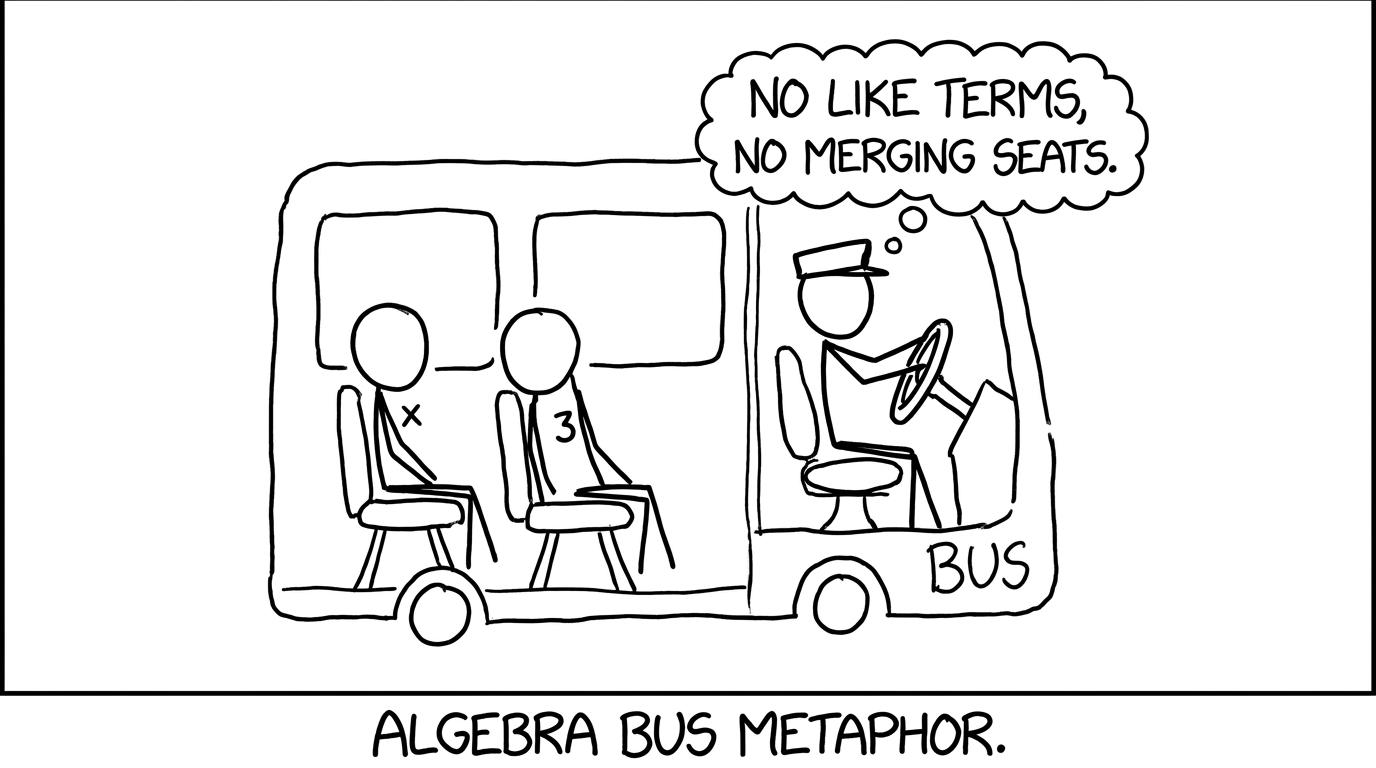 Like terms refusing to share seats on a bus
Bringing it all together: make algebra predictable again
If algebra feels like a wall, it’s usually because you’re trying to climb it in one jump. But the wall is made of bricks you’ve seen before: simplify, expand, factorise, solve. For GCSE students, the goal is not to “be good at algebra” in some vague way. The goal is to get so familiar with these moves that exam questions start to look repetitive.
Your next best step is simple:
- Pick one algebra skill (for example, expanding brackets).
- Practise it using Maths Genie revision lessons and worksheets.
- Mark it carefully using solutions and mark schemes.
- Then test it in context using GCSE predicted papers and past papers.
Start here and build momentum:
- Simplifying Algebra
- Expanding and Factorising Quadratics
- Target Tests
- GCSE resources and predicted papers
- Edexcel predicted papers
Algebra isn’t a talent you either have or don’t have. It’s a set of habits. Build the habits with deliberate practice, and your GCSE algebra will start to feel less like a guess and more like a plan.
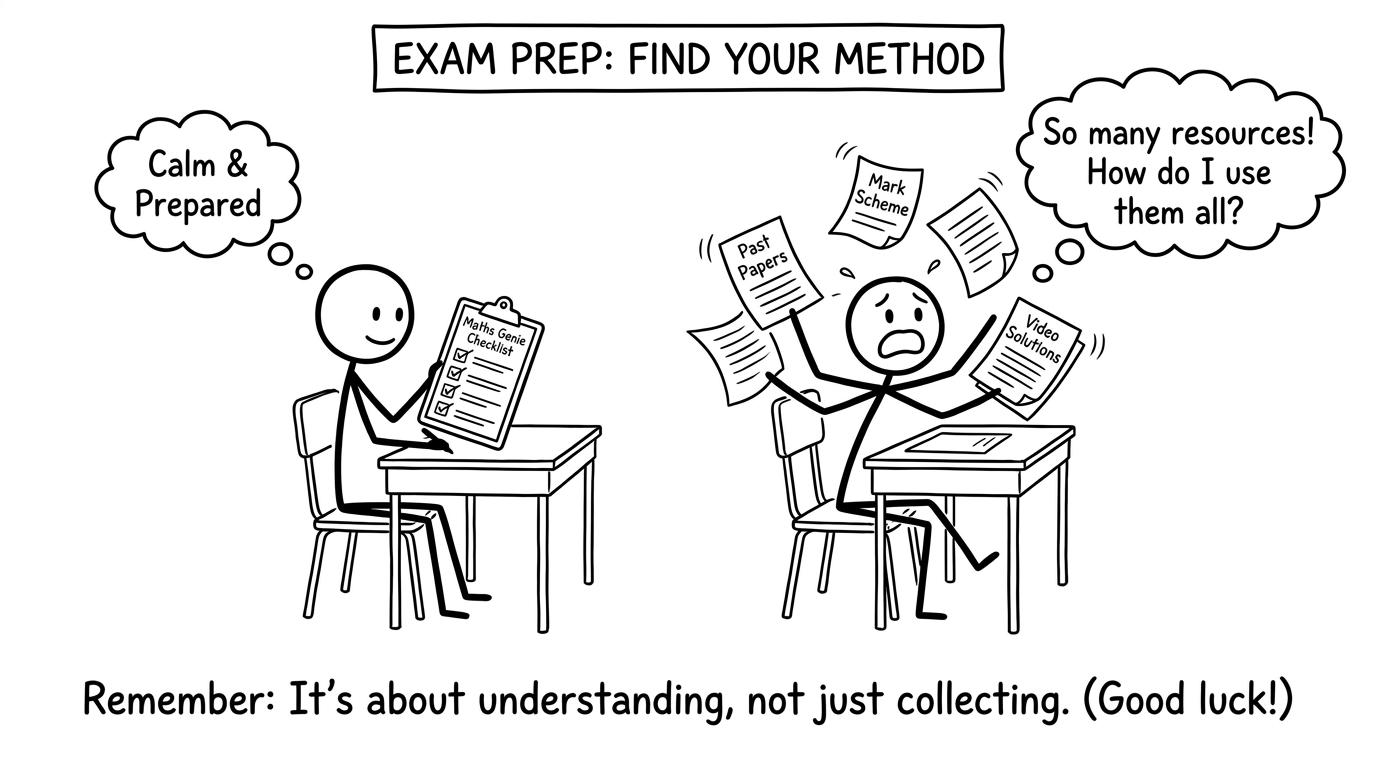 Exam hall with a Maths Genie checklist










